Charleston’s White Pig Tavern became legal at the end of Prohibition. Built on the outskirts of town along an old wagon trail later to be named Corson Street, and not far from the Philo Bay docks of the Puget Sound Naval Shipyard, the Pig began as a “gentlemen’s club” whose sawdust floor often collected the blood and teeth of erudite scholars whose learned observations ran contrary to those of their colleagues. The need for shipyard labor during the Second World War caused Charleston to double in size; soon thereafter, the foot of the town’s rough and tumble, blue collar Torqwamni Hill district took shape around the Pig and Corson Street. For generations the Pig was where the hard hats met when the 4:20 whistle blew, and also the spot they took their girlfriends and wives to on Friday and Saturday nights.
The building is a large, mostly wood, broke-back beige square that lies more askew to, than on, Corson Street, and is surrounded on two sides by vacant lots choked by Scotch broom, and to the north by its “sister” business, Elmo’s Adult Books. The Pig is actually the cobbling together of two buildings that had lain side by side (one a tool shed, the other a livery)—the broke-back middle is caused by this. A non-functioning 1950’s-era neon sign in which a pink pig wearing a hair bow is doing a jig with a blue pig wearing a top hat still clings to the wall above the front door; at no place on the building are the words White Pig Tavern to be found. Fifty years back, an owner by the name of Arvold Lemolo replaced the roof with corrugated aluminum, which makes a hell of a racket during rain, and also contributes greatly the Pig’s rag-tag appearance. Oddly, there is nothing structurally wrong about the Pig; and even though the humorless, post-modern nanny-state prudes seem bent on getting the Pig and Elmo’s razed, nothing has ever come from their annoying and exclusive take on morality. Interestingly, the Pig and Elmo’s are two of the longest lived businesses in all of Charleston.
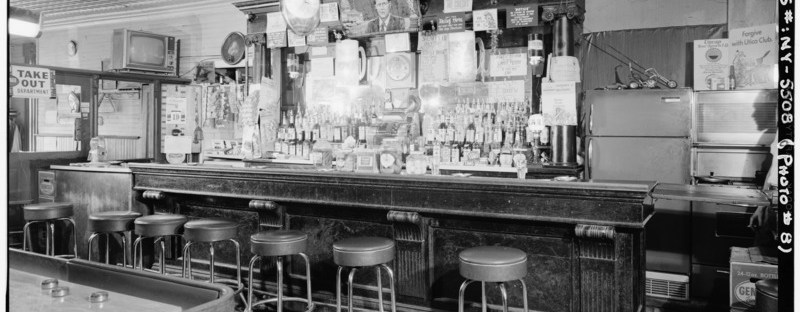
Inside, the Pig has few windows and it’s divided into distinct halves—of which, one sits higher than the other. The bar dominates the higher half; it is L-shaped, and has a whorehouse mirror that’s bolted to the wall behind, and runs the length of the longer line of the L. Whenever a patron spills a drink, or otherwise annoys the barkeep (saying “barkeep” is a way of doing that), he or she is required to pitch a penny “up and over” into a two-inch gap that exists between the wall and the top of the mirror. This tradition has been going on for a time out of memory. Once, a “Stupid Criminal of the Day” type of person had broken into The Pig toting a drill, a hose, a small vacuum cleaner, and the mistaken belief that there was a fortune in old, rare pennies behind the mirror. Of the many things that this fellow did not know was the existence of a “penny-trap” (also installed by Arvold Lemolo) that is easily and regularly accessed through the cabinet below the mirror. Still, he’d have gotten away with it if he hadn’t helped himself to the Crown Royal and passed out on the floor until the cops were called to collect him at 10 A.M.
At the middle, three burly 12”-by-12” wooden dock pillars hold up an equally stout roof beam that had been scavenged from an abandoned railroad trestle. The wood is black with age, yet it still exudes oil. Even though the Pacific Northwest is earthquake country, this decidedly handmade structure has held up without slipping an inch since the days of bathtub gin. The engineers behind this achievement, however, hadn’t been able to align the floors evenly. Hence, there’s a single step that separates the halves, it is known to one and all as the “Drunk Bump.”
The lower half features four maddening pool tables, whose rippling slates would challenge the abilities of the Martian rovers; walls done in faux knotty pine, and a floor covered by the funkiest orange shag rug to be found on this side of 1973. There’s also a sign affixed to the space between the restrooms that succinctly describes the soul of the Pig’s standard of customer service:
OUR MANAGER IS HELEN WAITE:
IF YOU HAVE A PROBLEM,
GO TO HELEN WAITE.
The bar opens at eleven. Until late afternoon, the old timers tend to gather at the nook of the L, trade barbs and talk about times gone by. Like all taverns of any age, the Pig exists on two levels: The young and the feral own the night, and those who have gotten too old to raise hell and meet Last Call tend to drop by earlier and earlier, then puff off like ghosts as the evening draws near. A version “Sundown syndrome” sweeps through the Old Guard at the start of Happy Hour. Awkward uncertainty shadows their actions; memories of having people to see and places to go itch the same way amputated limbs are said to do, and it becomes important to say anything that resembles “I’ll see you tomorrow” on their way out the door, as though by saying so the future will be.
This afternoon Frances Bowers and Bethlehem Shelby are sitting at the nook. The bartender is Miriam Watts, and her little dog is named Toy. The late June sun slants through The Pig’s few windows, and the fulsome, salty scent of an uncommonly still Philo Bay enters via the propped open doors, and is spread throughout by a litany of fans (this is The Pig’s air conditioning system), which drown out the steady hum of the traffic on Corson Street. The TV is set on baseball. The glacial crawl of the game matches the atmosphere in the Pig on a Tuesday afternoon.
“Beth, did you know that Pomeranians pee six times their body weight?” Fran asks as she casts a sly glance at Toy, who is sleeping on a small bed atop a footstool behind the bar, and, of all things, is fitted in a service vest. Fran is seventy-seven, frank-faced, tall in the bar stool, and dressed for winter—yet she speaks with a strong, clear voice even though she is becoming increasingly frail due to what she calls “cancer of the everything.”
Beth smiles. She is a small, tidy, much younger woman who could be anywhere between forty and sixty. Her dark eyes are uncommonly large and expressive; there are some who think that if she ever wore makeup she’d be “quite pretty, if she wasn’t that way.”
“Why no, Fran, I didn’t know that,” Beth says.
“Well, you see it’s a scientific fact that the little diseases can pee six times their body weight. Yet the fuzzy swine never drink a drop—they just leach the moisture out of their masters. That’s why Miriam here looks like a piece of jerky.”
Miriam lays a newspaper crossword puzzle aside, pats Toy on the head, and approaches the pair. She is somewhere around Fran’s age, and her thinning bright orange hair is arranged in a beehive that you can see through when the light strikes it. Miriam and her twin sister Madeline own and manage both The Pig and Elmo’s Adult Books.
“You know the price, Frannie,” Miriam says with a voice that has many years’ of Pall Malls in it. “You’re lucky that Toy is so good natured.”
“That’s true, Beth,” Fran says as she expertly flings a penny behind the mirror from a stack she has arranged like poker chips next to her vodka Collins. “Statistically speaking, only the dachshund is more violent than the pom. If a weenie dog turns against you, they go right for the Achilles.”
Something happens on TV. Well, almost happens. A batter tops a ball to second to end a potential rally.
“Goddammit,” Fran sighs, “run out the ball.” But the batter doesn’t do so; he jogs a few half-hearted steps up the line and is out by at least seventy feet. Fran’s antipathy for failing to run out the ball is well known, yet it has nothing to do with the vast sums of money that Major League baseball players make: It’s disrespectful. I don’t care if you have to pay to play—always run out the goddam ball.
“You never gave them much of a chance to run out the ball when I was a kid,” Beth says as she points to a row of three silver-plated trophies in a case behind the bar, which were awarded to the Pig’s women’s fast pitch team for winning the city league championship from 1969-71. Fran had been ten years older than most of the other players, yet she once had thrown five no-hitters in the span of four days. At six feet tall, and left-handed, Fran had a “drop-ball” that few men took the opportunity to have a hack at during warm-ups, even though they were extended an invitation to do so.
“Yeah, but they ran out the few chances they got—that, or I’d buzz their lazy asses on their next ups,” Fran replies. Then she looks at Beth, searchingly. “Let’s go outside, my little star. I know you’re dying for a cigarette.”
The state banned smoking inside the workplace ten years ago—even those workplaces in which no healthy activities take place. This forced joints like the Pig to contrive “beer gardens.” The Pig’s garden is atypical of such an arrangement. It is a high-fenced, twenty-five by forty foot enclosure that lies outside the backdoor. Three empty industrial cable spools have been knocked over for tables—two of which sport moldy patio umbrellas stuck through their center holes. Several lawn chairs of dubious structural integrity lie here and there, and upturned hubcaps and empty paint buckets serve as ashtrays. Toward the end of July on through August, the listless summer air carries the dusty cracks of opening Scotch broom pods into the garden; it’s an awful and dirty noise, which is often accompanied by the high smell of decomposing birds and rodents out where the broom and feral cat population are the thickest.
On their way out Beth steals sideways glances at Fran who now uses a cane. Fran has had her “cancer of the everything” for nearly five years. But the lady is spry, and it is not yet the time to keep a hand ready to catch her by the elbow. There is no one in the garden; it is as empty as the bar itself.
“Charming, as always,” Fran says as she sits down on a chair at the least decomposed table. “I came across what the newbies call a ‘hipster doofus’ out here the other day. You know the type, Beth, six-three, a hundred and twenty—had what they call an ‘ironic beard.’ He was huffing off a hookah, the vapor smelled like huckleberry jam.”
“Could you imagine Bogart vaping?” Beth asks with as she sits down and pulls two cigarettes out of her pack. To her surprise, Fran accepts the gratuitous offering, even though Beth hasn’t seen her smoke for at least two years. A faint nostalgia arises when Beth sees Fran rip the filter off her smoke and places the tamped end in her mouth. Beth gracefully brings a kitchen match off the table top. It’s now Fran’s turn to feel nostalgic.
“That’s so Harry,” Fran says. Beth’s mother, Harriet, died that April. Fran and Harry had been best friends for more than seventy years. “She could bring a match off anything.”
For an awkward moment, Beth fears that Fran will get weepy on her. But this is only a passing glimmer. She sees the same searching wonder return to Fran’s eyes that had been there when she had called Beth “my little star” for the first time in what felt like centuries.
“The hipster doofus turned out to be a nice enough sort of kid, really. He was curious as hell about me,” Fran says as she holds out her rosary, which she has worn like a necklace for as long as Beth can remember. “Turned out he was raised Catholic. I bet him that he had never gotten a load of a name more Catholic than mine.”
“Saint Frances of Rome Mary Josephine Bauer Bowers—confirmation name, Bernadette,” Beth says. “Remember how you girls used that to test Ray to see if he had too big a snoot-full, by making him say it?”
“Yeah,” Fran replies. “You’d think that my own husband would have had that down. But he always boned it at Frances—always said ‘sis,’ not ‘sez.’”
“You’ve got something on your mind,” Beth says.
“Yes, I do—Not to get old lady on you Beth, but it seems that I’m the last one of what the hipster doofuses might call my ‘social circle’ left standing—excluding Miriam and Madeline, of course. But I never count people who have made deals with the devil. It’s bad for the immortal soul.”
Beth figures that if anyone is entitled to “get old lady,” it should be Fran. Ray died years ago, but Harry (whom Beth loved, yet never called mom or mother) and Ellie Allison both passed this year—the latter, just ten days back.
“It makes sense, in a way,” Beth says plainly. “You’ve always gotten around to things later than everyone else. You were, I think, thirty-six when you enrolled in college, and at least forty when you married Ray.”
“Your memory is as keen as ever, Bethlehem. The feel good types always say that it’s never too late, and they were right, as I went. Still, really, how can it be too late to do much at thirty-six or forty? I had time enough for a twenty-five year nursing career and a twenty-two year marriage, and I have outlasted both by more than a decade.”
“And yet none of that is what’s on your mind,” Beth says.
“My father taught me baseball,” Fran says. “When he got old he’d half-joke from Halloween to spring that if he made opening day, he’d live to see October. He died in November ’93—true to his word, I suppose.”
“Every year has a spring-time in it,” Beth says. “The years to come are full of them.”
“And every year has a November in it. One less will suit me fine.”
“How is it, Fran?” Beth asks. It’s difficult to gauge Fran’s weight because she’s clad in baggy sweats and has a white turtleneck on beneath her sweatshirt. But the sloughing at her cheeks is telling; and the story isn’t pretty.
“It only grows at night—usually between three and four in the morning. Morphine helps. In fact, I’ve officially become a junkie. That’s why I stir drinks more than I have at them. I spend nearly all my waking hours stoned as hell, as I am now. Over the years, especially those in which I worked the ER, it used to break my heart to see people come in with injuries that were obviously self-inflicted. I remember one fella who had apparently taken a hammer to his left hand and told me he had accidentally got it caught in a car door—twice. He did it for the pills. Most people invent phony back aches to get them, but there are some who go the extra mile. I had sympathy for that sort of thing, but now I’ve got empathy for it. I never chip off my pills as to place myself in the same position; but I can see myself drawing from my long experience to work-up a good lie to get some. If needed, I bet that I can fake a migraine as well as Meryl Streep…Still, I do all right, except between three and four. Sometimes I consider getting up to chisel one off my supply, around then. Sometimes it gets easy to think about taking three or four. I’m fairly certain that three would fix it—but I have also seen more than one lost soul come awake at the ER because they had under overdosed. We used to speak meanly about the people who did that sort of thing; you know, ‘gotta Marilyn Monroeverdose in three.’ ”
“But that wouldn’t be running out the ball,” Beth says. “And I wouldn’t call myself a junkie, Fran. It’s not as though you’ve got a needle hanging from your arm.”
“Oh, I’m a junkie, all right,” Fran says. “I don’t lie to myself about that. But what I have learned, that is of use, is the distance between sympathy and empathy. I think about that a lot, nowadays, when I say my rosary, or enter the confessional. The distance between the two is much like that which lies between toleration and acceptance. For such, I owe you, the only person left whom I truly love, an apology.”
Beth’s large, expressive eyes tell a complicated tale composed of surprise, affection, and, yes, contempt. Oh, for the love of God, not that, Beth thinks. She laughs, brings a match off the spool and lights another cigarette. Seconds pass, nearly a minute. “Tell you what, Frannie,” she says, “you don’t tell Miriam that I’ve got a secret crush on her, and I won’t let it out that you’re banging her husband.”
Fran nods and purses her lips. “I guess I’ve got that coming.”
Beth rises and kisses Fran on the forehead. “I think you ought to move in with me. Those three and four o’clocks might go sour on you. They might lead to something that’s bad for the immortal soul. I don’t want you to be alone; you don’t have that coming.”
“It’s still a little way to November,” Fran says softly.
“Promises, promises,” Beth laughs.
Fran shakes her head. “So much like Harry.”
Leila Allison
If you loved this as much as we did don’t miss The Crossed Star of Bethlehem by the same author.
Banner Image: Jack Boucher [Public domain], via Wikimedia Commons






 literally stories