

The United States is no more a place than obesity sits solely on your hips. Your weight yo-yos until you recognise in your life the scolding echo of your grandmother clearing her plate.
This particular American kid is young and contains his country’s history—whose story is he living, he wonders, if not his own?
Everyone agrees Henry is a good kid. Polite, considerate, tall and smart. He does the dishes and listens to the women who want him to earnestly love them. His empathy is genuine as his advice. He’s the first to come over in an emergency. He pursues the satisfaction of his lovers with alacrity.
Underground he’s somewhat different, behind his smile his father grins.
*
Build to the edges as your geography permits.
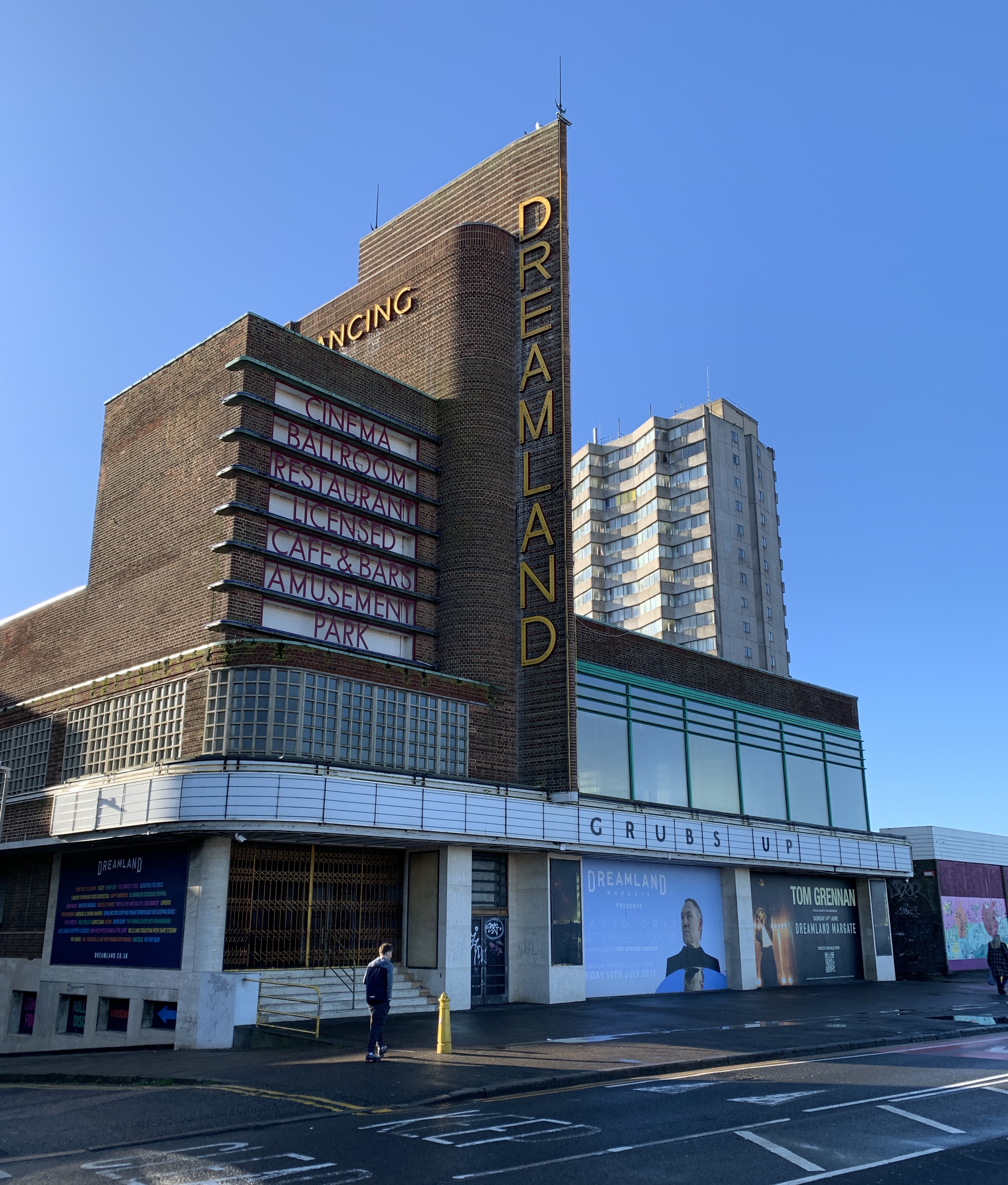
The tarmac of Marine Drive heads east from the high ground of Cliftonville and at the Margate clocktower becomes Marine Terrace, marked by arcades, ice cream parlours and rental apartments. It is a broad street. And poor. It peters out at the seemingly abandoned art deco façade of the Dreamland Amusement Park. Few inside are laughing though there’s screaming aplenty. Margate has seen better days and is myopic regarding its future.
Which is why the competing criminal tribes of Margate use tunnels to operate out of sight. Beneath pavements and sand is a whole other world.
*
Though The American Kid feels at home in the town, at no time had he imagined dying there.
It becomes perfectly and beautifully clear to Henry that he had been in the country only a little while before things went drastically wrong. It ain’t Henry’s fault—none of it is The Kid’s fault—especially the passionless martyrisations. Nothing is personal to Henry. If folk take offence being clipped or sliced that’s their chopped liver not his.
He maybe should have turned around and got back on the plane when he had the chance. What can you do? Life is sweet even when it’s bitter. You unwittingly build momentum without appreciating the need for brakes. No doubt the Greeks have a term for this as they do for everything. He can’t, at the moment, remember his Ancient Greek, being more a Latin swot.
It turns out, much to his horror, that he is actually no different, rhetorically and physically, than anyone. Everyone is exceptional or nobody is? A bullshit bummer, being no different than anyone. So much for his unquestioned exceptionalism. What a time to be alive.
Not that he thought of death much—not his; he was too busy living and having a good time. But he’d assumed, when he pictured himself broad of paunch and narrow of mind and white-haired like his Paps, he’d retire in the chosen land.
For the last five minutes he’s had enough thinking to last a life time. ‘No different than anyone’ was more an accusation of moral failure, a kind of Nuremberg defence. Once the torture stopped—the women were amateurishly gleeful, without class—Henry began to appreciate that this was less the admissible defence he might have imagined. If no different than anyone, why did he treat folk with such indifference? What can you do? There’s only one of you and millions of them. When you’re raised in an abattoir—even if it has curtains and is replete with euphemisms—who notices the blood? Extremism becomes mundane—you make assumptions this is how life is—and habitual exposure to violence dulls the senses. He supposes the thing about blind corners is you rarely see them coming.
Well, he’s run out of road this evening.
No way can he hit the brakes now.
*
He wishes he was not the only one alive in the cold ballroom. Hadn’t he warned Agatha to keep her hang-out underground? Don’t buy the art deco wreck, he’d said. She argued—it was what she did—the place was a fortress, would be a criminal lighthouse—she’d see enemies coming. They wait underground too, he’d warned.
But Agatha wanted to go legit. To come out of the sewers.
*
His ears itch but he has no fingers with which to scratch. He coughs out blood, as crimson and bright as the blood streaming from the stumps of his thighs. He should really do something about the legs. But what can you do?
The police will come to gawp and gag and photograph his body along with every other bum no different than Henry.
He could really do with a blow job.
*
You’re born with no say in the matter and no votive candle in red glass will protect you from being infected by a culture—freewill being as fallacious as claiming The Land of the Free has a zip code.
He’s never before understood the irony Daniel Dennett pointed out. Ha ho oh.
Another thing that bugs him while he’s at it: Henry will die being known as a kid—The American Kid. No say. This was never due to his youth but the relative age of every other broken constituent in the crime business.
Nobody back home went by their real name—folk invented their names along with their personalities as they raced toward a mythical Oz-like tomorrow. He’d seen musicals—he knew how the world worked. Folk rewrote themselves before buying in the services of an editor to redraft their story. Then the time came when they failed to recognise themselves in a mirror. Just featureless scribbles and eraser smudges stared back.
At least back home—America is home—folk expected others to respect their wilful lack of privacy, their right to the opportunity of reinvention. Whereas here a body gave itself no such licence; folk spent their whole lives as the same insipid person, lugging their syllables behind.
Why is his thinking roaming so inelegantly? Was this some end of life thing? Blood loss?
Lack of blow jobs?
He’s not old and not as young as he was—who is? To be forever known as The American Kid riles his sense of justice—maybe justice is bullshit too—but what can you do beyond pretend it ain’t so? Like everyone else. Maybe this is why the ancients felt the need to invent God and had Him make a heaven where all your dreams come true. Like a movie in which everyone’s a star. What a curse those dumb ancestors bequeathed.
*
Where did he lose his footing? He has so many stolen trousers yet to wear—some genuine designer.
He could really go for giving a blow job.
He’s surrounded by the wrong class of stiffs.
*
What does it matter that for some life comes up roses? What smug gardeners fail to mention is the blood and bone nutrients they expect you to donate. That’s capitalism, he supposes. Call it fate or providence—God knows Henry had called his own bad luck by worse names in his time.
Winter is coming again—snow is falling, brightening the evening sky knocking at the window. Henry is weary from the great deal that has happened this year just as the last. And the previous twelve months too. Now he comes to think, now there’s finally time, he feels like a child with vertigo suffering a cheerful and intolerable merry-go-round paid for by his parents.
Look at his smiling little face—it’s almost like a scream.
*
Henry is unusual—like everyone—and permits himself two minutes once a fortnight to reflect. This includes shaving. He generally doesn’t hold with looking back but back is pushing forward, waving its gory hands in his face.
He doesn’t hold with anything getting in his face, not normally, but he is strangely powerless. He lacks empathy even for himself.
He whispers, ‘Amor fati.’ For Henry it is only a brief jump from home-tutored Latin to reading Nietzsche’s Why I Am So Clever at Dartmouth College in Hanover, to grasping, in the dusty badlands of the moral majority, the mendacity of eternal recurrence—the idea suffering or happiness reoccurs over and over. When escaping the Arcadian States he shouted at the airport Nietzsche could fuck himself, he’d prove that German with the intimating moustaches wrong. He was manhandled by Homeland Security who suspected Nietzsche of fundamentalism. What price a college education?
Henry stares at the colourful bodies and the ragdoll limbs piled carefully in the corner, and he smiles at the pretty neon turning his blood into a homage of a Monet.
*
.Though the War on Terror had been declared over, nobody had informed the revolutionaries.
The military industrial complex was congratulating itself on finding this month’s existential enemy—Greenland. Henry suspected he’d not afford the peaceful prosperity given the high inflation.
What was life really about? Shouldn’t be feel content rather than empty? Something was missing.
Henry suspected it was himself.
What is it called when you’re neither unhappy or happy? Henry did not know the word. He wanted to find it in Europe.
Henry suspected the faces chanting ‘Build the Wall’ (when it had been built twice over) and ‘Lock Her Up!’ (when she had for too long suffered the imprisonment of her marriage) might in truth be prophesying an ultimate isolationism—closing the border; what if he couldn’t leave?
He was a good kid and didn’t want to hurt anyone unless he was provoked, but boy the place was poking him hard.
Convinced of his ability to abandon the violence of home, he read widely, went off curriculum if not grid, found hints of other countries, of a better life away from what Gore Vidal found so upsetting. He wanted to escape to the place where wings take dreams.
Henry applied to study a master’s degree. He was accepted by the University of Saint Andrews at Fife in Scotland, despite that lauded institution appearing to Henry’s way of thinking to be suspiciously lax regarding apostrophes—how many saints could one university lay claim to?
He packed a bag and sold Pap’s car while the old man was visiting an especially lucrative ‘aunt’ in New York City. Paps drilled ‘aunts’ like oil men dug wells. Whenever the kid asked the whereabouts of the Mom he’d never known, his Paps—who had a great many ‘aunts’ in several cities and who often travelled by Greyhound (the bus not the dog) to ration his potassium—would grow silent and talk of Vietnam, for he’d been in construction and made a fortune before losing it on the market.
Arriving in Scotland the kid never took a class. Nobody noticed. His grades were pretty good despite not submitting one assignment. Sometimes life incompetently conspires to make a prince out of a pauper, a valedictorian out of an idiot—what can you do? Just be grateful you share the same name as a genius taking the same modules. A case of mistaken identity was simply par for the golf course.
In Scotland Henry watched what passed for television. The Kid realised he had somehow fetched America with him. He suspected there was no cure for Showbiz Imperialism. It looked terminal. He stole a car in Fife and drove south on the wrong side of the road until he paused where the land meets the sea at England’s end. He bought chips and took a knife from a drunk, commenced a lucrative life with an air of existential resignation.
‘Making sense makes no sense,’ Henry said, wiping the stolen blade on the drunk’s trousers. Such badass chill and style got Henry noticed. The landlord scrubbing the blood from the floor put the word out under the streets there was a new kid in town. A lovely boy, sharp, polite, tidy hair, with a clear pathological intolerance of drunks getting in his face.
Employment followed.
The English and the Scotts are people who boil their cabbage even though they know they oughtn’t; when a brash kid comes—bright as a newly minted fifty-pence piece—they were dazzled by Henry’s Hollywood smile.
What can you do? You keep moving forward is what. There are things in life that simply happen—they come out of nowhere. All you can do is step out of their way if you see that nowhere coming. Which you can’t. What can you do?
*
Henry’s predisposition to violence had been imbibed with the tinned formula sucked from a plastic-leeching teat, swallowed along with his first solids like a radioactive isotope, until, in expectation of imminent violence—as seen on TV—his preference for preemptive action—as seen in movies—left him conditioned to simply react. He learned to turn the other cheek so as to better stab both sides of an enemy’s face.
There were seldom reasons, he reasoned. The non-existent God made him do it. If his actions were judged illegal he’d say the Devil lead him astray. The Kid was more a drinker of pulp-fiction platitudes than a deep thinker.
Henry loved money. Radix malorum est cupiditas, right? Folks about him were only income-stream patsies. It’s nothing personal.
Sure, he had a backstory—who doesn’t? But life is not television, the producers of which love a moving backstory to make viewers grateful for their colourless lives. The Kid’s backstory was practically non-existent—if there were flashbacks he never suffered he did not say. His life before England made the geological history of Iowa seem fraught.
The Kid had no opinion: a job was a job. He was paid handsomely and promptly. By the age of twenty-three he had six children under two, five current lovers, six confused boyfriends, and eight murders under his belt. Henry imagined a more symmetric life but couldn’t for the life of him figure out how to make the numbers add-up.
Were these achievements? Or tragic consequences of his character? But what formed his character?
There had been moments during his monthly two minutes of introspection when Henry wondered whether his life were a movie. If it so, it was not one he’d sit through. He should walk out and demand a refund. But no cinema gives your money back for a shit film—once you’d bought the ticket you’re out of pocket.
*
A headstone.
His name was Henry and he was about your height before he was cut down to size.
*
His father made a lot of dough from pumping his adoring ‘aunts’—enough to plant his kid in the Ivy League.
Paps gave no thought to fish and birds, how a fish might fly no better than a bird might breathe under water; he left it to Henry to choose his species—feathers or scales. Henry chose both—he wasn’t fussy, only hungry for the prestige he imagined money bought. Culture, like family genes, gets you in the end.
He’d didn’t need a horoscope only brighter parents.
You’re a goldfish in a capitalist bowl and you swim through the effluent of millions—even your own. You’re just another dumb dump.
Don’t strain it, drain it.
*
When the assault came—up from the sewer the camouflaged women flooded—Henry recognised a squirrel-eyed enforcer videoing the horror. He knew immediately why the slaughter had been ordered.
The chief executives of the long-warring ice cream families of southern England had set aside their differences to pool funds to hire Henry to kill a researcher investigating referred pain and cold-stimulus headaches—brain freeze, The researcher was about to prove that, just like the tobacco industry, the industry had suppressed evidence of frozen dessert addiction. It was unfortunate timing: The Kid had been reflecting.
Henry had taken the money and not iced the ice cream researcher—Henry took him for a drink given he looked kinda hot.
So it was the dairy mafia settled the score, raiding Agatha’s, where Henry was hiding. This massacre was Henry’s fault.
No more anything for Henry, no more blow jobs—life is give and take, he supposes.
*
He is admiring his legs in the corner—they look the best of the bunch.
He is bleeding out. Had he ever approved of belts he might have lived a little longer with the help of a tourniquet. But he is dying, which is taking a good deal longer than two minutes. This makes Henry mad, aggrieved at his own unproductive death—what a burden on Government budgets his corpse will prove.
He will never know the full and bloody extent of the forever gangland war his actions cause. It’s not his fault, though it is.
He’ll never again see his children or lovers or partners any more than use his legs. He’ll never count the blessings of his pennies.
But what can you do? Life has been sweet—he’s eaten his body weight in candy—even while screaming from vertigo two minutes once a month.
*
With each spurt of blood Henry hears the beat of John Cougar Mellencamp’s Hurts So Good. The American Kid is going to die pulsing out his life’s blood in time with the worst adult-orientated rock radio hit of his childhood. What a way to go.
He glances about him. Everything is beautifully unreachable. Henry stares at the art deco ballroom, headquarters of the least successful of Margate’s underground criminal rainforest tribes—uncontacted by philosophy or the moral imperatives of evangelists. There, piled neatly, a variety of limbs wait for collection. His legs are by far the most tanned and prominent—his are American legs. Those sneakers cost someone a small fortune.
He’s barely worn them.
*
What a time to be alive. What a perfect time to die.
Henry purls himself with longing. The world is so broke. Wherever you go folk poison their newborns, raise them for violent extinction. Henry’s no different. This is actually a mercy killing—The Kid won’t inflict his self on his kids.
His definition is stolen by the snow beating the window.
The ballroom is too small for the grandeur of its name.
A final world from Henry—hush—fleeting, barely audible—a syllable of sorrow—hush—do you hear The Kid bleeding out?
Tobias Ásgautr
Image: Dreamland Nightclub in Margate, front doors covered with metal grills. A brick building with advertising images on the side, large windows,and a couple of pedestrians walking past under a blue sky. provided by the author.

