circa 1963
Frieda
What a relief to get my seven-year-old, Claudy, occupied and out of my hair for awhile by having her little cousin stay on with us. Don’t I know the nonstop yank of an only child?
Stephanie, my sister, thought going home without her daughter after their visit a frightening idea. Of course she’d think that; she’s a skittish kitten; thinks everything bad that can happen will. I had to point out how swell our two girls get along, that her Mandy needed more girl time what with three older brothers afoot. Besides, how fair was it that Steph was blessed with a passel of kids, and I worked overtime to get pregnant at all?
“Don and me’ll get her back to you when we drive out to Omaha,” I promised. What’s three weeks? Surely you can loan her out three weeks.
While Mandy had her first vacation away from her parents, I planned to sit and yak on the phone with my friends without getting interrupted one hundred different ways. I planned to watch As the World Turns from start to finish, and read McCall’s cover to cover. I also planned to buy Mandy some leotards and take her to Claudy’s ballet lessons, take them to the chocolate museum, and have a meal at Bailywick’s all-you-can-eat Sunday buffet. Places Stephanie and Ed had no money for. Told her high time Mandy ate out somewhere better than McDonalds.
“Well, why don’t I ask her if she wants to stay?” My sister proposed.
“Hell’s bells!” I balked. “Get the kids to bed tonight and Ed load up the car and you go first thing before it gets light. I’ll handle Mandy at breakfast.”
Ed was all for it. Said Steph had to cut those apron strings someday anyhow; might as well be now. Once I got him on board, everything went like clockwork. She set the boys’ clothes aside and once the bunch went to bed on the lower level and the girls upstairs, Ed loaded the suitcases into the station wagon. At 4:30 a.m., I tiptoed into the guest room and shook Steph awake. The boys were so sleepy, they did as they were told and climbed into the car, barely registering what was going on. Steph wrung her hands and pivoted back and forth in the driveway till I gave her a big hug and bundled her into the passenger seat. Headlights off, Ed put the car in reverse and they backed out to the street for the twenty-hour trip to Iowa. So began my summer!
Claudy came first into the kitchen that morning, and climbed onto her chair. Mandy followed shortly in her cotton nightie, dragging her stuffed bear. I had waffles ready and batter in the iron.
“Sit yourself down,” I said to my niece. “Put some nice maple syrup on that waffle.” I informed her she was going to have a splendid vacation here with my family the rest of June. Shook the spatula in the air for emphasis. “No boys allowed!”
“No boys?” Her brows squinched up. She stood stock still, one knee halfway on the chair seat.
“No pesky, bothersome boys!” I sang. “Claudy, let me give you half to start,” I leaned over and tore a waffle in two.
“Where’s my brothers?” Mandy glanced about the quiet kitchen.
“Not here!” I beamed. “Brothers, Mom and Pop are on their way back to Iowa.”
“I-O-WA?” That little girl’s jaw dropped as her voice tilted up and her eyes got big. “They LEFT me?”
I can’t count the number of times she ran to the guest room, the lower level then outside to the driveway. Back to the guest room, the lower level then outside, just circling and circling. Standing barefoot on the cement out there in the driveway in her nightgown holding that teddy by one hand. She didn’t make a sound. Not a single peep.
She didn’t eat those waffles either. As a matter of fact, hardly ate anything for two whole days. Laid on the bunkbed in Claudy’s room clutching her bear. I checked her for fever; she was fine, then she turned her back on me and fell asleep. Well, be that way. And although she eventually joined us for meals, when Don tried to get a rise out of her with some knock-knock jokes, Mandy put her hands over her ears and stared down at her lap.
That girl hardly spoke for almost a week. I was spooked silly. When Claudy was busy with piano practice, I told Mandy she better straighten up because she was upsetting all of us. “Don’t you want your cousin to like you?” I knew that was a mean thing to say, but it popped right out of my mouth.
Her eyes got big and round, then she wrapped her arms about herself and shivered, as if cold.
Some dark cloud lifted, though, and Mandy started doing whatever my daughter asked, whether it involved giving up the favored hula hoop or letting Claudy have the last of the cherry jam on her sandwich. Next thing I knew, she was clearing the plates for me after our dinners. She
was plumping the pillows in the TV room and making her bed every morning. She even got a dishtowel and cleaned off Don’s shoes when he came home and left them by the door one evening. “I say we keep her!” He joked when he found them, expecting to win a smile.
She just ran off to her room and stayed there right through dinnertime.
My sister called every few days, and because of the long-distance cost, we only spoke for about ten seconds. “Is Amanda OK?” “Of course she is.” But during the third week, Steph wanted me to put Mandy on the phone. Well, I had to tell her that Mandy was having such a great time outdoors that all she wanted her mother to do was look forward to seeing her soon.
I had to say that; Mandy was on the swingset and refused to stop and come speak to her mama. I coaxed and I pleaded, even tried a bribe with Peppermint Palace for soft serve. No deal. She planted a foot in the dirt and twisted herself into a tight spiral, openly defying me for the first time. Even put her fingertips in her ears and then she exploded into tears, these deep wracking sobs. Now? You have to do this now? I couldn’t stand the sound of them.
I had to quick go back and lie to Stephanie. My sister’d have her undies in a bundle if she knew what was going on.
Stephanie
Frieda and Ed put me up to leaving my daughter and driving away. It’s not something I’d ever think to do on my own. I only got about three minutes to consider it; Frieda always in a rush after she gets some big bossy idea. But when she said it wasn’t fair she only got one kid from Jesus, I caved. Doctors told her after the Cesarean she’d risk her life for a second baby, so he shut down
business and that was that. Claudia was it. Frieda felt cursed and I felt like a bandit for having been spared her plumbing problems.
And true, my Amanda had no one at home to play Barbies with, no one to play jacks or hopscotch, us living out on County Trunk H miles from town. She had to tag along on her older brothers’ heels, getting scraped up and tossed around the way no girl should. Staying in the city with her cousin was supposed to be a reprieve from all that, a special vacation, I told myself.
But I felt nauseated the whole drive home, especially when the boys woke up in Ohio asking where Amanda was. Once Ed told them, they didn’t mention their sister again, as if
saying her name out loud might bring them bad luck. Ronny got a bit gloomy till the next truck stop when Ed bought them each a Milky Way. Then he cheered right up.
That night, sitting on the bed at the Motel 6, I ached to call her long-distance, hear my daughter’s voice. But Ed swore I’d make things worse because Amanda would beg us to come get her, and then what? Not like we’d turn around and undo all those miles!
“She’s too young for this, Ed! What were we thinking?”
He waved me off. That’s because he hardly knew what kind of company she was for me those long hours he was at work. We baked together while the boys roughhoused, peach tarts and cheddar biscuits and fun things. We dressed her dolls in hand-sewn smocks, play-acted parts of her picture books. Amanda was my touchstone in ways my boys were not, in a way husbands aren’t. As we drove through Indiana the next morning, I wrote Frieda a note telling her to call me soon as she got it once the girls were in bed. Stuck a page in there for Amanda, too, with heart shapes drawn all over it. Made Ed drive off the interstate into some little burg so I could find a mailbox.
No call came. Not that week, not the next. I lost my appetite and just smoked my Pall Malls, drank Sanka. Once the boys were in bed, I sat at the sewing machine with a Butterick pattern and yellow gingham piecing together a jumper for Amanda. Stayed up late two nights in a row making myself one to match. It was kind of big on me, but once my girl was home and we were back to baking, I knew I’d fill it out.
In the last week to go when the boys were at the sandlot, I dialed Frieda’s house and begged her to put Amanda on the line. She went outside to get her then I heard nothing, those expensive long-distance minutes ticking away. Finally she returned and said Amanda was having
too much fun with their new puppy to come talk. That was a sucker punch, alright, but there were only four days to go. I bit my tongue, thanked her curtly and hung up.
On Sunday soon as I heard them pull into our driveway, I rushed outside. I scooped Amanda out of their car with a whoop and did a jig with her in my arms. She went limp and heavy, like one of those cats they call “rag doll” because she just hung there, no expression on her face, no smiles. She wouldn’t look at me. Look at anyone. Frieda made a big show of acting all giggly about the swell time they’d had, then she hastily squeezed Amanda bye and jumped back into the car with Claudia before Don stepped on the gas.
I crouched down to face my child, and she fell against me with a cry. I wrapped my arms around her as she wept, big sobs wracking her. Shooed away the boys when they came up asking what was wrong. I held her tight as I could. My girl was home!
But Amanda’s been home a few days now. Not said much of anything–not even to me. She won’t join her brothers in play, won’t rock with me in the glider on the porch. Just clears the table without me asking, gathers up the laundry off bedroom floors, carries it in her arms to the
Maytag in the basement. “They make you earn your keep over there or what?” Ed teases. He’s as puzzled as I am. Can’t get her to talk to him either.
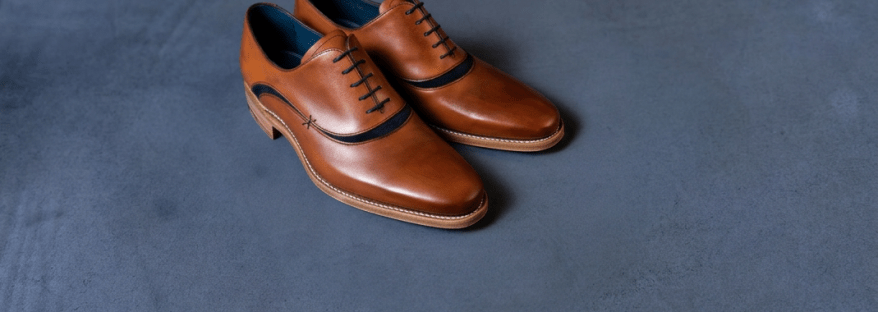
Except every morning after he shaves, Ed finds his shoes set neatly by the back door beside his briefcase, waiting for him. His good Oxfords polished and buffed so hard they shine.
Shoshauna Shy
Image by Mike Tyler from Pixabay– A pair of highly polished brown Oxford shoes on a blue background.