I took everything down by myself. Everything. I didn’t care. The lights on the outside of the house, the lights around the bushes. I cut my hand doing that. I took down the plastic reindeer in the lawn, the Santa hats on the porch, the candy canes that lined the walk way. I put it away. I put it all away. All in the basement where I put most of our decorations. I didn’t put them back in the boxes, I was tired and I finished pretty late.
I put on the radio and listened to Christmas songs to make up for the lack of decorations. Made eggnog. Adult eggnog. That’s pretty much all I drank the whole time my wife and the children were gone. In the morning, I had my coffee of course, but for the rest of the day I had adult eggnog.
They left in the morning. They left pretty early and my children asked why I wasn’t going to Grandpa’s and I told them my Dad was coming and we were having Christmas together, the two of us. They didn’t understand and I didn’t expect them to, but that’s what I had to tell them because the truth hurt me bad. It still hurts me.
What did you get the kids?” My wife asked me. We were standing in the kitchen. We had just finished dinner.
“We have to talk about that,” I said.
“Don’t spend too much.”
“That’s what we have to talk about,” I said.
“What is it?”
“Come sit for a second, please.” I walked over to the kitchen table.
Then my wife gave me this stare and I thought that maybe she knew. She had to know. I knew she was not suspecting the good. She came and sat at the kitchen table with me. It was pretty late. I remember when I looked out the window it was very dark and I saw my reflection and the reflection of my wife’s back as she sat across from me. I couldn’t notice myself. Nothing about myself I noticed.
I said, “I didn’t get the kids anything.”
She said, “Then, let’s go tomorrow.”
“I can’t.”
“Why not? The stores are still open. Nothing is closed.”
“I don’t have the funds,” I said.
She gave me that same stare when I first told her to sit. That kind of stare that looked through me. Maybe I was nothing. That’s how she looked at me.
“What do you mean?” She said.
“I don’t have it,” I said.
“Why not? What happened?”
“I had to get my Dad out.”
“You never told me he went back in,” she said.
“Found out a few days ago. He asked me if I could get him out.”
She shook her head. “And you did it? I can’t believe you.”
“It’s my father,” I said.
“These are your children,” she said.
She sat there shaking her head and I looked at her, my eyes watered just a little. I looked at my reflection in the window in our kitchen. She got up.
“Where are you going?” I said.
“We’re going to my parents. The children and me,” she said. “At least they’ll have presents for them. You didn’t get me anything did you? You probably didn’t. Why do I ask?”
I sat there looking down at my hands. My head started to hurt. My whole body started to hurt. I just sat there at the table. Just me. Not noticing my reflection. I heard her upstairs packing. I heard her moving around then I heard her tell the children to start packing and I heard them give her trouble so I went up.
I told the children to pack and they asked me why and that’s when I told them.
“My father is coming here for Christmas. It’s just going to be us.”
“Why aren’t you coming with us?” One asked.
“My father is coming here.”
“Come with us, Daddy,” one said.
“Yea, Daddy,” the other said.
I looked at them both and held them. “You’ll have fun at Grandpa’s. He’s got the place ready for you.”
I kissed them on their little cheeks and told them again to start packing. I went to the bedroom and my wife was filling up a second suitcase.
“You can take mine,” I said. “It’s bigger.”
She just shook her head and stuffed the suitcase. I sat on the bed. Then I laid down on my back. I watched her walk back and forth, back and forth with mounds of clothes in her arms and some fell on the floor.
“How long are you staying?” I asked as I looked at the bags.
“I don’t know,” she said. “A week or so.”
A week was a bit much for me, not seeing my children. But what was I going to say? I kept watching her walk back and forth. She had so many clothes. I watched her walk back and forth one more time when I faded to sleep.
I didn’t sleep long. I didn’t want to sleep that long. She didn’t wake me. The sun looked choppy as it came through the blinds. I turned over. My wife and her bags were gone. I didn’t put any pants on and I walked to my children’s room and they weren’t there either. Their beds were made. I hoped they’d be back for New Years.
That’s when I swallowed to hold the tears. I swallowed quite a bit, trying to get it all down. That nasty taste in my mouth. I went and brewed coffee. The pot wasn’t all the way done and I put in a bunch of cream and sat in the kitchen and tried hard to make the taste go away. I looked at the Christmas decorations outside and that’s when I did it. I put it all away. Everything. I didn’t care anymore.
I tried calling my father after some glasses of eggnog and he finally answered on the fourth try. I told him he should come. He said he’d think about it.
“It’d be good for you, Dad.”
“How so?” he said.
“Been a while since we had Christmas together,” I said. That made me think. Damn. That was the Christmas that Mom winded up in the hospital. No presents that Christmas.
“I can’t get the kids anything,” he said. “I can’t get you anything.”
“That’s fine. They’re not here. Just come up. It’d be good for you.”
“She left you?” He asked.
“We’ll talk about that. Come on, Dad. Please.”
He breathed a really long breath and cleared his throat. “Pick me up from the bus station. Be there in the morning.” He hung up.
The next day was Christmas Eve. Though, it didn’t feel like it. I guess that’s because of the decorations I put away. Glad I did. I threw on whatever I laid my eyes on first.
I drove the pickup that I hadn’t driven in quite a while to the bus station. The roads were riddled with melting snow. The bus station was packed and I waited for several minutes. A bus pulled up and many people got off. Then I saw my Dad. He looked better than I expected. He didn’t have a bag with him though. He walked down the line of cars. I noticed the woman next to him was walking with him. She was looking around. I realized she was with him. She didn’t have a bag either. I didn’t think he knew my truck so I honked and put my arm out of the window. He saw me. The both of them rushed to the truck.
“Boy, its cold,” he said when he opened the door and he rubbed his rough hands together. “This is Mina,” he said.
She hopped in first and I halfway smiled at her. She was a brunette, but the bottom of her hair faded into blonde. Her teeth didn’t look all that good. Under both her of eyes it was dark, almost purple. My father sat on the outside. The truck was tight.
“Good to see you, Dad.”
“Yea,” he said.
I looked at my father before I pulled off. I hoped he was alright. There’s no telling with him. We all rode back to my house. We entered the neighborhood and Mina talked about how nice everyone’s decorations were. She pointed at the Smith’s house. They always had so many things in their yard. Too many things. The grass could barely be seen. Then she pointed at the Lewis’s blow up Santa which my wife hated. Said she would deflate that thing once. Man, I missed her. I missed my wife and my children. I hoped they’d be back for New Years.
We got to my house and I pulled in the long driveway. Mina didn’t speak a word. Our decorations were in the basement. I didn’t care. She woke my father.
“We’re here,” she said.
“Home sweet home,” he said.
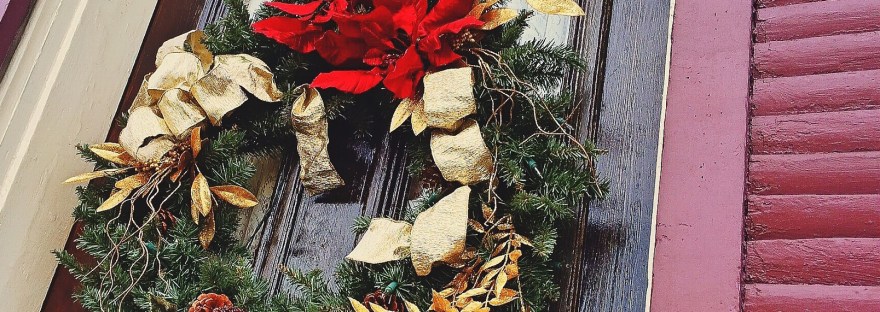
I saw the wreath on the front door. I forgot about the wreath. The small red ribbon that was tied to it blew in the wind.
We went in through the backdoor.
“You all are more than welcome to sleep in the guestroom,” I said.
I pointed to the door across the hall from the dining room. I watched them walk to the room and open the door and go in. They came out several minutes later without their coats. I didn’t realize how skinny Mina was.
I poured myself eggnog. They wanted some. I poured them some. They drank it and told me how good it was and we all had more.
“She left you?” My father asked.
“She went with the children to her parents for Christmas.”
“Why didn’t you go?”
“I wanted to spend it with you, Dad.”
“That’s sweet,” Mina said. She smiled. I didn’t look at her teeth.
“I never thanked you for getting me out,” he said.
I said, “You don’t have to, Dad.”
“You got both of us out,” said Mina. She smiled again.
I looked at my father and he took a sip of his eggnog then scolded her.
“You got one big mouth,” he said. “I told you about that mouth.”
Mina got quiet. Everything about her got quiet and she looked down at the table.
“It’s okay, Dad.”
“No, it’s not. She’s over here rambling and talking. I told her about that mouth of hers.”
“I promise, it’s fine,” I said. I looked at her. Mina kept her head down and her hands under the table. My father sat there shaking his head.
“Just wait,” he kept saying. “Just wait. I told you about that mouth.”
“Dad, seriously. I’m glad you’re here. I’m glad you’re both here.” I hoped he couldn’t tell I was lying.
My father shook his head more and flexed his jaw. “To Mina and her big mouth,” he said and he held his glass of eggnog in the air and threw it back and down his throat. He got up and walked to the guest bedroom. The door slammed then Mina jumped.
She swallowed and swallowed again. I could see she was holding back tears. “Thank you for getting us out,” she said. “We’d still be in there if you hadn’t.”
“It’s fine,” I said.
“Your wife left?”
“Just to go to her parents.”
“You have children, you said?”
“Yes. Two. They’re with her.”
“That’s nice,” she said. Her hands were on the table now and her fingers played on the rim of her glass. “Your daddy is a good guy. I know he has a past, but he’s a good guy. A lot of people don’t think so, but I do. Caring and gentle, if you can believe that. But when he drinks he puts that side away. He puts that caring and gentle side all away.”
I watched Mina. Her fingers playing with her glass. She looked up finally. I could tell she was looking at her reflection in the window behind me. I wondered if she noticed herself.
Evan J Massey
Banner Image: Pixabay.com