
Adrian Prokhoroff stood before his newly bought, newly painted home, dark brown lining the façade of beige. He felt surprisingly little for it, though it would only cost him a few years of mortgage payments, and he had been initially excited to buy it for its bargain price. He had bought it cheaply in part to silly rumors of its being haunted. And they spoke of the Renaissance. He went in with his two daughters.
The house was unusually dark for the time of day, though there were windows large enough and of a good number. The movers came in and set the wares of the undertaker in his parlor: coffins of various sizes, mourning clothes, hats, cloaks, candelabras. And the special chemicals of his trade were taken down delicately into the cellar, which is where Adrian would spend most of his time when working.
After the house had been settled in with his belongings, he made tea for himself. He brought the slightly chipped porcelain cup to his fleshy lips.
Outside it had become overcast and started to rain; the rain pounded and streaked the panes of the large window behind him.
Adrian, according to his nature, settled into the gloomy thoughts of his trade, the cost of replacing the suede garments that he had lent for the last procession that were ruined in the downpour of that day. He fretted over the promise of Katya’s sons made to him to oversee her burial. Then, he thought of Katya in her youth so long ago. She was once quite glorious. But enough of that. Would her sons send for him this far away with others of his trade conveniently closer to them and able to tend to the body with all the promptness necessary to such a task? A knock on the door interrupted his obsessive worrying, which would have gone on until evening left on its own unchecked. Adrian set his cup of tea on its saucer and went to answer the door.
Adrian opened the door to a short portly man standing with a jovial expression and a blush to his face, presumably from the cold weather outside, which had attenuated to a slight drizzle.
“My dear neighbor, I am Gottlieb Schultz. I am the local shoemaker. My place of business is across from yours. I extend you a hearty welcome.”
“Well of course, thank you, Gottlieb.”
“May I come in? It is rather cold, dear . . .”
“Excuse my manners. The name is Adrian Prokhoroff.”
“My dear, Adrian,” said Gottlieb and forthwith came in, snooped it seemed to Adrian, and made himself unpleasantly at home. His daughters came down the steps.
“And these are my daughters, Alina and Daria,” Adrian said.
“I am charmed, my dear young ladies.”
His daughters giggled, and they let their hands be touched by a cobbler.
“Well, now that we have all met one another, what brings you?” Adrian said with the frankness of his disposition and also professional nature.
“Yes, of course. I celebrate the 25th anniversary of marriage to my wife, a Silver Wedding as it is called, and I heartily welcome you and your daughters to come to my most humble abode where my family and friends plan to celebrate the occasion.”
“My daughters and I are busy.”
“Father,” both of his daughters said with an aggrieved air.
“Dear Adrian, there will be much to drink and partake of. You and your daughters should come.”
Adrian reconsidered this: a free meal and a chance for his daughters to meet suitors.
“I apologize for my brusqueness. Of course we will come.”
“Delightful, the celebration will start tomorrow at six, my dear Adrian, Alina, and Daria.”
“We will be there, most ready to meet our fellow neighbors.”
“Delightful. And you are most welcome to the neighborhood, dear Adrian, Alina, and Daria.”
“Yes, of course.”
“Well without further ado, I will take my leave of such delightful company.”
“Yes, please do.”
And with that Gottlieb and Adrian’s daughters left Adrian to his complete solitude in the darkening room.
Adrian thought of Katya in her youth once again, the way she brushed her dark locks away when laughing. His thoughts of her were broken when there was a sudden sound of glass shattering. Startled, he got up and made his way to the kitchen. The kitchen was in order, but the cellar door was open, possibly from a draft coming in from below. He lit another candle and went down the stairs creaking at each one of his steps. The light of his candle revealed all his jars and containers were on the floor shattered. He swore, bitterly. He searched the walls for any cracks or openings where a breeze could have crept in from. He found one such breach and looked into it. He saw a large soot-covered rat looking back at him with glittering eyes, and he backed away. He swore again and resolved to have the breach set with something and sealed. He would let it rest for now. And he went back up the narrow steps.
#
At six on the following evening, Adrian and his daughters crossed a long stone-paved road. Gas lights on lamp posts lined the edges of the streets lighting their way dimly on this cool fall night. Adrian wore black breeches, a frockcoat, a vest, and shirt with cravat, and went about tapping his cane on the road. His daughters wore long white blouses and pleated skirts. And they covered themselves with a small, single umbrella in light rain from skies that were grey and showed a half moon. Alina and Daria chatted away happily. Adrian tightened his cravat.
Adrian knocked on Gottlieb’s door with three raps and waited with his daughters. The festive sounds of laughter, glasses tinkling, and exhortations of all sorts in Russian and German could be heard out onto the street.
The door soon opened, and Gottlieb and his wife welcomed in Adrian and his daughters and introduced them to the other guests, all German artisans, and one fellow Russian, a Yourko Sokolov, a night watchman of the Nikitskaia Gate, which held off bandits and wild animals and such.
The cheer of the guests dispelled some of Adrian’s somberness and unrest from the night before. The uncorked bottles did the rest to relieve him of his rigid manners and free him of his taciturn nature so that he spoke freely to the great surprise of his daughters of questions about himself and his profession, which he always spoke of with the necessary decorum of such a trade. He went talking on and on in a flowing steady stream of words that were akin to water bursting out of a dam, and his daughters for once were the ones who had to restrain him from speaking, and to which he cried out, “Give an undertaker a day of respite and freedom to let him speak his peace, which he has kept from others with no heir to pass down his trade to. Give him cheers,” he raised his glass in mock toast. “Give cheers to undertakers, everywhere!”
“Yes,” Yourko said, enthusiastically. “Cheers to Adrian and his customers, the dead.”
And they all cheered to that except for Adrian, as new bottles were uncorked.
Carousing and full of wine, Gottlieb said in a voice almost like a trance or incantation:
“Adrian, you are a consorter of the dead.”
“What–How dare you?”
“But, Adrian, what bothers you so? I praise you.”
“By saying I consort with the dead!”
“Dear Adrian. I said you are a consoler of widows. How could you . . . You must stop drinking and control yourself.”
“No, I very well heard what you said. And it is filth. I have never consorted with the dead, never have done such a thing. And I say, may all the souls of hell visit me if I have so much as thought of such a thing.”
“Adrian, my dear man. Please, restrain yourself. No one—I would never dare say a thing of that sort. All my compatriots can vouch for me.”
“No! No! You and your kind fill me with disgust. I spit on all of you.”
“The very dead will visit you tonight, Adrian.”
“What did you say!”
“Dear Adrian, I have said nothing. I ask you kindly, and with dignity to your person, please leave my house.”
His daughters with a troubled look followed their father to the door, and the others were quiet with shock. Adrian felt their eyes on him and thus slammed the door shut.
At home, his daughters walked up the creaking stairs to their rooms. Adrian sensed they were angry but would not confront him on his behavior tonight. They were good daughters he often thought, better than he deserved. But he took little comfort in that tonight.
Adrian sat in his chair, closed his eyes, placed his hand over his head, and tried to calm himself. He made himself tea and poured honey into it. He sipped his tea, thirsting for more wine, when suddenly a wailing sound came from the cellar. Adrian stood. He heard footsteps come up the stairs, and the door creak open, and then shut. Adrian stood frozen expecting a robber, a bandit, but what stood before him was much more terrifying.
It was a specter in a white slip, her flesh peeling from her face. Adrian instantly recognized her. He had prepared her burial shortly after his wife had died.
The specter stared at him and said, “Do you know who I am?”
“Yes . . . Yes. How? Why do you come here?”
“Undertaker, how could you?”
“God, help me, have mercy.”
“Answer us.” Appearing suddenly before him were a host of women, whom he recognized one and all.
“My wife had just passed,” he pleaded with his accusers. “I was so desperately alone!”
“All debts must be paid.” The chorus of specters chanted, “All debts must be paid.”
Adrian inhaled and could not for all of his life exhale. He pressed his hand on his chest and burrowed his nails into his skin. “Please, forgive me. I am a wretched man with no one who understands me. I–”
“All debts must be paid!”
Adrian tried to explain himself but could only cough and gasp for breath in the mist drenched air. The ghosts swirled into a kind of vapor that he breathed in, and which seized his lungs, lunging into his heart, stilling his spirit, until he left his corporeal body and joined them to torment as they willed.
The next day, Adrian’s daughters found the body. They gave him a proper orthodox burial.
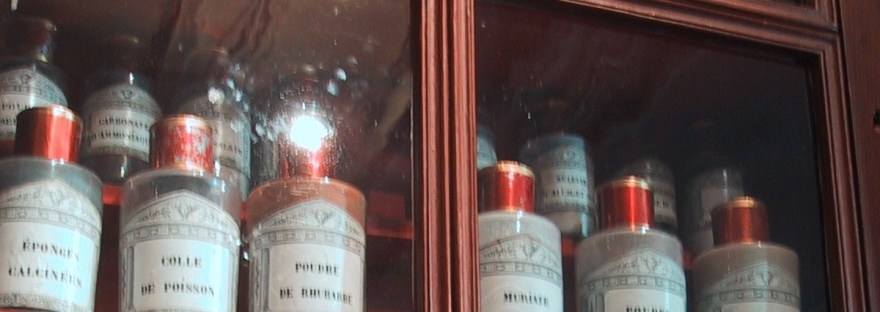
Image: A shelf of very old apothocary bottles by André Mouraux, CC BY 2.0 https://creativecommons.org/licenses/by/2.0, via Wikimedia Commons Bottles behind a glass door with red stoppers and white labels printed with black names.


The style of this is part and parcel of the whole thing, a ghost story should surely be set in a world apart from the current one and so we have it. The tale unfolds gradually towards a gory and ghostly end. Very entertaining. Thank you – dd
LikeLike
Edward
This one requires thinking on the reader’s part, which is brave writing and a very good thing to cause!
Leila
LikeLike