
In the dim twilight of Charlie’s bar an old man sat at the counter muttering about the weather. Outside, night winds blew up from the sea, salving the day’s heat still rising from baked pavements. It was too hot the old man said, it was too dry; his bones ached, his bowels didn’t move; John, the barman nodded, wiping glasses with a small towel. The barking laughs of other regulars, the clinking of the pool table, the air conditioner’s hum and Bob Montgomery’s measured voice on the TV lamenting another Red Sox loss mixed with the old man’s mutters.
For years he had sat on that stool, sipping beer and complaining. Yet each day found him unchanged, a short, solid man in a battered leather cap, walking without cane or support though he must have been close to eighty, glaring at people around him with unblinking blue eyes.
He had been in the army, people said, and come home decades ago to live in his family home in the seaside New England town. His parents died; his brother, also a retired serviceman, lived elsewhere. Old timers remembered, when he first came home, a woman and child lived with him, a little girl. But they had left him long ago while he went on living there alone.
That summer night, the bar door opened to the music of young voices, kids from the local college, three curly haired boys and two long, pretty girls, who sat and chatted at a table while sharing a pitcher of beer. As if to join the chorus, the old man came to life, raised his voice and began to tell John a story.
“When I was in the service,” he began, and John braced for war stories. But he heard something quite different. The old man spoke of a shooting star in the Alabama sky that pointed his way back to the barracks when he was lost. Of a dwarf he met on the road in Germany who told him about his future. About a mate, killed in a road accident who came back to turn the wheel of his car to save him from a similar fate. He told these tales in a higher, more tremulous tone than his normal speaking voice, as if he was sitting by a child’s bedside. When he was done, he raised his cap to the giggling kids, slapped it on his head and trudged back up the hill.
He disappeared up the long flight of concrete stairs that led to his front door, into the tall narrow house that perched on the hill like a hawk peering down on the street below.
Then the old man was gone. For a few evenings he was not seen at the bar, the mailman noticed the mail piling up in his box, then the local cops forced open the door, found him and called his surviving brother. A sparse funeral was held, attended by his brother and a few neighbors and a note was put on the college bulletin board advertising for boarders.
So, one day, as the new school term approached, a round young man with a fringe of beard clambered up the stairs to knock on the door.
“Are you Brendan Corbin?” he asked softly, as the door opened.
“That I am,” said the brother, a solid, stern little man, much like the deceased in bearing and appearance, though perhaps ten years younger. “And you are Jim, the college instructor?”
“Yes, Jim Espy,” said the young man, as he walked in. “I wanted to say,” he added, with a scholar’s gentle courtesy, “My condolences, I heard there was a death.”
“Yes, thank you. My brother Patrick. He lived here for many years while I lived in Boston. But I’m taking possession of the house and moving in.”
“But you are renting…”
“The top floor only. I don’t need all this space and could use help with fuel costs, with these New England winters.”
“By the way,” said Jim, “my daughter Jill will be staying with me sometimes. She’s six years old. If that’s ok.”
“Of course,” said Brendan. “And I have an idea.”
As Jim took in the old home, the worn-out baseboards and peeling walls, Brendan showed him the upstairs bedroom, bathroom, and a small second room. “You could use this as a study, or the girl’s room when she comes. But we have another option. Let me show you.”
And he took Jim up a flight of wooden stairs to an attic, where they looked out the window from the very top of the hill. From there they could see the sun washed town laid out before them, the solid stone buildings and ivy-covered walls of the college, the brick and siding of the little homes hanging along sharply inclined, angled streets that snaked down to the marina. At the edge of their sight, the late summer sun glimmered off the water.
Brendan turned from the bright window to the dusty attic. “We could clean this place up, add some weatherproofing and make this a room for your daughter,” he said. And Jim could see how it would provide more space for Jill to play, more sunlight, and a view.
So, the deal was made and Jim moved in, walking across a few roads to the college each day, with a scarf pulled around his neck as fall breezes blew more strongly from the shore. In the evenings, he made his meals in the kitchen downstairs then retreated to his floor, rarely encountering Brendan who offered little more than a terse “hello,” and “good night.” The attic was cleaned and insulated, a bed brought in, some shelves, a little table, and child-sized chairs, awaiting the first weekend when Jill would come and stay.
How Jill loved that house! Jim was amazed, and relieved. It was so different from the New Haven luxury complex where she lived most of the time with her mother and her mother’s boyfriend. So stark and lonely that he struggled to keep his spirits up as evenings fell.
“Captain Rabbit likes it here,” said Jill, as she settled into the attic room, pulling out of her case the favorite stuffed animal who always traveled with her. She held the captain, with his floppy ears and round yellow belly to the attic window as they gazed together on the town. Jim pointed out the roofs of the college and the hall where he worked and held classes.
All went well that weekend. All seemed well on other weekends when Jill came and stayed. But through the fall, odd sensations gnawed at the edges of Jim’s consciousness. He spoke to Brendan about it one evening in the kitchen.
“Brendan?” he asked. The little man turned with a “hmm.”
“Is there some sort of hot water pipe that you know of, under Jill’s bed in the attic.”
“No, nothing like that.”
“Because,” Jim continued, feeling foolish, but determined to press on, “When I went to the attic room last night, the window had blown open and it was freezing cold. I shut it and went to Jill’s bed but she was fast asleep, not cold at all. The air around her was toasty warm.”
“Well, I don’t know, children are warm blooded,” said Brendan, as he looked down at his frying pan. So, Jim let it go. But he had been surprised at that moment, as he reached his hands toward Jill’s bed. As if there was a warm cocoon around her, protecting her from the winter cold.
He also noticed, when she came on weekends, Jill couldn’t wait to go to the attic room. She ran up there, threw herself on the bed and started talking to herself, or to her rabbit, in a rapid stream of childish talk and stories. As if, Jim thought, there were a person up there she was talking to. It worried him. But he often worried about Jill.
She had grown from a colicky baby into a strange little girl. Her infant crying turned, over the years, into nightmares that brought her running to his and Ava’s bed. She dreamed of giant insects that chased her through the corridors. Of witches hiding in the closets. Of spectral hands that reached inside her window. Small for her age, with thin arms and legs that were never still, she was shy with other children, preferring the company of her stuffed animals and dolls who she spoke of with intensity, as if they were real people. Her eyes flashed as she talked about them, like headlights on a dark road.
The divorce pulled her more into her own world. She had come into the living room in her pajamas, holding one of her stuffed friends, on that terrible night when Jim told Ava he knew she was having an affair. He wanted to discuss it quietly, how much he knew, what it meant for their marriage. His voice forced through a swelling agony of pain; how could she do this to him, what was love after all? She threw it back in his face, his own inadequacies, his soft, unathletic body, lowly instructor’s salary, his gentle manner that she called obsequious and weak. He saw Jill and rushed to take her to her room as she clung to him, her arms around his neck.
How he would have loved to have full custody! But the law doesn’t work that way. Weekends with her was the best he could do.
Brendan noted the next odd thing that happened. They were downstairs at dinnertime, with Jim and Brendan moving back and forth across the kitchen. Jill was sitting with Captain Rabbit, telling him a story. “The dwarf,” she said earnestly, “came out from between the trees and put out his little arm to stop me as I was going down the road.” As she prattled on, Brendan stopped, his flat blue eyes fixed on her for a moment.
Later, as the girl wandered off, he said, “It’s a funny thing, but what your daughter said sounded like one of my brother’s stories.”
It was Jim’s turn to be dismissive. “There are many children’s stories about dwarfs.”
“Yes. But those were the words Patrick always used.”
That night, as Jim put Jill to bed, he kissed her and said “Good night my love.” And to the stuffed animal, “Good night, Captain Rabbit.”
“Patrick,” said Jill.
“I thought his name is Captain Rabbit,” said Jim.
“Well,” she said, “He’s Patrick now. Sometimes,” she said sleepily, “Patrick tells me things. He sits with me, in the attic, when you’re not around and tells me stories.”
“Darling,” he said. “You know he’s just a stuffed animal, don’t you?”
“No, he is not!” she said, sitting up, her eyes lit with fire.
“Alright, dear, alright. Lie down now and go to sleep.” And he sat, balanced on one of the little chairs until she rolled over and he heard the regular rhythms of her breath.
He went down the attic stairs. Then his legs seemed to carry him down the main flight as he ventured into Brendan’s lair, the draughty high ceilinged living room. The TV was on low and the old man sat in his chair, a sweater pulled around his shoulders, a newspaper in his hands. He glared up at Jim.
“So, Jill’s in bed now.”
“Yes,” said Jim, standing awkwardly.
“Come on in man, sit.”
Jim sat and started talking, haltingly recounting what was worrying him. Brendan’s scowl turned to a loud guffaw.
“I don’t believe in this nonsense. But Patrick did. And if there was ever a son of a bitch too stubborn to die and go away it would be my brother.”
Brendan laughed again. Jim did not join him.
“You know, Patrick had a wife and a daughter once, very much like Jill. I don’t think he gave a damn when the woman left him. But losing that child ate at him his whole life.”
“Oh,” said Jim.
“Sweet kid Jill,” Brendan grunted, and then looked back down at his paper.
“Thanks.”
“Mm, hm,” said Brendan, and the audience was over.
Jim had this on his mind when he went in to work on Monday. Sitting in his office in the psychology building at the top of an echoing stairwell, he heard the office next door open and knew that Claire, Dr. Dennison, was in. She had retired some years ago and occasionally came to campus. He stopped by and, after pleasantries, started to tell her about Jill.
“I’d like to help,” she said. “But children never were my expertise.”
He nodded.
“So why are you telling me this?” She stopped, and chuckled. “It’s because of the work I did with the paranormal, isn’t it?”
He nodded sheepishly.
“You know paranormal phenomena are least ninety-nine percent fraudulent nonsense.”
“Of course. But there are things we can’t explain?”
Claire sighed. “Yes. I have seen inexplicable things that seem like the persistence of past lives into ours. So, this man, Patrick, loved a daughter who he lost? And now you think he is haunting your little girl?”
“Yes,” said Jim. “Is that crazy?”
“I don’t know. As I get older, I wonder if our needs can be so strong that they will still exist even after death.”
Her voice was soft with pain. Through her lean, lined face and shroud of grey hair Jim could sense her ghosts, things taken from her, needs unfulfilled.
She shifted back to her professional manner. “But aside from what you’ve told me, does Jill seem happy?”
“She seems as happy with me in that old house as she has ever been.”
“And how does she behave towards you?”
He had an image of himself, over the past weekend, preparing their meal in the kitchen with difficulty because she kept holding him around the leg. “She has always lived in a world of her own. Some of that world has a closed door and I can’t come in. But the love and closeness between us feels strong.”
“That’s really all that matters.”
“Thank you,” said Jim, and went thoughtfully back to his office.
No one knows how the fire started. It might have been the teenage boys carelessly shooting off fireworks around the neighborhood in anticipation of the New Year, sending random sparks flying around the old homes in the dry winter cold. For Brendan, Jim and Jill’s house, tiny splinters of fire may have caught and smoldered on the roof, later bursting into flames.
Jim woke in the night with smoke in his nostrils and rushed in panic to see flames on the attic stairs. Brendan grabbed him by the arm.
“My daughter is up there!” Jim screamed.
“It’s too dangerous for you,” shouted Brendan. “The firemen are here.” The old man, more powerful than he looked, dragged Jim out to the front of the house as the firemen came in.
They entered the living room, with flames coming down from above. There was a crash, as part of the ceiling gave way. Jill came screaming, falling. If the cruel logic of gravity ran its natural course, she would have come hurtling to the floor.
But she didn’t.
For a moment, time stopped, a path formed, and she was brought down gently through a passage between the flames.
“I didn’t see that,” muttered the first fireman.
“Neither did I” said the second.
They rushed to scoop her up and bring her to safety.
Standing at the bottom of the long stairway, shivering in the cold as the fire diminished and the firemen finished their work, stood Brendan, in shocked silence surveying the damage to his house and a shaken Jim, holding Jill, her arm around his neck. As her father’s shoulder tired, Jill slipped to the ground, holding Jim’s hand and reaching out to Brendan with the other. Which he took, staring ahead, without a word.
Then as he turned, Jim saw, or thought he saw, lying in the darkness of the street but catching the illumination of a streetlight, a battered leather cap. Before his eyes could focus on it, a gust of wind came and it was gone, blowing down the hill, past Charlie’s bar, through the streets of the little town, and to the sea.
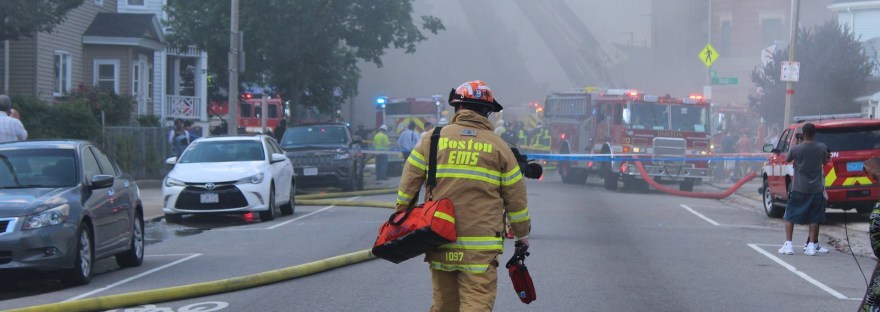
Image: fire appliances and fire officer at a house ablaze from pixabay.com


Very smooth telling of a sort of traditional ghost stoy but it was mesmerising, and absorbing. Lovely wordsmithing. Thank you – dd
LikeLike