In our city, the floodgates are kept shut by a machine powered on human breath. We call it the regulator. It listens to the lungs the same way a metronome listens to music. If rhythm breaks, the gates slip. Then the river takes everything.
For most of the year, the regulator rests. But each wet season, the rain swells channels, the river leans on city gates, the regulator roars, hungry for breath—the breath of one person who, in that season, shall breathe for the city. They stand in the cistern under the courthouse—mask on their mouth, belt on their ribs, breathing until relief comes. This year, God has chosen me. That is what I repeat to myself as they take me down. The stairs are wet and gloomy, and my hand slides smoothly along the rail.
Below, a clerk waits with a book. He writes with lead because ink rots down in the cisterns.
“Name?” he asks, and I tell him, proud.
“Congratulations,” he replies. “Luck smiles upon you.”
“Through God’s lot,” I say, thinking of folded slips, cheers, and prayers.
He wastes no more time. “Follow me,” he says, and I do.
We walk until we get down to the warden of the low rooms. A ring of keys hangs high on his chest. They knock on one another as he lifts the bar and opens the door.
There is a bench, a hook, and the brass face of a regulator. A pipe descends into the water, and another toward the gates. A small window in the brass regulator shows a wheel turning. Above that is a dial, where a black needle swings between two scratches; far right, at the dial’s edge, is a red mark. The warden taps it with his thick finger.
“When it touches here,” he says, “the gates slip.”
On the bench is a mask and a harness. The mask is black where hands have rubbed, and gray where mouths have pulled; its mouthpiece shines pale gray like dead fish. The brown leather harness has begun to form cracks, starting from the bottom, its color has faded to ghostly white.
As I process such a great burden, the clerk interrupts: “You shall keep the needle between the two marks at all costs. Remember, the gates listen to you, and not to us. I’ll read the oath. Say what you can.”
The clerk reads the oath:
“So hang steady when the current comes.
So let dry shoes wait by warm doors.
So feed the black between the marks.
So keep the red hungry, begging for needle.
So let the rubber remember my teeth.
So cry not for my pain, but for God’s.”
I look to the warden. “Will it hurt?” I ask.
The warden looks at the mask, the harness, and my hands. He wants to tell me no. “It is work. It is God’s will. It doesn’t stop. That is what it is,” he says.
He lifts the harness. The belt is tight, so I won’t slip if the water wants me. He tightens the straps until the leather finds bone. “You must not pull at it,” he says. “If you cry, do it through your nose. The needle, it reads everything.”
He dries my face with a towel and brings the mask to my mouth. “Bite.”
The rubber tastes like burnt cigarette butts. I love it. I’d rather be here serving God than back at my job. As I hang, we wait together in silence for a few minutes. Torrential rain starts. The intake line opens. I feel it in my teeth first. I take my first breath. The pipe hums. The regulator ticks and ticks and ticks. The warden leaves his hand on my shoulder for a moment, then steps back. The needle rises, falls, steadies with my nerves. The machine is honest: it answers exactly to the breath it’s given.
Four seconds in, six seconds out. Or five and five. I try both. The dial likes six out.
I hear everything above. Police closing the low roads. An automated voice telling people to move uphill. It’s been ten seconds, and my jaw already aches. My tongue finds a seam in the mouthpiece. My hands go numb. This is the shape of consequence: my ribs cinched to a rhythm, my back bowed toward the dial, my mouth turned into a valve.
When I was younger, I liked to press my ear to a cold stone and match my breath to the chill I felt. It was like lying on my mother while she slept. I keep that same rhythm now.
Above, they will say the city is safe tonight. They will say the system works. They will go home and eat a hot dinner. Their leather shoes will sit and dry.
I breathe in. I breathe out. The regulator does not steal; it only takes what I give it. I keep giving.
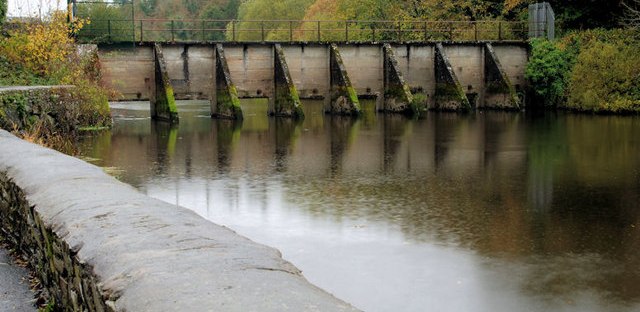
Image: Quoile floodgates, Downpatrick by Albert Bridge, CC BY-SA 2.0 https://creativecommons.org/licenses/by-sa/2.0, via Wikimedia Commons. A large floodgate across a gentle river with trees in the background and a stone wall in front.


Prin
I admire your flexibility with language and your fearless approach!
Leila
LikeLike
What a strange and imaginative tale. Beautifully presented a flight of fancy with a sad and poignant heart. Great stuff – thank you – dd
LikeLike
Chillingly on point with Bangkok under water – a very well written piece of fantasy that avoids unnecessary flourishes and pulls the reader into the narrator’s perspective. An excellent start to the week!
LikeLike
I’ve read this story before on Flash Fiction Magazine. Still great.
LikeLike
Prin,
It feels like what it feels like to experience death, although we’ll never write about it, will we? Creepy and beautiful. — Gerry
LikeLike
An original and imaginative story. The specifics of the machine’s mechanics provide effective world-building. The oath is an excellent touch, as is the image of dry shoes waiting upstairs. Very good.
LikeLike
Do I rage at the cruelty, long for the sense of purpose, or accept that we all feel this way sometimes? The details are wonderful (tastes like cigarette butts) and the poem works. The line “I love it” is unexpected and real.
Ted
LikeLike
You’ve got great narrative control between reality and fantasy here and such a strong writer’s voice. I look forward to reading more of your work.
LikeLike
Hi Prin,
The metaphor hunters will love this!
I enjoy it for its sparse but plentiful description and inventiveness.
I thought the idea of his memory going back to his mother could take this into a completely different road!!
Very different and thought provoking!!
All the very best my fine friend.
Hugh
LikeLike