
‘Above the spume!’ Dr Gerasimos Evangelatos chants as he presses his disputed sandal to the pedal. Cephalus, his family’s latest ‘stray’—though what is a stray cat but an unmet friend?—gingerly stares from the front basket. ‘Above the foam of the sea!’
The singing man swallows a fly, spits on the road, dodges an enamoured red cockerel chasing a brown hen across the steep road, for desire has no more road sense than Gerasimos. The bicycle, with Gerasimos theoretically atop it—in reality the man is floating metres above his own head, his thoughts are already at the beach inspecting the turtle nests—swerves across the road before unexpectedly, even to himself, somehow returning to where he began, much to the consternation of the German tourist racing him. In the last two-hundred metres she has overtaken the idiot on the bicycle twice, only to witness him from her rear-view mirror disappear down an alley or veer through an olive grove, to find him triumphantly ahead of her Fiat. This is, she believes, unforgivably Kefalonian, which though beautiful, seems a law unto itself by adhering to unfathomable physics. She’d eliminate the ants and angry wasps too, if she could. She no more approves of Greeks on ancient bicycles beating her to the beach than she does the horrid cats begging for scraps at the rental villa. She revs the engine.
The song Gerasimos bellows, for singing might be too generous a description, is called Yalo-Yalo. It is as close to a Kefalonian national anthem as is possible. The lament is not officially recognised, it is sentimental, cloying, especially given the island is not a nation—no matter what the locals think. No Athenian civil servant would dare insist on the Greek anthem at local ceremonies. Government officials have found themselves seeking shelter amongst frowning police in Argostoli having foolishly sung the official anthem over Yalo-Yalo, wondering why it is their anthem is being sung with the wrong melody and entirely incorrect words a la kantada, that mesmeric polyphonic liturgy-like homage to love in all its forms. Hearing people sing Yalo-Yalo causes the members of The Lixouri Philharmonic Orchestra to set down their pomp and brass, remove ancient blue peaked caps, weep with longing.
‘My love is asleep! My love is taking a nap!’ he warbles, as if anyone could sleep through his stentorian rendition. His bass-baritone voice becomes infused with vibrato due to the uneven road. Bicycling Kefalonia offers many rewards to discerning cyclists, among them exhaustion, throbbing rectus femoris muscles, breath-taking sights, wonders and second chances, the clearing of one’s sinuses, and piles. Though early in the morning of what will be another warm blue day, and though it is September and the tourist infection has begun to be cured as if by the autumnal antibiotic that is (relatively) cooler weather, the road from Spartia town to the little beach one and half kilometres away is already pockmarked by white and red rental cars in a way that reminds Dr Gerasimos Evangelatos of smallpox. No tourist nor lover dares sleep when Gerasimos yodels. Neither can Cephalus, growing used to his human, and who chooses to paw at passing red butterflies that taste, he imagines, of fish heads smothered in cinnamon butter.
There are many little roads to the beach—all are precipitous and narrow. Each morning at this time of year, Gerasimos sets off enthused to inspect the nests of a handful of turtles that long ago mistook Spartia beach for more fashionable beaches—Spartia is too narrow beneath its cliffs for most turtles to consider ideal. Dr Evangelatos loves the few that brave Spartia—he thinks of them as outliers like himself. These turtles come much later than their peers elsewhere. He thinks of the animals as late bloomers, and (a British expression) pernickety, preferring their quieter, more exclusive coast just as Gerasimos prefers his peaceful life.
He once visited England—his wife Anna and, at the time, baby son Nikos, were staying with relatives. Despite his onerous work and voluntary duties, Gerasimos found himself moping, sulking, pouting at home. A man of science, Gerasimos dedicated two days to eliminating possible causes of his disquiet. He discovered: he missed kisses; putting Nikos to bed; Anna’s nagging concern. He ate, but chewed indifferently. He sighed often. He misdiagnosed a kitten. He sang less often. The bed was cold. He remembered Anna’s warmth with every breath—he wanted to curl beside her to smell her hair. He migrated north—though he could manage only two days before fleeing Birmingham. His wife Anna tells of Gerasimos appearing so alarmed from the taxi journey and temperature that he did not unpack. So much, she often says, for romantic gestures. ‘He’d no sooner bounced Nikos on his knee than he replaced his hat and coat, borrowed a scarf, and announced the animals were calling him home.’ Gerasimos says the visit to England left him frozen but in possession of many archaic words he made notes of—‘pernickety’, ‘abaft’, and ‘alack’ amongst them. Translating these into Greek has not proven satisfactory. He has not surrendered his ambition to drop casually into conversation ‘avaunt!’ and ‘erewhile’. Anna says her husband thinks he is too funny for words, and Gerasimos calls her a genius, insists on kissing her neck, which makes her melt like chocolate beneath an August sun. She says the cause is his beard; he says it is his animal magnetism. But this is the way of older husbands and younger wives—they dote as often as complain, regularly as sunset.
‘Oh waves stay calm! Don’t wake her just for me!’ Gerasimos wails.
Cephalus, bored—made dyspeptic by butterflies that did not taste of cinnamon butter—stares ahead with keen eyes, hunting for dragonflies. His white tail snaps stiff, his whiskers pushed back by the breeze the velocity of the bicycle creates. Chased by Mrs Koutoumanis’s six white geese, the veterinarian holds down his tan cap, and the wind lifts his beard to cover his eyes for an alarming second. He fails to avoid a tarmac wavelet—even road layers are permitted the odd hiccough on a bad day—and the bounce causes one of Gerasimos’s bicycle clips to ping from his trousers and disappear amongst the ancient olive trees belonging to the widow Mrs Vasilakis who is waiting, as she does each morning at this time, for her wartime Italian lover, unaccountably delayed from keeping his evening promises by the existence of his wife. On average, Gerasimos loses seven bicycle clips a week—he has a spreadsheet. He pays for the replacements himself, and does not charge the animal charity nor the animal surgery he runs. Since the Greek bicycle clip industry collapsed, he has been obliged to buy Chinese clips, which often come coloured a rather distasteful yellow.
‘To the shore! To the shore we are riding!’
His voice is a red shift song so ancient the olives and orange and pomegranate trees feel the melody in their roots, and rosemary bushes loose oil. A goat bleats in admiration as the veterinarian flies past. Had the man sought to examine the wily goat, its reaction would have been entirely different. No goat trusts a stationary veterinarian, but one suffering apparent perpetual motion is to be admired rather than doubted.
‘There’s nothing else that I would ask! Save for you to be my lover!’
Gerasimos loves this line in particular. He warbles it at breakfast—usually a thick coffee spooned on tsoureki bread, which though intended for Easter, Anna is obliged to bake all year (despite telling Gerasimos of the benefits of fibre over mastic and mahlab). He’s an old fool, she says, but she loves his hefty voice—it throbs with love. Not only for her and Nikos, but for life on the island. She is twenty-two years younger and has before now, during an argument, said she is looking forward to widowhood and inheriting his pension. This causes Gerasimos to belt out Yalo-Yalo louder. ‘Whilst there is still time!’
This morning Gerasimos improvises a verse when discovering the brakes have failed.
’Holy shit! Holy shit!’
The callipers fail, the pads do not budge, the bolts of both pivots are gone! Damn the hiccoughs of tarmac layers, blast Germans overtaking him illegally! (Her driving is perfectly legal but to Gerasimos that is not the principle at stake.)
‘One must accept one’s fate!’ Cephalus is informed in no uncertain Greek. He should, he tells Cephalus, who seems more excited than alarmed by the increase in velocity, have listened to Anna. Hadn’t she warned this morning that a man wearing his thickest white socks and most disreputable sandals deserved all the troubles he’d receive? No matter his toes were cold—a normal husband would wear boots! He insisted. She took a photograph to show her friends in Argostoli. On their cigarette breaks the women compare the idiocies of their husbands and sons. After twenty years with no end to this conversation in sight. Anna complains of the menagerie her Gerasimos fetches home—poisoned pine martens, a three-legged tortoise, broken-hearted fledglings rejected by the sky, even, once, an octopus he named Odysseus. One of the many things Gerasimos admires about his wife—apart from her fixation with his inadequate attire, and her tolerance of Birmingham—and apart from her eyes, which set him, still, afire (oh! the archaic English!)—is her tenacity at proving wiser than his years on a daily basis.
Dr Evangelatos is not religious. A veterinarian easing the passing of a beloved animal, heals goats and donkeys, who rescues the run down left injured on melting roads, does so not through praying. He applies scientific learning. That most Greeks are named for saints or biblical figures is simply a vestige of superstition, he says. Another of Anna’s many cousins runs what passes for a Greek bakery in England. (Not the cousin in Birmingham.) The bakery is in Margate, an entirely different species of town though often equally depressing, according to Anna. The seaside bakery is called The Foxhole, because—says Anna, eventually getting to her point—there are no atheists in foxholes. One shouldn’t, she warns her husband, dismiss faith as superstition. Faith is a more universal form of hope. He has noticed Anna has, over the last year, begun to attend church. (He wakes and she is gone. And he feels lost, unsaved.) She has hung an icon in the lavatory. (This makes his stools hard, he lies). Gerasimos attributes her spirituality to Nikos reaching middle school—he has recently turned twelve—and Anna, between her work at the estate agent and her insisting on looking after her son and husband regardless of their wishes, has time to contemplate her existential purpose. ‘Soon you’ll be dead,’ she said matter-of-factly recently. ’Do you want me to not learn how to pray for your soul?’ Despite being non-religious, Dr Gerasimos Evangelatos finds himself praying to his namesake, Saint Gerasimos. He is unsure whether praying on a bicycle is permissible. He’ll ask Anna should he survive.
‘Saint Gerasimos! This is Gerasimos!’ he cries, holding on to Cephalus to stop the little cat from leaping from his basket. ‘We’ve not spoken. I’ve been busy. However it seems–’ and he takes an oath that if saved he shall never wear socks with sandals.
An unforeseen divot causes Dr Evangelatos to veer toward the side of the road. His bag of medicines and tools levitate into the air from where the veterinarian nonchalantly plucks them. Cat and veterinarian are impressed, disappointed no-one save the German tourist witnesses this miracle. He takes this as a sign his wife’s religiosity may prove helpful. Gerasimos relaxes. A great peace and acceptance descends. He is free-wheeling, upright, but suddenly untroubled. He waves as he passes dear Mrs Loverdos-Livieratos, who saves nearly as many cats as himself. The veterinarian imagines people bemoaning old cat women are barking up the wrong tree. He removes both hands from the handlebars and pulls out a notebook from his jacket to record his witticism. The notebook is full of case notes and similarly appalling jokes. Anna, who every evening suffers the reading of the day’s notes refers to her semi-retired husband’s quips as stone jokes—they sink without trace and hurt when they hit. Cats and old women caused the old vet—who could no more give up his occupation than he could his beloved bicycle, despite it being regularly impounded by the police—significantly less trouble than old men and their dogs. He had never once been bitten by an old woman (or a cat). He has the scars testifying to the regularity of assaults by men and dogs.
He turns a sharp left onto an even more profoundly declivitous section of hill (God bless the English lexicon!) simply by leaning. He bathes in basil, jasmine, cypress, tastes the heat of the road, expectorates a fly. As the bicycle is chased by two dogs, a horse looks up from its chewing to admire the spectacle; it does not join the parade. The vet raises a majestic middle-finger to a young constable struggling to raise his speed gun. The vet croons loudly, for in this unforgivably cruel world what can we do but sing?
‘Let mounts crumble! Let mountains shrink and fall!’
Cephalus accompanies the doctor’s howl—the two perform a knot. As his flat cap flaps, his billowing white shirt blooms like a ship’s sail, as his braces the colour of Myrtos beach and his scarlet sash red as Anna’s lips flutter, Dr Evangelatos recalls that Byron mentioned he owed Greece for making him a poet. For himself he gives thanks to the cats of Kefalonia for inspiring his career. He was a late comer, like Spartia turtles. He will continue to be a veterinarian, no matter the opinion of The Geotechnical Chamber of Greece, the registration body of his profession that is seeking to deregister the bicycling vet, oblige him to retire. Retirement would mean surrendering and Gerasimos refuses; he will continue to serve the animals of south-eastern Kefalonia and those who fret for them. He will always use those cease and desist letters as bedding for Niko’s guinea pig (who is named for the current prime minister).
Gerasimos approaches his favourite pothole chicane switchback with glee, though a little faster than usual. The competitive German has overtaken him for the last time. It is said that gravel and pools of thick dust undo many novice drivers—the safety barriers on the more forbidding cliffs testify to this—and whilst there is no evidence that the potholes camouflaged by gravel have never been filled because of the bribes from tyre suppliers, Gerasimos knows the German, currently searching high and low for the right gear (and cursing in Bavarian her navigating husband) will be forced to brake violently or move to the wrong side of the road, allowing him to perform a ballet-like manoeuvre of undertaking genius. What does it matter that on this morning tourists and Greeks consider the Kefaloniti—the forty-thousand souls living on the island—mystifying, portentous and pretentious (a belief the locals encourage)? What does it matter that he is an old man with a young child and a beautiful wife? A vet knows to treat the reality of the present with dignity and kindness. Life is a rare gift. He will always be his own insouciant Kefaloniti self, no matter! So be it the island is drowning in the evils of AirBnB, impoverishing the island while making a handful rich; one day the incendiary politics of his youth will reignite and the island will shrug off Athenians and all the cats shall be fed from the public purse.
‘Let the sea! Let the sea become wine!’ he sings ecstatically. Cephalus yelps in agreement.
The sun climbs down white ladders to his back, the cross-stitched island befogs (ah, England!) in all its brakeless beauty! And Gerasimos? He is suddenly wide-eyed, for he encounters the edge of the little cliff above the beach sooner than expected. No demurrals withstand the reality of a patient beach at the bottom of a hill. The bicycling cat and doctor very much reach the end of the road.
They fly, still furiously peddling—the doctor’s becomes a swallow’s heart. He shoves Cephalus into his shirt—the stray is no longer a stray—he belongs, he trusts Gerasimos, and the veterinarian lifts his arms as if they were wings. The front wheel dips. For a moment, Gerasimos believes he shall ascend forever into the morning, know at last what it is to be a natural creature at home in another element.
But Anna and Nikos stand before him. He is fated to fall, be joyfully earthbound rather than fly—to lose this life with them so soon would be unforgivable, and Anna would never let him hear the end of it. Her soft lips and scolding words are waiting at home, her wisdom and arms, her concern. Cat and doctor begin their tumble from great heights. They have leapfrogged over the beach to the amazement of tourists and fishermen alike. The bicycle separates—two wheels down, mudguards up, brakes left, chain right—an exploded diagram.
Dr Evangelatos awakes in the clear sea, sitting on sand. Atop his cap sits Cephalus as if he were a crown of claws. Small fish inspect the transgressor. As women, children and men wade to see to his safety, Gerasimos makes the sign of the cross.
‘Thank you,’ the doctor whispers to the sweet waves and bitter sky.
Ten metres beyond turtle flipper breaks the surface. The old man weeps from joy.
‘Good journey, you late comer!’
He pulls out his notebook, finishes his song: ‘Let the boats become glasses from which roisterers drink!’
There will be time enough for the long walk home, for home is worth the struggle to reach. In the meantime, he might attempt to teach Cephalus to swim.
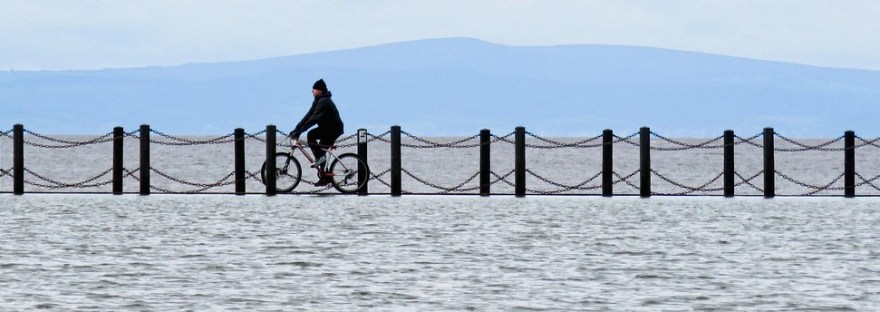
Image by Tim Lutton from Pixabay – a person bicycling beside the sea.


What a delight this story is, fun, quirky and beautifully written. 5 ⭐⭐⭐⭐⭐
LikeLike
What a truly lovely piece of writing, excellent beyond my words to describe. Thank you so much for restoring my faith in the strength of words to weave together into small miracles.
LikeLike
Beautifully written, full of the joy of life, humour and a clear love of language and Kefalonia. Anthony’s writing is wonderful.
LikeLike
A joyful, uplifting, amusing story beautifully written and I fee we are very lucky to have this on the site this morning. Thank you – dd
LikeLike
Antony
As always you set a brilliant tone that never loses its grace nor energy.
Leila
LikeLike
I found the paragraph starting, “‘My love is asleep! My love is taking a nap!’” to be littered with a plethora of delightful and inventive bons mots, a veritable minefield of genially buoyant humour.
LikeLike
Bravo!!! and thanks -mick
LikeLike
Lush, rhythmic prose that bursts with personality, as does the MC. Very nice.
LikeLike
Hi Anthony,
Normally this type of story is referred to as a character story. This is much more than that, it’s also a life story that is as beautiful and dangerous as the road he is on.
Excellent.
Hugh
LikeLike
Motion and miracles, the doctor reminds me very much of the character of Zorba the Greek by Nikos Kazantzakis, always moving, totally absorbed in the present moment yet juggling numerous moments at once…. and the singing, too, very Zorba like. Sirtaki. The motion of the story is like a dance, also, it seems to veer a bit out of control, but that turns out just to be another unexpected move that is choreographed with the whole. I like the fact Dr. Evangelatos is a vet and cares for the animals, especially the cats, which I understand are everywhere in Greece.
LikeLike