
On those windswept weekday mornings, asphalt driveway crusted with snow, my father would get up early, put on his secondhand boots and an old coat, and exit through our front door into the blue hour to get the motor running. That fifteen-year-old station wagon would stall if not warmed up properly and might not start again. My father would sometimes have to push it down the hill to get the engine going, my younger brother Bill and I sitting quietly in the back seat, the smell of alcohol already on my father’s breath.
My mother would have left for work by then. She cleaned other peoples’ homes in the next town over and took three buses to get there. She wasn’t paid very much. I’d be tired from the night before, unable to sleep due to the cracks and slaps and my mother’s muffled screams coming through the kitchen door. Sometimes, I could see traces of the bruises on her face and arms when she got home from work, despite her best efforts to cover them up with makeup and long sleeve shirts.
The last time I was in that rusted car, I brought a can of beans with me to school. It was carefully hidden in my backpack with my school books, my homework and the jelly sandwich my mother had made and packed for me the night before. I’d been storing up cans of food in my school locker for months, planning my escape. I’d pulled up neighbors’ weeds, walked their dogs and wiped the car windows of passersby to save up enough silver in an old, dirty sock in my bottom dresser drawer to buy a one-way ticket out of that place. It took me the better part of a year for that sock to get heavy enough with quarters and half-dollars. I got onto a Greyhound bus after school that day, my backpack filled with cans of food and a one-way ticket in my trembling hand. It took me four hours to get across the State line and I never returned to West Virginia.
I once told a neighbor about my mother’s beatings. I was twelve years old, and it was about a year before I left. My father punched me in the stomach that evening when he found out, so hard I had to spend the night in the local hospital. They thought there might be some internal bleeding. My father told the doctor that my older brother and I had had a fist fight while he was at work. But my father wasn’t working and I didn’t even have an older brother. I never told anyone else about the beatings after that, I was just too afraid.
I’m a lot older now and don’t know how I made it after leaving West Virginia. I don’t like to think about it and won’t tell you much about it now. I will tell you that I’ve lived alone since then. I spend many hours playing card games on the table in my living room, particularly solitaire. It helps me to pass the time. My neighbors call me “that old man.” I suppose their name for me is accurate although I rarely speak with them.
My one-bedroom apartment is nondescript, but it suits my needs. It doesn’t cost me very much and my monthly social security check just about covers it. I work a few hours a week at the fast food joint down the street to make ends meet. I never married and stay in my house most of the time. I prefer things that way. I never had any children of my own. I think it’s better that way. I wouldn’t have known what to do with them.
I had a girlfriend about thirty years ago. Her name was Sally and we went out for a few years. She was five years younger than me and couldn’t have any children as a result of a childhood illness. Towards the end, Sally asked me if I would marry her. I said it didn’t make much of a difference to me but I would if she wanted me to. I thought I owed her that. Sally asked me if I loved her. I said I didn’t think so but that I wasn’t really sure. She asked me why I would want to marry her then. Sally moved out of her apartment over the next few days and left town. I didn’t know she was moving away before she left and only learned about it from a neighbor after the fact. I never heard from Sally again and don’t know what became of her.
I wrote to Bill about two years after I got off the bus, and he’s been coming to visit me every few years for the last forty years or so. He still lives in West Virginia. Bill says he’s not angry with me for leaving him, but I don’t really believe him. My mother never responded to any of the many letters I wrote to her after leaving home. I think she expected me to protect her somehow. Bill says she never left my father before he died but that the beatings stopped after he had a heart attack and then a stroke. Bill says Mother passed away a few years ago and was still cleaning homes on the day she died. My father never stopped drinking and lived for only ten more years after I left.
Sometimes I go back to where that bus dropped me off, just to take a look at it. I get butterflies in my gut while standing there remembering. The buses are newer now and the terminal has been painted. There are more buses these days and the buses are more crowded. They’re filled with families and grown men and women but no boys travelling alone. I wonder what would have happened to me had I never gotten on that bus and just stayed home.
I asked Bill a few years ago where our parents are buried. He told me where and I went. The grass was long and unkept. It hadn’t been cut for a while and covered the flat gravestones. I had trouble finding them. The grass was turning yellow and orange from the strong sun. Mother was buried next to father. She must have wanted it that way. She’d had an abusive father who struck her and told her she was no good. Mother could have responded in one of two ways. She could have renounced her past and vowed never to repeat it. She could have decided she would have nothing to do with abusive men and certainly wouldn’t marry one. Or she could repeat the chaos and madness in the choices that she made. But I wouldn’t be alive today if she’d chosen the former.
In the mornings these days, I go downstairs and make myself a pot of coffee. It takes me the better part of a day to finish it. I’ll eat a piece or two of toast with jelly. I may dunk the toast in my coffee. I like to watch the children walking to elementary school on the sidewalk in front of my house, their backpacks strapped tightly to their little backs. They’re filled with books, their homework and the lunches their mothers have carefully made and packed for them. I wonder what their fathers and mothers are like. I wave at the children through my kitchen window as they hurry on by. The asphalt sidewalks can be slippery when they’re crusted with snow. Sometimes, a child will slip and fall. Then they pick themselves back up and continue on their way.
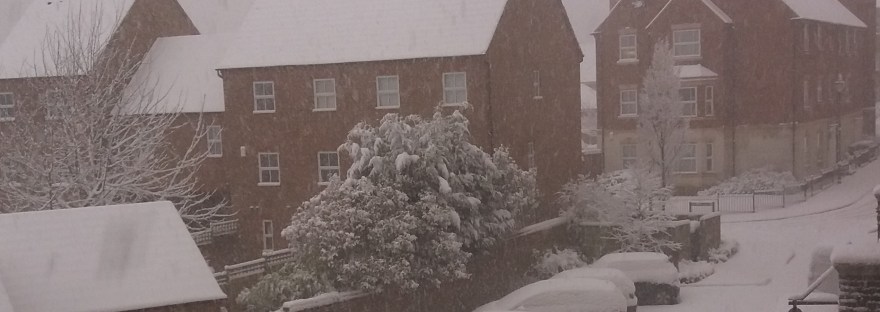
Image: Snowy street scene from dd

 literally stories
Hi Gil,
I really did enjoy this!
The simplicity in it shows the confidence of an established writer.
There is a wonderful understated sadness all the way through that is never dramatised, just simply told.
This actually had me at the ‘second hand boots line’…I don’t know why.
Brilliant tone and the pace was perfect.
In a weird way it reminded me of the ‘Brookes’ soliloquy just before he hung himself in ‘The Shawshank Redemption’.
I feel a wee bit depressed (HAH!! More than usual) so for you to cause emotion in a reader is all good.
By far, in my opinion, this is the best thing that we have ever seen from you!
All the very best my fine friend.
Hugh
LikeLike
Hi Gil
Utterly dark and concealed. So beautiflly restrained. Perfect metaphor about this sort of life. Reminds me of Charles Bukowski and his violent father. It’s said that abusers were usually abused, but, God damn it, people can choose to vent elsewhere. Punch a loud mouth in a bar, let the family alone.
Leila
LikeLike
Great read. The tragedy of an abusive childhood leading to a lifetime of loneliness, with a pinch of hope at the end. Very realistic storytelling.
LikeLiked by 1 person
I suppose the saddest thing about this, from my point of view anyway, is that the abusive father never knew how he had ruined and wasted the life of his son. When I read things like this I think of the day the child is born, usually to joy, though of course not always and they are all just tiny humans and then off they go to success and happiness or waste and despair. I thought this was a very moving piece though rather depressing. Thank you – dd
LikeLiked by 2 people
Some scars never heal. The emotionless style of the narrative reflects the emotionless MC, who seems to have buried his. Very well done.
LikeLiked by 1 person
A real downer, but sad to say all too believable.
LikeLike
A sad and reflective tale of a life twisted by abuse. Well paced and hits the right one. Excellent.
LikeLike
There’s a lot here in that it’s almost a lifetime of hurt and pain within a very short piece, but the prosaic, gentle nature of the writing holds it together perfectly. I particularly like the final paragraph that works as a kind of sad, but hopeful refrain.
LikeLike