
They say that telepathy is a gift.
But it was not a gift when I was designed as a tool—a gene-twisted thing, a tool made of meat. My gaunt, pale, body was designed by the norms for one purpose—reading the thoughts of other norms. I was made to be a psychic burglar, built to uncover the secrets that a norm hides in the lies or silences of their porous mind.
It was not a gift when I decanted, not born, fully adult but empty of memory, lifted from a sterile birth tank, my mirror-like eyes reflecting the gleam of the room’s metal in the bright florescent light, my nose puckering from the smell of my chemical womb.
It was not a gift when I was given the number 749947, not a name.
It was not a gift when the void of my newly made mind was programmed to fear my own kind, an irresistible compulsion, a magnetic repulsion, a trembling panic immediately summoned by the presence of another telepath.
It was not a gift when I was thrust into a world of twelve billion fearful norms, a world where there are so few of us and so many of them. A world where I envy the people that fear me.
It is not a gift that I am alone, alone, eternally alone, thirsting for intimacy that I can never have, pretending that I am a man, not a tool. Pretending that I am free, not a slave.
They say that telepathy is a gift.
They lie.
# # #
We walk the same New York streets, but my world is not their world. They know this. They are taught that our differences make us dangerous, that we are to be feared, that we are needed to interrogate the killers, the revolutionaries, and those who disobey the oligarchs or the regime. They are taught that we are a necessary evil, but an evil, nonetheless.
Today, the setting sun aligns perfectly with Manhattan’s east-west street grid, a baleful, cauterizing eye that swathes the deep gash of the concrete canyon in a golden-hued bandage of color. A hue made by lonely photons, born in the heart of the sun, which have traveled through ninety-four million miles of emptiness just to illuminate this moment. Photons whose glory is damped by the dark glasses that hide my silver eyes, photons that are blocked by the baggy hooded sweatshirt that hides my distinctive form.
The norms are everywhere. I am a shark in a school of guppies, a tiny speck of difference in their ocean of sameness. Pay this one no attention, my clothing says. You need not gasp in fear. There are no mirrored eyes behind those glasses. This person walking beside you cannot strip your mind naked in an interrogation. You should think, “Why yes, he may be oddly dressed, but he is one of us.”
But my clothing lies. As much as I want to be one of them, I am not.
I drift, carried in the tide of norms that flow down the sidewalks, the waves carrying them toward the shore of the things they dream are oh so important. The traffic lights turn our motion into a parody of a dance – start, stop, wait, start, stop. Rats seeking cheese, cheese that the powerful dangle eternally, always in sight but just out of reach.
They are so like me, yet so different.
I stop walking. I am like a rock in the middle of the flood of norms, and they part to flow around me. In a crowd, I do not fear to open my mind. With so many around me, the contact is too diffuse, too temporary for a norm to notice. There will be no complaints, no detection, no investigation of unauthorized reading. No punishment from my watchers.
Their thoughts overlay each other, like a graffiti-covered subway car, tagged, then tagged again, and again and again, and again, until there is no discernable car, just graffiti hurtling along clattering rails. Randomly, one of their thoughts will rise to the surface of the chaos, before it disappears, replaced by mental flotsam from a different norm:
<Images of a child, crying> <“and she said . . .”> < “tomorrow? At 3 . . . “>
<“But I didn’t mean . .”> <Maybe the rebels have a point . . .>
<coffee smell, so rich . . . > < Shit I’m late . . .>
<I wish he had . . .>
I damp my awareness. I’ll want that concentration, soon.
To quench the thirst.
# # #
The building might have been a former hotel, converted into something more useful following the regime’s travel bans. The lobby is filled with tepid, sugary muzak; a crisp, instrumental version of some approved patriotic ditty; its clean chords clashing with the faded, stained carpets. The bitter smells of cleaning supplies tickle my nostrils, and dust covers unattended surfaces. Like so much else, time has made this place less than it once was.
Past the lobby, the hallway is a labyrinth of identical dark glass doors, each marked only by the name of a business and a number. Most of the businesses here are grey market – businesses willing to take cash, ask few or no questions about customer’s loyalty to the regime, and even – sin of sins – deal with telepaths. The last door on the left, the one that I visit every month, reads “Companions, Ltd.”
It might as well read “Oasis for the Thirsty.”
The receptionist is a tall, professionally dressed woman with rich ebony skin. There is a nameplate at her desk that says “Kavita.” I watch her as I lower the hood of my sweatshirt and take off my sunglasses. She blinks several times but manages not to shudder when her gaze meets my mirrored pupils. It is, after all, her job not to shudder.
“749947,” I say. “I have a 18:30 appointment.”
She takes my cash and deposits it in a plassteel safe. She turns back to me, her head down and eyes averted. “That’ll be Yin,” she says, looking down at her desk. “She’s new. Kariana is no longer with us. Room 5. She’s expecting you.”
And me, her. The thirst is nearly irresistible.
# # #
Yin is a petite, older Asian woman with short, jet-black hair. Her face is punctuated by the red dot of a bindi tattooed on her forehead and a complicated set of ear piercings. Indian heritage perhaps, I think, trying to remember if India is an ally of a foe of the regime this month.
I can see that she has changed the room from Kariana’s arrangement, and a smiling, chubby Buddha figurine sits in one corner. At the corner, on a desk, there is a holocube of her with a man and a young girl on a beach. I do not need telepathy to see that they are the anchors of her life, the ones that surround her with the love that I am denied.
The ones that slake her thirst.
But the well-worn brown leather chair next to the desk is still there. She asks me to sit.
“You’ve done this before?” I ask. “Allowed a TP to read you?”
“Twice,” she answers. “The first time, it wasn’t that I . . . allowed it. By coincidence, I was on the ferry that left Battery Park just before the bombs went off in ’57. I was questioned. It was . . . not pleasant.”
How do I tell her that the TP that read her probably hated themselves for doing it? That they probably desperately wanted to be one of them and not one of us? That their only choice was to read or die?
“But I do not dwell in the past or look to tomorrow. I live in the now,” she continued after a moment. “The second time was yesterday, here. It was . . . acceptable.”
Acceptable. Of course. This was a job for her, a transaction.
I sigh and look at her. “I just . . . I need . . . to feel, something. Something that I know is there; just not for me. Something that is forever out of reach . . .”
I wipe back a tear. The gene-twisters didn’t take that away. “Can I . . . Can I hold your hand?”
She smiles. “If you wish.” She reaches over. Her hand is cool against mine, her fingers interlacing with mine, our skin a staccato contrast of light and dark. The sensation of touch flows through me; almost electric, its energy feeding the anticipation. “What would you like me to think of?” she asks.
I look over at the holocube. “Them. Your partner and . . . your daughter? The ones in the holocube over there?”
She smiles again. “Happily,” she says. Her eyes meet mine and I do not see fear.
I open my mind. Her thoughts flow to me:
<Time, time, time, a moment without it, eternal, never decaying, never leaving, his smile, his eyes meeting mine, and I run to his arms, his full, strong arms and I leap into them and he grabs me and lifts me and we spin, the sun, the brilliant sun warming the sand; rays made just for us, warming our skin, making the water sparkle and then there is the ocean smell and he is there and we kiss and I want to happy cry, cry at the joy of him, Rajit, Rajit, my love, and the bond, the bond of forever, of the eternal moment, the want, the need, the fulfillment, this moment, we spin and Anna laughs, the laugh of four-and-a-half year-old innocence, of endless potential, of tomorrow and tomorrow and tomorrow and tomorrow and “Mom, you guys are silly!” and if I died this moment there need be no other and he puts me down and she runs to us and the way she looks at us those brown eyes of joy and she reaches out and we are not Yin and Anna and Rajit we are one and forever and >
Her thoughts flow through me and I am lost in forgetfulness, There is no thirst. I experience the timelessness of it; the strangeness of it. Love. I am unaware of time and her thoughts shift . .
<she runs in to the tiny kitchen and the candles of the cake light the darkened room and the smell of chocolate, of raspberry, of wax and it cost a week’s food credits but the look in her eyes her mouth open with surprise, that little gasp as she sees it and Gods she’s seven years old now and I want time to stop and “Make a wish, Anna,” and she inhales, an impossible deepness to it, a liminal moment before she exhales where the universe is balanced on that breath and she blows and the candles flicker and her eyes her eyes her smile>
A timer dings. The receptionist opens the door. “Yin? That’s ten minutes. Sir? You’ll need to . . um . . stop.”
No! It can’t be over this quickly. I want to stay in those moments, to be someone else, to feel like that; to imagine that I am not me . . . But a deal is a deal. I damp my awareness and let go of her hand. “Of course,” I say.
I look at her and there is a blankness for a moment, a common reaction to unlinking. Then she stands up and looks at me.
There are vast volumes in that look, libraries of emotion, none of them good.
“Thank you.” I say. “Are you o.k.?”
She smiles briefly, but there is a falseness to it, and looks over at the holocube. “I am . . It was . . . acceptable.” She pauses. “Kavita can help you with your next appointment. I need to . . wash up.”
“Thank you again,” I say awkwardly.
I know that soap and water will not wash off the taint of my touch, the wrongness of selling her memories. I feel shame, shame at my need, shame at the world that made me.
But I know that I will be back.
I can already feel the thirst.
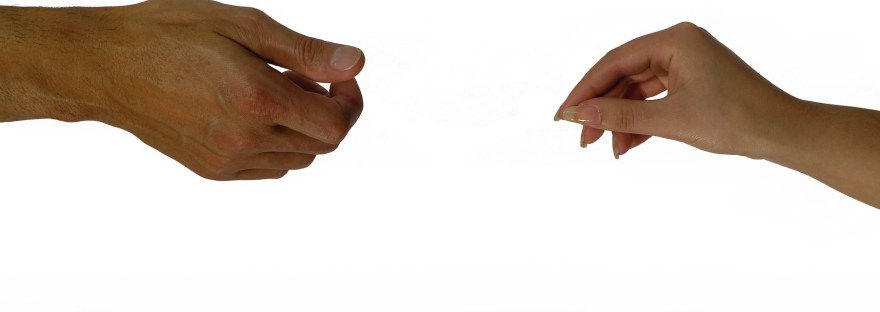
Image from Pixabay.com – a male and a female hand reaching for each other.

 literally stories
An incredibly imaginative concept with a twist to it that really works. I love the idea of being a ‘psychic burglar’ but this being a curse rather than a blessing. The idea of such people needing to book into appointment for peaceful minds to read is a superb one and I think this whole idea could make for a much, much longer (perhaps novel length) idea. All of this is helped a great deal by the writing and the strong narrative voice.
LikeLiked by 1 person
David
Interesting look at a form of prostitution. It also can be compared to a drug addiction. Hellworlds run by regimes are a fairy tale that will never die because, unlike its opposite number, unhappily ever after is infinite.
Leila
LikeLike
Hi David,
This is a very complex and imaginative piece of work.
Letting someone get so close opens so many aspects of giving and acceptance. I like how you have played down the ideas of trust to something more, or is that, less basic.
This one will stay with me for a while!!
All the very best.
Hugh
LikeLiked by 1 person
A really interesting and novel take on an old idea with the telepath as a kind of psychic vampire. The intrusion of people’s thoughts was particularly well done and the piece as a whole was nicely retrained whilst also packing some emotional heft.
LikeLike
Yet another way for people to be used! I thought this was incredibly imaginative. Is it just a question of time before someone finds a way to steal our thoughts – chilling idea. a really fascinating read. Thank you – dd
LikeLiked by 1 person
David
The point of view in this piece was excellently well-done, imagining as it does the interior world of a “creature” who may be in the future. Somehow it reminded me of Einstein’s famous quote about World War Three: He didn’t know exactly how it would be fought; but he knew that the next war after that would be fought with sticks and stones. Henry Miller also predicted a complete collapse of civilization as we know it, right about now. Not the end of human life; the collapse of the current “civilization,” which are two different things. In Miller’s mind, the collapse of the civilization we have now would be a good, NOT a bad, thing. The ultimate rebels don’t protest or make a noise; they remove themselves; they don’t participate at all, ever, in any way, as much as is humanly possible. These people exist everywhere humans do, from India to America and everywhere in between; their loneliness must be something like your protagonist on one level, in the way he roams the world alone. A being without a home and without a creed, but with special knowledge somehow.
This was a really good sci-fi story that raises questions like the best of this genre does. Your story shows that everybody is human, even the people who aren’t “human”; and it also points out that those who are most looked down upon by everyone else are human too, which is a beautiful truth. Nietzsche, like Van Gogh, hung out with prostitutes sometimes; he also died a virgin. Thanks for the creation of a complex, thought-provoking tale.
Dale
LikeLike
David
Telepath # 749947 is a palindrome, isn’t it? All balance and symmetry with a great thirst for human contact and memories, even other people’s memories.
Heavy stuff. How easily we hand over our humanity to regimes, political parties, governments, and corporate structures. Churches.
Quite a trip. And like any skillfully created and meaningful story of the future, it is about today. Or else why read it?
Scary wonderful!
Gerry
LikeLike
Great story. Wonderful take on a concept that becomes an excellent view of a being’s life. Complex and sad.
Well done.
LikeLike
Odd world indeed. There isn’t much politics in here other than the world is in a very bad place. Have the norms any armor to prevent brain plumbing? Seems like that would be a natural invention if protons come through the eyes. Possibly the regime would punish anyone seeking privacy.
I thought the mind “prostitute” was more like an odd version of a therapist.
I appreciate the different perspective.
LikeLike
Excellent world building and (non-human) character development. The telepath’s yearning for connection and intimacy comes across loud and clear. The MC might be a “tool,” but is one most of us can relate to on some level.
LikeLiked by 1 person