
Whenever the mystery of Colonel Corpse’s murder had been solved, a process happened which Bishop Aubergine could not fathom, and Colonel Corpse was resurrected and murdered yet again.
The case had continued in this fashion for as long as Aubergine could remember. For the guests of St Michael’s Lodge, life revolved around murder and mayhem to the extent that the phrase ‘murder most foul’ was written across the floor tiles by the grand stairwell. Who killed the Colonel, with what and where were questions perennially at the forefront of the guests’ minds. They were also the business which had now taken Bishop Aubergine to the chapel, a room he knew well, but did not understand the purpose of.
He had searched this room for clues many times in the past. On at least one occasion he had found buckshot embedded in the wall and a fresh bloodstain on the floor, proof positive that the murder had been committed in the chapel, with the shotgun. Another time, some cigar ash left on a kneeler had led a breadcrumb trail towards the personage of Commodore Cobalt, a fellow guest, who was revealed to be the murderer. Indeed, innumerable times had Bishop Aubergine hunted around this room, magnifying glass in hand, poking in one corner, prodding in another. It was like an old friend. For most of that time, he was aware of no other duty, no other purpose than to spend all his time revealing the identity of Colonel Corpse’s killer. It was in pursuit of this goal that Bishop Aubergine currently had his inquisitive eye on the brass cross on top of the altar, checking for fingerprints. He picked it up, to get a closer look.
As Bishop Aubergine analysed the cross in his hand, something unprecedented happened. For a moment, he saw something in the mirror of his mind unrelated to murder. He saw a gargantuan, gothic building and heard bells ringing, and choirs singing. The aroma of incense surged through his nostrils. He saw himself feeding wafers and wine to people from an altar much bigger than the chapel’s, yet the wafers weren’t poisoned, neither was the wine, and neither had anything to do with Colonel Corpse. He watched as a vision of himself said words to crowds, ritualistic words which they repeated back to him. He learnt a new word: faith. But then he was back in the chapel, hunting for fingerprints.
He stood for several moments, head to one side and mouth agape. The images he’d seen made no sense to him. At the time, they’d felt natural; they had a context to them. But as Aubergine tried to grasp for that context, all he could see were visions of weapons, rooms, and suspects. For a split-second, he’d gained an understanding of the world outside of St. Michael’s Lodge and the never-ending murder case, but he’d lost it.
Bishop Aubergine gazed once more at the cross. After he stared at it for a while, he determined there was no better use of his time than to stare at it some more. With a furrowed brow and a puzzled expression, he stood motionless in front of the altar. He reasoned that if he strained his eyes and furrowed his brow some more, perhaps he would see more of the strange images he’d been privileged to witness. His eyes closed and his hands clenched around the cross, shaking. Nothing. He let it go.
The bishop’s purple-shirted, old arms reached up and his leathery fingers rubbed his temples. ‘Come on, come on!’ reverberated in his head. For a split-second, he sensed a vision appearing. A dead man. A bearded, important, dead man, known by many. His death of significance to people worldwide, yet somehow he would return from the dead. A man who had been murdered. By someone in the house. But who, with what, and where… it was Colonel Corpse!
Bishop Aubergine’s eyes sprang eyes open. ‘Bloody Corpse again!’ He hurled the cross to his side, hitting a silver goblet which fell to the floor, rolling underneath a pew. Scurrying after it, Aubergine bent on his knees.
He wasn’t in the Chapel anymore. In his psyche, he was transported to a million occasions when he had adopted this position, saying words with a profound significance. His head was bowed, his hands were clasped and he was wearing what appeared to be a smock the same colour as the purple shirt he was quite sure he had never taken off. The stone floors of the ancient buildings he prayed in had left lesions on the cartilage in his knees. Pray, another new word for him. For a second, no more, he saw the dog collar around his neck and knew why he wore it.
He was back in the chapel, his hands around the silver goblet he had retrieved, yet could not remember doing so. Bishop Aubergine looked around the room, searching for some kind of poison administering device hidden amongst the furniture. There was always the possibility he had been drugged. Maybe Schwartz, the butler had put something in his after-dinner coffee which would explain the visions he had experienced that night. But that didn’t explain the meaning they had, which was now beginning to fade.
On a stand, close to the altar, a book stood. An old, thick book, leatherbound, with writing in old-fashioned golden lettering. In the past it had meant nothing to him, but now Aubergine felt like he should know every word in the book inside and out. He tried to peruse it, but it was impossible to open. It was as if it were a prop, never intended to be read.
There was a picture on one wall. A table in a simple room, on it an array of consumables. Thirteen men were sat around the table, of varying ages. The bearded figure in the middle of the group was someone Aubergine felt he should recognise, but the only familiarity he had with the figure was borne from having seen the painting so many times whilst unmasking numerous killers. Sometimes the murderer turned out to be Aubergine himself… So why could he never remember killing Corpse before unmasking himself as the murderer? The question started to run through Aubergine’s mind again and again, with no reasonable answer forthcoming.
On the opposite wall, ten rules were written on two wooden tablets. A selection of wildflowers were wrapped around the words, encircling them in natural beauty. For the first time ever, Bishop Aubergine bothered to read them. ‘”Thou shalt not kill.” Someone should tell this lot that!’ Aubergine chuckled to himself, but as soon as his laughter started to ring from his little joke, it caught in his throat. The smile left his face, his mouth drooped and he looked down at the floor, muttering under his breath. He knew he should know the significance of these rules. But the only rules he was aware of were those governing how the case could be solved. Why was it that when he walked down the corridors, he could only move a certain number of paces at once? And why was that number a maximum of six?
With a feeling which resembled sinking to the bottom of an ocean (whatever that was), Aubergine realised that couldn’t explain these feelings, beyond dementia. He needed guidance. Without thinking, the old hands came together. ‘Our… Father, who art in…’ An idea began to form in his mind. A new word, a concept. ‘Heaven!’ His eyes shot open, his mouth once more a black hole in the midst of his face. ‘Forgive us our trespasses. Assuming we’re responsible for them,’ he said. Bishop Aubergine had taken his first step on the road to Damascus.
***
The next thing Bishop Aubergine knew, he was in the saloon. The familiar smell of daffodils wafted in the air, helped by the light wind flowing through the ajar windows. Unlike Colonel Corpse, the garden’s flowers were always fresh. Lying back on a Queen Anne sofa was the person responsible for summoning him here, Mrs Emerald, decked out in an opulent green gown. ‘I think you know why I called you here,’ she said.
Indeed, he did know. This was not one of the odd transitions which had taken place in the chapel. He had often jumped from one side of the mansion to the other because someone wanted to accuse him of murder. Only now did he realise how unusual this anomaly was. ‘Get on with it.’
‘Temper, temper, Bishop. If you’ve got nothing to hide, you’ve got nothing to fear.’
‘Get on with it, I said.’ Bishop Aubergine was in no mood for prolonging the misery.
‘Very well. I suggest that you killed Colonel Corpse, in the saloon, with the chisel. Can you help me?’ Mrs Emerald wore a smug grin across her face.
Bishop Aubergine wracked his brain for some evidence he could provide to refute the allegations. His eyes looked up to the heavens he had only just discovered existed. He searched for something, anything to say. ‘No, I cannot help you,’ he said, after some deliberation.
‘I also have nothing to say,’ a new voice said.
Bishop Aubergine looked behind him to identify the source of the voice. It was Dr Coffee, in her practical brown jacket and skirt. She was skim-reading her notebook, looking for relevant clues to disprove Mrs Emerald’s hypothesis but finding none.
‘I knew it. I would like to make an accusation,’ Mrs Emerald announced. ‘I accuse you, Bishop Aubergine, of murder most foul!’
The lights flickered as gale force winds began to blow through the windows, raising the curtains into the air. Unusual, seeing as the weather had been all sunny spells and light breezes only seconds before. Bishop Aubergine walked to the centre of the room, his feet dragging more so than ever before. ‘Yes, I killed him. When I entered the saloon, it was only to help myself to a glass of port. But I saw him, sat in front of a roaring fire. It occurred to me to push him in, but that wouldn’t have been certain enough. Looking around the room, I saw another way. On top of the Japanese cabinet was a chisel. I picked it up, marched on Colonel Corpse and slit his sinful throat.’ Lightning struck outside, and a clap of thunder echoed around the room.
‘Excellent, justice is done!’ proclaimed Mrs Emerald. ‘And more importantly, I won.’
‘Congratulations Mrs Emerald, you solved the murder.’ Dr Coffee clapped her hands as she walked towards the object of her felicitations. ‘I had come to several of those conclusions but needed a few more pieces to complete the puzzle.’
‘Better luck next time,’ Mrs Emerald said, raising a large glass of gin to her lips.
The two women walked towards the door, ready to begin the proceedings again. ‘Wait,’ Bishop Aubergine said.
‘Why?’ came the reply from Mrs Emerald.
‘Why aren’t you going to contact the police? Why aren’t I going to prison?’ Bishop Aubergine watched as the Mrs Emerald and Dr Coffee stopped, their eyes glazing over. He received no answer for a moment.
It was Dr Coffee who attempted to answer the question first. ‘Do you want to go prison?’ she asked.
‘No, but that doesn’t answer my question.’ Bishop Aubergine paced back and forth across the rug he stood upon, stroking his chin. ‘Sit down; I have some questions.’
The two women hesitated, before walking back into the room and sitting down on the Queen Anne sofa, a safe distance away from the bishop. ‘This had better be worth my time,’ said Mrs Emerald.
Aubergine remained standing. ‘You both witnessed me admitting to the murder of Colonel Corpse. You’ve both seen me admitting to it many times, just as I have seen you doing so. But I had it down to two suspects this time: me and Countess Mandarin.’ Bishop Aubergine paused, palms outstretched. His audience continued to look at him, no change to their expression. ‘Don’t you see? I murdered Colonel Corpse, but I couldn’t remember murdering him until just now. I was investigating other suspects. And how is it that when the Colonel is shot, we can’t immediately tell that the weapon was the shotgun? Why are we looking into the whereabouts of a chisel, or a sword?’
‘That’s simply how things work.’ Dr Coffee wrote some notes.
‘But they shouldn’t do. Neither should murderers investigating their own murders be commonplace. And nobody should be murdered more than once.’ Bishop Aubergine again paused, a slight grin on his face, waiting for pennies to start dropping.
‘What are you getting at?’ said Mrs Emerald.
Bishop Aubergine’s grin gave way to an exasperated frown. ‘I’ll try something else. Dr Coffee, you are a respected archaeologist, yes?’
‘Yes.’
‘Right. I don’t know what archaeology is, Dr Coffee. Do you?’
Bishop Aubergine looked at her as she searched for an answer to his question. Her eyes were raised. They looked to the left, then to the right, then back to the left again. Her fingers tapped against each other.
‘We haven’t got all day, dear.’ Mrs Emerald said to her.
Dr Coffee’s head turned in the direction of Mrs Emerald, glaring at her. ‘I don’t know what archaeology is,’ she admitted.
‘Ha! Some archaeologist.’ A belly laugh came forth from Mrs Emerald.
‘Are you any different, Mrs Emerald?’ asked Bishop Aubergine. ‘Your fifth husband died, having made a fortune in trafficking blood diamonds. He left you everything.’
‘I don’t like to talk about it.’
‘But what is a blood diamond?’ As Bishop Aubergine looked at Mrs Emerald, he could see the internal cogs turning within her brain.
Mrs Emerald’s cheeks glowed a shade of scarlet which clashed against the vivid green of her dress. Her mouth puckered, as if she needed to bestow a kiss to someone she disliked. ‘How should I bloody well know?’ she barked out, in a tone Bishop Aubergine had heard her use towards servants in the main.
‘Exactly. And when you think about it, I bet you don’t know what a bishop is, what a commodore is, what a chapel is for, or a chisel for that matter. And I doubt any of you can remember why you want to kill Colonel Corpse.’ As Bishop Aubergine spoke, he paced back and forth, his hand gestures becoming more dramatic as he did so.
‘You have established that there are some gaps in our knowledge, and that some aspects of the Colonel’s murder make little sense,’ said Dr Coffee. ‘You have yet to explain your point.’
Bishop Aubergine breathed in an excessive amount of air. ‘I found out what a bishop is today. I’m a spiritual leader; I help people to understand a higher power. And that’s what I think explains everything. We’re controlled by some force, that repeats the murder and the investigation again and again.’ He was greeted by blank stares.
Dr Coffee broke the silence. ‘Why would such a power do what you suggest?’
The bishop bit his lip. ‘I’m not sure about that. The only answer I can think of is inconceivable.’
‘I’m all ears,’ said Mrs Emerald.
‘It must gain some sort of enjoyment out of it. It must find murder to be entertaining.’
Both women laughed in response. ‘Why would anyone or anything find the worst crime of all to be entertaining?’ said Dr Coffee, between giggles.
‘Bishop Aubergine, I do believe you’ve been working too hard.’ Mrs Emerald was laughing so much that she nearly dropped the double gin in her hand, but she could still manage to mock her rival. ‘Tell you what. Schwartz, Countess Mandarin and the good doctor here can investigate the next one. I’ll find you a stiff drink.’ Mrs Emerald and Dr Coffee continued to laugh as they left the saloon, Mrs Emerald moving four paces down the corridor, Dr Coffee then walking six.
Bishop Aubergine was left in the saloon with his thoughts. He considered taking his ideas to Commodore Cobalt. Or maybe Schwartz. Both of them were practical sorts.
Deciding on his next steps, he began to hear voices, unfamiliar ones. He tried to place where they were coming from, coming to the conclusion that they were from above him.
‘Another game?’ said one.
‘Nope. Molly’s got an early start tomorrow,’ said another.
‘I like this game,’ a younger voice said. ‘I’ve won three times!’
‘Beginner’s luck. Off to bed with you, missy.’ It was the first voice again.
With that, some further realisations popped into Aubergine’s brain. He had never walked up the stairs, neither had he ever been to bed. That begged the inevitable question, what did he do when there was no murder being committed at St Michael’s Lodge?
When a gigantic hand picked him up by the head, chucked him into a box with his five lifeless comrades and left him in darkness with St. Michael’s Lodge placed on top of him, he knew. Colonel Corpse was never the dead one at the Lodge. And Aubergine had eternity to contemplate his existence, or lack thereof.
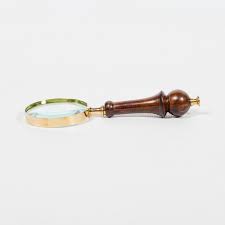
Image: Google Images. Small magnifying glass with an ornamental wooden handle

 literally stories
Matt
Very well done. In this universe of infinite possibilities (except in my hometown) it may well be if you can think it then it might be. Imagine a character like Hamlet “reading” you as you study him. Stuff like your work today helps to expand the imagination.
Leila
LikeLike
Clever! Nice work with the repetition and dawning realization.
LikeLike
Those are some hefty paragraphs containing a serious bundle of madness in them! I thought I was reading a game of Cluedo made real at first and then the religious references kicked in and then I wasn’t sure where I was – none of these things are bad things. I seriously enjoyed reading this.
LikeLike
The layout is all cocked up as they say in the classics. I’m working on it. 🙂
LikeLiked by 1 person
Think I’ve knocked it back into shape now. If anyone sees a weird version please let me know. dd
LikeLike
Is cocked up and cockup primarily British?
LikeLike
Aha! That makes sense – I kind of liked the accidental/avant garde paragraphing, but yes, an easier, and still very enjoyable read now sorted out!
LikeLike
Hi there Matt,
This was a bit of fun.
I think board-games are understated and need more exposure so hopefully your story will help.
I have poor co-ordination and due to that, all arcade games were a bust for me.
However, I can play a mean game of Backgammon!
I would love to play against the best but I know that I’d be humped. When all is said and done, you are good when you don’t make mistakes….But, it is still a dice game which is all about luck. Luck has never deserted me, it was never with me in the fucking first place!!!
Hugh
LikeLike
Finally an explanation why I claim to be a mathematician but don’t know much math. The games people play and are played.
LikeLiked by 1 person
In most instances, of course, “hate” as a sentiment isn’t as starkly conveyed as in the Charleston murders. But “hate violence” has become a catch-all label for acts impelled or accompanied by prejudice, bias or bigotry.
LikeLike
What a lovely romp! Thank you.
LikeLiked by 1 person