
I was surveying the sandy beach laid out before me from a vantage point on the clifftop. I’d been hiking for hours, days on end, along the coastal path. It was late in the century. Herring gulls and fulmars rode the thermals of the summer’s day and I was thinking about the latest spiders.
The creepy beasts have a long and honourable history, beginning in the depths of ancient time. But it was millennia before we were able to unleash their true potential.
I know what you’re thinking: tarantulas. Big, hairy and mean. Well – big in the insect world. Thank goodness we managed to put an end to that line. I dread to think what would happen if they found a way back, bigger, bolder and badder. You can see them in the old horror B-movies if you really have to: inspirational, but not in a good way. The stuff that nightmares are made on. One suspects that that Edgar Allan Poe had something to say about the creatures, dwelling among a romantic theatre of spooky dark glowing menace and terror. Do ravens eat spiders? I’m sure cats do, bite by bite, bit by bit.
Events were unfolding on the beach in the southern reaches of Wales that day, as I watched. I was privileged to witness a gathering of some of the most modern creations. I believe what I saw, though hesitating to approach too close, was rehearsal drills for the famous Day of the Flame. I remember that the reckless but well-organised goings-on made me think of army, navy and air-force manoeuvres readying for combat, those bad old days. We shall fight on the beaches. Small airplanes zoomed overhead like raging roaring bees; people in uniforms clambered in and out of small seacraft in the shallows, splashing and cursing. Give me a Lucifer to light my fag.
Assemblies of spiders are unusual, to be sure, the olden creatures in their natural habitats were solitary beasts, soloists, singletons, introverts, schemers. Have you seen in the preserved records even two of them together lying in wait at the centre of one of those clever little delicate weave-works they make, lit by a ray of sunlight through the mist? Of course not, but the new evolution has its ways.
It’s all too easy to become enmeshed in technical intricacies and engineering jargon discussing the origins of these fine beasts, which is lovely and we shall, but what we also need, as we’ll see, is a vocabulary of beauty, locomotion, silk and fire.
The beach spread out below me was a smooth plane where the tide retreated far out, allowing recreation of all sorts to take place. It was, perhaps, the sands and dunes of the bay of Freshwater, south from the ruins of the centuries-old castle of Pembroke, in the old reckoning – if I have my coordinates correct. The wide expanse of sand was marked out in a pattern of geometric shapes drawn by the thinnest of lines. As I watched, a gliding scriber, reflecting the sunlight off its gleaming shell like an overgrown silver beetle, titanium-coated, buzzed faintly as it inscribed circles and squares into the surface, dipping its drawing-rod in and out as it tracked along guided by onboard electronics and watched no doubt by an operator in a faraway place, if distance makes sense. Expectancy hung in the air.
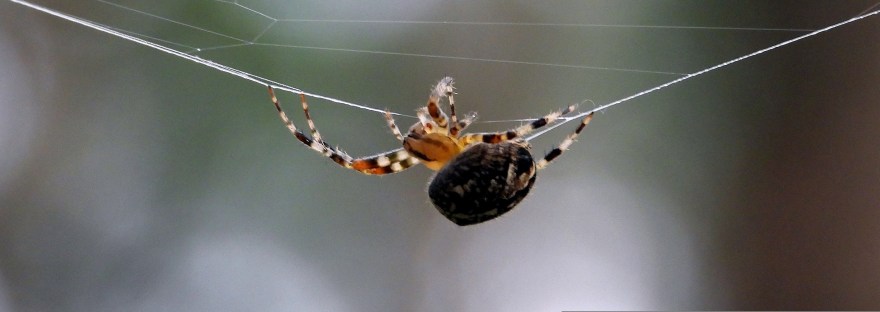
These fine creatures specialise in sprawled-posture locomotion. They don’t just scuttle about at random though, there’s a plan, a blueprint. The phrase keeping a low profile was invented for them. You’re in for a surprise if you observe one of the old models closely, their remarkable repertoire: running and climbing, swimming, diving, abseiling (up, as well as down – don’t try that at home, kids!), rolling, gliding, and flying through the air with the greatest of ease! Who knew? But what they specialise in is walking, a more difficult art than most people imagine: the way they move is a marvel. They perfected the art of walking in ancient times, legs stepping back and forth, forth and back, two forelegs left-right-left-right, alternately, like we do; the next pair following suit, opposed to the first pair like tweezers pinching together and away by the body-shell; then the next pairs of delicate crooked limbs do the same, even the less evolved ones. Our best human-like brains have studied the alternating shift-gait and observed closely the hydraulic limb extension of their octopodal locomotor apparatus as closely as bionically possible.
The buzzing line-marker was continuing its labours down below. Waves spilled onto the shore. The tide was far out.
If you go way back, you’ll find the medieval terms for some of the early species: poison-head, dew-spinner, phalangio; and you might well imagine others: hang-weaver, scuttle-away, trapeze-monk, octo-sprite, spell-binder. Those old humans then lived closer to the land and forest and knew what they were talking about, they had the knowledge, the feeling. Now we’re working backward, replicating, emulating, re-inventing, back to basics, back to nature, in a new way.
Spiders’ silk-spinning choreography is written in the annals of time. A beautiful thing. It wasn’t only the famous moth that had a clever way with silken threads, finespun, graceful, shimmering. Arachne, a shepherd’s daughter, according to Ovid in his Metamorphoses, challenged a goddess to a weaving contest. In those mythic times some mortal women wove extraordinary creations, and Arachne crafted the most perfect piece of silken tapestry you’ve ever seen. Its design though mocked the great god Zeus even if it shone like the sun, bright with rainbow glows. Loyal Minerva, goddess of knowledge and handicrafts, but also – why on earth? – warfare, could not match it. Outraged, she attacked poor Arachne, who, so chastened, hanged herself! By what kind of rope or rein is not recorded. A crying shame, and, yes, her soul was transformed into the spider bearing her name: Arachne the weaver. Karma or travesty? I’m not sure.
I know it won’t have escaped your notice that The Metamorphosis is the name of a very famous German-Czech short story from a century or two ago, which some people have actually read, in which a human wakes up in bed finding himself transformed into an insect. Not necessarily a spider, but, certainly, an arthropod of some sort. A startling awakening if ever was, and fuel for many a nightmare. Some stories don’t go away. Six legs or eight, it doesn’t matter. Coincidence? Hardly – one wonders, doesn’t one, whether the author was an avid student of the poetic works of the great Roman poet. It seems likely. After all, he had gained a classical education at the gymnasium in old Prague.
The silver beetle was still plying its way in the wide expanse of sand down below. The sun was high. I remembered hearing about the Day of the Flame but had never seen a broadcast of it. Rumours were rife and growing, woods and towns were abuzz. It happened rarely – when was the last one? – and I was apprehensive. There was a date to be announced. A venue. It had to be soon – just look at the rehearsal.
Some people have a thing about spiders, phobias even. Beat students among us will recall some of Mr Kerouac’s zany passages like in On the Road: ‘the only people for me are…the ones who never yawn or say a commonplace thing but burn, burn, burn like fabulous roman candles exploding like spiders across the stars…’; and in Big Sur… ‘that feeling when you wake up with the delirium tremens with the fear of eerie death dripping from your ears like those special heavy cobwebs spiders weave in the hot countries…’. We know the feeling, do we not? So old Jack had a thing about the beasts and he was one of the wild ones; he knew something about fires and burning.
As I watched the proceedings down below, my thoughts turned to more matters of engineering and art. Arthropods aren’t the easiest of creatures to design and build. The intricacy needed is astounding, the bio-coding, the synapses, the articulation of skeletal materials. Legs. Elbows. Knees. Apprenticeship is long and arduous, even in these sophisticated times. No shortcuts. Forebears made studies and more studies, buried now in the Memory Banks if you care to look: the mechanisms for attachment to vertical surfaces dependent on fluid adhesive; oh their beautiful clever scurrying: large variation in the distribution of foot-ground contact employing microelectronic force-sensing technology. Inspiration came too from creative artistes with their own spider-consciousness: a Louise Bourgeois from back beyond the day sculpted giant mother-ship spider forms. A big job of hers appeared in Spain and Canada, legwork described panachely: each corrugated limb ends in a sharp edge joined to a collar above which an erratically textured swirling body emerges. Goodness. A looming blackness rearing over your head. The biomatic engineers studied it all, tested models in the labs, and set to work.
The air of expectancy was blooming down below.
You’d be surprised at the size spiders can reach when fully augmented. You might have seen prototypes, but that can’t do them justice. Some species evolve from large to smaller – dinosaurs into fluttering feathery birds for example, but with spiders it’s the other way round. Today’s spiders, like other arachnids, sport a beautifully engineered exoskeleton, not unlike the principle of the external pipework that so surprised visitors to Paris who’d come across the Centre Pompidou, though our advanced models are much more refined and artful. You know what I mean: architects. So the breath-taking arachnids of today are designed with flexible, beautifully articulated limbs. The height of some I myself have seen can put a two-storey house to shame. It would be a brave person who took one as a pet, even with the advanced control systems available now. Even so, they can tread softly as a whisper. A group of them marching stealthily over the undulating chalk downs of Wiltshire or Sussex would be something to behold!
The latest niche lines, as you might read in Arachnids Today, are becoming known for their fire-throwing adaptations. Old Jack would understand. Not unexpected, in hindsight: Japan’s Jorogumo, the Joro spider, as my friend was recounting as we walked along Jamaica Street in the drizzle the other week, was a spider-woman leading fire-breathing playmates in all kinds of naughty, frivolous, deviant and sometimes dangerous games. Japan is such a source of valuable miraculous inventions and strangely foresightful folklore, isn’t it? The engineering for self-igniting flame-throwers isn’t as straightforward as it might be, but look: firework displays, rocket fuel, paraffin wax, internal combustion, flint and steel, the guys know what they’re doing, right?
Below me, larger than life, startling the onlooker, animals began emerging in single file from an inland nook, strutting, stepping beautifully, daintily, purposeful, slowly assembling, silent, orderly, respecting the geometry in the sand, obedient to an invisible law. They moved sedately, legs synchronised, forward, stop, forward, lilting, high as double-deckers, each knowing its eventual position, unerring, spreading out like branches from a tree-trunk, reaching their allotted spot, coming to an elegant halt, eight legs symmetrically arrayed, knees and elbows bent, heads raised expectantly, eyes dark, as they stood to attention. Each shape inscribed in the sand held its own single giant arachnoid, arrayed in a pattern like the starting grid of a giant board game.
Waves sipped the shoreline, for a moment the only audible sound. The air felt electric, the beach a forest of spindly limbs and dark canopies.
As I watched, whisps of steam began to puff out from the flanks of the insects’ bodies and from scalloped vents in their legs, like smoke from medieval furnaces or a great-great-grandfather’s tobacco pipe, one by one, in turn, a sharp hiss accompanying every spurt of hot wet air. The hissings grew, swelling like an orchestra of percussion, syncopating across the beach, repeating, rippling, rhythmic, musical.
The air was turning a cloudy orange. I sensed heat floating up to the cliff-top. The drifting birds lifted themselves higher. Speckled, flickering, tiny tongues of flame began to lick out of the calibrated apertures in the spiders’ crooked frames. Then a low thudding drumming music began, as if someone flicked a switch. It grew until the ground shook with the thunder of it. The spiders began to sway in their places, lifting a foot here, a foot there, each one, all of them, kinematic, turning, swivelling, gyrating. There must have been forty of them.
At an invisible signal, violent hot red searing bursts of fire exploded out from the insects’ steaming jets, arcing high up into the sky, painting it red, orange, yellow, the music pounding louder, beating, pulsating, volume turned high, off the scale, deafening; flames leapt up, over and over, higher and higher, red heat shocking the air with every whooshing blast, you could feel it, crowds on the clifftop were gawping, and some crazed souls filtered out over the beach, daring to dart through the forest of spinning spindly cavorting legs, dwarfed by the fire-breathing giants.
The spiders were dancing.
It was time to go. I powered up my neuromuscular motor-set, turned and continued my journey.
The Day of the Flame was approaching. I’d heard there’d be big surprises. I needed to be there.


