
I hadn’t been back to Dad’s since they started the demolitions. Slum clearance of Victorian streets stretching down to the south bank of the Tyne. Had they been in nice areas of Newcastle the red brick houses would have been smartened up instead of knocked down, but not in my father’s rundown part of Gateshead.
I pick my way over beds of rubble, rosebay willowherb swaying where lives were once lived. They created a wasteland and called it peace, Dad said.
His neighbours left long before he did, their front doors sealed with corrugated steel, GAS OFF spray painted across in bright blue. For a while, he was the last person left here. They interviewed him on the local news, when a reporter went door knocking to find residents holding out against the council. I thought he came across well, quoting Tacitus in a street condemned as a slum, with his parakeet on one shoulder and his cockatiel on the other. “They’ll take me out of here longways,” he told the reporter, after the wasteland line.
At the start, Dad’s neighbours ran a campaign against the Pathfinder scheme, even though it was meant to benefit them, with promises of new flats along the river. Only a handful were ever built. One neighbour ran for election on a stop-the-demolitions manifesto but never got anywhere.
Then, everyone else gave up, took the money and went, all except Dad. It was inertia as much as belligerence. He wasn’t seriously one to take on authority, but always preferred to wait rather than act.
“Do nowt and things work out,” he always told me. He called it a theory, as if he was imparting hard-won wisdom, but it was just his nature. He wasn’t hurting anyone, holed up there in that isolated flat, the one good tooth surrounded by the rotten.
I round the corner of his street, Dunsmuir Grove. They still haven’t swung the wrecking ball here. The brick townhouses are a design known as Tyneside flats: one upstairs, one downstairs, each with its own front door and long back yard. “The privacy of the landed gentry, but for the working classes, these flats,” Dad said once, stretching back on his deckchair in his sunny yard, shaded by one of his date palms. My father’s house was his castle.
I walk up the hill to number 181, remembering the bright yellow rose that always flowered in Dad’s front garden in June.
Glancing at my phone, a reminder pops up. Father’s Day. I hadn’t realised.
I’m delighted to find the rose in full bloom, huge heavy flowers obscuring Dad’s front door, sealed off now like the others. I lift back the rose. The spray paint is different from next door. Same bright blue, but one word, not two: DAD.
Filled with curiosity, I nudge the corrugated steel with my shoulder. The door swings open.
Something inside me quickening, I step over his threshold and start to climb the stairs.
“Dad?” I call, unable to break the habit. “Where are you?”
As I near the top, I step over spiralling tendrils and push past long, green fronds, spilling from the front room onto the landing. His plants have taken over. Dad would finish a plum or a date and if he didn’t give the stone to his parrots, he’d plunge it into a yogurt tub of compost, find the perfect spot, and get a new plant growing within days. He inherited his green fingers from his grandfather Ralph, head gardener at a country estate. Ralph nicknamed his beloved grandson Pip, and the apple fell close to the tree.
I peel back a giant date leaf and step into the dining room. There’s the wall that he turned into a floor-to-ceiling notice board, with clippings of his favourite musicians and news stories that touched him. Mandela, the miners, the release of the Guildford Four: Gerry Conlon, fist raised in victory outside the Old Bailey, flanked by his sisters Bridie and Ann. Clippings that made me want to be a journalist.
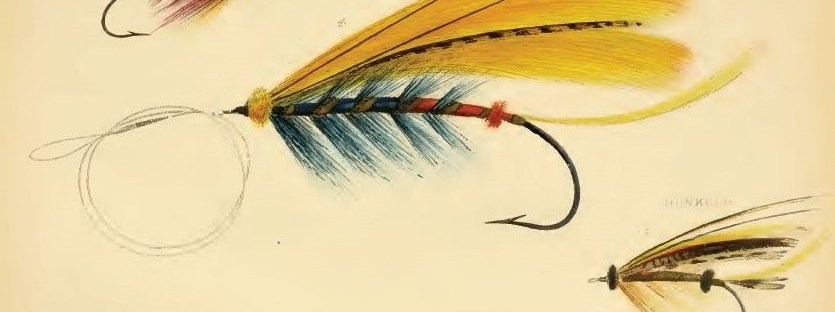
Clamped to the table is his vice, and in it a half-tied fishing fly. Bright yellow, a sunray shadow. When I was a little girl he used to let me help him tie flies, showing me how to bind delicate scraps of feather and fluff around a hook. A tiny hackle—like a miniature of his own dad’s Army cap feather—to lure the salmon, a bit of tinsel to make it flash, a dab of beeswax, and we wound it all tightly together. I doubt many fish went for the alarming creations of my childish fingers, but Dad didn’t mind.
Propped up on every chair: a copy of the Hexham Courant. Is Dad hiding behind one now, like the old days? I search for chunky fingers gripping broadsheet pages, dark green waders splayed out below. Riverbank or front room, he’d hide like that for hours.
Once when he hadn’t answered Granny after the third time of asking, she brought her walking stick down hard on top of his newspaper, cracking it like ice. As deft as any champion angler casting across a still pool, she hit her target. Dad gaped at his tormentor, eyes as wide as a hermit crab wrenched from its borrowed shell.
I turn to the wall behind me, pinned with cards, letters and gift tags from Christmases and birthdays. I peer closer. I realise they’re not addressed to Dad. They’re from him. Hundreds of them, written in that familiar scrawl with the three big kisses. Everything he ever sent me and my brother Louis hangs here.
From the kitchen comes the hum of the oven and a delicious aroma. Baked salmon. Dad will have filleted the fish himself after catching it on a rod he made by hand and painted with my middle name.
In the corner of the room, his tiny television crackles on. The Black Cat. He played it every Christmas, a horror about a mad architect who built a Bauhaus-style haunted house. I picture my brother, not in his office at the Film Studies Department, but as he was then, a chubby, sincere lad squeezed beside me on the settee, reciting lines by heart to impress Dad. Tears fill my eyes at the memory of those vanished holidays.
I jump, startled, as a cockatiel shrieks from the top of the date plant. Her wings brush my cheeks and her claws scrape my scalp. She sweeps me out of the room and we fly together up the stairs. Dad’s books line the walls, spines leaping out: the Romantics, the Russians, the Modernists. The poems and stories he loved, that inspired me to write my own books, the ones I wanted him to love.
“Where is he?” I ask his cockatiel. But Dad never imposed on his parrots by teaching them English. In the kingdom of mammals and birds this fisherman was ever the polite tourist, imitating their squeaks and trills. Now, just as when Dad and his parrots were in high spirits, the flat is filled with birdsong.
The cockatiel lets go and with a painful thud I crash down onto the second floor landing, walls sloping in on me. The birdsong fades away. Both doors here are closed. I push one open but jump back.
The carpet is strewn with broken china, the mugs Dad smashed when he lost his rag. I hear a shout. At the back of the room, a man in waders pounds a riverbank with his fists. His catch has got away. A little girl hides behind a rock nearby, because it’s her fault that he lost the fish. She looks about five years old. She’s so hungry that I feel it in my own stomach. But then she should have eaten before she came. A fire sizzles in the grate, two 1-litre cartons of fruit juice in the flames. The juice had added sugar and the girl’s mother should have known better than to buy it, but she wastes money bloody spoiling her, doesn’t she?
The man in waders sees me and lunges, with a grunt. I duck out of the door just as he kicks it shut with his heavy sole.
Heart racing, I push through the other door. It’s flooded with sunlight, four more little girls here, playing happily with two fancy rats. A table is laid for them with soft-boiled eggs and soldiers cut from homemade bread, while beyond, frogs leap into a pond thick with spawn. I know who laid the table and baked the bread. It was Dad, when he became a doting grandfather to my nieces. Once the stress of providing for a family was over, he mellowed, just like his father before him.
A smiling old man sits in the corner of this room, not Dad but the same nose. About seventy, he wears a soft trilby and holds a rabbit’s foot, the kind gardeners used once to pollinate flowers under glass. He doffs his hat. I’d know him anywhere, from the old photos at Granny’s. It’s Dad’s grandfather Ralph, the one who called him Pip.
I close the door gently, so as not to disturb them. I turn to the other door. I want to lift that girl from behind the rock, let her play with the others. But the room is empty. Dusty floorboards, stripped walls. Another man marches forward, yellow hackles up on his Army cap, a tattoo of Britannia and lion on his forearm. He’s angry, and he’s aiming a rifle and bayonet right at me.
“Where’s your father? Stealing his mother’s currants again, I bet. Stuffs his face behind our backs, that lad.”
Behind my granddad looms his own father. A miner with helmet and lamp, blackened face and hands. Dad’s other grandfather. He’s in an even more foul mood than his son. He kicks the soldier in the backside, sending him lurching forward, bayonet blade flashing. I slam the door on that inheritance.
Music drifts from downstairs. Shostakovich’s 5th. Dad’s favourite.
“Dad? Dad, are you there?” I call, pounding down the stairs two at a time.
But the first floor is an empty shell. I run from room to room but his plants, books and clippings are gone. Wires hang from smashed plasterboard, and through a broken window, a demolition truck beeps, louder and louder. There’s a crunch and a metal claw rips through Dad’s kitchen wall. The room gapes open, exposing the rubble of the street behind.
The claw swings towards me and I stumble backwards, crashing down the stairs to the front door. Dazed and aching, I push the door open.
There’s just time to rip off one stem, heavy with roses, before I run from the trucks.
My father’s house, my father’s house. The words match the rhythm of my feet, racing back to town, to Central Station, onto my train south. The priest said it at his funeral service: My father’s house has many rooms.
When I get back to my flat, it’s far too quiet. I switch on Radio Three. Shostakovich’s 5th.
In the front room, something catches the light, a glint in the corner of my eye. I bend to the carpet. It’s a fishing fly, a bright yellow sunray shadow. The one that got away.
I catch a ghost of Dad’s scent in the air, not the expensive aftershave I bought him after I got my first job in London, the stuff he never wore. But of beeswax and newspaper clippings and his old waders, and a good smell, simply of him.
Hooking the fly onto my lapel, I whisper: “Happy Father’s Day.”
I reach into my pocket. Something digs into my finger, the thorn of a rose. I go to the kitchen to look for a tub and compost.
Where did you go, Dad?
The answer comes back, like the rush of a gathering shower lifting the leaves above a riverbank.
I’m here, pet. I’m in the other room.
Image: A drawing of a fly for salmon fishing. Edward Fitzgibbon (1850), Public domain, via Wikimedia Commons


Hi Hannah,
I see that you tied in the title.
This is a reminiscing piece. I really did get a sense of her father and her kin. The descriptions were clear and jumped from the page. The demolition of communities continues to go on!
We’ve seen this type before but to me, this is that wee bit special due to your writing.
This has a lot of charm!!
All the very best.
Hugh
LikeLike