
Woke up to frosted window panes and frozen pipes. Marta and I made do with the gas stove, lighting it old school with matches against the hissing invisible stream. Water supply was low, but would last us a few days. The driveway had vanished beneath the white, with only the stitch of barbed wire fence to mark road from field. While I was attaching the snowplow blade to the truck, Marta called out from the house that Pam, our neighbor, wasn’t answering her phone.
“It’s not yet six,” I called back. “Give them a minute.”
“Go check on them, won’t you? Don’t make it look like a favor. Fetch back a cup of flour.”
“Yes, milady.”
Pam had recently inherited the land when her great uncle Bard, a long-time porch fixture at our place, recently succumbed to stomach cancer. Not how I’d choose to go. I remember Pam from thirty years ago, pigtails and strawberry jam smeared around her mouth, squirming in a stool while her now-deceased aunt extracted a tick from her scalp. Now she was a doctor of some sort, married, and about as beautiful as a woman has any right to be. She and her husband Len decided to make a go of farming.
In no hurry to intrude on their morning, I fed the animals, plowed our drive and a good stretch of the road, then did theirs. Len didn’t have a blade. Still shopping around, he told me when last we spoke. Except for the work of my truck, everywhere you looked was sugared land, gorgeous beneath the creeping red sun. When I killed the engine and headed up the porch, I paused to listen.
Faint booms, rumbles. Coming from town.
I continued to climb the porch and knocked. Circled round to the kitchen when no answer came. The house was dark, quiet. A bluejay hopped nervously in the snow.
It was when I went around the far edge of the house that I noticed the footprints in the snow. They came out of the woods, sloped down the hill, and led right to the door to their mudroom.
Coming.
Not going.
I climbed down to the snowy yard, walking quiet now, my heart ratcheting up, ears pricked for activity. I unsheathed my hunting knife and paused at the dark entrance. The door had been forced, the wood frame split and slivered around the lock. Inside I saw wet stains colored by the gold dawn light on the mudroom floor. There was a comforting smell of leather and sandalwood.
I called out for Len and Pam at half volume, my heart rebelling against making any noise. Didn’t matter much. Satan himself would have heard the blade scraping against the drive. I slipped out of my boots and padded into the little kitchen. Faded yellow wallpaper curling at the edges. Aged, clean. Someone had left bread, cheese, and cold cuts on the countertop and two bottles of beer, with just a swig left in one. I smelled the lip of one of the bottles, and my nose wrinkled, though it didn’t smell off—not exactly.
My breath fogged in the cold. Winter had preceded me into the house.
When I reached the front hall, I noticed boot prints coming around through the living room, passing over the oak floor and staining the rug, heading towards the kitchen, but vanishing after that.
I listened.
The silence felt heavy.
Up the stairs I crept, pausing to listen every few steps. On the landing I found Len. He was cold, the carpet stained red. His big corpse was dressed in flannel pajamas, a shotgun gripped tight in his hands. He’d fallen face-first, smashing his nose and glasses.
I knew the house, of course. Could see that bedroom door was shut. I pried Len’s fingers off the gun—also inherited from Bard—eyes never leaving that door, heart thundering in my ears.
It was loaded. Len hadn’t even gotten off a shot.
As I crept to the door, I heard a floorboard creak. I paused a long time in front of that door. God knows I did not want to open the door. The longer I waited, the more I didn’t want to but knew I wouldn’t have been able to look myself in the mirror if I didn’t. I twisted the knob and kicked.
There was Pam on the bed.
She was alone.
Still.
An image of the girl with the red-stained mouth and the tick in her scalp flashed in my mind, and I had to stifle a sound in my throat. I covered her modesty and face with the quilt, averting my eyes to the framed image of Christ hanging on the wall over the bed.
Bard’s, not the good doctor’s.
Christ seemed to wink at me.
No, it was the reflection on the glass: a shadow moving across the window. I swiveled and saw the soldier standing on the porch roof, gun leveled at me, ready to fire through the glass. There was an explosion, the window shattering in two directions. The soldier called out, tumbling backward into the yard below.
I approached, knocked the remaining teeth of glass out of the frame with the barrel of the shotgun, and examined my work bleeding out in the snow. As I stood there among the swirling flakes, I could hear more bombs detonating in town. From up here I could see a line of military vehicles on the road. I looked down at my feet and noticed blood dribbling out onto the snowy roof.
When I reentered the room, I saw my reflection in the glass projected over Christ. I didn’t turn from the sight. Nor did I feel the hole in my chest blooming red over my tawny winter coat.
I stumbled down the stairs, making my way to the mudroom, to my boots, then I remembered the flour. A cup of flour. That was the point of all this, wasn’t it?
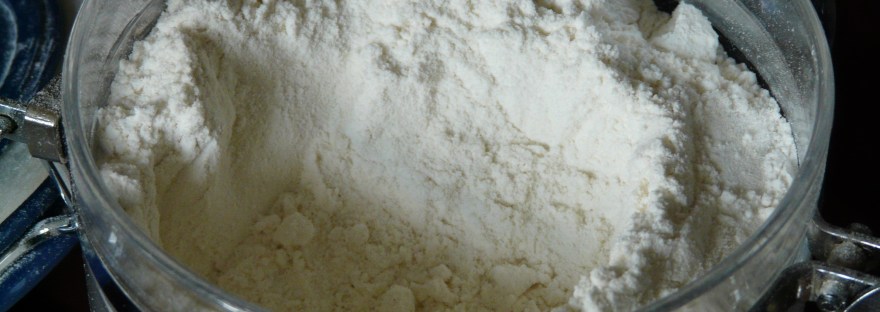
Image by Hans from Pixabay A container of white flour with a scoop taken out.


Nicely dystopic – the books from town hinted that something was deeply awry and the walk through the house adeptly ratcheted up the tension. An excellent piece!
LikeLiked by 1 person
Superb build up of tension. There is a lot untold in this which leaves the reader with plenty to chew on. Expertly written – thank you – dd
LikeLiked by 1 person
Tim
I’m onboard with Diane, the tension setting is first rate. And the simple title, something mundane, increases the irony ten fold. Well done!
Leila
LikeLike
Hi Tim,
This is all about where the reader wants to take from it. That shows an amazing skill and confidence from the writer!
This reads effortlessly. And that is a huge compliment.
All the very best my fine friend.
Hugh
LikeLike