
It all happened once upon a time about, oh, two and a half years from now. It was a warm summer morning, a Saturday it was, in the backyard of an ordinary house on an ordinary street in a most ordinary town, Sandusky, Ohio to be precise. But that’s all that was ordinary about it; the little girl certainly wasn’t. And as for the stranger… well, he was aptly named.
It was almost noon and little Gerta Marlowe, a cherub of seven years with rust-colored hair in pigtails and the rosiest cheeks east of the Central Time Zone, a child who’d already earned herself a well-deserved reputation as a born heller – pardon the expression – at the Sandusky School for the Seriously Maladjusted if not Sociopathic, was kneeling in her backyard engaged in a timeless pastime. With her right hand in one smooth, practiced motion she dropped a red ball, scooped up five metal stars, then caught the ball on the first bounce. Gerta was thrilled. She had never done fivesies before, at least not without cheating, and her little heart swelled with pride. She was about to run into the house to announce her achievement to her parents – who by the way would have been quite indifferent, engaged as they were in a timeless pastime of their own – when she noticed a stranger in her backyard, watching her.
He was a peculiar-looking fellow, especially for the greater Sandusky area. He stood six feet tall, give or take an inch, and was dressed all in black: a black top hat, black shirt and tie, black pants, black shoes, and a black satin cape with a silken lining the color of blood. His skin reminded Gerta of day-old snow, a slush-colored grey; and his eyes had a funny glow and seemed to change colors – first red, then orange, then yellow, then red again. On his forehead, like the stumps of something that used to be, were two pale green swellings he occasionally scratched. Leaning on a fashionable and obviously expensive shiny black cane with an ivory skull handle, he tipped his hat and smiled at the girl.
“Hello Gerta,” he said.
The child wasn’t startled to see a strange man in her backyard – her mother said the neighborhood wasn’t what it used to be – so she looked up at him, shielded her eyes from the sun with one pudgy little hand and said, “Ain’t ya hot in that cape?”
The stranger laughed. “I like to be warm,” he said. “I’m accustomed to lots of heat.”
As he spoke the sky darkened and in the distance she could hear the sound of thunder. At once Gerta concluded he either lived in Florida or an apartment with a wood fireplace.
“I can do fivesies,” she said.
“I know. I was watching you. I’ve been watching you for a long time.” His eyes danced and sparkled like someone on the verge of acquiring a long-desired, precious treasure, a bit like Madonna’s on her way to Tiffany’s. But his eyes weren’t the anatomical feature that caught the child’s attention.
She pointed to his forehead. “How’d ya get them bumps? Was you playin’ doctor too?”
With one hand the stranger covered the two green knots protruding from his otherwise unblemished forehead and when he took his hand away, the “bumps” had disappeared.
“What was your question?” he said with the same smug, self-satisfied smile of every magician who’s ever walked the earth.
“Not bad,” said the freckle-faced fawn. “Seven on a one to ten.” She rubbed her little backside with both hands. “Too bad old Fred didn’t know that trick.”
“Ah, Fred. Your little brother. You hit him with a baseball bat as I recall.” He was smiling broadly now. “Nearly fractured his skull. Yes, that’s when I first took note of you.”
“That trick could’a saved me some grief.”
“But Fred had it coming, didn’t he?”
Gerta nodded, the victim of a cruel injustice. “All’s I wanted was to play doctor. Do a operation, if ya catch my drift. Once he started crying, I had to clobber him. Ya can’t operate on a crybaby.”
The stranger rubbed his hands. In glee perhaps? Or anticipation? And sparks flew in every direction.
“Gerta, have you ever wished you were the most beautiful girl in the world? Or the wealthiest? More money than you could ever count. Or both?”
The daughter of one of Sandusky’s most successful bookmakers, Gerta replied with her dad’s favorite expression. “You bet!” Then, because the stranger’s question had started her little wheels turning, she looked up, smiled ingratiatingly, and said, “Will you give me a dime?”
The stranger laughed. “I can give you anything. Anything in the world.”
Gerta laughed too. “Make it a quarter,” she said.
The stranger waved one hand in the air and a gleaming new quarter appeared in his fingers. He handed it to the child.
“Thanks,” she said, gracefully sliding the coin inside one of her exceptionally soiled ankle-high white socks. “How’s about another one?”
The stranger was momentarily nonplussed. “Aren’t you wondering how I did that without reaching into my pocket?”
“Nah,” said the child, throwing a rock, trying to wing the neighbor’s cat. “You palmed it.”
“Too much television,” the stranger muttered when the girl asked his name. Well, that’s not quite how she put it.
“Hey, what’s your handle, turkey?”
“I have many names,” he said with the grin of a game show host. “Different people call me different things. You may call me Mephistopheles.”
“Metta-stop-the-leaves? What kinda name is that?”
“F, F,” he said. “Didn’t you learn your ‘F’ sound?” He quickly regained his composure. “I’m a strange man with a strange name. Try again. And this time sound it out.”
“That ain’t so strange,” Gerta said. “Take my brother’s name – Fred. Now there’s a strange name. Hey Fred! That’s what my mom says. ‘Hey Fred!’ Fred. Now that’s a name for ya.”
Mephistopheles frowned.
“Could be worse,” the child continued. “That’s what my dad says when Ohio State beats the spread. ‘Could be worse, Gerta. The Browns could move to Texas.’ Bet ya never thought of that, did ya, Missed-a-stop? It could always be worse. Your mom could’a named you Fred.”
“Is-stoph, is-stoph,” he said. “Not a-stop.”
“Yeah, right.”
“Look, I didn’t come here to talk about names. I’m here for something else.”
Gerta smiled shrewdly and lowered her hands to her ankle. “You ain’t gettin’ that quarter back.”
The knots on the stranger’s head became visible again and he began to scratch them.
“You can keep the quarter. That’s not what I want.”
“I knew you wasn’t here to play jacks. Not with that cape on.”
“I’m here to make you happy,” he said.
“Oh brother, I should’a knowed. Look, Mess-a-sheep, we got Wikipedia, so we don’t need no ’cyclopedia.”
“Lees, lees,” he said. “Not sheep. And I’m not selling encyclopedias.”
“And we don’t need no vacuum cleaner or freezer full of meat or land in Arizona.”
“I’m not a salesman. I’m a trader. Think of me as a trader of things.”
“Like that Arnold Benedict?”
“No, more like the junkman. Do you know what a junkman is?”
Gerta shook her head and he grunted in frustration and mumbled to himself, “I’m gonna close this deal if it kills me. Which of course it can’t since I’m immortal.” He turned back to the child. “Now, where was I?”
“Here to make me happy.”
“Thank you. Now, I can give you anything. Anything in the whole – ”
“What’s the downside?”
“Will you let me finish? Please!” He took a deep breath. “Now, I can give you anything, make any wish come true. And in return I only want one little thing.”
“I ain’t gonna stand on my head!”
“I don’t want – ”
“Not for no crummy quarter I ain’t.”
“I don’t want you to stand on your head!”
“Take it easy, Flea-stopper. Just cut to the chase. No more beatin’ round the bush.”
The stranger seemed to be counting to ten. Then he said, “Look, why don’t you call me ‘Mister M’? And I’ll call you ‘Miss Marlowe.’ How’s that?”
The child clenched her tiny fists. “Make it Ms., Buster Brown, or I’ll hit ya where it hurts.”
“Very well, Ms. Marlowe. Well, as I was saying, all I want is something you won’t even notice is gone. You won’t miss it long as you live. In fact some people don’t even think they have one. You can’t see it or feel it or – ”
“Cut the pitch, will ya, Jack. Just gimme the goods.”
“I want your soul,” Mephistopheles said. “I want your soul very much.”
As her parents were devout atheists, Gerta had no idea what he was talking about. The only person she knew with soul was Gladys Knight. She shook her head in disbelief.
“You’re in the wrong part of town, Bozo.” She slammed both fists into a tuft of grass. “I knew it was too good to be true.”
“Not that kind of soul,” he said. “The devil. Hell. Everlasting life. Don’t you know about any of those things?”
“Sure,” said Gerta. “Like when some twenty-to-one shot beats the chalk in a photo and my dad loses his shirt. ‘Damn it to hell,’ he says. ‘It’s the work of the devil.’ Yeah, now I got ya.”
“Close enough,” Mephistopheles said. “Now, here are some of the things I can give you. Gold, diamonds, make you a movie star or a queen – ”
“Candy?” she interrupted.
“All you can eat.”
“M&Ms?”
“Yes.”
“Plain and peanut?”
“Yes, yes!”
A wise child, Gerta knew a good thing when she heard it. “Stop-the-leaves, old boy, ya got yerself a deal.”
Mephistopheles heaved a sigh of relief and a sheet of paper appeared in his hand.
“Here’s the contract,” he said. “Sign on the dotted line and I’ll grant your wish.”
Gerta slapped her little thighs and laughed out loud.
“What’d ya take me for, a bimbo? I sign nothin’ ’til I gets my wish.”
“But this is standard procedure. You sign, then I give you anything you want.”
“No way, Doctor J. First the wish, then I sign.”
Mephistopheles looked up, heavenward perhaps, and mumbled something about how he hadn’t wanted anyone this much since Job.
“All right, in your case I’ll make an exception. What is it you want?”
“That’s more like it,” said Gerta. “Now, leave me think. Candy’s bad for your teeth, ain’t it? Besides, Mom’ll just eat it all herself. And gold’s heavy. I’d have to lug it all the way downtown. Diamonds are hard to fence…”
Gerta was in a quandary. What to wish for? Movie stars live in California. Never mind the wildfires, with those housing prices she’d never get a mortgage. A queen? Her dad said some of them lived in closets and who’d wanna do that? Having never heard of Sigmund Freud, let alone read him, she knew nothing about dip-sticker envy and couldn’t wish for one of those.
“Can ya get rid of Fred?” she asked.
Mephistopheles nodded.
“Turn him into a toad?”
“If that’s what you want.”
“Yeah, but then who’d I have to beat up on?”
“Look, I’m bending the rules as is. If you’d just decide what you – ”
“Ain’t you something?” Gerta said. “I mean, ain’t you something. You come round here, trespassin’, walking on my grass, a reject from some Halloween party – but that’s okay, I don’t say nothin’. Then you breaks into this spiel – gonna give me this, give me that, all I gotta do is sign some paper. So I starts thinkin’, maybe old Fleabites ain’t so bad after all. The dude did give me a quarter. And now he’s gonna make me a movie star, stuff like that.
“I got my doubts, see. Plenty of ’em. But I figure, what’s to lose. So I starts thinking about what it is I want. But all you say is, ‘Step on it. Step on it.’ Well here’s what I think: five’ll get ya ten you escaped from some funny farm. Gonna turn Fred into a toad. Right! You must think I’m a dummy. Fred ain’t even home. He’s over Grandma’s. Tell ya what Mister Made-a-mess, if you’re so all-fired magical, prove it! Turn yourself into a toad. Then, maybe, if I feel like it, then we deal. Got it?”
The stranger was beside himself with rage. He stomped his foot, then tapped the ground three times with his cane. But little Gerta wasn’t watching. She didn’t expect anything to happen, so she’d turned back to her red ball and metal stars. And when she looked up the stranger was gone.
“Now where’d he get to?
Then she heard a croak – Er-rk – and looked down. Squatting next to Mephistopheles’ cane, in fact, holding it in his mouth, was a small, grey toad. She bent down for a closer look.
“You’re cute,” she said. “And look at you bitin’ that turkey’s stick.” She reached out to pet the creature. “But where’s old Messed-up?”
“Er-rk,” went the toad.
“Gimme that stick, little froggy. Maybe I can hock it.”
But when she reached for Mephistopheles’ cane the toad leaped up and bit her thumb.
Never one to panic in a crisis, Gerta smiled and calmly smacked the animal with the back of her hand, sending it flying across the yard.
“That’ll learn ya,” she said picking up the cane.
The toad sprang toward Gerta, or perhaps toward the cane in her hand, who can say? Unfortunately for the little creature though, Gerta saw it all the way. Somewhat like a hanging curve ball. She swung the cane like a baseball bat, blasting the toad right between the eyes and sending it flying over the fence and into the neighbor’s yard.
“Home run!” she shouted. “C’mere little froggy, let’s do it again.”
But when she chased him, the toad hopped away. Then Gerta saw a sheet of paper in the grass, Mephistopheles’ contract.
“That litterbug,” she said.
She picked up the paper and ran to the street where she spotted a large white truck marked Sandusky Department of Sanitation.
“This old stick must be worthless too,” she said. “Otherwise he’d a took it with him.”
So she heaved the contract and Mephistopheles’ cane into the back of the garbage truck where, with a loud, sustained whir, a huge metal arm slowly but steadily crushed them both along with a half-dozen bags of garbage, turning it all into a crunched-up, unrecognizable mess to be dumped at the local landfill. Since Gerta’s house was the last one on the street the truck picked up speed as it drove away. Curiously enough, though no one seemed to notice, a small grey toad frantically hopped down the middle of the street, as if chasing the truck of all things.
Meanwhile Gerta ran into the house to tell her father she could do fivesies. But he was talking to her mother, saying he’d decided to give up bookmaking and go into a legitimate line of work.
“Maybe open a hardware store,” he said.
And that wasn’t the only unusual thing taking place. At that moment in a remote part of Central America two armies on the verge of war threw down their guns and went home. In fact over the next few days many strange things happened. The Trumps all moved to Siberia taking Tucker, Sean and the My Pillow guy along with them, and, with the possible exception of Barron, were never heard from again. In Hollywood Liam Neeson agreed to a new film without a single fight scene or kidnapping. The owner of The New York Post turned the paper over to students at Columbia’s School of Journalism. The Dallas Cowboys never won another football game. Ever. J.D. Salinger’s estate released cartons of his unpublished short stories. (And none of them were about Seymour.) Stacey Abrams received the Presidential Medal of Freedom while Devin Nunes returned his, saying he deserved it as much as Spiro Agnew. Admitting they’d never win on his watch James Dolan sold the New York Knicks to a group led by Spike Lee. Dancing with the Stars and The Masked Singer were cancelled, ratings for FOX NEWS plunged and PBS soared. Mohammed bin Salman confessed to the murder of Jamal Khashoggi and turned himself in to the World Court. Admitting they were hacks, liars, or outright cuckoo, Maria Bartiromo, Kayne West, and Marjorie Taylor Greene retired into obscurity. In fact, by the end of the week there was no more war, no disease, no poverty or prejudice – the world became a wonderful place to live. One could almost say it became paradise. And except for an occasional outbreak of toad bites, it was.
Originally published in Fine Lines Literary Journal, Volume 30, Issue 2.
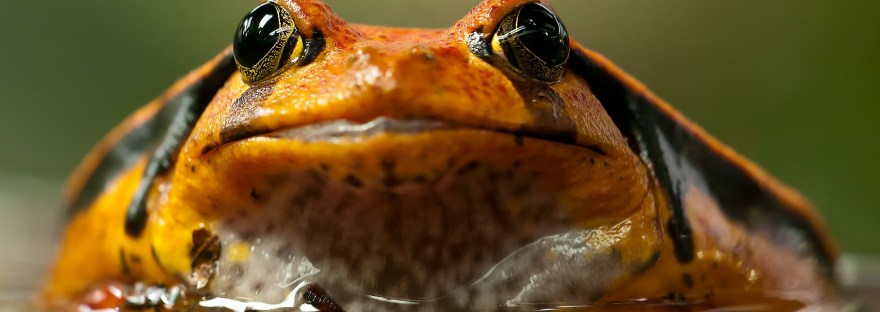
Image: A large, fat toad face on to the camera from Pixabay.com

 literally stories
Brilliant, the wonderfully precocious Gerta doing a number on Old Nick – fantastic pace and real fun to read. A great Friday story!
LikeLike
John
This fun story makes sense. Who says that the leaders of Hell and Heaven must stay the same. Here, turnover keeps evil fresh.
Leila
LikeLike
Humour stories have a bit of a mountain to climb with me but this was really entertaining and why not a happy ending to a story about Old Nick – I reckon it was time. This was fun – thank you – dd
LikeLike
thanks. all best. jd
LikeLike
Hi John,
The wee lassie was a lot more scary than Auld Nick!
Well thought out and very entertaining!!
All the best.
Hugh
LikeLike
Thanks Gwen. Much appreciated and deeply gratifying. jd
LikeLike
Great stuff, thank you.
ps. I can see why Salinger wouldn’t be writing any more Seymour stories, but the Franny and Zooey characters would surely also start to irritate after a while.
LikeLike
Reasonable people can differ. I could not finish Catcher in the Rye. I didn’t want another moment wit Caufield. Franny and Zooey are OK with me (relative to Holden certainly).
LikeLike
Agree. Best Mick. jd
LikeLike
I needed a laugh! Always good to see the tables turned on Nicky boy – nicely done.
LikeLike
Entertaining, well-paced and just right for a Friday.
LikeLike
John,
I loved the play with Metta-Stop-The-Leaves’ name and the way Gerta beat up the Devil-Head with her 7-year-old Gerta-ness.
But if The Dev is real, how about God? That’s another story.
“Gerta Turns the Father Almighty into a Frog” would definitely be worth waiting for! — gerry
LikeLike
Old Scratch has lead to a lot of good stories, including this one. I vaguely remember another Satan story LS ran, but it wasn’t as much fun as this one.
LikeLike
Forgot to mention that is one Helluva Frog! Festive.
Leila
LikeLike
Great story. Loved the details of the battle. Gerta’s play with language, and of course, her final victory.
LikeLike
I liked the part where J. D. Salinger’s unpublished stories were released, and none of them featured Seymour. Gerta turned from child to teenager in sophistication, within the course of her short conversation with the Devil, indeed, it seemed like Mephistopheles was stooping rather low trying to capture the soul of a child but as she was sociopathic, well…. I like that the end results were wistful and non-violent, esp. for Liam Neeson.
LikeLike
“You give him that dime, he take your soul.” This story had Mephistopheles giving the dime, literally.
Nice touch with the all black outfit. Had an ominous feel about it, almost chilling.
And when she swung his cane, Tom Gordon style, she reminded me of Trisha McFarland facing down the bear in Stephen King’s “The Girl Who Loved Tom Gordon.”
I loved that part!
LikeLike
thanks Steven. Much appreciated. jd
LikeLike