
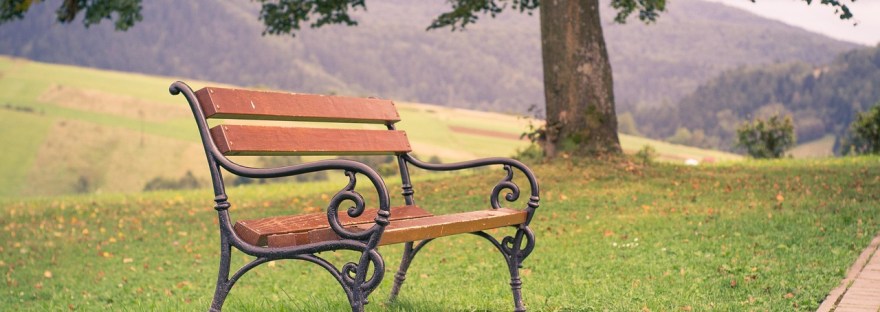
He sat on his usual bench at the top of the hill, a wooden seat framed by wrought iron, perfectly positioned under the spreading shade of an oak tree. From this vantage point, the extensive park rolled away in green waves, stretching toward the river winding lazily through a neighbourhood of opulent estates. Grand homes, hidden behind walls of clipped hedges, exuded an air of quiet affluence, while two nearby mansions stood conspicuously empty, their owners absent for years. He often marvelled at the indulgence of leaving such places untouched—silent monuments to wealth and those who had far more of it than they needed.
The park was quiet, its fields dormant in the midday stillness. A few dogs occasionally ambled past, led by their equally unhurried owners, but the space was mainly his to enjoy. Summer had thinned the usual crowd; the locals were undoubtedly escaping to even more luxurious retreats down the peninsula or overseas. The heat was bearable. It wasn’t too humid, and a light breeze stirred the earthy scent of sunlit grass. It was a scene he never tired of—a sanctuary where the world’s weight seemed to lift, if only for a while. It was his happy place.
His children often teased him about his habit. “Why this park? Why this bench?” they’d ask, bemused by his effort to reach it each week. He would shrug, offering a simple, “The peace, the view. You don’t get this anywhere else.”
But there was more to it than that, a truth he couldn’t quite articulate even to himself. The pull of this place wasn’t just about tranquillity or the way the river tied the landscape together in a harmonious flow. It was something more profound—a connection that felt oddly personal. At first, he had dismissed it as an accident of geography—the park’s closeness to his son’s school, just a stone’s throw away with its sprawling, palatial grounds. It was as if the park was a prelude, setting the scene for the grandeur of this private school’s manicured grounds and stately buildings.
But that wasn’t it. Sitting here, he felt closer to a life he had once dreamed of but never quite attained—a life that lingered beyond his grasp.
As a boy growing up under Singapore’s relentless sun, he had devoured tales of English boarding school life, especially the hilarious escapades of J.C.T. Jennings at Linbury Court. Those stories painted a realm of camaraderie and charm, of cricket matches and countryside mischief, that felt entirely removed from the concrete cityscape he knew. He had longed for that life and imagined himself among the storied halls and pristine lawns, but it remained out of reach.
Years later, in Melbourne, he watched his son stride confidently across his school grounds; the echoes of that boyhood dream resurfaced. It wasn’t Linbury Court, but in his son’s polished shoes, flawlessly tied tie and self-assured gait, he saw a faint reflection of what he had once longed for. It was a bittersweet and unexpected triumph, as though life had taken his dream and reshaped it in its own way. While he wasn’t the one to live it, he found comfort in knowing he had played a part in making his dream a reality through his son.
Over time, he had accepted that near-misses and unfulfilled goals defined his journey. He had worked hard and achieved much, yet never quite reached the heights he had envisioned.
His was not a story of failure—far from it—but of striving, of brushing against the edges of possibility without entirely breaking through. His friends called him tough and said he had grit, but he knew better. Grit was fear dressed up – plodding along the same worn-out path, even when the reward felt hollow and the work had lost its spark.
He was bitter at first, but with age came an increasing —though hesitant—sense of acceptance; the finishing line was within sight but out of reach. He almost made it. He carried his ‘almosts’ like old scars—part of him but not something he showed off.
As he stood to leave, he glanced back at the bench, his thoughts drifting. Unlike others in the park, this bench bore no plaque, no marker of someone’s memory. It was a detail he hadn’t noticed before, but it struck him now. Perhaps, he thought wryly, his children might one day reveal his scars and dedicate it to him:
“Dad, you made it … almost.”
He smiled at the thought, a lopsided grin that felt heavier than it should have. Then he walked off, his steps steady. The park’s tranquillity lingered in his mind like a familiar refrain.
Image: Park bench at the base of a tree with hills in the background by Maria from Pixabay

 literally stories
Hi Ameer,
This was stunning!
You managed to put across that feeling of want and ambition that we all have had but very few of us achieve.
‘His was not a story of failure—far from it—but of striving, of brushing against the edges of possibility without entirely breaking through.’
You have said something that we all lose in one way or another but can’t explain.
The biggest compliment I can give you is this reminds me of the best line in a song ever!!!
‘My Expectations may be high, I blame that on my youth.’
(Fergal Sharkey – ‘A Good Heart.’)
This is a story that we will all read and state – ‘That’s what’s been niggling me!!!!’
To resonate with so many – This is as good as I have read!!!
Hugh
LikeLiked by 2 people
Ameer
Gleaming proof that precise yet descriptive language expressing meaningful thoughts can make just sitting there worth reading. First rate.
Leila
LikeLiked by 1 person
Wonderfully written but you got me in the guts with the reveal of why he’s sitting there and the later his vicarious fantasies. So simple and romantic.
We’re all guilty of comparing ourselves to others, especially when it comes to property and imagining who lives in these massive houses and covering their lifestyle, which is almost certainly contains the same amount of unhappiness, boredom, stress, frustration as the rest of ours. Well I am at least.
This made me think of my own children a little, in that I hope they get the chance to chase their dreams or travel before they have to enter the workforce.
Excellent writing.
LikeLiked by 2 people
Wow, thanks for this. Wish I’d written it!
LikeLiked by 1 person
A gentle and poignant piece really bautifully written. The main character was wonderful and the whole thing helped to put in place our wishes and wants and how much so many of us have to be grateful for. A big story told in a few words. Super – Thank you – dd
LikeLike
A touching little piece that makes a nice point and does it beautifully.
LikeLiked by 1 person
A wonderful character sketch. I love the line “He carried his ‘almosts’ like old scars…” I guess most of us do. For most, hopefully, the cuts that left the scars weren’t too deep.
LikeLiked by 2 people
Ameer
When I reached a certain age, I found those benches everywhere. I know now why I avoid them so strenuously. I guess one day I’ll have to sit down and think. Thanks for the preview. Nice work! — Gerry
LikeLiked by 2 people
Is there anyone without “almosts”? Job not hired, the love that got away, the place we’d rather live, the one we should have treated better?
LikeLiked by 1 person
“Grit was fear dressed up – plodding along the same worn-out path . . . ” Those “silent monuments to wealth” & that “lopsided grin that felt heavier than it should.” Just three lines – out of so many – that make this story so powerful. Rarely has the word ‘almost’ been given such poignancy.
Geraint
LikeLiked by 1 person
It’s a very appropriate balance how the park bench, a ubiquitous, public and democratic piece of furniture can sit amongst private (in this case, unused) wealth and through that act as a deft and clever metaphor for a life not quite accomplished in the way hoped. All this done through careful and rich evocative description.
LikeLiked by 1 person