
Mussolini loved his monkey. Historians may argue over the details of this strange relationship, but the existence of the creature, and the very real bond between man and monkey, cannot be denied.
The beast was named Giuseppe, almost certainly after the great Giuseppe Maria Garibaldi, father of Italian unification. Admittedly, some sources scoff at this claim, pointing out that Giuseppe is a traditional name for organ grinder monkeys everywhere. This author, however, does not believe Benito Amilcare Andrea Mussolini would stoop so low as to name his beloved companion in such a common manner.
Setting aside the namesake of this remarkable monkey, let us turn instead to the historical evidence. Multiple contemporary accounts, painstakingly researched by later historians, confirm that in or around 1935, Mussolini, Il Duce himself, master of the Italian peninsula, came into possession of a small simian named Giuseppe. The monkey rode upon Mussolini’s shoulder for an entire decade, right up until the bloody end.
It is important to note Mussolini’s relationship with Giuseppe remained a tightly held secret. Only a very few persons outside the inner circle of the Grand Council of Fascism knew of the monkey’s existence. Giuseppe the monkey never appeared in public. The Italian people did not know the creature’s name. The reasons for this secrecy should be obvious to even the most casual of historically minded readers. No one could be allowed to make a monkey of the great Il Duce.
Benito Mussolini loved to address the populace. He delivered many speeches from his now-famous balcony above the Piazza Venezia in Rome. Italians thronged to the Piazza to hear Il Duce speak. According to reliable witnesses, not even one of these masterful orations included the presence of a monkey.
While it is an historical fact that the monkey never graced Mussolini’s presence in public, there did occur one near miss. On this occasion, little Giuseppe slipped Benito’s mind, but not his shoulder. Just before Mussolini and monkey stepped out onto the balcony and public view, an alert aides removed the creature. The displeased simian chattered its disapproval and tried to bite the hand that held him. Mussolini laughed at the aide’s frantic discomfort, then stepped through the open doorway and into a multitude of voices crying “Il Duce! Il Duce!”
But what of the creature itself?
The monkey Giuseppe was a Panamanian white-faced capuchin, a member of the species Cebus imitator and not a member of The Order of Friars Minor Capuchin. Capuchins are small New World monkeys. This is fortunate because Il Duce would have looked foolish with a brown-frocked friar sitting atop his shoulder.
We can blame 15th-century Portuguese explorers for the confusing name. When the Portuguese reached the Americas, they encountered small monkeys whose coloring resembled the brown robes and large hoods of Capuchin friars.
How Il Duce acquired his monkey is a matter of some controversy. To answer this thorny and still hotly debated question, one must look to The Second Italo-Ethiopian War. In 1935, Italy invaded Ethiopia. Historians remain divided about the reasons for the Italian attack on Ethiopia but not the results of the African conflict. Italy was victorious. The Ethiopian Emperor Haile Selassie fled to exile in the United Kingdom. The Italians took control of Ethiopia, Eritrea, and captured one confused Capuchin monkey.
Italian officers shared the creature’s confusion. How did a New World monkey from Panama become entangled in an Old-World war? The answer is that the little fellow was an interloper, a fugitive simian captured by an ill-fated Ethiopian expedition sent to the malarial swamps of Panama. How this expedition came to be, or what its aims were, is a mystery that has yet to be solved.
The few incomplete sources available to researchers suggest that the expedition ended in abject failure. The research vessel returned to Ethiopia bearing a crew stricken with malaria and, caged in the hold, one captive monkey.
As a newcomer to Africa, the little Capuchin would have been scorned by the native populace of Vervet, Blue, and Grivet monkeys. It is assumed that the native monkeys objected to the newcomer’s language, customs, and political beliefs.
Ironically perhaps, his salvation came at the hands of the invading Italian army. A field officer adopted the as-yet-unnamed monkey. Returning to his homeland, the enterprising officer felt the monkey might be a suitable token of tribute to Il Duce, much as the returning Caesars once drove captured foes through the street of Rome. The monkey was never paraded before an adoring public.
There are a few fringe historians, those researchers not deserving of the name, who suggest that the monkey might have been purchased from a Roman pet shop. This is a spurious claim at best and does not merit serious debate.
This author, for one, believes the Ethiopian source material to be the true story. Thus, in 1935, Benito Mussolini came to be the proud owner of a capuchin monkey he subsequently named Giuseppe. Let us close the debate there and move on to what is known of their time together.
It is an incontrovertible fact that Il Duce and Giuseppe soon became inseparable. Moreover, they seemed to share a common language. Il Duce would lean to his right shoulder and whisper in the monkey’s ear.
According to eyewitnesses, Giuseppe seemed to demonstrate a complete understanding of the Italian language. The monkey could not respond verbally, of course. In place of speaking, Giuseppe tapped out his answers in Morse code, rapping his tiny knuckles against Il Duce’s bald pate. In this manner, the two carried on long conversations.
One such scene is recorded in a contemporary diary kept by a member of the inner circle. In this account, the animal—monkey, not Mussolini—is described as perching beside Il Duce’s bullet head and hammering its responses home utilizing its simian knuckles. This is an amazing image to contemplate, and this author wishes he could have been present to witness the spectacle firsthand.
Some of these simian-to-human discussions may have had far-reaching consequences, not only for Italy but for the world. For example, Mussolini’s decision to side with Franco during the Spanish Civil War probably came from monkey memory. The little creature harbored a long-standing grudge against the Portuguese who uprooted him from his native land. One might conjecture that the monkey was confused as to the distinction between the Portuguese and the Spanish, an error many fall prey to still.
This is not to say that monkey and master were always in agreement. For example, Giuseppe warned Mussolini away from any alliance with Hitler and his Nazis. In this, the monkey may have been aping a prejudice inherent to the species. The Nazis had a perhaps deserved reputation for bad relations with simians across the globe.
But in this case, Il Duce would not be swayed. And thus, his first steps along the pathway that would lead to his grisly doom. History does not record if the monkey ever rapped ‘I told you so’ onto Il Duce’s naked scalp as the bloody denouement unfolded. Separated from events by almost eighty years, we can only speculate.
When viewed through the lens of history, the monkey’s warning proved prescient. By 1943, the Allied armies were firmly encamped on the island of Sicily and threatening the Italian Peninsula. King Victor Emanuele stripped Mussolini of all power. Following his meeting with the king, police arrested their now disgraced leader.
His captors imprisoned the former Il Duce at Campo Imperatore, an isolated resort in the frigid Abruzzo mountains. The monkey hated that icy plateau. Fortunately, for the monkey at least, their suffering was short-lived.
Three months later, German paratroopers and Waffen-SS commandos staged a daring mountaintop rescue. When the Nazi commandos spirited Mussolini away in a tiny airplane, one small monkey went along for the ride.
Mussolini and his monkey escaped their immediate doom, but the rescue only staved off the inevitable. The Italian army surrendered to the Allies. The Nazis created a puppet state in Northern Italy and Mussolini became their marionette.
The once proud and belligerent Il Duce survived 1944, but only just. The New Year did not bode well for the crumbling Axis.
The Allied army advanced and the puppet strings became a noose around Mussolini’s neck. His erstwhile German allies abandoned him to his fate and retreated to Austria. The organ ground to a halt. Giuseppe may have been only a monkey, but even he could read the writing on the wall. The Capuchin tapped a frantic message onto his master’s skull: Time to go, Boss.
In April of that fateful year, a Nazi convoy fled toward the Swiss border. Mussolini, his mistress, and the monkey threw in their lot with the retreating Germans. The attempted escape failed.
Mussolini wore a German uniform, but it did little to disguise the frowning face that had adorned propaganda posters for three decades. Communist partisans stopped the convoy near the village of Dongo. The partisans recognized Il Duce, if not the monkey.
Swift and summary judgment followed. The historical records remain crystal clear on what happened next, apart from one small omission.
The partisans transported Mussolini and his entourage to the small hamlet of Giulino di Mezzegra. The prisoners, including the once great Il Duce, were lined up against a low stone wall. A hail of machine-gun bullets cut them down. The bullet-ridden bodies lay in a bloody heap, but no eyewitness account makes any mention of a monkey among the dead.
Perhaps the partisans didn’t have the heart to kill the little creature. It may be that some kind-hearted communist adopted it as a mascot. We may never know the truth. What is almost certain is that Giuseppe witnessed the bloody event and got the message. He quickly switched sides, embracing the partisan cause and random shoulders.
There would be no immediate honors for the corpse of Il Duce. The partisan executioners piled the bodies into the back of a lorry. Mussolini and his once exalted Fascist cohort were stacked one atop the other like so many slaughtered cattle. The dead were then trucked to Milan and dumped on the cobblestones of the Piazzale Loreto.
The crowd retained no vestige of the ecstatic awe once heaped on their fallen leader. Instead, they heaped abuse, showing neither mercy nor restraint. The throng surged around bullet-riddled bodies, kicking, spitting, hurling taunts and insults. But this was only the beginning.
The bloody corpses were hoisted into the air and hung upside down from the canopy of a filling station. Civilians crowded below the macabre display, hurling stones and abuse. A woman pulled a pistol from her purse and pumped five shots into Mussolini’s upside-down body, one bullet for each of her executed sons.
Benito Mussolini’s fate was sealed, but the story of his monkey continued.
There is much conjecture over whether Giuseppe the monkey accompanied his dead master to that fateful plaza. We may never know with certainty. No witness claims to have seen a mournful monkey clambering about the canopy of that Esso station turned abattoir.
After that fateful and bloody day, the monkey’s trail goes cold. From this point on, the story of Mussolini’s monkey becomes a tale of guesswork and rumor. Yet there are some few clues and perhaps a faint trail that leads to the truth.
Mussolini’s battered corpse disappeared into an unmarked grave. Over the next year, there were a series of unsubstantiated sightings near the purported gravesite. Citizens spoke of a small creature haunting the unconsecrated ground. Without photographic evidence or reliable sources, this author is inclined to relegate these rumors to the realm of myth.
Whether or not the monkey mourned his master may be conjecture, but the fate of Il Duce’s corpse is well-documented. Fascist supporters dug up the body and made off with it. Italian authorities recovered the stolen corpse and kept it hidden for eleven years. Finally, in 1957, Mussolini’s remains were interred in the family crypt in his hometown of Predappio.
The strange voyage of Il Duce’s bones had come to an end. But what of Giuseppe the Capuchin? There are many lines of speculation ranging from the prosaic to the absurd. With diligent research, however, this author believes he has uncovered the most likely scenario.
Like most former Fascists, the monkey Giuseppe kept a low profile. It appears he made his way south to the Ligurian Sea. Reports place the monkey in Genoa, where it is said he was adopted by a kindly organ grinder of no political bent. The monkey earned his living cavorting for tourists, collecting coins in a tin cup, and wearing a battered black fez.
It is perhaps wishful thinking to believe that the monkey remained content with this humble lifestyle, but such seems to be the case. Local legend has it that Giuseppe met a female Capuchin, Esmerelda, a simian assistant to a competing organ grinder.
The two monkeys mated and sired a long line of Italian Capuchins. Many of their offspring continued the family tradition of show business. The most famous of these, a great-grandson of Giuseppe and Esmerelda, starred opposite Harrison Ford in a Hollywood Blockbuster.
Mussolini’s tomb has become a place of pilgrimage for Neo-fascists. Even to this day, followers of the dead Il Duce gather to commemorate the anniversaries of his birth and death. The dress code is rigorously black.
No one knows the final resting place of Mussolini’s monkey.
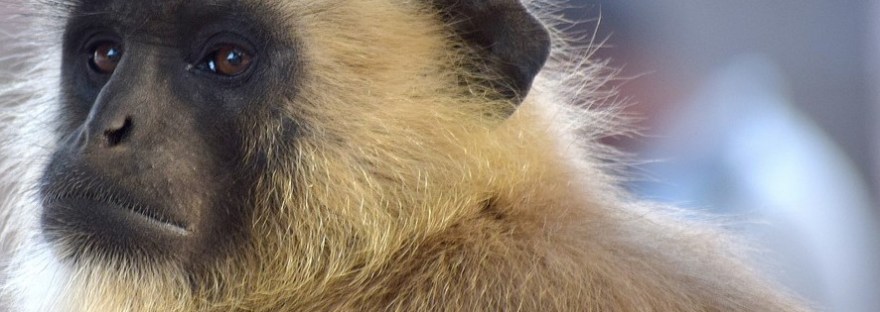
Image by Rajesh Balouria from Pixabay – the face of a rather disgruntled looking cappucine monkey.


I admit it, Marco, you ragamuffin: when I began the story I wasn’t sure whether to believe the tale or not. (Your tongue wasn’t so firmly in your check yet). So I naively Googled, “Did B. Mussolini really own a monkey?” The answer came back forthwith: “No, stupid!” He did, however, own a lion, as well as a cabinet of ministers comprised mostly of apes, but that’s another story.
The story was so effective because it contained well-known factual data: the daring escape from his mountain prison, the nature of his death, various dates.
Other “facts,” like the species of monkeys and so forth, I refused to lower myself to check out, having been been burned so badly before, so part of the question is still up in the air.
This story has all the good earmarks of a prank, but without costing anyone any money or the expense of a time-share or anything. It was ingenuous, Marco; good one. You rat!
One more thing: you don’t sell beachfront property in Florida, do you?
LikeLiked by 3 people
Thanks for the kind words (I think). I do not have any beachfront property at the moment, but could I interest you in a lightly-used bridge?
LikeLiked by 1 person
Beet – I wondered as you did. Some historical facts, some lies (monkey knowing Morse code – they don’t get beyond Esperanto or sign language), but how about the rest? Thanks for the research I’m to lazy for.
LikeLiked by 1 person
Marco
I am happy that the Monkey did not wind up upside down in the square.
You know this could open up a series. Hitler’s Hamster; Churchill’s Chinchilla; Gere’s Gerbil (yes the bad joke that never dies). It will be a franchise worth millions! Benito should have listened to Simian Pisano. Only dictators wind up upside down in the square.
Brilliant story!
Leila
LikeLiked by 3 people
Some might say that you shouldn’t turn fascism into a joke, to which I would respond that no turning is necessary! Given that Benito and his modern day equivalents (including he of the Orange Hue) hated and continue to hate being made fun of, pieces like this are to be welcomed – and it’s also wonderfully well-written! I loved the image of the monkey rapping out messages on M’s bald head!! Brilliant.
LikeLiked by 2 people
I’m a believer – Loch Ness Monster – The Yeti – Selkies – Hound of the Baskervilles and now – now Mussolini’s Monkey. I believe therefore it is. Canny little chap isn’t he – Thank you for this it is ingenious. Diane
LikeLiked by 2 people
You had me going for a little while! Very funny and beautifully written. A perspective on the downfall of Mussolini
LikeLiked by 4 people
I love this! Reminds me of some of the work by Andrey Kurkov (who I thoroughly recommend) in that it takes something quite quirky and amusing, but makes a serious point with it. This was a thoroughly engaging read and I so wish it were true!
LikeLiked by 2 people
Lovely! The tone is beautiful, the story imaginative. Thank you! 🙂
LikeLiked by 1 person
Lovely! Thanks for posting. 🙂
LikeLiked by 2 people
Marco,
Guiseppi’s story seems draped in a writing style adopted from a wry sort of over-explained facetiousness in a comedic tradition that the narrator, or ‘the author,’ never veers from.
I read on hoping, expecting at least, a faulter. Never!
Also, learning that Il Duce’s monkey was fabricated proved personally embarrassing, because I had convinced myself I remembered seeing old newsreels of Mussolini with the monkey on his shoulder @ public events like motorcades and balcony appearances.
Fooled me totally. Thanks! — Gerry
LikeLiked by 4 people
Really good. I have to admit that it seemed plausible until I read “Time to go, Boss.” Now that’s funny!
Nice job.
LikeLiked by 2 people
Marco
I was hugely impressed by this “realistic” allegory which came up with the perfect symbol to encapsulate all dictator/authoritarians and their primitive ways. Nothing against monkeys in the real world, but in this fiction the monkey seems to be a shadow self for the Great Fool, who has appeared in many ages and is rearing his ugly head in multiple places around the globe today. It makes a great contrast with other, super-rare leaders like George Washington who voluntarily give up power, placing other people before themselves. Wanna-be dictators always appeal to the lowest common denominator in the populace, the primitive ways of what Nietzsche called “the herd” mentality: not-thinking-for-yourself, and not feeling empathy. While I do not feel this way about real monkeys and gorillas, who I believe are on the whole much more sympathetic and intelligent than we give them credit for, in this satirical fiction the symbolic lesson was telling and superb: and an act of resistance. Thank you!
Dale
LikeLiked by 2 people
Just reading this brilliant satire caused my tongue to drift to my cheek. A brilliant blend of historical fact and fiction. I look forward to the sequel – Hitler’s hamster. Well done, Marco!
LikeLiked by 2 people
Adding the part about a monkey from Panama in Ethiopia screams “I dare you to believe this joke” and yet I still bought some of it.
Abyssinian later, Mr. Mirth
LikeLiked by 3 people
Absolutely great. So many humorous lines kept me smiling and reading. Difficult to make such well written joke out of Mussolini.
Loved it and the mix of pseudo history with comments about a Capuchin on Mussolini’s shoulder. And “the monkey tapped a frantic message onto his master’s skull: Time to go, Boss.“
So many great lines.
Great story.
LikeLiked by 2 people
Wonderful. Not just the morse-code monkey, but the piss-take of bombastic historical scholarship: ‘viewed through the lens of history’ Ha!
LikeLiked by 2 people
Thanks for all the great comments, Folks! You keep me going.
Marco
LikeLike
Thanks for all the kind comments, Folks! You keep me going.
Marco
LikeLike
Thanks for all the kind words, Folks! You keep me going.
Marco
LikeLiked by 1 person
Hi Marco,
I was at a cremation a few weeks back and the minister said something about Boaby that made me think of this. He said, ‘Boaby never let the truth get in the way of a good story.’
Brilliantly written and as already stated, the best satire is that that you think could have been!
All the very best my fine friend.
LikeLiked by 1 person
Very interesting historical details, told in the formal olde time style. The facts are all there, but I wonder, what did the monkey see in Mussolini and what did the dictator see in the monkey? They appeared to engage in very sophisticated communications, and it would seem that perhaps the morse code knowledge might be passed down to the creature’s kin. I know Hitler had a pet Alsatian, Blondi, who was euthanized in the bunker in Berlin, but I did not know of this intelligent, faithful, fascist capuchin. Thanks, Marco, for this little-known revelation.
LikeLiked by 1 person