
Translated from the Korean by Bruce and Ju-Chan Fulton
The particles of snow, barely visible at first, thickened as the day wore on.
The nuisance of having to leave the comfort of home was tempered by the childlike effervescence triggered in me by this the first snowfall of the season.
In sequence I locked the door to my bedroom, the entryway door, and finally the gate bordering on the alley, and as I dropped the jingling key ring in my bag I silently tsk-tsked: why do I need all these keys if I’m the only one living here? And then to erase my customary feelings of desolation I set out at a brisk pace, though nothing urgent awaited me.
We met that day at a Korean restaurant, a group of high-school classmates who gathered monthly to pool our savings and socialize over a meal. As the saying goes, when you get old, you value your friends more than the old man. It was a nasty day, but everyone showed up, covered with a dusting of snow. The topics of conversation among us old ladies were forever the same: the old man, spoken of in a manner that could be labeled somewhere between a complaint and a compliment; the sons and daughters we were so proud of; and sob stories about our fading eyesight and back pain. Directed at me would be admonitions such as, You ought to adopt a son; you’re not getting any younger. To which the others would chime in, practically foaming at the mouth:
What, let an adoptee suck up what her old man left her.
Well, that’s what our own kids do these days.
You need to hold on to that money, so if you get sick you can afford to go to the hospital.
Money is power, especially when you get old.
Useless words, all of it, leaving me bitter and lonely by the time the meeting ended.
Outside, the snow had turned to sleet. After long, boisterous goodbyes we went our separate ways. At the mouth of the alley a youth with a plastic bucket emerged from the restaurant’s kitchen and fixed his gaze on me.
“Uh, excuse me, are you…?”
I cocked my head, thinking he looked familiar, but no detail from the past came to mind. “And who might you be?”
“I’m Yunshik.”
Aha. One winter day my husband had come home late with a boy in tow. Snow was pouring down and he had found the boy shivering beneath a utility pole and decided we would put him up for the night. But after that one night I didn’t let him go; I felt I was meant to keep him. The previous year our middle-school son had drowned in the ocean and my husband was diagnosed with cirrhosis of the liver, and it occurred to me that by taking in this boy I could avoid such misfortunes, which I had always associated with others. I had figured his age at about twelve; Yunshik himself didn’t know for sure, said only that he had been at an orphanage as long as he could remember. He never really opened up to me, but I offered him kindness and affection as best I could. And when he disappeared without a trace less than a year later, it was inevitable, despite my sense of having been called to the task and earning good karma thereby, that I felt disappointed and betrayed. I tried to placate myself by thinking it’s in their blood for orphans to wander.
Here he was four or five years later, at the cusp of adulthood. He wasn’t that much taller, and the way he looked up at me left his brow wrinkled like that of someone much older. Those years must have been difficult and tiring.
He said he had been living outside the city, working at a pig farm. I didn’t have it in me to ask why he had left, or to offer solace for the difficulties he must have experienced.
“Can I offer you a ride? You’re still in the same place?” He opened the door to his truck and wiped down the seats with a rag. I gathered my skirt and clambered in on the passenger side.
The snow was melting and the roads were a mess. I looked in wonder at the hands on the steering wheel, the hands of a boy I used to call Son. I always felt uneasy in a taxi or on a bus, but strangely enough my mind was now at rest. He didn’t say much, and when we did manage snippets of conversation, he was careful to avoid calling me Mother. Thank god for that—to me it would have sounded like he was laughing at me or scorning me.
“Aren’t you cold?” he kept asking as he wiped the foggy windows with a gloved hand. “And you’ve aged.”
With a forlorn smile I nodded.
He removed his by now sodden glove, and my eyes came to rest on the huge scar on the back of his hand. He must have noticed, and he grinned. He’d been scalded by boiling water, and it was my fault. Every day I had applied ointment and changed the bandage—this was when my husband was still alive and before our daughter married and left home—and now I felt warmth gather inside as I thought of that time.
He pulled over near the alley to my place.
“Why don’t you drop by sometime?” I said.
He grinned in response.
“Or is there a way I can get hold of you?”
“The man who owns the farm just sold it—I have to move.”
I got out but couldn’t bring myself to head for home just then. Something was pulling at me–and the next moment rising inside me. My house, quiet like a tomb now that the sun had gone down, no one there awaiting me, the lonesome dining table—how much longer could I endure? I turned back, feeling I had to retrieve something. Yunshik was still there. He looked down as if he’d dropped something.
“If you have to leave the farm,” I said, approaching the truck and trying to make myself sound business-like, “and you don’t have a new place, why not come back here—your room is the same as it ever was….” I hadn’t planned it, felt only that I’d wanted for a long time to say this.
“Get back in, please. I’ll bet I can squeeze the truck down the alley.”
Hearing his cheerful voice, I climbed back in and we exchanged secretive grins like partners in crime.
Author: O Chŏnghǔi
Translators: Bruce and Ju-Chan Fulton
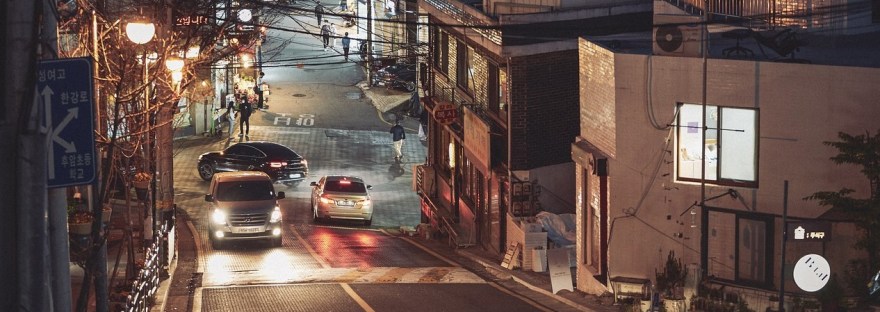
Image – Street Scene in Korea from Pixabay.com – Nightime scene of a street with cars and vans and houses with lights shining from inside.

 literally stories
Hello all involved!
This is a fine translation, an honest and lovely work. I fear my original comment was lost in translation, but that’s the way it goes.
Leila
LikeLike
A happy ending in a world with too few.
LikeLike
A lovely story. So much of her life filled in seamlessly. And as the previous commenter said, a hopeful ending that seemed genuine.
LikeLiked by 1 person
Hi folks,
Superb story, superb writing, superb translation.
So all good!!!
All the very best.
Hugh
LikeLike
Such a beautiful tale with so much sadness closed off with some happiness and warmth – this story is like a poetic walk through cold rain with a warm fire waiting for you at the end. Great stuff.
LikeLiked by 1 person
just read The Reunion for the second time. It is so wonderfully well observed. For example, when she climbs into the lad’s truck (after he’s wiped the seat) and she looks at his hands on the wheel, and despite the roads being a ‘mess,’ realises that she’s perfectly at peace, although she was always uneasy in taxis and buses. Brilliant.
LikeLiked by 1 person