
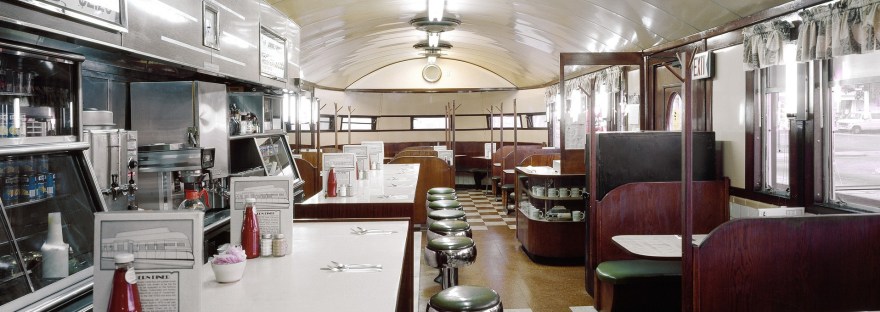
I think it was an I-Hop where I met him. For sure it was an all-night diner because it was three in the morning when I pulled off the highway and into a space beneath a neon sign. The diner crouched in its glow like a stepped-on creature, oozing incandescence. I left the Ford and went inside.
It was just him at the counter, a paper cup between his long, thin fingers, so I couldn’t help but look at him, and it was just me in the doorway, so I suppose he couldn’t help but look at me. My first impression was of spindliness and elongation, like he was all stretched-out somehow—not in a sick or unnatural way, just like God was in a spindly and elongated mood that day. If you could blow a man out of glass, dark glass from wine or soda bottles, that would be Johnny. And if you could put a light inside that glass, a lure like an anglerfish’s, that would also be Johnny. He was hairless except for his eyebrows, which waggled at the sight of me. I took a seat and ordered coffee and a slice of pecan pie.
“Coffee gives me the jitters,” said Johnny—not that I knew his name then. “Can’t do coffee.”
“What have you got there?”
He tipped his cup so I could see the water. He was dressed like a homeless professor who’d spent the last month hopping trains: Hawaiian shirt, dirty brown khakis, a brown plaid blazer, and a big brown camping backpack propped between his knees.
“How about another slice of pie,” I said when the waitress brought mine, “for my friend here.”
But Johnny waved me away. “No, thanks. Can’t do sugar. Sugar gives me the jitters.” He put his mouth low to his water and lapped it. “You know what I could use?” I waited. “You’re not heading north, are you?”
“I got drop-offs up past Charlotte.”
“That’s perfect,” he said. “My flight’s at seven-thirty.”
“How were you planning on getting there,” I wondered, “if I hadn’t come along?”
“Someone was bound to come along.”
I couldn’t get my head around his answer, so unbefitting for a grown man, trusting like not even a child could be trusting without getting knocked to the ground or called stupid, but at the same time so serenely philosophical as to be wise. Someone had come along, and that someone was me.
“How do you feel about dogs?” I asked.
“I got nothing against dogs.”
“Raccoons?”
“Nothing against raccoons.”
“You’re in luck, then. You’ve got yourself an overnight to Charlotte courtesy of one raccoon and two dogs.”
He reached down the counter. I leaned across and shook his hand.
He told me his name, then.
The only sounds inside the car were the engine’s susurration and my three furry passengers’ tranquilized snores. I used to talk to the animals but quit that eventually, not just because quitting was an option, which it hadn’t been with people, but also because you never know which pets might know some English, and which ones might spill your secrets to their owners, and which of those owners might go and post your secrets along with their one-star reviews, and then you’ll have to find some other line of work.
“Where’re you flying to?” I asked Johnny. Maybe I was setting unrealistic expectations by kicking off the conversation, but I really wanted to know. I can handle silence and whatever lurks inside it, but I can’t always handle not knowing.
“Jerusalem,” he said, real matter-of-fact-like, as if there were no wars and never had been.
“Jerusalem where?”
I thought maybe Texas, maybe Illinois, but he said, “There’s only one Jerusalem. And a few other places named after it.” His face was all lips in the glare of the oncoming high beams, which grew bigger and brighter as I crawled up the on-ramp, and then they were not high beams anymore, were a streak of wind and corrugated steel ten axles long. I merged.
“Jerusalem,” I said, “in the middle of all this?”
“If it weren’t for all this,” he said, “there wouldn’t be much point in going, would there?”
“I don’t know.” I shrugged. “I try to stay away from those things.”
“I was born for the middle of things.”
“You Jewish?” Like I’d just called him the N-word—that’s how I felt after I said it. Not that Jewish is the same as the N-word, unless you’re the other sort of N-word, the one you can say but not be. “Sorry,” I mumbled. “I’m sorry. I didn’t mean nothing. I don’t care if you’re Jewish or not Jewish. You just don’t really look Jewish, that’s all.” Peering sidelong through the dark, I wondered how my words had landed. He didn’t seem perturbed, but you never can tell these days. Not with black men. Not with white men. Not with human beings.
The car bounced off a pothole. From the crate behind us came a long, low moan.
“Jesus looked Jewish,” said Johnny, “and look at all the good it did him.”
“You’ve got a point there.”
Before I quit talking to pets, I quit talking to people, not because I didn’t like talking, but because I found out that I’d never really known how to listen. I used to think I was listening, but listening and thinking that you’re listening are not the same. Sometimes the words you’re hearing sound just like the words the other person’s saying, but they’re not the same. Turns out you can’t have a whole language made of nothing but homonyms. That’s like having a language made of words that turn straight into snakes once they’re out of your mouths. They’ve got no allegiances. You never know who’ll end up bitten.
“He was supposed to look Vedda, you know.” Johnny’s lips moved like actors alone on a stage, spotlit and talking to themselves.
“Like what? Like Vader?”
“Vedda. Sri Lankan. Indigenous Sri Lankan. It was our fault he ended up looking Semitic instead of Sri Lankan.”
“You’re talking about Jesus?”
“There’s only one Jesus,” said Johnny. “And a few other people named after him.”
“Mostly Mexicans,” I agreed. Then I remembered that Mexicans was one of those words that comes out of your mouth meaning one thing and lands in someone else’s ears transformed. I felt like Johnny was listening keenly, judging every word, not against a public record of taboos and slurs, whose stigmatic connotations can be standardized and known, but against a private log of bugbears, pet peeves, and erratic irritations. So far, by some miracle, I’d said nothing to upset him, but maybe it would be the next word from my mouth that did it, no matter how benign: party, carburetor, toaster oven.
“Moses, now—” he began, but I cut through him.
“I don’t know if it’s rude, saying Mexicans. I got nothing against Mexicans.”
“Moses,” he said, “was supposed to be Mexican.”
“Moses was?”
“Well. Olmec.”
I’d never heard the word Olmec. I had no idea that’s what you’re supposed to call them these days.
“There was shit going down over there in the rubber lands that Moses was supposed to be a part of,” said Johnny. “Agricultural development. Tribes unifying. Texts getting put down. We fucked it up. Fractions of a nanosecond. Slivers of degrees. Navigator is a tough, tough job.”
“Moses?” I echoed. “That’s who you’re talking about?”
“He wouldn’t have been called Moses if we’d dropped him where we was supposed to,” said Johnny. “Would’ve been something else. Something with more syllables.”
I would’ve liked to ask who we was, but I didn’t dare. The trap had not yet sprung, but that didn’t put me at ease. Even if Johnny wasn’t laying one for me, the universe might still be laying one for both of us. I felt like I’d walked in on something private and unseemly, and now I couldn’t look away.
“Your history is ours turned inside out and upside down,” he said. “Our mistakes—not all of them, but some—have been the same as yours. Not that we ever needed anything from Earth. We’re not conquistadors. We just can’t seem to help ourselves. Can’t stop sticking our noses in other folks’ business—with the best of intentions, mind you, but I’d be lying if I said we didn’t fuck things up.”
“Everyone fucks things up once in a while.” I was relieved to discover that we had this in common—that I might offer solidarity and absolution, even, instead of always waiting on that olive branch that never seemed to come.
In his throat, a flat, hard noise. “Not like this.”
I wanted to ask where he thought he was from, but those could be dangerous words, calling attention to the fact that we were not, in certain ways, in this together, and I didn’t dare.
“Siddhartha wasn’t too far off,” he went on. “Just a few hundred miles. But Mohammed was meant for the Congo. Zoroaster for southern Spain. The nav who dropped him in Iran still hasn’t heard the end of it. A few souls, we lost altogether. One, we dropped in the Pacific. Presumed to have become a prophet to the porpoises.” Another small, hard, mirthless noise.
“But that’s not you,” I told him. “That’s not you who did those things. That’s not on you.”
“Solar winds, gravitational drift, continental drift, quantum fluctuations…it’s a miracle we ever hit your planet at all, much less a certain region, a specific population. Then again, maybe we shouldn’t be trying.”
He was telling me he wasn’t human, but he seemed more human to me than I seemed to myself sometimes. More run through by guilt. More deserving.
“Why not use your ship,” I asked.
“My what?”
“The ship you came here in. To get you to Jerusalem.”
“You think we send bodies?” He snorted. “We don’t. We send souls.”
“However you got here,” I said, “why not just do the same to get you over there?”
“Because I’m a body now. There’s no separating me from this body.”
“Why not?”
“Can’t be done.”
“But what about the first time? Coming here?”
“I was never a body before,” he said. “Just a transmission. You ever wonder why you turn out certain ways from being born to certain stars? They all have fingerprints, those stars. Signatures in the electromagnetic rain. Fetal development’s affected. That process can be engineered.”
It hurts to realize you don’t even know enough about the universe to guess if someone’s story could be true. It leaves you feeling anxious, helpless, balanced on a knife’s edge. Eventually, I said, “You’ve really thought this through.”
“We’ve only had two hundred million years.” Through the reflection of his face, he watched an overpass go by.
“I’m confused about something,” I said after a while. “Why Jerusalem? What is it that you have to do?”
“That’s an epicenter. That’s where they need damage control.”
“But let’s say you don’t go. Then what happens? Have you got a boss or something?”
“My boss is the cosmos,” he told me. “My boss is your history. My boss is the naming of things. That’s not what you mean, though. Yes, I have a boss, and yes, if I fuck up, then ninety-seven years from now, long after me and this body are gone, my boss will know.”
“Why not just stay here, then?”
“Tell me something,” he said. “Do you give a shit about your little world?”
“I’m just saying, we’ve got plenty to fix over here. Not that it’s your job to fix things. I’m not saying—I mean, if anything, it’s my job. But what about the police over here? And George Floyd?”
“That’s precisely what the others tried.” In his voice, a forceful passion, emotion strained and knotted up with torment centuries old. “That salvation thinking—that’s precisely what’s gotten us here. You look around, you see all the little fires burning, all the stupid problems popping up like weeds, and you tell yourself, hell, maybe I’m not where I’m supposed to be, but I am here. That’s what you tell yourself—that you can make the best of things, that all you need is knowledge, wisdom, clarity of vision, when what you really need, the only thing you really need, is an affinity for those you walk among. You’ve got to get their culture in your cells. You’ve got to write your message on their DNA, and yours, in script that they can read.”
“You mean Hebrew?”
“Hebrew,” he snorted, “English, Sanskrit—all just words. I’m talking about the spirit living in those words.”
“But it’s something you can learn?”
“We’ll see, won’t we?” He sounded truly bitter now. “I’m the first to get here since you folks invented airplanes. We’ll see what can be learned.”
“Tell me your message.”
“I can’t,” he said. “It’s not for you.”
“Try me, please.” Even to myself, I sounded like a beggar child, but I couldn’t help being tired of hearing only what I shouldn’t say and never what I should, where not to tread and never where to point my compass, what I should reject and never what I should believe. “If you tell me,” I said, “maybe I can tell others. I’ll help spread the word.”
“If I tell you,” said Johnny, “then the cycle never ends.”
“But you’re not even Jewish. Israeli. Whatever. You’re American, aren’t you?”
“I am,” he said. “I am American. But I was not supposed to be.”
“I feel the same way sometimes.”
“You do not,” he snarled from his corner of the Ford. “You feel nothing of the kind. American against my will, against the very grain of my existence, never mind what I was meat for, no matter how I’ve studied, trained. You people don’t know anything. Du Bois had no idea.”
“America’s the problem,” I agreed.
“But not my problem. Not the problem I was calibrated for. And yet I landed here.”
“I’m sorry,” I said. “I’m just trying to help.”
“Trying to help yourself, sure. I’m beyond helping.”
We drove in silence for a while more—not the silence that I’d gotten used to, even come to crave, but a tense, unpleasant silence, thick and dark and slimy. My knuckles whitely clenched the wheel. We weren’t too far from Charlotte now.
“How about this,” I said suddenly, pushing my words through that silence as if steering a boat toward a lantern-lit shore. “How about we go together to Jerusalem?”
“Together?”
“Why not? I haven’t got anything keeping me here.”
“You are selfish,” he said flatly. “You are small.”
“I’m just trying to help. I’m not selfish. Maybe we can get more done together.” I knew he’d say no, but I thought at the very least he’d do me the courtesy of telling me why. He did not tell me why. I waited, but the silence between us grew thicker, a contemptuous edge to it now, a brutal and absolute disregard, as if all the irrelevance ever accorded me by the endless procession of souls who’d turned out better, brighter, higher, and hotter than me were abruptly concentrated in that silence, distilled. “Why not call someone in Jerusalem?” I demanded. “Email someone in Jerusalem? This is the twenty-first century. We’ve invented more than planes.”
Johnny said nothing.
“You’re the selfish one,” I told him. “You’re the asshole.”
He said nothing.
“Fuck you,” I told him. “Get out of my car.” The rumble strip rattled the cages, failed to wake what slept inside. The shoulder was littered with glass shards and fragments of plastic and chrome. Going eighty, we weren’t far from Charlotte, but Johnny wouldn’t be going eighty anymore. I felt good to be the reason that the world, which had never shown any interest in me anyway, would go on burning for another thousand years. “You’re a piece of shit,” I told him as the stillness settled in. “You’re nothing.”
He unfolded himself from the Ford. The sodium vapor floodlights glinted off his bare skull. He stood and watched me from behind his cool, dark, unrelenting eyes.
“Go fuck yourself,” I told him. “You’ll never get where you’re going, and we sure as hell don’t need you here.”
I leaned across the seat and pulled the door shut. He kept watching, unblinking, as I merged back onto the highway, drove on.
I made my drop-offs at sunrise, then drove to a motel. Every time I glanced in the rearview, I expected to find Johnny’s unblinking eyes, but of course they were miles away. In the room, I brushed my teeth, and his eyes didn’t show in the smudged bathroom mirror, or in the window above the AC, or even in my dreams. I had no dreams. When I woke, everything was orange just like the floodlights on the highway, only this time it was coming from the sun.
I switched the TV on.
They were saying that a man had died. Walking on the shoulder fifty miles south of Charlotte, his back to the traffic, he’d been clipped and ended up in a ravine. No lights on his back, no reflectors, and that spot was a problem, well-known. Two others had already died there. Two little crosses planted by the road.
On the edge of the lumpy bed, I sat through half a dozen commercials, waiting for the news to cycle through again, but they didn’t show his picture, and they never said his name.
I got up and went to stand in the motel room’s doorway, gazing out across the parking lot and listening to the overpass. Tree frogs were screaming, and crickets were fucking, and the moon wasn’t high, wasn’t full. I wished that whoever’d had the room before had left some liquor for me, but there wasn’t any liquor. There wasn’t even a Gideon’s Bible. Probably, there’d been one once, but if so, it’d been stolen.
That’s what I remember, anyway.
Iage: American Diner interiro with bar stools at a counter set with sauce bottles and menus and booths against the wall of windows from pixabay.com
 literally stories