

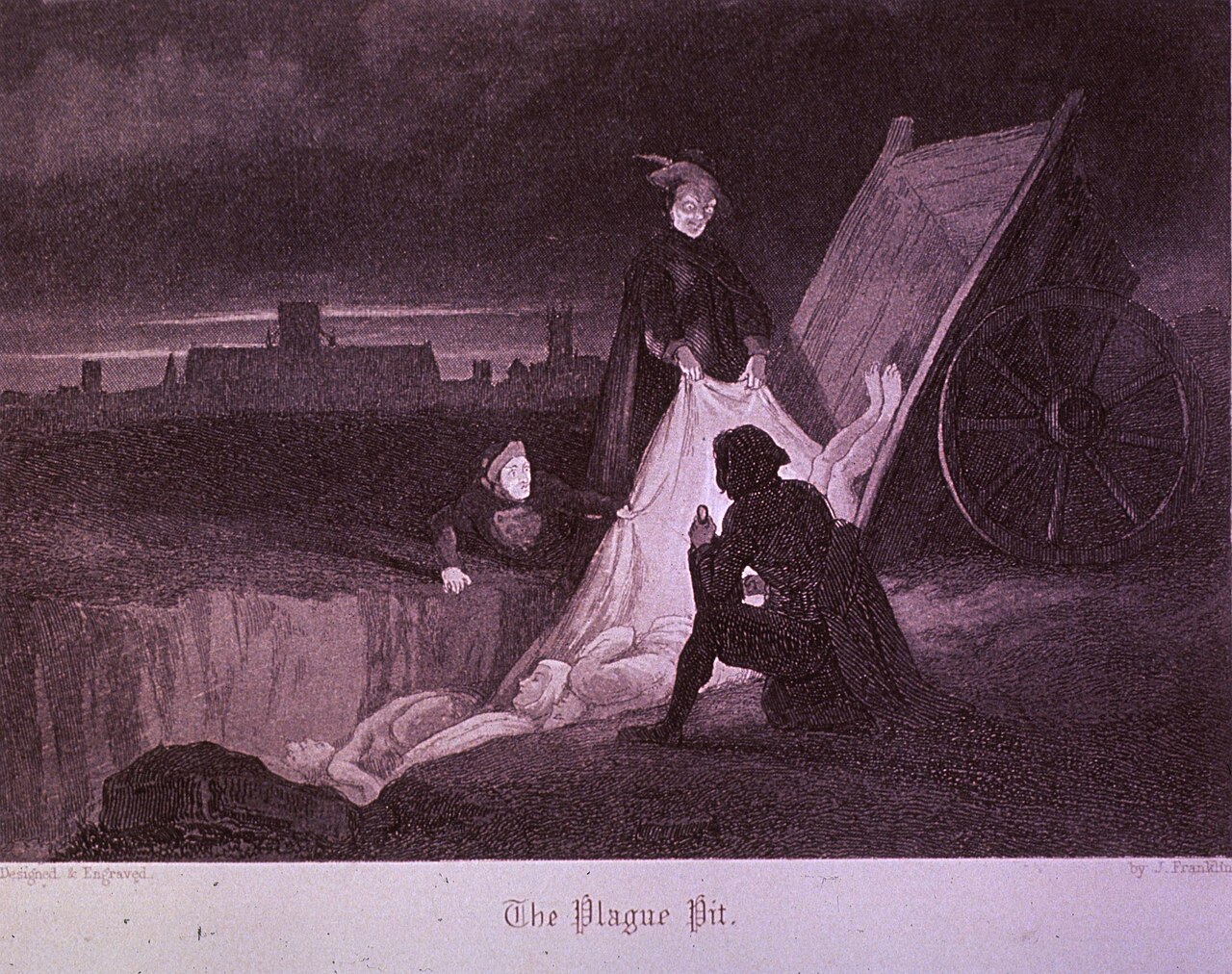
To pull his cart through the wheel-sucking mud of Friars Lane, Godric Owen leans forward well past his feet and tightens his grip on the poles. His arms and legs protest that they are virgins to any form of hard labour. His back creaks at each dip of the wheels. Flies crowd on his forehead to feast on his sweat. The chamberpot contents and horse shit that adorn the city’s gutters find his toes through holes in his shoes. Stop, seek ale, his dry throat cries, but he resists and vows to work to well past dusk.
Oblivious to his efforts on their behalf, his passengers lie supine, their mouths agape, their rigid arms and blackened hands trying to touch the sky, to beg, Mea culpa, Deus omnipotens.
Godric twists his head around to meet their stares. “In your countenances I see fear of hell, the certain punishment for your recently ended lives of debauchery and intemperance. Sadly, it’s too late for confession and penance. Any priests who still stand are busy tending to the not-yet-dead. I would do my best for your salvation, make the sign of the cross and chant, te absolvo, but must insist on recompense for lost time: a farthing for each blasphemy you have uttered, a penny for each act of fornication, a shilling for murder.”
Godric is teasing his guests. He already searched their pockets, found only lint and a morsel of cheese. Their loved ones got there first.
To shuttered, three-storey tenements he calls, “Corpses, please. Tuppence buys transport to a pit freshly dug in soil replete with worms and hungry roots.”
Silence. Nothing moves. Windows and doors stay closed.
Business on this round of the streets, his first of the day, has been slow. There are three riders in his cart, but by now there should be five or six.
“Good plague,” he whispers, “keep me busy for two more weeks, that I may reach me monetary goal.”
Right away a door opens. Two hooded men drag out two bodies dressed in linen nightclothes”
“Fourpence to carry these two good souls.”
“The city already pays you well.”
“Aye, but a generous gratuity assures their swift passage to hallowed ground.”
One man slaps four pennies on Godric’s outstretched palm.
Godric says, “I know these two unfortunates. Often I have seen them riding behind four horses in their speeding carriage, splashing mud on humble folk. May I suggest you benefit this distinguished burgess and his heiress wife by fetching furs and jewellery for them to wear to the last judgement and beyond.”
“For you to sell in the market, knave? Nay.”
After the men dash back into the house, Godric struggles to lift the well-fed burgess and dump him full body and face down atop a woman known for raising her skirts in alehouses to hawk her services. The wife is light; he wraps her arms around a man whose deft fingers earned him the name, Pocket Phantom.
Godric trudges on. “Carcasses, please.” See, mother, I ply a worthwhile and lucrative profession. A summer has passed since the plague fairy came to them, roasted them in fever for days and blew bubbles on their groins.
Mother’s parting, loving words were “God works pranks, kills decent men and women whilst a lazy, wallowing boar like you is on your feet again. Be warned, no fool will take my place and provide your bread and ale. Take up a trade, or, better, learn to bend the laws but pay the judge and dodge the hangman, for that is the path wherein riches lie.”
Beneath a bridge, dead rats the only witnesses, Godric harvests woollens and linens from his guests. The burgess’s wife is generous, furnishing a silver ring he wrestled from her curled finger and a gold florin hidden in the toe of her hose. Leather boots free from holes and shiny from grease come off a house-builder who days ago was spry and arrogant, jeered and threw stones at Godric and cart.
At the graveyard a digger dumps the load into a half-filled trench and says, “For shame, Godric Owen, you crater-eyed, scrofulous, squashed-gnome son of a whore, you have left the good dead with only strips of tattered clothing.”
“Lest you do the same, William me fellow bastard. At least me mother hosted city officials and a nobleman or two. A beauty, she was, so fair that only me father, whoever he was, can be the source of the ugly features you noted, as well as the pig nose you failed to mention. Nonetheless, I thank him for seed that helped me mother shape me keen mind. The beggar who parted your mother’s knees begat a dolt.”
“A wise man would not be so cocky. Soon you will drink away whatever wealth you have gleaned from silenced citizens, and we’ll both be beggars. All the cart-pullers have died of the plague, save you and one other, who reports the rush of customers is slowing fast.”
The cur could be right, and the trend could subvert Godric’s plans. After a moment of tooth-grinding panic, he vows to accomplish more with less, seek elite passengers, charge higher fees, harvest better finery and trinkets.
Word has it the plague came late to the castle, but has leapt the moat and breached the walls. They say servants lie prostrate on floors beside lords and ladies who have taken to their beds. The nobles have their own graveyard, but there might be no one left well enough to dig its wet soil.
The royal banner flown atop the castle keep hangs limp and tattered. Never before has Godric dared approach the bridge and gate, but today no guards are in sight. All is silent as a resting moth until Godric cups hands around his mouth and calls out, “Ahoy, me coach awaits Sir Corpse and Lady Cadaver.”
A man clad in fine silk hose and a leather jerkin decorated with a crest of arms comes out the gate, pushing a serving-cart burdened with a body so fresh the head and four limbs dangle off the sides.
Skin on the dead man’s head and hands shows none of the plague’s black tokens, but his bloodied shirt bears a gash the size a sword might make. The bearer hands over a cloth bag that appears to be heavy with coins. “Scoundrel, give this nobody a secret grave. Be warned that if you speak of him, even to your shadow, any of us who live on will find you, slash open your belly and draw out your entrails one curl at a time.”
“Me lips stay sewn as shut as a nun’s lady-gate.” Godric observes the fallen nobody has the smooth hands of a somebody. “If the deceased happens to have worn a jewelled crown, perchance it should accompany him in the afterlife.” The knight draws a sword, and Godric retreats with cart and cargo.
From another survivor this morning he heard that a bakery has reopened. A flaky crust stuffed with savoury beef would reward him for labours that began before dawn.
The public route to Market Street winds around the estate of an early victim of the plague, a magistrate who in the past winter awarded Godric a cold day in the stocks, for nothing more than being drunk and publicly lustful.
No guards are in sight. Godric cuts through the overgrown garden. Standing by a well, he adds up the coins in the cloth bag: three shillings, a better haul than he makes on his best days. A search of the passenger’s breeches locates a tiny inside pocket from which Godric pulls a ring, which he bites gently and turns in the sunlight.
Glory be, the stone is a ruby that would dwarf the fattest finger, set in a heavy nest of gold.
Once he finds a buyer, Godric has reached his goal and need haul no more dead. The ring deserves a place of honour; Godric tucks it into a buttoned-down wallet sewn into his filthy codpiece. He removes boards that cover the well, lifts the body, murmurs, “Me liege, I thank you,” dumps mystery lord headfirst down the well, replaces the boards and kneels in prayer. “Plague, from this moment, spare the lives of all who remain in this city. Whether they be saints or sinners, all form me future clientele.”
He and mother formed the plan together. Whilst he made his first round gathering the dead, she came down from heaven as a wisp of vapour and spoke in her gentle voice, “Save and hide your coins, my son. Buy goods for pittances and find a place where you can sell for gold what citizens can find nowhere else. Nurture ambition.”
Godric has hauled many a shopkeeper to the graveyard. Many of their heirs must sell.
Within weeks a sign above a door will read, “Mingled and Fine Goods, Master G. Owen, Proprietor.” Men and women so poor they risk the hangman’s caress will plunder homes of the dead. Furniture and heirlooms that would cry thief if sold in the street will arrive at Godric’s back entrance, their possessors grateful to collect enough pence for a few days’ bread. Once polished and placed in rows, all will look legally acquired.
With his profits he will buy one by one every shop in the city that sells like goods. Prices of wares will be his to set.
He shall marry in church a woman of good name, though left so hungry and alone by the plague that she endures his appearance and low birth. He will learn to be kind, and the word love will pass between them.
Each evening, Master and Mistress Owen will dine on beef or venison, honeyed cakes and French wine. Godric will remember his humble roots and invite the orphaned maidservant who cooks the meal to set four places at the table, including one for herself and one for Godric’s departed mother.
Plague, giver of opportunity.
mage: A plague pit from wikicomons. Abstract: A mass burial of plague victims is in progress under the cover of darkness; the bodies are being dumped from a two-wheeled cart into a large hole. National Library of Medicine, Set 72157624155591660, ID 5036592971, Original title The plague pit


