
Zara always left her cross-stitch on the staff room table, alongside a pile of magazines that had been there longer than anyone could remember. Chloe, the new supervisor, paused when seeing her one morning, holding a key in her clenched fist like a weapon. Her brown overalls served to make her already stocky features even more oppressive as she stared down at the smaller, swarthier woman.
“What are you doing?” she asked, her nose twitching as she spoke.
“Cross-stitch,” Zara replied, balancing the fabric on her palms as if kneading dough.
“I can see that. My question is: why are you doing it here? In worktime. Why aren’t you working?” Chloe frowned and was about to further clarify her meaning before suddenly suspecting that she was being mocked. She glared at her subordinate.
“My shift doesn’t start for forty minutes.” Zara spun the fabric around her dexterous fingers, completing a half stitch.
“Then why are you here? This isn’t a hotel.”
“The bus only comes once an hour. I have to be either forty five minutes early or late.”
“How long will that take?” Chloe felt sweat under her armpits. She was trapped in her line of questioning; having set a suspicious tone, she did not know how to escape.
“Many years. There’s only ever enough time to do one floss before I get ready.”
Chloe nodded and wrapped the key between her hands on her way to the door. When reaching it, she turned back with narrowed eyes. “You shouldn’t do that here. This is where people get changed.”
Zara bowed her head. “I’ll find somewhere else ma’am.”
Chloe opened her mouth, annoyed that her words had been interpreted that way, before striding away.
For the next three months, Zara carried out her cross-stitch in the cleaner’s cupboard. Most of the floor was taken up by an old fashioned vacuum with a pipe that slithered around the floor on the slightest touch. The smell of disinfectant mixed with dust. She balanced the tray on which she kept her threads at a forty five degree angle against a wall, making constant adjustments with her free hand as she weaved the needle. The part of the design she was focusing on was red and yellow, colours that were barely distinguishable from her surroundings on their spools, but that became vivid when interwoven.
Zara had accessed the room using intra-shift fraternity. She had been too nervous to speak to anyone outside her team, but fortunately, one of the women she worked with was friends with someone on the night shift, which the cleaner, Mick, was an honourary member of. A short explanation of Zara’s dilemma was all that was needed to persuade him to leave the key to his ‘office’ in the staff room microwave, so that Zara could use it whenever she needed.
There was a high staff turnover around that time, as a series of strikes meant that the factory rarely operated at full capacity. Such it was that when Chloe heard a noise from the cupboard on her way to the stockroom, she was primed to investigate. She pressed her head against the door, briefly imagining the filthy things the workers could be doing, before thrusting it open with an aggression that froze Zara in profile, her hand paused in the act of piercing the fabric, the needle glittering.
“Get out,” Chloe said, alarmed by the implied threat.
“Are you talking to me?” Zara asked, gazing into her forehead.
“Of course I am.”
Zara finished her stitch before folding her arms over the tray. She raised her eyebrows. Chloe was disconcerted momentarily before ordering her to change.
Chloe’s report about the incident discussed the image she had glanced. It resembled certain subversive symbols, which, despite being archaic in nature, had the potential to cause disorder. The needle could be used as a weapon, if not by Zara, who had always given the indication of being as passive as the rest of her people, but by anyone whose passions were inflamed by roughly spoken words. More philosophically, there was the question of discipline. Workplaces should be treated with respect, with every movement of the workers contributing towards the common purpose. Anything extraneous had the possibility, if not the likelihood, of invoking subversion.
The report was inelegantly phrased, Chloe having as little formal education as any of the workers. Her references to the spiritual degeneracy of indirect resistance were therefore discursive and inferential. In any case, the factory managers, wary of unnecessarily inflaming tensions, decided to take no action, save agreeing that Zara should be told that cross-stitching was no longer allowed anywhere on the premises.
Chloe was made redundant a month later following a review. Subsequently, each supervisor was theoretically responsible for twenty two members of staff, meaning that no one else did more than glance at the entry in Zara’s file. Zara became a mysterious figure, rarely talking to anyone, moving from place to place around the factory to ensure she was never caught again.
The completed cross-stitch was hung up, framed, in the staff room the day an announcement was made that the factory was going to close. The workers were too concerned with their futures to see the design, which comprised numerous interlocking stars. On the day of the announcement, Zara left the factory floor holding her tapestry needle after telling the other workers that she felt unwell. Her out of character boldness made them follow her a few minutes later, to find the stockroom door forced open, revealing pallets of clothes.
By the time they left that night, they had requisitioned enough jumpers to ensure a warm winter. Zara was never seen again, leading some of the workers to wonder whether she was a guardian angel, sent to ensure that they survived the coming storm.
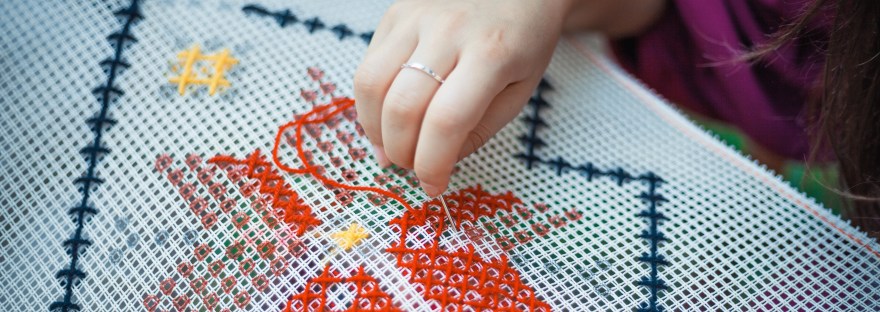
Image by Bob Dmyt from Pixabay – a hand hodling a needle sewing a cross stitch pattern in red on a white background.


Hi Mark,
This is well done. It makes a few excellent points about how unimportant a workforce is and the same going for the twats that enforce. (Firms!)
It finishes like a modern day fable.
An interesting and perceptive piece of story telling!!
All the very best.
Hugh
LikeLike
This shows very quickly how a little imagines power can turn the nature of a human and bring out the bully in them. In the end though there was comeupppance not only against the bully but against the other badness. I wonder where Zara went? Entertaining piece for sure. Thank you – dd
LikeLike
Mark
People like Chloe ensure that the concept of hell will not go extinct. They keep the wish for that sort of place for the type of people they are alive. Seems a shame that a decent person must be a magical being of some sort. Well done.
Leila
LikeLike
A sharp satire. I appreciate the quiet resistance through something as small and patient as cross-stitch, under a regime that treats any unproductive act as subversive. I also have sympathy for Chloe. She was in over her head and fared no better than the workers.
LikeLike
Mark,
I loved the story. I was also haunted by the term “being made redundant.” Really? Being made a tautology? Being in excess or abundant? Anything but the truth. We live our lives in such a muddle of language. Me too, I realize. I guess we would all rather be deposed than canned. Nice job. — Gerry
LikeLike
I kind of see it like the unseen, unspoken threads that hold a community together
LikeLike
I thought this was great – perfect character exposition, tension, and a wonderful ending.
LikeLike
A strange and rather mystical story that leaves me with more questions. For example, I wondered why they would frame the completed cross-stitch in the staff room. Also, there were quite a few strikes, though Zara was framed as passive. But that doesn’t really matter, the mood of the story is what stays with me. The writing absorbed me in. The character of Zara is an almost mystic figure. An individual making her own original and creative impact, threading her stitches into sweaters. And I do also have sympathy with Chloe, all caught up with the system.
LikeLike