
It was around twelve forty on a Sunday afternoon when the dispute acquired the peculiar density of all apartment controversies, having swollen far beyond its obscure beginnings into something at once intimate and abstract. It was no longer a matter of mere lunch. It was no longer of mere smells but of religion, caste and civilisations itself, and so when the green WhatsApp notification bubbles accumulated with urgency in the Residents’ Association Group, it carried with itself prophetic revelations, accusations, clarifications, corrections, screenshots, invocations of tradition, appeals to tolerance, references to bylaws nobody remembered drafting and precedents nobody could locate.
KINDLY MAINTAIN THE VEGETARIANISM OF THE BUILDING.
This is a residential apartment ok? not a market.
Nobody is targeting any community.
Then why mention food habits?
Some residents are uncomfortable. Especially senior citizens
Residents have rights.
What rights?
Across the third floor of Saraswati Devi Apartment Complex, however, the corridor itself appeared stubbornly indifferent to the proceedings. The air remained thick with the scents which had spent the morning escaping beneath doorways and drifting freely between households with none of the caution later displayed by their owners. Ceiling fans revolved against the humidity gathering over Chennai. A television somewhere replayed an old comedy scene. Wet clothes hung from balcony grills and a pressure cooker sat cooling upon a kitchen counter. A crow perched upon a water tank and screamed into the afternoon.
Several hours earlier, before the first message had been sent and before the men of the apartment complex had appointed themselves custodians of heritage, two women had awakened on opposite sides of the same wall. Long before sunrise had properly entered the city and even before the newspapers arrived folded into their daily geometries of road accidents, political mis-happenings and cricket scores, S of Flat C-302 had crossed the cool mosaic floor of her apartment barefoot, gathering into herself the day’s obligations. She knew that Sunday, contrary to popular belief, belonged neither to God nor leisure but to women. Behind her lay the principal beneficiaries of the morning’s labour. Her husband occupied most of the bed, sleeping. He was a man who had never once wondered how breakfast arrived. Her son had migrated diagonally across his mattress during the night and her daughter slept beneath a cartoon bedsheet despite the heat.
On the other side of the wall, in Flat C-303, F had entered an almost identical morning. Her husband, whose contributions to the WhatsApp debate would eventually exceed those of any other resident, remained asleep beneath the ceiling fan, one arm draped dramatically across his forehead. Her children slept too (though not very diagonally). The apartment slept. Only she moved through it, switching on kitchen lights, washing vessels abandoned from the previous evening, tying back her hair and beginning, as women had begun for generations before her. The labour of ‘love’ they call it.
In both kitchens small onions had been peeled until fingertips carried their sharp sweetness. In both kitchens ginger and garlic had been reduced to paste beneath stone and pressure. Mustard seeds had crackled in gingelly oil. Curry leaves had hissed. Tamarind had darkened patiently in steel vessels. Coriander powder, chilli powder and turmeric had entered the proceedings in almost identical proportions. The same red masala stained the sides of both kadais. The same steam rose and the same Sunday hunger announced itself. Even the dish had begun as the same dish. Kathirikkai kuzhambu in one household. Meen kuzhambu in the other. Only a single noun had changed. Where one vessel received cubes of purple eggplant, softened slowly until they soaked the tamarind gravy, the other welcomed thick slices of vanjaram fish, lowered carefully into the same scarlet depths. By noon, even the aromas, having mingled freely in the corridor’s stagnant air, seemed less interested in preserving their distinctions.
Outside, the apartment complex was slowly awakening. Milk packets disappeared from doorsteps. The security guard drank tea from a steel tumbler. Somebody washed a scooter and somebody else watered jasmine plants. The children emerged one by one from sleep and immediately vanished again into the freedoms afforded by Sunday. A plastic cricket bat appeared, while arguments regarding fielding positions commenced.
Inside the kitchens the women continued working.
Neither husband offered assistance. But they surely did appear periodically in search of tea. Both complained about something inconsequential. One found fault with the strength of the coffee. The other could not locate his towel. The women listened and nodded and ignored and stirred.
Yet by twelve forty that afternoon, somewhere between the kitchen and the WhatsApp group, between hunger and opinion, the fish had become an ideology. The first accusation of some “very fishy smell” left Flat C-302 shortly after lunch was served. The second (of “decorum in a civil society”) arrived before the first had been answered. By the third (“Non veg must be eaten outside, not cooked inside the premises”), the children had stopped paying attention and by the fifth (“Chi!”), the fathers had emerged into the corridor. By the tenth (“Some vegetarians are allergic to fish smell”), entire civilisations appeared to be at stake.
It was at this precise moment that Kavin the resident child (the diagonal sleeper) of C-302, carrying a steel plate piled with rice and kathirikkai kuzhambu, encountered Amina the resident child of C-303 (the straight sleeper), who stood opposite him in the corridor, holding fish curry and rice.
The adults were arguing loudly enough now that what their kids were up to had ceased to matter.
Kavin stared at her plate, while Amina stared at his.
“Want one piece?” she asked. Both of her top incisors had fallen off, revealing toothless cave.
He nodded.
The exchange was quick even before the adults could notice and once the pieces of meat and vegetables had been exchanged, they sat camouflaged in the same-coloured gravy.
The children tasted and then tasted again as around them voices continued rising.
Culture and tradition and respect and community we disused in loud shouting voices. The words floated above their tiny heads like clothes on a laundry line.
“It’s the same,” Kavin announced eventually.
Amina considered this carefully. The stupidity of boys worried her immensely.
“No.”
“What?”
“Mine has bones.”
For several seconds they ate in silence and reconsidered what samenesses and differences meant in a world like theirs. Then they exchanged the entire plates.
By the time the secretary finally restored order to the WhatsApp group and the residents retreated into their apartments carrying their grievances with them, neither child could remember which lunch had originated in which kitchen. The gravies had merged upon the steel plates into a single red stain. A fish bone rested beside a piece of softened brinjal and the corridor still strongly of tamarind and coriander and hot oil and generationally marinated communal hatred.
The afternoon, having survived its brief encounter with civilisation, returned quietly to a joylessly joyful lunch.
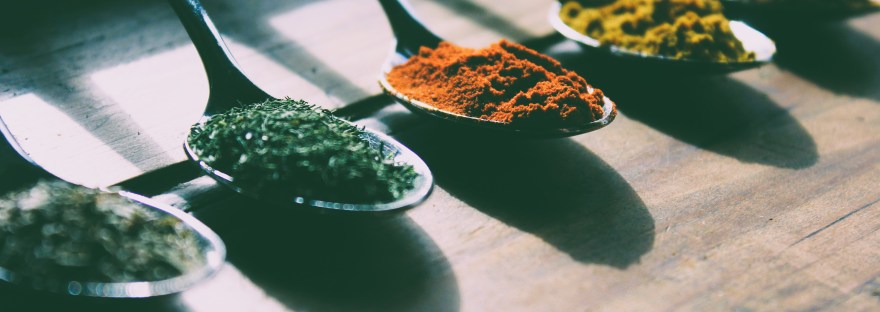
Image by Lars Beulke from Pixabay – A row of spoons holding various coloured herbs on a wooden board.


Hi Samyuktha,
This does make a fair point but my reason for enjoying this is a bit random, it’s due to ‘Blue Minks’ attempt at putting across the same sort of message with their song ‘Melting Pot’
I know the story is about Veggies and Vegans being against normal people. But the ‘same’ idea made me think of that song. Something that was anti-racist in its time has become hysterically racist.
Derek Griffifths did a version with all good intentions, but, well emm, that didn’t work!
I really did enjoy this.
Hugh
LikeLike
Wauw first one, never happens :). What a beautiful story, the imagery really worked for me. I felt like I was there on that warm Sunday morning when that person washes their scooter… and now I want curry.
LikeLike
(I mean of course after Hugh!)
LikeLike
Aha – neighbour dispute – it would seem that it is a universal problem. This was witty and the sort of story that would make the reader shake their head knowingly. Really entertaining. Thank you – dd
LikeLike
Samyuktha
People keep getting into other people’s business. They try to justify it but that sort of thing will always lead to conflict. Well done!
Leila
LikeLike