
Herschel sat quietly in the corner of the cafe. There was a small pistol pressed against his chest, he could feel it there, beneath his rain coat, cold like ice against his pale flesh. His fingers were long, spindly, white. He was seventeen.
When he closed his eyes he thought he could see Jerusalem as he imagined it. Jerusalem as he saw it in paintings, stony and glistening with heat. When he closed his eyes he could see his family, his fathers face, the drooping dark eyes, his tight smile, his arthritic fingers.
He stepped into the cafe bathroom and took the pistol from its hiding place. It glistened in the gloom, metallic and cold. He could see his own face in the mirror, greenish pointed cheekbones and hollow cheeks. He carefully switched the safety to off. He clenched his jaw.
But once he had been a child. He could see Hanover, the small cramped city, he could see his brother Shlomo, a crushed mess of blood and bone on the cobblestone and hear his mother wailing. He could still smell it, the blood. The sky had been very blue that day, taunting and violently blue, burning his eyes. His mother wailing at the sky, at the eibeshter. Dear god, dear god. Dear god. What have you done?
A blur of fist fights and the sharp taste of grass, the smack of a soccer ball, his brother’s grave, pale and luminescent in the moonlight. The walls of the city narrowed as he grew, crushing his thin frame between their stone and mortar and brick until there was nothing left inside him except his mad longing and the strange darkness that sometimes flashed in the brilliant black of his eyes.
Now he was walking, swift and quiet, his raincoat flapping around him, footsteps light on the cobblestone. It was early, Paris was misty and gray, smelling of rust and old dead leaves. He was a marionette, his arms and legs swinging as if pulled by some invisible strings. He felt as if he could see everything all at once, he was god now wasn’t he? His presence encompassed the whole city and the whole world. He was walking above these streets, beyond this body. He turned a corner, another. The sun was pale and colorless that morning. He could hear Hitler’s voice on the radio as he had heard it as a child, the sharp staccato of his speech, the static buzzing through every word, he could see his parents sitting and listening in the kitchen, blue shadows, mouths drooping, their bodies seeming to be sucked down into the earth by some incredible force of gravity.
He had entered the embassy, he was walking up a flight of cold marble stairs. Thin, dark haired, eyes enormous in his face.
“You have important documents for me?”
He did not see the man’s face. There was only the swastika, a red mark burned into his retinas.
“In the name of twelve thousand persecuted Jews,” he said quietly, “here is your document.”
He grabbed the gun from beneath the folds of his raincoat and shot the man five times. The pistol was cold. He let it slide from his fingers and onto the floor. Sunlight poured golden into the room, outlining his strange and sparse figure. The man slid slowly from his chair, cursing and bleeding. Herschel’s eyes were very large and dark in his face.
There was the clamor of footsteps and two men suddenly rushed into the room.
“I don’t intend to escape,” he told them. “I won’t do anything more.”
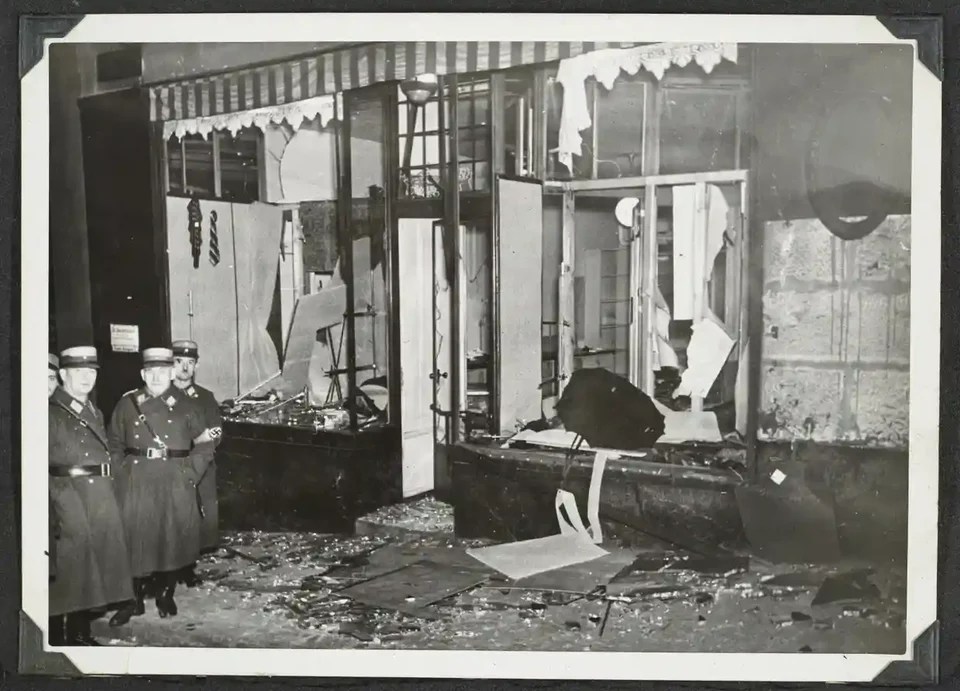
Image: Kristallnacht – 5578.webp
Image from an album of unpublished photographs once “in the possession of a Jewish-American serviceman who was deployed to Germany during the second world war”, and subsequently donated to Israel’s Yad Vashem memorial by his descendents. From Wikicommons public domain. A black and white picture of a ruined shop front with officers in uniform stood alongside.


