
Mate is so much more than a drink — it’s a living tradition
that binds us to each other and the land.
Fabiana Pose
The Eurovision Song Contest winner that year was a stunning brunette from Paraguay, Gisela Ortiz, who represented Spain in the contest and sang an enthralling guarania (romantic ballad) that won the acclaim of a large segment of the voting public and the members of a jury of music industry professionals. She soon turned her meteoric rise to fame into cash by tirelessly promoting a variety of products and services.
One of the products that Gisela advertised was a brand of yerba mate produced in the southern corner of her native country. In interviews, commercials, and other opportune moments, Gisela breathlessly declared: “Every morning, when I wake up, I make myself ready for the world by drinking a gourd of the famous Villarica yerba mate. It is delicious and gives me more energy than any coffee or tea can provide.”
The suppliers of Villarica yerba mate shouldered gladly the cost of Gisela’s endorsements. They had recently expanded their yerba mate plantations and had developed at great expense a new cultivar of the Ilex paraguariensis plant, dubbed“Variety C.” The new yerba mate variety had greater yield, was drought resistant, and lent itself better for industrialized forms of mate such as capsules, energy drinks, and extracts. The Villarica owners were anxious to recoup their investment.
Gisela’s promotional effects bore fruit. Before her triumph, the main market for yerba mate products was South America’s southern cone, with minor consumption pockets in Germany, Japan, the United States, Spain, Syria, and France. However, the prestige provided by her repeated endorsements brought new users into the Villarica rolls, and a year after Eurovision, sales of Villarica yerba mate products had tripled.
***
The first dark clouds on the horizon took the form of a research paper in a virology journal, in which a new rabies-related virus was reported to be present in the leaves and stems of yerba mate Cultivar C. The newly identified virus, tentatively named “yerba mate virus C” was heat resistant and more active than previous versions of the rabies virus.
At first, this discovery was dismissed as a scientific curiosity without health significance because rabies cannot be contracted by ingestion, as the virus is destroyed by the stomach acid and mucosal barriers in the intestinal tract. However, it was later determined that if a Cultivar C solution was ingested by a person experiencing cuts, ulcers, gum disease, bleeding lesions, or other mucosal damage in the mouth or throat, the virus could find a pathway that led it to the central nervous system, causing progressive inflammation of the brain and spinal cord and eventual death.
An increasing number of rabies cases started being reported in Europe, Asia and the Americas, all involving people who had not been exposed to a rabid animal but exhibited some of the preliminary symptoms of the disease. It took weeks of frantic sleuth work by the World Health Organization and the health agencies of several countries to discover that ingestion of Villarica yerba mate products was the likely source of the pandemic. By that time, the air waves were filled with reports of previously healthy people exhibiting hyperactivity, excitable behavior, hallucinations, lack of coordination, and hydrophobia followed by horrible deaths.
Global panic ensued. A strict interdiction on the importation or sale of Villarica products was imposed by most countries; the prohibition was later extended to sale of any yerba mate products whatever their source. The yerba mate industry was virtually extinguished overnight.
***
In the five South American regions where the use of yerba mate was most prevalent (Southern Brazil, Paraguay, Uruguay, Argentina and Southern Chile), the rabies scare took an extra dimension. A vast majority of the population in those areas were habitual consumers of yerba mate in hot and cold serving versions, and for many people drinking mate was an ingrained habit; yerba mate consumption is habit-forming and can lead to a caffeine dependency, much like coffee or tea. Moreover, in many cases drinking yerba mate involves the deeply rooted ritual of sharing a gourd with friends, family, or coworkers. This communal aspect created a psychological habit that went beyond physical needs.
Gisela Ortiz, the worldwide apostle of the consumption of yerba mate, returned to Paraguay and gave a TV interview that was seen by millions of people throughout the world. In it, she expressed the views of the industry and her own position: “I continue to believe that drinking yerba mate is a healthy and socially commendable habit. With the banning of Cultivar C and the destruction of the plants that may carry the rabies virus, the risk of consuming other varieties of mate is non-existent. I will continue to drink yerba mate daily and urge my fans and other yerba mate consumers to do likewise.”
Gisela’s pronouncements were criticized as self-serving by many, who dubbed her the “Typhoid Mary” of rabies. Her picture was burned in spontaneous protests in Asunción, Montevideo and São Paulo; in Argentina and Chile, however, public opinion was evenly divided between those who agreed with her views and those who opposed the continued marketing of yerba mate, “a known instrument of death.”
Soon the general population in those five regions split in three camps: those who abstained from partaking of yerba mate altogether; those who continued to use it freely, in total disregard of health warnings; and a growing faction that consumed yerba mate but cautiously examined themselves for potential exposure to the virus as evidenced by tingling, pricking, or burning sensations at any part of their bodies, in which case they would rush to receive a series of painful vaccinations to fight a possible rabies virus. Sadly, in many cases when medical attention was rendered it was too late to arrest the fatal progress of the disease.
***
Leo and Laura had known each other since elementary school and, over the years, had developed a friendship that blossomed into a torrid romance. They dated continuously while living with their respective families but, when he was hired as project assistant at one of the largest architectural firms of Buenos Aires and she got a job at a pet store, they figured they were making enough money to live together. They rented an apartment in Almagro, a bohemian barrio in the center of the city, and set up a happy household there.
The ongoing concerns over yerba mate and rabies affected the couple differently. Laura did not drink mate; she preferred English tea and downed a couple of cups of Constant Comment in the morning and another one with dinner. Thus, she regarded the rabies outbreak as a distant human catastrophe that did not affect her.
Leo, however, was a yerba mate aficionado and often got together with friends for a drinking and chatting session. On those occasions, he was the cebador (pourer), in charge of brewing the mate, making sure it was perfect, and serving the gourd around the circle of drinkers, who sipped the brew out of a bombilla (filtered metal straw). He was very proud of his skill and was always in search of new varieties of yerba mate to try. He had just bought a one kg bag of Villarica Cultivar C for twenty thousand pesos and was not about to throw it away, so he kept it in his cupboard to enjoy himself and not to share with others, just to be safe.
Laura and Leo went out one evening for dinner to a Mexican restaurant in Palermo. She had a mild ceviche; he, feeling adventurous, ordered enchiladas picantes, corn tortillas stuffed with chicken and smothered in a blistering red salsa. The following morning, he had developed two canker sores, small painful lesions with white centers and red borders inside his mouth. He laughed it off: “that’s the price for eating hot Mexican food.” The sores would be mostly gone in a couple of days. In the meantime, he fixed himself some tereré, a cold beverage made from yerba mate and fruit juice, to calm the irritation.
A week later, Leo developed flu-like symptoms: a fever, muscle aches, fatigue. These were soon followed by agitation, restlessness, muscle twitching and a racing heart. Laura decided to call her family doctor to make an urgent appointment for him, but first did an internet search to better describe his condition. She nearly fainted when she discovered that his symptoms were an indication of the onset of a fatal rabies illness. She had a brief episode of panic and then took hold of herself. There was no point taking Leo to a doctor to receive a certain death sentence. Instead, she quickly packed two suitcases, nudged her semi-conscious lover to follow her to their car, loaded Leo and the luggage, and sped south, out of the city and towards the Atlantic beach resorts.
Four hours later, they arrived at Mar de las Pampas, a tranquil, forest-heavy village with unpaved roads. Laura rented a secluded cottage away from traffic and half carried Leo into the dwelling’s bedroom. His condition had deteriorated: he had unsuccessfully tried to swallow a sip of water, his mouth was overflowing with saliva, and he was mumbling to himself.
Laura had read the descriptions of the yerba mate rabies pandemic and knew what would soon happen to Leo. He would experience hallucinations, foaming of the mouth, extreme agitation, and thrashing about, followed by a deep coma and death by cardiorespiratory arrest. He had only a few days to live, and his death would be extremely painful for him to experience and for her to behold.
She had chosen to flee the city because she wanted no witnesses to his pain and to the steps she knew she had to take. She waited a few hours until Leo quieted down and fell into a stupor, and then cautiously approached him armed with a pillow and pressed it forcefully over his face, seeking to stifle him. He awoke and fought her; in the ensuing scuffle, he scratched her arm and then, running out of energy, rested his head on the mattress as she completed smothering him to death.
Laura was out of breath as she sat on the edge of the bed, looking helplessly at Leo’s inert body. Then she went to the bathroom to examine her cuts and bruises. Had he infected her? Would her death follow his, accompanied by the same horrors from which she had tried to protect him?
It was a moot question, she realized. Her life was meaningless without Leo. She vacated the cottage, leaving her lover’s cadaver behind the closed door. She drove back towards the city until she found a propitious place and veered out, speeding, to crash the car against a tree and turn it into a flaming inferno.
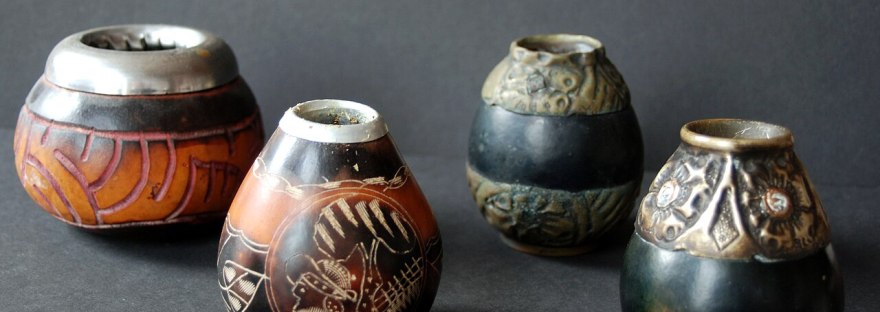
Image: A collection of tipos de mate (drinking gourds for Mate tea) Ornately carved and painted bulb shaped vessels in brown and blue from Mariano-J, CC BY-SA 3.0 https://creativecommons.org/licenses/by-sa/3.0, via Wikimedia Commons


Matias
It was interesting to watch this story fall from its flight and crash. It is a perfect mimic of how we will destroy ourselves when it is endorsed by a cult of personality.
Leila
LikeLike
A different story but familiar in so many respects with interesting information woven into the prose. I enjoyed this. Thank you. dd
LikeLike
Nicely done. Effective world-building from a global pandemic then all the way down to one couple’s kitchen table. It’s how calamities actually hit…at the individual level. Laura’s choice to flee instead of seeking help, and what she does once they arrive, is unflinching, and the story makes it believable. Now excuse me, but I have to go pour my case of yerba mate down the drain.
LikeLike
Hi Matias,
No matter what, if I feel I want to check the details, the writer has done their job.
There are three parts to this and I don’t think that they traditionally (??) gel but for some reason, it sort of works, it works very well!!!!!
Due to me checking the details, which some are factual and some aren’t, I’ll have to say how well done this was!!!!!
All the very best my fine friend.
Hugh
LikeLike
A rather deus ex machina tale. Kinda reminds me of the covid vaccination resistors not wanting to wear masks, and even losing their jobs for this resistance. It doesn’t matter what the evidence is that I shouldn’t drink yerba mate, even if its possible I’ll contact deadly rabies, I’m going to practice what I believe in. I am certainly glad I wasn’t living with Laura.
LikeLike