
No retreat offers someone more quiet and relaxation than that into his own mind, especially if he can dip into thoughts there which put him at immediate and complete ease.
Marcus Aurelius, Meditations
She was foaming at the mouth. Her eyes dilated rolled.
Her mind was gone–possessed by Bacchus– she could not hear her son.
Euripides, The Bacchae
Marcus sat alone, cross-legged, in the quiet of his studio, having dimmed all lights. He sought to set his mind at rest by deeply inhaling and exhaling; as errant thoughts floated into his mind, he considered each one for a moment and dismissed it.
As usual, among the first thoughts that attempted to take center stage in his mind were musical recollections of various kinds, from current pop songs to random classical melodies. Those were soon dismissed, but made repeated attempts to gain traction until they were energetically banished.
Next in line were assorted worries: finances, health, family relations, social and political concerns. The ease or difficulty in casting those anxieties aside depended in great measure on how realistic they were if examined objectively. For example, the fear of a catastrophic financial decline was dispelled by considering that under all but the most extreme scenarios, his estate – though not considerable – should last for a longer time than he expected to remain alive.
Likewise, his body was undergoing a steady deterioration, but aside from debilitating arthritis he could not detect in himself any signs of a life-threatening condition. On the other hand, he had serious doubts about his children’s ability to manage themselves after he was gone, but this legitimate concern, once examined dispassionately, led to no obvious strategies that he could implement to improve their chances of success later in life. Therefore, he could worry, but could do little to negate the risks of failure his successors would face after he was gone. As for social and political concerns, those were also legitimate and troubling, but given his age and social status, he could not detect much beyond what he was already doing to improve society.
The process of clearing his mind of unrealistic or unprofitable worries often left Marcus facing an opposite risk: smugness in the belief he lived in the best of all possible worlds; that he had reached a plateau in which there were no more hills left to climb, and no improvements that needed to be undertaken at this late stage in life. In reality, a self-serving validation of his life was as unproductive as miring his soul in a swamp of fears and recriminations. Considering those unhelpful extremes, why meditate?
One undeniable benefit of meditating was the ability to achieve equanimity by shedding worldly cares and concerns. Meditation resulted in greater mental calmness, facilitated confronting the challenges of day-to-day living, and reduced the chances of experiencing stress. Also, meditation reduced the potential for unnecessary conflicts and thus improved his relations with others. Finally, by removing distractions he was able to focus better on matters that were truly important and reach better decisions. So, Marcus was reassured – as always – that meditation was a useful tool and one that he should utilize without fail.
***
This particular night, however, all of Marcus’ efforts at achieving a full meditative state failed due to a recurring vision that resisted dismissal. A young woman with long flowing hair appeared before his closed eyes, head crowned with an ivy wreath and body covered by a misshapen animal skin. She held on one hand a fennel staff circled by ivy vines and leaves and topped with a pine cone; the other hand barely subdued a writhing snake. She was gyrating wildly, beautiful and ferocious at the same time. From his classical studies, Marcus recognized his visitor as a bacchante, a female worshipper of Dionysius, the Greek god of wine, debauchery, and excesses.
As she circled around Marcus, the bacchante intoned words that he did not understand but whose meaning he was able to capture. She was beckoning him to cease meditating and surrender his body and soul to the lures of the world. She seemed inebriated and reeked of wine or some other spirit, and her body released a feral scent that filled the room.
Marcus had given up intoxicating beverages and drank only tea and mineral water. The pleasures of the flesh had also departed with advanced age, leaving behind only dim memories. All the same, his withered body was not unresponsive to the summons of the visitor.
Marcus got up slowly, every bone creaking at the effort, and grasped the hand offered by the temptress, who had dropped the snake and allowed it to wiggle away. She then led Marcus into a series of bodily contortions that even as a young man he would have been unable to negotiate, while breathing alluring words into his ears. As they danced, their bodies came increasingly in contact and soon Marcus realized with astonishment that he was getting an erection, an occurrence he had not experienced in decades. He felt excited but ashamed. Where was the equanimity, the calmness of mind and body he cherished? Why was he regressing to the primitive urges of a boy in his teens?
His misgivings were short lived. The bacchante delivered an unexpected push to Marcus that landed both on the floor. There, she tore off his garments and shed the animal skin that had covered her. Soon they were naked, coupling in earnest, she biting off chunks of his body, he forcing his member deeply into hers, oblivious of anything but his unquenchable desire.
A few moments (and yet, to Marcus, an eternity) later, he emptied himself in her body as she went on devouring his flesh. As his climax subsided, she rose from his inert body and uttered a triumphant shriek. She then retrieved the animal skin and staff and disappeared.
On the floor, Marcus wondered whether the apparition had been real or a construction of his fevered mind. He experienced a pang of regret at her loss, followed by an intense pain in his chest. He never knew whether he had suffered a heart attack or been the victim of a bite from a departing snake, but in his final moments he mused that meditation was a great tool but an inadequate substitute for the living he had missed all these years.
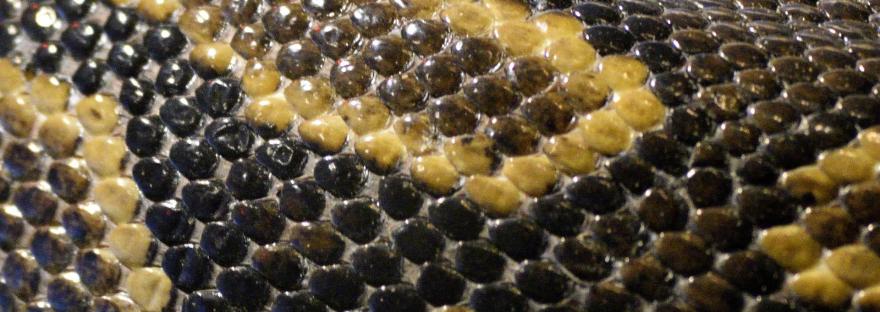
Image: Black and yellow snake skin from Pixabay.com


Ha! Nice one! Not sure about the punchline (I’ve always struggled to meditate myself but I know a couple of folk for whom it has been a literal life saver) but I enjoyed getting to it. Well written and I particularly liked the way the tone shifted – and yes, the Bacchae were not just about guzzling wine and having a bit of a dance! À good mid-week read.
LikeLike
Well he went out on a high!
Well written and entertaining but I’m glad after all those years of being sensible the MC had a final fling!
thanks – dd
LikeLike
Hi Matias,
I enjoyed the thoughts as he tried to empty his mind. I think any of us who have had trouble sleeping would recognise this.
If you want someone to visit you, it would have to be a follower of debauchery!
Good on him for having a last hurrah!!!!
I think it is clever of you to leave the reader wondering why she chose him.
All the very best my fine friend!!
Hugh
LikeLike
Matias
The She Beast is tremendous and the juxtaposition of characters is truly well done! Not a Live Now sort, until the end.
Leila
LikeLike
I feared that wasn’t going to end well for Marcus. Too bad the lesson learned, that meditation is no substitute for living, came too late.
LikeLike
Matias,
Perhaps too much meditation in the long run; at least he brought to his member to the finale. It seems a waste of a perfectly good life, but a fun read! — Gerry
LikeLiked by 1 person