
The moan of miller Beale’s crude bell is nearly swallowed by the third week of February cold. Gray stirs in his haybunk, clinging to Leith. There the marshlands stretch toward the North Sea, and Elspeth—his bride—walks the rain-dark fields beneath a graphite sky. Their daughters run in widening circles through the grass: Isobel serious beyond her years, Alisone all wild curls and laughter, and wee Violet stumbling after them, gap-toothed and breathless. Pregnant clouds drag their swollen white bellies across the Lowlands. The wind tastes of salt.
The bell tolls again.
Once.
Gray sits upright.
Men who oversleep are dragged into the Newichawannock Woods in their skivvies and bare feet to chop and climb until the pads split open, blue and frozen.
Gray slips his hand under his nightshirt, finds the raised letters on his chest. The brand still tender after two years. S for Scot. Or is it Slave? He builds ships for Cromwell’s England—the very country that crushed the Scottish Covenanters, tore them from their homes, sent them across the Atlantic to this miserable, dark land called Maine.
A roper, like his father and brother before him. Twisting hemp fibers into rigging for Covenanter Navy ships. Not a soldier. But Cromwell’s henchmen didn’t care for such distinctions. Malcolm resisted. Shot in the head. Their father next.
Gray counted himself fortunate then. He’s no longer sure.
He rises to piss in the copper thunder pot and cinches his belted plaid tight. The pelts at his ankles once warmed another man—one of the nine laid in the frozen earth. Nine of the twenty-two Covenanters driven here in 1651.
Gray crosses to the next bunk and taps a pale foot protruding from under a threadbare happing.
Duncan, up now.
He doesn’t stir. Gray taps harder. Duncan’s eyes open, fever-bright, and he rolls out shakily. Just a boy. Nineteen, maybe twenty. Can’t be more. He dresses slowly, each movement deliberate, like moving through water.
You’ll be well soon.
Duncan nods but says nothing.
Gray scoops cold bean porridge from a tin cup and plies the knee-deep snow to the timber mill at woods’ edge, Duncan dragging along behind. Most of the men spend their days heaving massive white oaks through the drifts, breaking their backs in the punishing elements. But Gray has a skill. Miller Beale keeps him inside, working the timber. A seven-year sentence, they’d said. Gray’s daughters will be grown and married before he can seek passage back across the Atlantic. If he survives. If any of them do. He pushes the thought away.
Mac Griogair is already spudding the timber when Gray pushes open the wicket. Wind and snow follow him in. The oak timber spans nearly the entire length of the mill—one hundred and fifteen feet of it, waiting to be shaped into a mast for Cromwell’s warships. It will tower two hundred feet above the deck when finished. At the base, someone had burned the King’s Broad Arrow. A crowfoot mark from the time of Charles. This tree grew from the earth free of kings for five hundred years. Now it belongs to Cromwell.
Gray’s hands know the work without thinking. Two years of the drawknife, pulling repeatedly until the oak begins to round. Section by section. Blisters fill, burst, bleed, heal, callous. Then fill again. He’s stopped counting the strokes.
Miller Beale doesn’t allow conversation unless it concerns the work. Hand me a knife. Shore to turn. Watch your head. The silence fills with memories Gray tries to purge. He saves them for sleep, where he can see his girls as they were. Where they remain exactly as he left them—a bouquet that never wilts.
Late morning, Duncan coughs. Gray glances up. The boy sways, grips the timber, then collapses onto the log like a wet blanket. Before Mac Griogair can reach him, miller Beale rises from his post by the woodstove. The other men, heads down, return to their work immediately. Gray keeps his eyes on his blade but watches Duncan from the corner of his vision.
The boy doesn’t move.
Miller Beale stands over him a moment, jerks his chin at Gray and Mac Griogair. A dead man serves no purpose to a miller. They walk Duncan back through the snow, one on each side, half-carrying him. In the dormer, they lower him onto his bunk. Gray fills the water cup, places a damp cloth on Duncan’s forehead. The boy’s skin burns.
Read from my Bible.
Miller Beale calls from the door. Gray eyes the frayed leather spine, rises. Tells himself he’ll read to the boy at lunch. There will be time.
Duncan coughs. Loose red curls. Like Alisone. Gray almost turns back.
After lunch, Gray returns to find Mac Griogair sitting beside Duncan’s bunk, fiddling with his red beard. The Highlander looks up, shakes his head once. Gray stands in the doorway. The boy’s body still lies there, already beginning to look like something left behind. Mac Griogair has covered him with a blanket, placed a cup of water and some salted fish on the floor beside the bunk. An offering for a journey Duncan won’t take.
He asked for you.
Gray says nothing. There’s nothing to say. He should have read to him. He didn’t. Now the boy is dead, and Gray is still here, and tomorrow there will be more work on the mast.
The afternoon passes in a deeper silence than usual. Gray says a prayer for Duncan over his adze—not out loud, just words in his mind that may or may not reach anywhere. The mast rounds nicely, considering. Behind the mill, the sun sinks low. Hoarfrost creeps between the slatted siding. Miller Beale has been gone all afternoon. The fire in the stove burns down to embers. No one dares add wood without permission.
When the dinner bell rings, the sky is already pitch dark. Gray is glad for the long day in the shop, for less time beside the empty bunk. The men fill their tins with stew and johnnycakes with molasses. Inside the dormer, the fire is already lit. Miller Beale always softens when a soul is lost—some small mercy, perhaps guilt.
The doctor came while they ate. Just a fever. Not typhoid.
Miller Beale’s eyes fall on the boy’s empty bed. He avoids Gray’s eyes before the crooked door slams behind him.
The men strip to their skivvies and clean up—dishes rinsed, thunder pots emptied. Someone has already stripped Duncan’s bunk. The bare hay looks obscene somehow. More work for the rest of them now.
Some of the men pray quietly.
Mac Griogair leans from his bunk.
Tell us about Firth of Forth. Where the River Forth meets the North Sea.
The men gather close, pulling their thin blankets around their shoulders. They look younger in the firelight. Like boys, really. Waiting for a story.
Gray stares at Duncan’s empty bunk. The stripped hay. The water cup still on the floor.
A boy who grew free of kings now belongs to the earth.
Gray pictures his girls running through the grasslands and wonders if heaven looks anything like the fields of Leith.
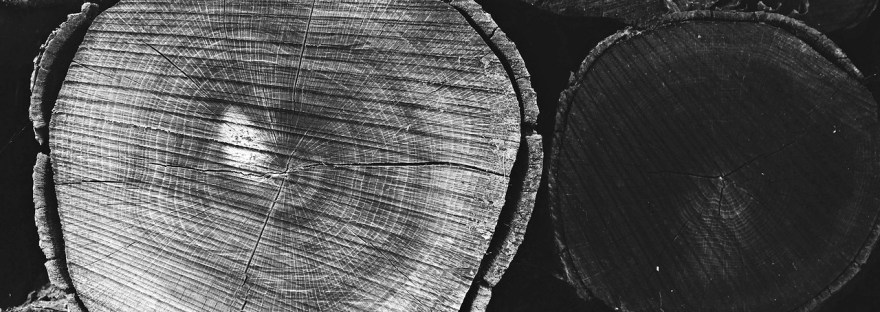
Image: Image by Kati from Pixabay black and white picture of the bottom of felled trees showing the age rings.


Hi Christopher,
I reckon that you have a passion for this, as it feels that this has been well researched.
I’ve read one book on The Covenanters (Can’t remember much about it.)
I knew a wee antiques dealer who made a fortune out of an old plain sideboard with a huge hole in the middle due to a first experimentation with Gunpowder from a Covenanter. My gran was a ‘Peden’ which, the name goes back to those times.
I look forward to reading Mick Bloor’s take on this.
HAH!!! A Scotsman looking for an Englishman’s take on our history!!!!!!!
An excellent story!
Hugh
LikeLiked by 1 person
Thank you, Hugh, for your kind words and observations. This little bit of history is fascinating, albeit tragic.
-ck
LikeLike
A powerful start to the week – bleak and unrelenting but rich in period detail that draws the reader in. Very well executed.
LikeLiked by 1 person
Thank you so much, Steven, for your kind words. I am glad you enjoyed the story,
-ck
LikeLike
Heartbreaking and yet another example of man’s inhumanity driven by greed and a lust for power. This was really well done and I was transported to that terrible place. I loved the line about the tree growing free of kings, excellent.
thank you for this brilliant start to the week – dd
LikeLiked by 1 person
Hi, Diane–I’m so glad you enjoyed this story. Maine’s history, especially, fascinates me. Thank you!
–ck
LikeLike
Christopher
You did well giving a memory to people whose lives were brutal and brief. Yet they kept at it, somehow, for some reason.
Leila
LikeLike
Thank you, Leila, for your comment. I can’t imagine the conditions and the heartbreak, but I wanted to honor that in this story. Much appreciated.
–ck
LikeLiked by 1 person
A well-researched and well-crafted historical piece. Several excellent lines and images, like the tree that grew from the earth free of kings for five hundred years and Gray’s memory of his girls as a bouquet that never wilts. The guilt over Duncan is handled with restraint, and that makes it even more poignant. Very nice.
LikeLike
David, thanks so much for your observations–I much appreciate them. I’m glad this piece resonated with you.
–ck
LikeLike
Very intriguing look at a piece of history I’d never heard about, these Scottish Covenanters. Ironic that Cromwell crushed Scotland, for the covenanters resisted Charles I. They faced real repression under Scottish King Charles 2, and many were actually allied with Cromwell. But in this case, they lived over in the New World working for the Puritans, the only relief for Gray being dreams, and telling stories of the homeland. Very bleak existence, no families, only the work and the winter, in this case. Ironic ending re: being free of Kings. That’s about all they were free from. Reading a story like this makes me feel very lucky I wasn’t living in those days.
LikeLike
Thanks so much for your comments–I believe there is so much more to be said for this time in history. It is fascinating and, yes, brutal.
–ck
LikeLike
For more stories and a preview of my upcoming novel Earthshine, please stop by:
http://www.ChristopherKostynPassante.com
https://www.instagram.com/christopherkostynpassante
https://www.threads.com/@christopherkostynpassante
LikeLike