
‘Who are you? What are you?’ I mean these were his first words. No ‘my name’s Hedrik and you are . . . ?’ holding out his hand to be shaken. Not a bit of it. Who are you, what are you? I mean, pardon? But then he’s a genius, you see, and they have different standards. They don’t need to stoop to the niceties, not when their heads are chock-full of . . . whatever it may be, tones, colours, visions, the likes of which the world has yet to fathom. Wars come and go, but Hedrik and his ilk come and go once only. There I go saying Hedrik and his ilk. His having an ilk at all was not something he cared to acknowledge, in fact he spat the word, as though I’d said something offensive, as if my saying ilk had meant that I saw him as one man among many, that there was an ilk from which he’d emerged or an ilk he belonged to, like some club. But the ilk of which I spoke was that of the elite, the pantheon of the greats, the most luminous of roll-calls there is. Once that was explained, he eased. As to the question who was I and what was I, I had no answer, which I suppose was answer enough in itself. But it was soon clear to him that, above all, I knew his music. I could hum the opening of his Palindromeda, could cite the shifts in rhythmic accent in his Strings Attached. The pathos of the toy-piano was known to me. There were rhythms I could mimic by tapping on a tabletop, whole sections I could whistle at the drop of a hat. He was perhaps impressed, despite himself. If so, it didn’t last. He was, unsurprisingly, upfront. ‘How can I put it,’ he said: ‘Fuck off.’ Just like that. I thought if he says anything like that again I’m just going to get up and walk out. His twilight years, these. Polly Tonal, I said, who was she? Just kidding. But seriously, polytonal, as distinct from atonal as distinct from parallel fifths all sixes and sevens and diminished this and augmented that and if the tone of C produces overtones of G and E the overtone G produceth subovertones of D or is it B whereas whole tone scales differing as they do from the diatonic bring to bear the atonal polyrhythmical dissonance such as heard in your Staccato-in-fucking D!
Well, what can I say, Hedrik didn’t move. It was then I think he saw the situation for what it was. There was no button to press. Or more accurately, he could press that red button all he liked, there was no one coming, the things was, how shall I put it, kaput. Polytonal put the kettle on. I’ll put the music on, I said. He was frightened now. So on it went, tra la la. No one will hear you, I said. They’ll only hear the music. Your music.
Who am I, what am I ?
Take a guess, I said.
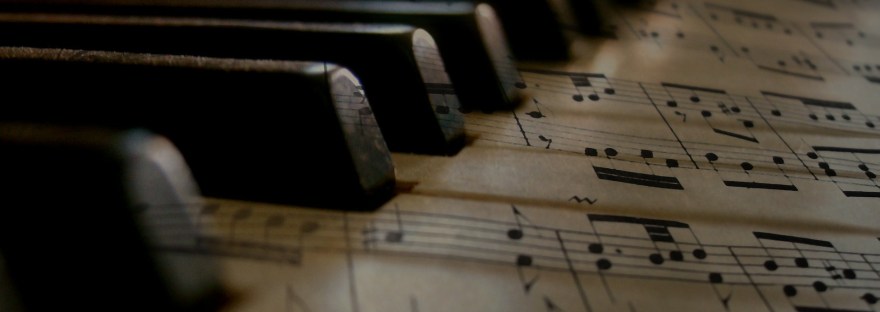
Image: A piano keyboard with written music flowing away from it. From Pixabay.com

 literally stories
Hi Geraint,
What I loved about this was it made me look!!
I didn’t find much but that’s not the point. It was believable.
All the very best my fine friend.
Hugh
LikeLike
A strangely mesmerising piece that, of course, raised all sorts of questions as to who and what. Laced with some lovely phrases, such as ‘ Polytonal put the kettle on.’ which made me lol! I liked it *a lot*.
LikeLike
Absolutely brilliant ending, a tone change as it were – hahahaha from peevish to downright spookily evily threatening. Ooer missus. Great stuff. dd
LikeLike
Geraint
The general increase of unease, from poor manners to fright moves this along like a nocturne. Wonderful word choices and that it says as much in such a short space is admirable.
Leila
LikeLike
Geraint
The situations and characters you create in your micro-fictions have a novelistic reach. You do in prose what Picasso tried to do in Analytical Cubism. Each of your pieces is a portrait – of more than one character.
All added up, your gallery of idiosyncratic and eccentric characters has a strange beauty to it that is one-of-a-kind. Walter Pater said great modern art is adding strangeness to beauty.
The genius creates things that have never been done before, and that is why it looks like madness to the rest of the world. “The world” can’t recognize what’s never existed before. It takes other geniuses to see it first. The world only catches on much later. In the meantime, such wholesale misunderstanding can indeed drive the genius mad. And I mean misunderstanding of the life, not the work. It’s to be expected that the work would be misunderstood and little understood – even after the genius is only here in spirit. Almost everyone who sees a genius in the flesh doesn’t know what they are. But they know they are something. Something different.
Dale
LikeLike
The narrative voice is pitch-perfect — anxious and menacing. The music theory spirals toward madness and builds dread. Excellent.
LikeLike
Thanks, all, for the generous comments.
LikeLike
Some kinda bad dude in town. Maybe jealous. Obsessed. Definitely mad about polytonal. Quite the snapshot.
LikeLike