
Long before Máire’s time, the village of Mallow was a peaceful settlement in Munster, its fields rich and its people rooted deep in the land. But in the late fifteenth century, calamity struck—a raid by an English militia descended like a plague.
The soldiers came under a moonless sky, burning crops and homes in ruthless fury. Families were torn apart, fields left to rot beneath ash and blood. The village was broken, and many whispered it was more than just war’s cruelty—that a curse had been cast, a shadow woven into the soil itself.
The O’Neils, as one of Mallow’s oldest families, were said to bear the brunt of this ruin. Some believed the Winter King’s court watched the devastation with grim interest, twisting sorrow into a kind of binding—an ancient price paid for old bargains made and forgotten.
Since that dark winter, Mallow has never truly healed. The winters grew harsher, the illness more relentless, and the people lived in the cold breath of that lingering curse. The woods around the village are said to murmur with the restless spirits of those lost—whispers of grief and vengeance tangled with fae magic, waiting still beneath the frost.
ƒ
They buried the last of her children on a wind-scoured morning in February, when the frost clung to the blackthorn like white lace and the sun hung low behind a veil of cloud. Máire O’Neil stood beside the open earth, her hands chapped and raw, holding the tiny wool cap he had worn in his final days. There were no tears left. Grief had settled in her marrow, heavy as lead.
The priest had long since gone to Cork, and the hedge mass-man had vanished after Christmas, so it was the old midwife, Bríd, who muttered a blessing in a mix of Latin and Munster Irish, casting herbs on the small, cold bundle. Bríd looked at Máire not with pity, but with something closer to fear. A man with a shovel stood nearby, out of ear-shot of the last few witnesses.
“That’s four,” someone whispered behind her. “The fever’s taken them all now. The O’Neils are fading.”
Máire heard them but did not turn. The villagers kept their distance—crossing themselves as they passed her in the lanes, leaving food at her doorstep, never staying long. Some said she was cursed. Others whispered she was watched by things older and colder than fever. Either way, they knew to keep away from the O’Neil widow with no children left to bury.
The cottage was too quiet now. Her husband’s pipe sat cold on the hearthstone. The cradle, carved from ash wood and once warmed by three babes in turn, rocked slightly whenever the wind stirred. No matter how tightly she lashed the shutters, it moved.
She stopped eating on the second day after the burial. On the fourth, she followed the slope beyond the potato fields, where the land grew stony and strange. Past the standing stone they called An Geata Glas, the Green Gate, though no green had grown near it in living memory. They said the fae passed through there in the old days. Said the O’Neils had once made a pact, long broken, long regretted.
Máire passed under its crooked shadow and didn’t look back.
She wandered until the brambles tore her skirts and her boots filled with moss. The trees thickened, oaks and yew tangled together, the sort of woods that didn’t belong entirely to this world. And there, where no birds sang and the air was sharp with the smell of cold iron and dying things, she sat at the roots of a twisted tree and wept—not with sound, but with silence so deep it seemed the world hushed to listen.
The snow began to fall—not the wet, earthbound flakes of Ireland, but dry, crystalline powder that shimmered as it landed. A rustling came from behind her, like a fox nosing through fallen leaves.
And then a voice, small and sharp as a sewing needle, said “My, my. You’re just the sort of sorrow he favors.”
Máire did not startle at the voice. Grief had scraped her hollow. She simply turned her head.
The creature crouched on a branch above her, picking at its nails with a bone needle. No taller than a child, though its limbs were wrong—too long, knees bent backward like a hare’s. Its cloak was stitched from scraps of linen and fur and moth-wing lace, and its face was puckered like a dried apple. One eye was gold and round as a coin; the other blinked sideways like a goat’s.
“You’ve come far, Ní Néill,” it said, testing her old name. “But then, your kind always does. The O’Neils are walkers-between. How else could you last this long with sorrow like yours?”
Máire looked at it without fear. “Are you the devil?”
The creature snorted. “Child, the devil plays fair. I am only what the King sends to mend things gone crooked.”
“The King of what?”
It bared its little teeth in something like a grin. “Of Ice and Ash. Of the Hollow Hall. Of the Once-Bright, Now-Bleeding Star, the Stolen One, if your tongue loves tragedy. I call him my liege. You may call him the Fae King, if your tongue prefers poetry.”
Máire stared at the falling snow. “And what does your king want from me?”
“Nothing,” it said, hopping down. “Or nearly nothing. He has long watched the O’Neils for reasons of his own. Yours is a house of interesting grief, I reckon. His court finds such legacies… useful.”
From its patchwork coat, it drew a bundle wrapped in frost-pale linen. It unfolded to reveal a loom—small enough to carry, made of pale yew wood etched with strange curling sigils. The frame was strung with threads that shimmered like spider silk under moonlight.
“A small mercy,” said the creature. “For your hands, to remember what your heart cannot hold. Anything you weave with these threads will take sickness from the body it touches. Wounds will close. Fevers will break. The dying may rise, if not too far gone.”
Máire stared. “Why? Why me?”
“Because you’ve nothing left to lose lass. And he’s curious what will come of you when you begin to forget.”
That stopped her. “Forget?”
The pooka’s grin widened. “Aye. It’s only fair really. Grief is weight you see. Healing is price. Every saint is a trade. Besides, your memories… they’ve lingered long. He wants to see what happens when they don’t.”
Máire looked down at the loom. Her hands trembled—not from cold, but from the sudden throb of possibility. If she couldn’t have her children back, perhaps someone else might keep theirs.
“And if I say no?”
“You won’t,” scoffed the pooka. “You O’Neils never do. You’re all stitched from the same thread.”
It held out the loom. The threads sang like a wind through bare branches.
Máire reached out—and took it.
They found her at the edge of the village come spring, seated on a stump with the loom across her lap, weaving by the light of a still-cold sun. The cloth that spilled from it shimmered like morning frost and smelled faintly of peat smoke and rain.
The first to approach was a farmer whose daughter had not spoken since the fever. Máire handed him a narrow sash of woven silver and green. He wrapped it around the child’s wrist. By dusk, she was speaking in soft murmurs, asking for porridge and her doll.
After that, they came in pairs, in droves. From Munster’s ragged hills and crooked towns, word spread: the widow O’Neil had been blessed—or else cursed—in a way that healed. Some came crawling. Some carried babies with ash-colored skin. Some brought coin; others, trinkets or bread or songs.
Máire asked for nothing.
The loom drank her hours. The warp and weft shifted with her thoughts, patterns emerging she did not understand—knots that hummed, braids that sparked faintly with light. When she asked the loom for a cure, it gave. When she tried to rest, it hummed restlessly, as if it hungered.
She hung the finished cloths on a line behind her cottage, weighed down with river stones to keep them from flying away. They glowed faintly in moonlight. Locals began leaving bits of lace or buttons on her windowsill, in thanks or reverence. The village priest, returned from Cork, would not enter her garden so jumbled were his thoughts. “Holy,” he muttered. “Or something close enough to worry me,” he’d say when asked.
And yet.
It began with a name.
She woke one morning unable to recall her daughter’s middle name. It hovered on her tongue, then vanished, like breath on glass. She wept, but the loom hummed gently behind her, and the thread pulled tight, and she wove through the sorrow.
Then she forgot the way her youngest had laughed. The sound, the shape of it. How her husband’s callused fingers felt when they brushed her cheek. Her eldest’s birthmark. Her baby’s lullaby. The cradle’s creak, now silent.
Dreams replaced memory. Dreams of faceless children standing in the doorway of her cottage, watching her with empty eyes. When she woke, her hands were always threaded with frost.
They began to call her Máire the Saint.
She did not correct them.
Tatterleaf returned once, curled upside down from the lintel like a bat.
“You’re popular now,” he chirped. “The King is very pleased. He says you’ve nearly outshone your great-grandmother.”
Máire looked at him without expression. “Did she forget, too?”
Tatterleaf only smiled, his sideways eye glinting. “Oh, dear. She forgot everything.”
And then he was gone.
She wove on.
Years passed as winter’s slow pulse, weaving silence into Máire’s life. The village healed, grew prosperous, and came to rely on the cloths that came from her loom—blessings she no longer fully understood. But on a chill morning when frost etched the windows with icy lace, the magic began to unravel.
A small boy, curious and fearless, slipped past Máire’s thin protests and reached out to touch the shimmering threads stretched taut across the loom. His fingers brushed the silver strands—and in an instant, a sharp crack echoed like breaking glass.
The boy recoiled, clutching a bleeding palm.
Máire’s breath caught.
The loom trembled, the shimmering threads dimmed and frayed, unraveling in slow, agonizing knots.
Her head spun with memories rushing in like a torrent—names, faces, laughter, cries—all the moments she had woven away, forgotten to save herself and others.
She saw the gleam of her children’s eyes again—now bright and clear, not blank. Felt the warmth of their touch, the softness of their breath on her skin.
But with the flood came the ache.
The fevered nights, the final goodbyes, the hollow silence of the empty hearth.
She staggered back as the threads snapped like brittle ice.
Outside, the village held its breath.
And through the trees, a cold wind whispered—a voice both sorrowful and amused.
The loom lay broken at her feet, its pale threads unraveling like the strands of her own memory. The village gathered beyond the hedgerows, silent and watchful, their faces carved from years of hope and fear.
Máire reached out, fingers trembling, and gathered the scattered threads into her hands. They shimmered faintly, warm as a heartbeat.
Tatterleaf appeared again, stepping from the shadowed woods, his mismatched eyes gleaming.
“The King awaits your answer,” he said softly. “To hold your memories or to lose them, for the sake of the village you’ve saved.”
Máire looked toward the distant hills, where frost still clung to the bare branches.
She thought of her children—their laughter now vivid as sunlight, and the ache of their loss sharp as the cold wind.
“I will not forget,” she said, voice steady. “But neither can I let this magic unravel all I am.”
She rose, the final threads slipping through her fingers like mist, and began to weave once more.
Not a cloth for the sick or dying, but a shroud—a final weaving to bind her sorrow, and to mark her passing from this world.
The villagers wept, but Máire smiled, a bittersweet curve.
As the last thread was tied, the snow began to fall again, soft and pure.
And when the morning came, the cottage was empty. The loom silent, its magic spent.
But in the winds that swept through Munster, the whispers remained—a story of a widow, a loom, and a bargain made beneath the winter sky.
* An 18th century story set in the Saga of the Stolen One world.
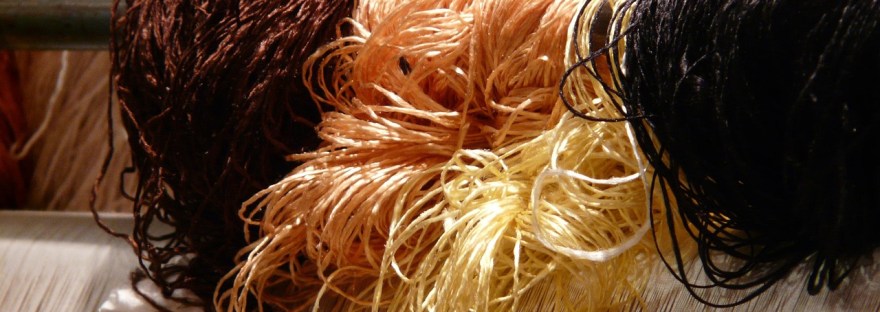
Image by Hans from Pixabay – threads for weaving in gold, bronze, black and brown, a little bit tangled.

 literally stories
Absolutely wonderful! Laden with just the right sort of detail to take the reader into that world and finished with a perfect ending. As fantasy stories go this is one of the best I’ve read for a long while.
LikeLiked by 1 person
I thought this was a beautifully told fable. The words transport the reader and centre them in the world of ‘maybe’ just as a good fantasy story should. great stuff – dd
LikeLiked by 1 person
A.A.
With so many writing about blended realities it is hard to stand out due to all the “noise,” But this one does the trick. Entertaining and engaging, plus a wonderfully weird little creature.
Leila
LikeLiked by 1 person