The hare has appeared, again. She is out and about.
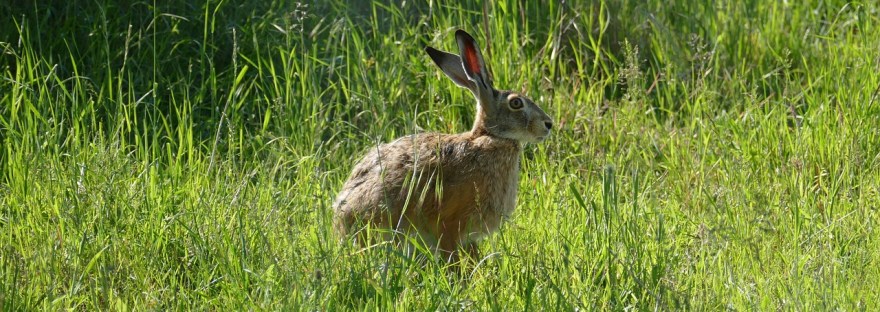
She sits back on her long, folded hind legs showing her profile to the onlookers in the static caravan a few yards away.
Motionless, Sphinx-like, you sense her alertness, her tingling nerves. Her senses are finely tuned to the coastal surroundings. The sky is reflected in her eyes, blue sky and green ocean blended, long ears full of sound beyond the human ear, her nostrils twitch and her webs of nerves process a myriad scents: salt spray, petroleum, tar and the pineapple bloom of yellow gorse. She faces west, inland, away from the waves sipping the steep shoreline at the base of the shingle bank behind her.
The animal takes a single step forward, slow, tender, soft, the left foot delicately lowered, the haunches extending, a coiled spring, then it raises itself again and pauses once more, unmoving, statuesque, sweeping the landscape through large unblinking eyes. Then the same with the right foot, bending, flexing, careful, forward motion. The whiskers bristle like antennae receiving radio from another world. Her chest moves in and out with intricate breathing, inhaling the evening air. A brown coating of short, combed hair glistens as the rays of the setting sun filter through the haze. The lantern of one of the two lighthouses, the old and the new, on the shale-coated spit of land, begins to revolve. Surf rakes and thuds on the shoreline, out of sight.
Hares, as you know, are creatures of myth and folklore, magical animals adorning heraldry, hunted by bloodthirsty horse-people, wolfed down by the customers of gamekeepers, celebrated and sometimes body-swapped by witches and wizards. They are one of Nature’s shape-shifters. Books have been written about them. There’s a Christian angle to much of it, not always angelic, though I myself would prefer a pagan provenance. The Buddha, god rest his soul, also has a notable stake in hare-lore: when Lord Indra was starving to death, Buddha turned into a hare and dove into a fire to roast himself for the great god to feed upon. Imagine! And then there are our Chinese neighbours, who regularly have a whole Year of the Hare to themselves. But let us not get carried away.
They love to hold boxing matches in springtime to try to impress each other or fend off unwanted attention. Everybody knows that. They are creatures of the twilight and the night. They can run like the wind, swift as the wind, if you can ever see them for dust. Don’t be late – kiss the hare’s foot. I expect you knew that in April the full moon is called the Hare Moon in rural parts of the country, and among some urbanites too, probably, and so it’s not for nothing that these wonderful beings are always in tune with the tides advancing and retreating on our shores under the moon’s seductive lure. One wonders, doesn’t one, about their connection too with human menstruation. Perhaps research into this has been undertaken, it’s more than likely. It’s the sort of thing they do.
The man in the caravan gingerly puts down his videocamera while the hare sits shimmering in the dusk through the window, processing the signals she is receiving from the surrounding terrain, or elsewhere. The woman and the daughter beside him stand watching, staring, unconsciously holding their breath, scared to move lest they disturb the apparition before them.
The spit of shingly land is dotted with a smattering of tar-painted cottages and small abandoned fishing boats pulled high up the slope from the water’s edge. Gardens are made of stone pillars, faded frayed ropes from fishing vessels, driftwood, pebbles, and triffid-like vegetation. Over it all, rears up the vast grey hulk of the advanced gas-cooled nuclear power station, giving off a symphonic hum. The one wind-blown stranded public house would be called The Old Ship Inn or The Buccaneer, or perhaps The Fisherman’s Arms.
None other than Aphrodite had a hare as her companion, a telling choice for the goddess of love. Symbolic. Iconic. The onlookers in the caravan were not scholars of ancient Greek mythology, unlike wayward poet-historian Robert Graves for example, with his white goddess, moon-mother and all that, but they could surely sense the bio-electric sensuality of the animal parading itself before them.
By now, I’m certain you’ll have been recalling the most famous song of recent times about these exquisite members of the animal kingdom, namely Year of the Hare, by the sadly under-rated Canadian avant-garde rock combo, Fucked Up. What’s in a name, eh? Not to be confused, by the way, with Year of the Cat, by good old Scottish Al Stewart with his plaintive English tones in a country that turns back time. Or, if you’re of a more rustic persuasion, you will have recalled Hares on the Mountain by traditional folk-singer Shirley Collins, who, coincidentally, resides to this day in the hilly town of Lewes (‘loo-iss’)in Sussex, southern England, with its prison, its St. Pancras Priory ruins (thank-you, Henry VIII), and its infamous annual bonfire night, a town I happen to know quite well. But wait.
As the onlookers watch, the hare begins to take a few more slow steps forward, shadowy as the dusk deepens round the arc of artificial yellow light cast from the caravan’s uncurtained window, as if called by some extra-terrestrial force. Her eyes glow brighter in the gathering gloom, taking on a turquoise hue. She takes one step, and then another, and another, rhythmic, deliberate, precise, each step exactly mirroring the former. She bends to nibble the grass in the way that normal hares do. She raises her head and sniffs the air, sensing who-knows-what vibrations. She knows the gaze of the spectators behind the window. The moon appears from behind a cloud and its light falls over the land.
The anatomy of a hare is a wonder to behold, the inner workings, the design. The skeleton is a work of kinetic sculpture, a Tinguely masterpiece, their musculature a work of pure da Vinci art. Almost, you might think, magical. No, magical. They are blessed with a diverse and highly adaptable locomotor repertoire. They can run – well, obviously – they can bound, jump, swerve, spin, dodge, leap, crouch, twist, twirl, turn, squat, swivel, spring, somersault, whirl, bend, bow, gyrate, gambol. They can gallop better than any clumsy equine beast. They can fly. They are acrobats as regards the air.
***
Agnieska arrives for the evening shift and enters the control room in Basement X1 of the humming power station. She takes off her coat, shakes her hair and greets Piotr and Magnus, already seated in white jackets in front of the array of flickering screens. Another day in the pit. Agnieska takes her seat and raises a quizzical eyebrow at the others. Piotr gestures at a dark screen showing a thin glowing green line of zig-zags and whorls on the background of a blurry map like a dark Jackson Pollock painted by a child. The cursor at the end of the sinuous line is blinking, bright, slow, stationary beside a grey oblong smudge the size of a fingernail. On, off; on, off; off, on.
Agnieska smiles, points. ‘Been out long?’
‘About half an hour,’ says Magnus.
‘Any hiccups?’
Piotr glances at a second screen, where long lists of codes and numbers accompanied by oscillating lines scroll upward in a continuous flow. ‘All functions within range,’ he says. ‘Five-02 had a couple of mini-peaks, nothing off the chart.’ He picks up a styrofoam cup of coffee and sips.
‘Been busy at all?’
‘Slow so far, keeping an eye out, focusing, harmonising, sensors all in sync,’ says Magnus.
Agnieska nods, puts on her spectacles and gazes at the blinking cursor.
The operatives are silent for minute.
Some old cultures forbade the consumption of hares as food: warrior tribes believed their shyness and propensity to run away from danger would permeate their own beings and make them weak. As I was reading one day. There’ve been other examples, haven’t there, of this contagion between edible animals and humans. Take caviar, for instance. Or fore-leg of the ox. In medieval Britain it was bad luck also to call the leporine by its name Hare, hence sly nicknames abounded: light-foot, slink-away, lurker in ditches, wall-eye, the skulker, the sitter-still, the dew-hopper, and many more. Colourful vocabulary those peasants came up with, didn’t they?
‘Warming up then,’ says Agnieska.
The blinking green dot on the screen begins shimmering and slowly moves toward the screen’s left edge by a centimetre, then another, trailing the green string as it goes, then stops, again. The oscillations grow tighter and sharper-peaked on Piotr’s scrolling screen. Numbers revolve in the digital stream.
Magnus surveys the array of knobs, lights, sliders and levers on the control board in front of him, looking like the sound engineer for a rock show about to start, and carefully pushes a small lever up from 5 to 7 between his thumb and forefinger. He sees his two colleagues nodding while they watch the green cursor. The lever legend indicates a CCX-O* command.
Outside on the shingle, the humming power station’s orange security lighting and the moon’s pale rays cast a lurid glow over the landscape.
The caravanners watch the hare move, in silence. The girl thinks the hare is watching her with its big left eye, she shivers, she thinks it’s reading her mind; the woman puts her arm round the girl’s shoulder.
The hare turns her face toward the onlookers. Her eyes glow a brighter blue-green in the gloom. She takes a step toward the caravan window and sits again. Something is going on inside her beautifully-tuned brain.
‘What’s the autonomy setting?’ asks Agnieska. Magnus checks the monitor – ‘only two-point-two.’
‘Anyone in the caravan?’ asks Piotr. ‘Positive presence,’ says Magnus, checking the heat sensors’ output reading, ‘two, maybe three. Near the side window.’
‘Let’s see how she’s feeling,’ says Agnieska. Magnus nods and pushes a slider upward on the control deck. The blinking green cursor grows brighter and bigger. Magnus, concentrating, head bowed, adjusts more knobs and sliders.
What brain the hare must have been endowed with to be able to perform their life-or-death tricks. What mesh of synapses, neuron load, cerebellar tuning, neural filigree, what lightning-fast motor control, reflexes, what sophistication of auditory and olfactory engineering – hearing and smelling, to you and me. Another thing about hares is they’re rarely seen these days; should you spot one, you should consider yourself lucky, blessed, in fact. You should hum to yourself one of the hare-songs.
The onlookers watch as the shingle-hare raises a foot and licks it. Her ears begin rotating back and forth – obviously, the watchers correctly think, scouring the surroundings for any unusual sound or sign of danger. Her nose bristles as her olfactory sense is raised, heightened. The caravanners register that something is being made ready. She lopes forward, turns and lopes back. Suddenly she sits up on her haunches, ears erect, front feet dangling, her head turning this way and that, neuro-motor system running, senses tingling, almost audible.
She has become electric. She feels alive.
The girl in the caravan imagines a stealthy fox creeping round the distant edge of the shingle under the lurid light. Warning: danger.
The hare scans the scrubby vegetation of the shingle and looks over toward the power station’s hulk. The hum seems louder. You can hear it in the caravan.
Then.
The hare rears up on her hind legs, every finely programmed instinctual function on high alert. She launches herself into the air, her hind legs like pistons, she jumps, spins, somersaults, bounds like a gazelle over the wire fence, and soars back again, her rear-end bouncing up and down as she gallops around and around, swerving, see-sawing, twisting and turning, cavorting, athletic, acrobatic, impossible to catch, every sinew straining, every muscle and tendon activated, every neural cell glowing, turquoise eyes shining, radiant, triumphant.
In front of the blinking screens of Basement X1, Agnieska, Magnus and Piotr are smiling.
*CCX-O: cerebro-cortex/olfactory
Image by VinaConstanze from Pixabay – A brown hare in the grass

 literally stories
I find this mesmerising. the pace of it is finely tuned and perfect. Right from the beginning there is a strange air of threat, I think, which builds throughout. The vocabulary is spell binding. Altogether stunning. dd
LikeLike
Thank you, Diane – glad you enjoyed the hare’s outing. Thanks also for the brown hare image , in a perfect profile! best, A.
LikeLike
Alex, good to see another one of yours! Quite right: there is something magical about a hare. And well achieved, especially in sighting her beside Dungeness nuclear power station. I count myself fortunate to live not far from Ben Chonzie, famous for its mountain hares with their magical ability to turn snow-white in winter. bw mick
LikeLike
Hi Mick, nice to hear from you and thanks for your thoughts on this. Glad you identified Dungeness – one of my favourite places (where I did once spend an entrancing half-hour watching a hare…). Thought you might also notice a couple of sly references to the ISB. Lucky you – I’ve never seen a a mountain hare. Cheers, Alex
LikeLike
Alex
Your work is always mesmerizing. Be it Swans or Hares–exquisitely presented and thought out.
Leila
LikeLike
Many thanks Leila, another one from the famous spam folder ! 🙂
LikeLike
What begins as a lyrical meditation that blends natural observation and mythology becomes a chilling commentary on surveillance, control, and humanity’s manipulation of nature. I’ll never look at hares the same again!
LikeLike
Thank you, David, yes indeed, modern tech reaches places undreamt of in our old mythologies!
LikeLike
Very nice indeed! At first I thought, of course, it was a well paced meditation on hare related folklore but then the setting began to make its presence known and suddenly it all turned and twisted, like the hare itself. An absolutely excellent piece on which to end the week!
LikeLike
Many thanks, Steven. Glad you enjoyed – twisting like the hare itself – ha! – yes. best wishes
LikeLike
Intricate and labyrinthian description that seems natural and scientific at the same time, and we know why by the end. From the first mention of the nuclear power plant, I knew something was up! It was such a contrasting image to the naturalness of the surroundings. This made the story quite sad for me. Very well written, though, weaving the hare, the caravan watchers, and the power plant staff together in a strange connection. Each is perceiving something very different. The irony of course is that they piece seems quite mystic throughout, the hares described as “creatures of myth and folklore” We’re drawn into this by the skill of the writer’s description. This story gives a different, absurdist spin on the Van Morrison song “Into the Mystic.”
LikeLike
Hi Alex,
Like Diane I was also mesmerized by your lyrical language and presentation. There are so many good bits – including the story itself! The digressions into music, folklore, mythology, and astrology (I’ve keen interest – having been born in the year of the rabbit 🙂 make for a lovely syntax in the story and keep our minds alert! And all the while foreshadowing the sinister, out of sight technological demons.
There are many lines I really like and this is just one…“Surf rakes and thuds on the shoreline, out of sight.”
Thanks for an enjoyable read.
My best,
Maria
LikeLike
PS… sorry… this line needs another parenthesis ! (I’ve keen interest – having been born in the year of the rabbit)
LikeLike