
Tonight Jack would talk to the ghost. He took to the street. The warm wind is blowing on his face. Splash—pound—Nikes scrape the edge of a curb. Whoa that was close. He lets his mind wander down into his feet. His mind is splash-pound.
Running at night made him feel like a character in a black and white movie. Especially, when the headlights lit him up. Like he was on the silver screen. A swift street pounding shadow—getting farther from home. Red then green shiny streets reflecting in the stoplight, then the night pauses on yellow. Steam coming up from the sewer grates. A hungry rat comes up for air.
Jack thinks, better hurry the rain’s coming again, then—so what if it does… His course takes him toward the warehouses and factories. A deeper thickening of pollution—in a way it’s comforting.
The blue bus light winks on a faulty circuit on Edsall Avenue, across from a defunct arcade. A gigantic purple and green centipede sign smiles and slithers across the roof with a splintered hole—maybe from a shotgun.
Would Jack see the ghost? Like he has been seeing him for the last five nights. Jack thinks about probabilities and “A Coin Flip” study goes through his mind. Will it be heads again for an even six nights straight? Jack works in statistics. He is an insurance actuary just like his deceased father was before him.
His chest tightens. The blue flickering light is approaching. A mammoth is coming. Air rushing into the brake cylinders—Tsss…Red lights flash and a door clanks open. The city bus stays and seems to take a deep breath. Tsss…It trundles away like a sad giant, toiling endlessly, thanklessly. Jack smells diesel fumes and sees stark white faces lit up—going to some drudgery or leaving one.
A familiar figure with rounded shoulders is sitting alone under the flashing blue light. The color fades. Rain drops like black ink hit the halo of a streetlight. The idea of a black and white movie comes again, so in this winding-down time, impossibilities and probabilities merge casting shadows over reality.
Jack’s dead father is sitting there. Jack feels a sharp pain in his upper back. He thinks he might suffer a heart attack. Jack, the insurance actuary, quickly calculates the odds of dying: 41, male, running in the urban darkness, low traffic, high crime, light supper, slip and fall rain, one daily bowel movement (Metamucil), blood pressure (elevated, Zestril), family health—fair—all this going through his head faster than an IBM.
Sitting in the hard flickering light on a bench, Jack’s dead father waits to catch the Night Owl bus like he always had, escaping his insurance actuary tables and spreadsheets. He is still a workaholic, even in death.
Jack’s plan of speaking to the ghost was harder than he thought, as he slowed up, more breathless from apprehension than running, fear crept into him like an ice sickle dripping down his neck, maybe that was the rain. The menacing urban silence is broken by a distant screaming siren—that’s better. It’s comforting, like the pollution. Some violence is taking place or a car accident. Jack calculates the odds of death by murder. A US Census table of city demographics flashes through his mind. A dog is barking and more join in like they too, are hearing death.
The apparition wore the same clothes they buried him in. A black suit, somewhat undertaker creepy once it was on him and a little baggy. His sandy hair incorrectly parted on the left side. A little too much white base on his cheeks, making his lips look too red and lively like a hood in a “Great Gatsby” gin joint. Then the color bleeds out of the lips and they are white. The rain stops and the night goes back on pause.
Jack looks down at the neon green swoops of his Nikes. He straightens his yellow Adidas shorts, and fluorescent green T-shirt with the silhouette of a runner. His reflective wristbands are dripping sweat and raindrops. He steps forward within his father’s graveyard shadow.
All the color bleeds out of Jack’s bright clothes that are picked to keep him from becoming roadkill—even his tan is gone. Jack studies the black hairs on his white arm seeing a dark vein standing out running under his wrist band. The damp shirt and his sweat catches an icy breeze. As if the open bus stop shelter of glass and steel is air-conditioned. Goosebumps rise on his arms. If he had hackles, they would be standing. Jack steps into the bus shelter.
People at bus stops don’t always want conversation, especially at night, and from lunatics with wild supernatural ideas. All they want is a safe bus ride home in their lumbering giant to whatever or whomever waited for them. A slab of cold pizza and a slice of TV. Jack thought, why am I getting twisted? He is a ghost.
“Hello,” Jack studies the man. Maybe he wasn’t his father?
“Hello,” The man has a pleasant look on his face, and Jack realizes the stranger looks younger than his deceased father—younger than Jack is now. How could Jack think this man was his father?
A clunky musician’s case sat by the man’s feet. He looks at Jack and his eyes are his father’s. They are deep sad wells of a dawning failure, and the circles are just starting. “Are you going to Kalamazoo?” He smiles the same crooked smile as his father’s. Showing the familiar slight gap in his teeth.
“What?” Jack’s chest gets tight again. How many times had his father said that when Jack was a kid on his bike or skateboard? He swallows hard, and automatically says, “Nah, I’m takin’ the number seven to Cleveland.” Jack almost adds, Dad.
The man smiles. This is the correct response to an inside joke and he whistles a sad tune. Jack heard it before, hard to place, something to do with summers long ago. It might be, “Danny Boy,” Jack hums along. “The pipes the pipes are calling…” A sadness overtakes him and loosens some inner wall, and suddenly he thinks he might cry.
The man crosses his legs, feels in his coat pocket, and Jack knew a stick of Wrigley’s spearmint gum would be presented. “Like a stick of gum?”
“No, thanks.” Jack says wiping at his eyes like it was the rain. He would have taken it, but gum from a ghost in funeral clothes didn’t appeal. Then he thought, no this is ridiculous. He is just some lonely guy commuting home after another long day of drudgery in the cubicle, figuring out insurance actuary tables.
Jack realizes he has named his father’s past profession. A spooky, cold job that his father delighted in doing, Saying odd things at the dinner table, about being a .03 chance one of them would choke to death on chicken, but a .05 chance on steak. Jack has followed in his father’s footsteps. Working at the insurance company in a long line of desks, much like a famous picture of the writer Franz Kafka, except Jack has a bright computer screen. After tonight Jack will start calculating the odds of people returning from the grave.
Jack saw a Sears price tag dangling from his father’s left cuff. Fright cuts through Jack in a bright stomach dropping realization. Jack bought that suit. His mother pulled it off the rack arguing with Jack about the color, six months ago. Jack wanted a blue suit. Even though the light is poor and flickering Jack notices, the man isn’t wearing the silver wedding band. Jack could see it was not there when he offered the gum. Did the undertaker steal it? That damn ghoul.
“What kind of instrument do you play?” Even though Jack knew because his father always played a trumpet out in the garage. Where Jack’s mother exiled him, and then yelled in her best nagging voice, Come on Johnny it’s late… The neighbors are gonna call the cops, again!
“Trumpet.” says Jack’s father, the ghost. Jack examines the case. It’s shiny. The one in the garage was beat up with scarred stickers slapped on to it from places like Wabash, Lansing, Bloomington, and, of course, Kalamazoo. He hopes his mother hasn’t dumped it at Goodwill. “Ahem,” he clears his throat. “Would you like to hear me play?” A ghastly white tongue wets his lips.
This reminds Jack of having morning coffee with his wife, writing his little stories, as she Face-booked. The same eagerness in his voice, “Ahem,” clearing his throat, “Would you like to hear a quick story? It’s just a thousand words.” She declined most of the time, saying she couldn’t focus on a story, too early, or not enough coffee or… etc. When she did. Jack used different voices to make his convoluted tales sound better. Like lowering his voice for the corrupt copper mine official, raising it for the glad-handing Girl Scout…
The ghost (if he was a ghost) opens the case. The trumpet catches the streetlight in a magical golden glint… then the color drifts away like smoke, and it is dull and dented, almost bone white. Something to wake the dead for revelry. “I’m going to play some Chet Baker in E-flat.”
His father, in his funeral suit from Sears, at the bus stop raises the trumpet. Something biblical in the motion like a priest and a ritual. All the eagerness in his eyes, white stiff lips press the trumpet’s mouthpiece. Funeral rouge cheeks expands. Jack hopes the music from the other side will be blissful—smooth—like Miles Davis or Charley “Bird” Parker. The heroes of the blues and jazz, his father chased his entire uneventful life.
The horn-blower plows through the notes, honking his way up the scale, screeching and squelching off key and so unearthly loud that Jack starts back peddling, and runs from the terrible racket. His Nike’s slapping the wet pavement! The chaotic-cacophony, now mixed with all the neighborhood dogs howling. Then it stops. A voice calls, “Slow down Jack! You have a .069 chance of dying of a heart attack at age 41, when running at 13 miles per hour. Watch out for the airplane!”
Jack hears funeral taps, and he looks back and sees something black rising from the bus stop’s blue oasis of light, like haunted, angry failure.
The next night the stars are shining and swirling in the pollution like Van Gogh’s Starry Night… Jack’s feet are not pounding the gutters. They are resting on his La-Z-Boy chair’s footboard with the colored afghan on his legs like an old man, writing the story of his father. The Ghost. “Ahem… Judy.”
Judy gives him a wary look. “What?”
“Would you like to hear a story about my father?”
She refuses to look him in the eye, shifting in her matching green La-Z-Boy, looking back at her phone. A kangaroo is bouncing and boxing at a barking dog. “Nah.”
Jack is disappointed and slams his laptop shut. He thinks of the last words the ghost spoke to him. Watch out for the airplane! He stares at Judy who is smiling, then she chuckles at the kangaroo and dog fighting. Jack frowns. “You know just sitting there… You have a .0086 chance of a 747 crashing and blowing you to hell.”
She looks up from her phone. Judy is very hurt, she yells, “So do you!”
Jack’s on the wet street. His Nike’s are splash-pound, splash-pound, splash-pound. He’s taking an early morning business flight to Detroit. There is a .0066 chance… He squashes the thought with a sprinting burst and strides past the empty bus stop on Edsall Street.
The sun is shining gloriously at Midway Airport in Chicago. Once they are in the air, the sky goes from light blue to dark blue, then black. The cabin lights turn on like it’s nighttime. A storm blows down off of Lake Michigan. The old timers would call it a “Heller.” Twenty-foot waves are tossing ships like toys. The plane rumbles under his seat, sheet metal is straining in the walls, heads of hair shake in a sort of blurry unison. They are rushing higher and higher like they are riding a roller coaster that is climbing and climbing almost straight up, for a vertical plunge.
A woman sitting next to Jack smiles and says, “Ooh, golly.” She genuflects with red fingernails and grips the armrest. “I’m Ann.” She has a Wisconsin accent and laughs, “I’m from Oshkosh, B’gosh.”
Everything smooths out, and there is a loud cheer! The black sky is tinted with an ominous yellow like it has contracted malaria. Then another wicked bout of shaking wind-shearing turbulence—they’re not out of it yet. A loud bone jarring bang hits somewhere near the tail-end. Jack looks out the window and sees a white triangle flashing through the black sky. He can even make out AIRBUS-AIRBUS-AIRBUS… The jet lurches down filling up space with its tonnage. Then straight down. His stomach is in his throat and never leaves it.
His father is sitting beside him. He is the screaming face of Ann, “Are you going to Kalamazoo?”
“Nah, I’m takin’ the No. 7 to Cleveland.”
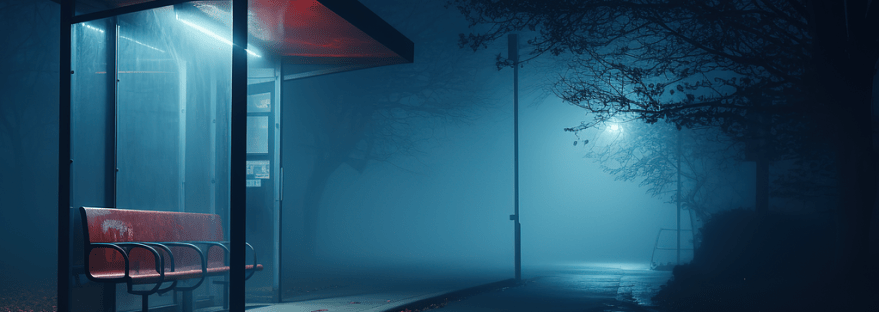
Image: Bus stop at night in the mist on a lonely road by Vlad Aivazovsky from Pixabay


Christopher
This messes with my mind, which is usually pretty messed up to begin with and has been since, say, 1968. Still, instead of trying to force a literal meaning, I find that letting it happen to me is the way to go. Absurd, moving, and a bit OCD, it is brilliant. Especially the little stuff like “ice sickle.” You are either a brilliant, perhaps great writer emerging, or you are pimping us like a Roy Batty figure from the future (I can mess write back, he heh). I figure the former, but such tends to pay the same wages of the latter.
Great work
Leila
LikeLike
Hi Leila
Always great to hear your take on my stories! It’s wonderful to hear, it messed with you. Lol. I think I’m in the same boat–a cabin or probably a tiny room over, perhaps even stowing away on this vessel cruising out of the sixties, sadly missing Woodstock.
Thanks so much for your excellent comments!
CJA
LikeLike
Christopher
Anyone who reads this tale and doesn’t feel mesmerized by it needs to either wake up or possibly check themselves for a pulse. This story makes the very supernatural itself feel natural and that is a story-telling trick accomplished by few other writers. Among the Americans, Nathaniel Hawthorne, Washington Irving, Leila Allison are able to do this – and you. The reader feels like they’re in the real world and yet it’s haunting as hell and the ghost is real. The “hell” here feels like the meaninglessness, or the pointlessness, of modern life. I read somewhere the other day about the suicide epidemic among American males aged 18 to 35. The vast majority of them cite things like “useless” and “pointless” in their suicide notes. And yet this father is still alive; has returned from the grave bearing messages for his son.
Your short stories are so nuanced and subtle that they are story-telling miracles, almost. Being subtle and having nuance are not skills that are loudly applauded by society for the most part, but they are the things that make for great story-telling art, because they lead to mystery, and MYSTERY is the essence of life. This is a mystery story that tells a story about life’s deepest mysteries of all.
The CLARITY in your writing is almost beyond compare (again Leila comes to mind). You write beautiful sentences that are also almost invisible in the sense that they serve their narrative function first and THEN are beautiful. Again, it reminds me of some of Nathaniel Hawthorne’s best short stories.
The father character and the main character in this story both remind me of Bartleby in Herman Melville’s great short story, “Bartleby, the Scrivener.”
Your tales are non-ideological, non-dogmatic. They don’t drag a bunch of stale, preconceived ideas and opinions about the state of the world after them in their wake. Again, it has to do with mystery, the mystery of life, and capturing that for the reader. Your stories are built upon deep, true, realistic characters, and you never let them off the hook just as you never condemn nor judge them. I think you learned this from Chekhov, at least in part. Brilliant!
This tale is almost karmic, maybe about how we will (“will” as a verb) our own fates. Maybe…
The subtle and nuanced humor in all your stories is also one of their defining features.
The matching pairs of the closet artists (father and son) and the bored and/or angry audiences (both of the wife characters) is an amazing twist.
You have the ability to create an entire character in a few lines, sometimes just within a single thing they said. Shakespeare does this too, as does Chekhov. (Not that any of us are Shakespeare, but yes that this is a Shakespearean attribute!)
A brilliant story, worth many, many re-readings! Haunting, enchanting, entrancing, thought-provoking, soul-exploring, death-exploring, death-defying, and more…
Dale
PS
The non-dogmatic, non-ideological, non-opinionated nature of your stories cannot be emphasized enough. Stalin ruined Russian prose and Russian fiction by making all the writers write ideological and dogmatic works…Chekhov is the key, the anti-Stalin who understood the mystery of being human!…
LikeLike
Hi Dale
Thank you for your close reading and analysis of this story!
These other authors you mentioned including Leila, are fine company to be in so thank you again!
Hawthorne really sets a high bar. His stories have the dark wilderness crouching down on people. Love that, lol.
“Bartleby, the Scrivener.” I need to read this again.
I’m glad it came across as clear. That’s one of my big goals as a writer, usually opting for shorter sentences. And with that mantra of “show don’t tell”and use the active voice.
I liked how you described “Hell.” “Pointless and meaningless” A terrible statistic about these young people. The undertow that carries people away. I’m not too sure if I haven’t spent spans of time in this place too. Writing seems to counter it.
Characters are tricky people. Drawing them with a few details and making them alive is the crux. How many brush strokes until the painting is a blur? I think in writing, showing a character is one of the biggest challenges. Because even though they may mimic a living person (hopefully not a stereo type), getting them breathing across the page is something that can be brow beating, but also rewarding.
That sounds awful about Stalin and his lousy crackdown on the arts and religion. A truly Godless person–State sponsored–literal Godlessness. He was right up there with Hitler. Someone says that every five seconds but it’s true. lol.
Thanks for your great comments!
Christopher
LikeLike
Christopher
Your characters are so real they seem like real people. They really do!
That business about the wife and mother character banishing her trumpet-playing husband to the garage and still yelling at him to shut the hell up is hilarious, and real, and true!
And then the cycle/s repeat, like they do in life, as the writer tries to read a short short story to his wife and is told No Thanks. And then his reaction, and then her reaction to him (“So do you!”) is all so real that it seems really REAL (and true). And all your stories are FILLED TO BURSTING with moments like these.
It makes me think of the Mona Lisa. She’s just sitting there. So plain and yet so mysterious that she became the most famous painting in the world. Bob Dylan said, “Mona Lisa musta had the highway blues, you can tell by the way she smiles.” And yet that smile is a small smile, a subtle smile, a tiny smile, a smile of the eyes more than anything else, a smile that sometimes looks like it isn’t even there at all. Subtlety and nuance are the way to go, and your writing is masterful at this!
Dale
PS
Another example would be Michelangelo’s statue David and the look in his eyes right before he throws the stone that will bring Goliath the giant straight down.
LikeLike
Hi Dale
You know it’s funny (and excellent) where you pointed out how the women in Jack’s life are basically the same. A sort of rejection and approval seeking mold that he learned from his father and mother. I wish I could take credit for the advanced thinking and observation you made, not even realizing the deeper meaning of his wife being like his mother. I knew Jack was quite a bit like his father. What drove him, but what you said about the mother and his wife being alike is great. I can see in hindsight how that could work. Glad it turned out like that.
I think people who read stories think the writer is in complete control, like they are God (for good or bad), but I’m not sure that is the case. When writing and changing things draft after draft until the picture gets as clear as I can make and the plot holes are filled-things become blurry again in the repetition. I can see why Carver dropped his stories in the drawer for a few weeks. Then read them again–cold.
The deeper psychology of a story may be there in the unconscious mind, but all the connections might not be conscious.
Stephen King said stories are “found things, like fossils in the ground.”
Happy the characters are life-like–that is so important. It’s good to hear subtle vs heavy handed.
Yes, Mona Lisa is full of a lovely mystery. Cool Dylan description. Here eyes are almost playful. She doesn’t seem pretentious, but not common either.
My Dad used to say Princess Diana was ornery the way she smiled. I could tell how much he liked her. A beauty in a different way.
Wow that sounds incredible about M.A’s” statue of David. That is a very clear image. I can see it without seeing it!
Thanks for your truly great comments!
Christopher
LikeLike
First thing I thought David Lynch Twin Peaks
So many connections – Former actuary notes little in common with my work.
Sharon went to college in Kalamazoo and was an actuary originally from north of Detroit.
Late sister and live brother in law in the Chicago area.
LikeLike
I read on here or maybe Saragun Springs, that you were an Insurance Actuary and you worked in statistics. I thought about writing you in as the MC, but I didn’t’ want to get sued or something. Bizarre all of the co-incidents.
LikeLike
Very well-written. The use of colors in the imagery was excellent and drew me in. Love the ending. I think the MC will have an eternity to spend with his father. Or not.
LikeLike
Thanks for your comments, glad it came across well!
LikeLike
Okie doke.
LikeLike
A deliciously noirish and superbly written ghost story – I was so hoping he wouldn’t take the plane but I should’ve realised a happy ending was not on the cards!
LikeLike
Thanks for reading and for your kind comments!
LikeLike
At first I thought how comforting it might be to have another chance to see a dead relative, but, of course, it wasn’t, was it? I wonder how many of us would heed the warning. I have a suspicion that it wouldn’t be many. Another well written and enthralling story from your keyboard. Thank you – dd
LikeLike
Yes meeting the relatives again besides in dreams might be complicated. They may know too many things from the other side. Thanks for your kind comments! CJA
LikeLike
PS: Love the image for this story! Couldn’t be any better!
LikeLike
Hi Christopher,
It would be easy to say that this was one for the Metaphor Hunters. I think that the life / death what was known / what was hinted to / is an absolute masterclass on balance of story.
That balance is even more brilliant when we realise that every reader will take something different out of this.
The imagery and actuality that you have given the reader is something to behold!!!
All the very best my fine friend.
Hugh
LikeLike
Hi Hugh
Thank you for this! It’s great to keep learning the craft and receiving feedback. Your thoughts on balance are very insightful. I like the idea that a reader might get a different take on the story.
Best
Christopher
LikeLike
Hi Christopher.
To be honest, I can only spot balance when it’s done very well, or done very badly!!
You my friend – Do it very well!!!!!
Hugh
LikeLike
Thanks Hugh!
LikeLike
Mysterious multi textured tale of randomness and synchronicity… Jack doesn’t know it, but he too is going to become a ghost…his Dad tried to warn him! His trumpet sounded like a crashing plane, and then there was the voice. Jack just kept pushing on to the plane. I like the way Jack blends and changes with the ambiance at the bus shelter. We just never know what’s going to happen next, the odds are good to know, but nothing’s certain until it happens.
LikeLike
Hi Harrison
Yes, life is a runaway train…or jetliner. It’s going to crash, but when?
I was hoping to effectively use color and subtract it. Glad it worked!
Great description of his trumpet sounding like a crashing plane.
Thanks for your excellent comments!
Christopher
LikeLike
Hi Christopher, I’m late with my readings, and all i can say is – all of the above – a true film noir – intense, engaging and full of surprise turns for me. Thanks for a great read.
my best, Maria
LikeLiked by 1 person
Hi Maria
Glad you stopped by!
Thanks so much for your kind comments!
Best
Christopher
LikeLike