
The art of projection, in this instance, involves an ingenious contraption that allows me to float above ground while speaking grave truths to those I’ve been hired to frighten. Or to comfort. Or to confuse, as the case may be. Sometimes silence is all that’s required, but silence of a special kind, needless to say, the kind they call ‘loaded’, the kind that towers, or otherwise makes a portentous impression. Ghost is what I do. It’s a living, if you’ll pardon the expression; and a good one too, in that those who require my services, being usually very rich, pay very well. I’m familiar with the interiors of castles, manor-houses, hunting lodges, theatres, the odd inn. I’m given the requirements, told what manner of ghost it is needs to haunt the place, and adapt accordingly. Doubtless, to your bodily eyes, at this moment, I appear little more than a tallish man, bearded, bald and middle-aged, but trust me, when I’m clad in dusty servant’s garb or bedecked in faded finery, my face moon-pale, I’m altogether more imposing, unsettling – especially if observed from a short distance. Should a haunting entail my having to speak, I learn the words given me, no matter the language, and intone or croak or mutter or bellow in whatever accent is most appropriate. I’ve made cryptic pronouncements in Old French, I’ve made cryptic pronouncements in Latin; I’ve cursed in Swedish, foretold ill fortune in Gaelic. I’ve been a judge who was hanged for murder, I’ve been a minstrel who drowned in a moat; I’ve even been a dead gravedigger, one said to haunt a particular cemetery adjacent to a certain cathedral. It wouldn’t do to be too specific. As I say, ghost is what I do. But never, never have I knowingly been party to any kind of plot or conspiracy or such like. My involvement in matters was always necessarily limited to brief appearances, a few words here, a protracted silence there. I was not privy to the wider machinations of those who engaged my services.
When the young woman first approached me, I was wary. Very. When she named the sum I would be paid for my ‘appearance’, I was astonished, endeavored not to show it, naturally, and, not unnaturally, accepted the offer. It all seemed simple enough: I had merely to appear among the turrets at some point gone midnight, my robed figure shrouded in fog; each appearance was to last no longer than a minute at most.
What can I say, the young woman was very persuasive. Her manner was direct, but not without humour, and the explanation she spun around this particular haunting was convincing enough, otherwise I’d not have taken it on. She was ‘spirited’, as they say, and I’ve no doubt she’d berate me for using just that word, patronizing as it is. That, in fact, was very much the issue at hand. Men, she said, were fools, and she’d a prank to play that would show them up for the fools they were. I’d not the nous, at that point, to consider whether this view might also apply to me. She had everything prepared: my costume, my wig, the face I was to wear. The Projectionator would do the rest, and I’d float for the apportioned time, as agreed. My first and second showings were witnessed by the very persons I’d been hired to frighten; all went well. What I had not anticipated was that, following my two showings, I would be required to make one last nocturnal appearance, during which I was to deliver a barrage of words – to a man already more than half convinced that I was the spirit of his dearly departed father. As I think I mentioned, I’m no stranger to cryptic declamations, gnomic utterances, but the words given me on this occasion far exceeded the number of words given me on other assignments. I’d no problem with the memorizing of said words, but I was more than mildly perturbed by their meaning – at least as much of them as I was able to comprehend. There are words, and there are words, but these were of a different order altogether. Initially, I don’t mind telling you, I demurred, sensing in it all something more than untoward; but once again, though for the very last time, the fee on offer was a little too high for me to decline. How the young woman came by such sums, I did not ask, wouldn’t have presumed to do so; none of my business.
And so it was I appeared in the interminable fog once again, and spoke the speech given me. I did not think to question the content. Mention of murder, dastardly deeds and so forth are not so unusual in my line of work – though the sheer specificity of deeds described should have given me pause. I’d certainly no inkling of how incendiary the words might prove to be. I spoke them, was paid my fee, after which I departed, and was glad to do so. Repercussions, ramifications, consequences: these did not enter the equation. I go where the work is. I’m good at what I do, as I’m sure any number of those whose dwellings I’ve haunted would attest. But never again, I can assure you, will I allow myself to be so used, so played-upon, and by one so young, and so apparently artless, fresh-faced, candid, direct – if also humorous. Very persuasive, as I say. But then, as she said, men are fools, victims of their own emotions, all too happy to be thought creatures of Reason. I, it seems, was simply another fool. She was, as I say, young. I called her Miss. She addressed me as ‘Sir’ – though it has to be said with a hint of sneer in the pronunciation. Drop the ‘Miss’, just call me Ophelia, she’d say. A modern young woman; there’s a lot of it about. I’m old-school, however, and ‘Miss’ she remained. That any of it happened at all is quite beyond me. As I say, repercussions, reverberations, these did not enter the equation.
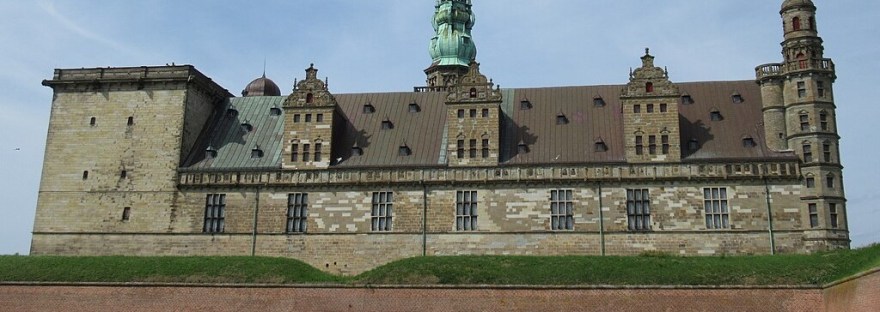
Image: the battlements at Elsinor by Superchilum, CC BY-SA 4.0 https://creativecommons.org/licenses/by-sa/4.0, via Wikimedia Commons

 literally stories
Hi Geraint,
I really enjoyed this but I didn’t understand the ending. The only thing I could think on it was maybe a ‘Will the Quill’ reference. I took that from the mention of ‘Ophelia’.
But I have no idea where it ties into her getting one over on all the men.
But like any good story this more than held it’s own even with my reader shortcomings!!
You are piecing together a fine body of work.
It’s always a pleasure my fine friend.
Hugh
LikeLike
Thanks Hugh, much appreciated. I can’t seem to leave that quill bearer alone. Whereas in a little bookshop called Atticus – here in Lancaster – an attempt was once made to get in touch with the old boy via the Ouija board!
LikeLike
One of my favourite plays (not that I know as much about the Bard as you do obviously do.) But poor nutty Ophelia, was she a manipulator – hmm might have been I guess. I loved the tone of this. Another great piece from you. Thank you – dd
LikeLiked by 1 person
Thanks Diane.
LikeLike
Geraint
Before going bonkers (unless that too was an act), Ophelia did share some interesting comments on men, before the play I think. Could be she may have heard the nunnery crack before and too often. And she also had a somewhat verbose, fatuous father to vex her. Never know, Gertie might have had a hand in this, certainly the cash.
Bravo
Leila
LikeLike
Gertie hmm yes . . . The plot will always thicken, that’s for sure. Thanks Leila.
LikeLiked by 1 person
Geraint
I will go further–I can see the procurement of a body double for Ophelia. Just buy some unfortunate girl at, say, the nunnery, who suffers a terrible accident that not only kills her but disfigures her face. Stick her in one of Ophie’s old dresses, and while everyone is getting killed at the sword fight a certain young woman in a coach coach departs to France along with most of Denmark’s bankroll.
Leila
LikeLiked by 1 person
Excellent: well-conceived and entertainingly written.
Reminded me of a favourite Hebridean story. A crofter died and during the wake, a family member climbed on the crofthouse roof and called down the chimney: ‘I’m leaving the croft to Norman.’
ps. Fine header of the battlements of Elsenore
LikeLiked by 1 person
Thanks Mick,much appreciated.
LikeLiked by 1 person
Geraint!
What an utterly brilliant take on the “murder most foul” theme! This is a wonderful flash or microfiction that has the power to reinvent the second or third most famous play in the western world (after Oedipus Rex and maybe Romeo and Juliet). The reader can pause and consider this fact and feel astonished by it; completely astonished! The main character created in this piece is an amazing invention, and amazing here is not used hyperbolically.
Ophelia is also given her due (as are women in general).
And the “Apparitionist” is also dramatic fictional commentary on nothing less than the human condition itself.
This matches some Beckett pieces with its subtlety, nuance, resonance, restraint, humor, HILARITY (understated, even if that’s a conundrum), packed language, clear and simple language, and characters who don’t begin and end at the beginning or ending of the story but exist before the story and continue living on after the tale is completed. It’s the “Theater of the Absurd” come ’round again.
It’s a multi-genre or hybrid piece in the sense that I could see this performed upon the stage just as successfully as it is in its microfiction mode.
What a joy it is to follow your writing as you continue to unveil one wonderful work after another! Every new piece of yours is my new favorite and that means they’re all my favorites. (These are all “all-new” even if some were composed earlier as you said they were – so fresh they’ll always be new.)
These should also be, literally, prize-winning, if there were any justice in the world.
Dale
PS
Along with a dramatic monologue and a microfiction, this could also be termed fictional literary criticism, or fictional Shakespeare criticism. Brilliant! The term “thought-provoking” doesn’t do it justice…(Bob Dylan would love this piece…as would Charlie Chaplin…and Sam Shepard…)
LikeLiked by 1 person
Your every comment enriches every story Dale. Your take on matters always a must-read. Thanks.
LikeLiked by 1 person
What a fun read. Totally enjoyed it, the prose, the pacing , great voice that fit the tale.
LikeLiked by 1 person
Thanks, much appreciated.
LikeLiked by 1 person
A mashup of Shakespearean tragedy, taking advantage of naive individuals, and a bit of comeuppance. I think The Bard would love it.
LikeLiked by 1 person
That’s a gratifying thought. Thanks David.
LikeLike
Geraint
I thoroughly enjoyed it. Reminded me of Tom Stoppard’s “Rosencrantz and Gildenstern Are Dead” in some ways, but more hidden. — Gerry
LikeLiked by 1 person
Thank you Gerry.
LikeLike