An elderly woman walking around her garden in her slippers found a half-fledged baby bird on the ground under a Kowhai tree. Bare patches of pink skin showed between forming feathers. No mother bird called for it. The woman cradled the fledgling in her hands, its yellow beak opening and closing weakly. She carried it back to her warm kitchen and kicked off her muddied pink slippers, placing the bird in a shoe box with a hot water bottle under it for warmth. She dug for worms in her garden between patches of chives and mint, and put three in a Crown Lynn tea cup. She held a writhing worm in front of the little bird’s beak, and it snapped it up. Every few hours she fed it, fussing and talking to it as though it could understand her every word. The fledgling brought a new focus into her quiet house where no children lived anymore.
Over many days, the baby bird gained weight and grew, soft feathers covering the bald patches on its body. She was satisfied it was going to live, decided it was a boy, and named it Midnight. She put him in the bathroom and let him jump, then fly around. His feathers became dark and she was pleased about the name she’d given him.
When he was ready to be free, she opened the bathroom window and watched him sit on the sill for a few minutes until he flew away into the Kowhai tree, disappearing amongst the yellow flowers in the intense New Zealand sun. He returned to the bathroom windowsill several times over the next few days. But she knew one day he would never return, and she didn’t know which day would be the last time she’d see him.
Midnight travelled many kilometres over treeless vineyards to a wetland where willows leaned precariously in the boggy ground. He gorged on red berries from a Hawthorn bush as big as a tree, taking each berry to the ground and piercing it with his beak to eat the flesh.
A recently unemployed man sat writing a short story, pen poised in mid-air more often than it reached paper. Out his lounge window, he saw Midnight coming to the Hawthorn day after day, the berries redness exposed after the leaves had flown away in the wind, like a flurry of snow. He admired the young bird’s iridescent black feathers and bright yellow beak. The handsome bird took his mind off losing his job of five years, without so much as a thank you. Covid 19 had cost him his income. He was trying to be philosophical about it; maybe it was for the best. His manager had been an asshole.
The blackbird was sophisticated and suave compared to the dull sparrows and starlings who shared the red Hawthorn berries. One morning when the glistening droplets of dew still hung from branches and berries, the man stepped outside with his camera. He took photos of the blackbird flitting in the tree, and moved closer when it landed in the dewy grass on the steep bank. He was eyeing up the perfect shot when his gumboot slipped in mud and he fell backwards, leg wrenched sideways with a snap. He lay awkwardly, pain seizing him like a gin trap. ‘Jeez!’ was the only word he could squeeze out between clenched teeth. He took a breath and called for help, hoping his neighbour was home.
The retired man who lived next door had just answered the phone to his daughter when he heard the panicked shouts from down the bank.
“Hang on a minute,” he said to his daughter and struggled to his feet, his back pain worse than he’d told anyone. He hobbled outside onto his deck and looked over the fence to his neighbour’s property, something he often did anyway. He didn’t like the neighbour who had once rung at three am complaining about flooding in his back yard, blaming him for messing with the creek. It had happened only weeks after his wife had died and the phone call had upset him. But it looked like the neighbour was in trouble.
“Gotta go, honey. The fellow next door needs help. I’ll ring you back later.” He hung up.
The daughter stared at the phone in her hands, the beeping of the disconnected call loud in her silent house. She put the phone down on the hall table. You don’t really matter, his absent voice told her. He was always helping other people, not her. Others had always taken priority, especially the foster kids he’d taken in when she was growing up. She’d needed him more. Just a month ago he’d been recognised in the Queen’s Birthday Honours list for services to children. Her mum was as dedicated to helping others too, when she’d been alive.
It hurt to think of her mum. She needed her, and now she was gone. Her dad didn’t call her very often anymore. They were trapped in grief together, but alone.
She grabbed her coat and walked outside into the bone chilling morning air, a cold like the morgue where she’d had to identify her mother. They’d never found the driver of the ute which had struck her on her early morning run. She pulled her coat tight across her chest, walking to the liquor store. Gin was what she needed. She stared at the man serving her, guilt tightening her mouth as she swiped her card and waited seconds until it was accepted, then left the store, bottle in hand.
The man behind the counter watched her go, recognising her as a regular. Her glare had upset him. He’d always made an effort to be friendly to customers. Maybe she was having a bad day, he told himself trying to put it into perspective. She was obviously fucked up with the amount she drank. Only two days earlier she’d bought two bottles of low-price gin and a couple of cans of wine from the cheap miscellaneous bin beside the counter. He’d always wondered who bought wine in cans.
It felt good when he took a deep breath, his lungs needing the stretch. It relaxed him a little. He took out his phone and scrolled through Facebook for a few minutes while the shop was empty. There was a message from his wife. ‘Did you make an appointment to see the doctor?’
He scowled at the phone. She was nagging. ‘No’, he messaged back.
She looked at his brief ‘No’ and tossed the phone onto the empty passenger seat as she drove. He was waking her up five times a night having to piss and was too proud or stupid to see the doctor. He kept saying it was okay, no problem. His father had died of frigging prostate cancer, so she thought he’d be a bit more concerned. She was more worried about it than he was. Her hands jittered and she knew a coffee would help. She stopped her car next to a coffee cart with no queue, ordered a double shot latte from the young man with a pony tail of blonde dreads behind the counter, then checked her emails.
The young man handed over her coffee and caught her eye, flashing a smile.
“Kia kaha! Have a good day!” Somehow it lifted her mood and she grinned back, before getting in her car.Enjoy the rest of your day!” Somehow it lifted her mood and she grinned back, before getting in her car.
The young man loved seeing the woman smile after she’d arrived with shoulders hunched and a complicated expression on her face. He’d been told he had a great smile by several people, and he understood how it could change people’s mood after he’d visited a drive-through recently. A week after his foster mother’s funeral he’d still been upset, but a college kid at the drive through where he’d ordered a cheese burger had given him a huge, friendly smile and it had changed his day. He’d tried to analyse why it had helped him, but came to the conclusion that he didn’t know why it mattered, yet it had helped him.
He watched as a man in tidy jeans and a high vis jacket pulled up in an expensive work ute. The man ordered five coffees in an array of different combinations. Flat white. Long black. Two cappuccino’s one with sugar, one with cinnamon on top. A chai latte with almond milk.
“Early start?” he asked the middle-aged man.
“Six am today,” the man commented tiredly, zipping up his jacket to his neck.
“I get up at six for my morning run.”
The older man stared for a second, a brief moment when fear filled his eyes. His phone beeped, the tune of Knight Rider ringing out. He answered it and walked away along the footpath, talking and gesturing angrily.
He grunted a quick ‘Ta’ when he collected his order and took the coffees back to his car in a take away crate. The council were on his back about a botched roof job. He’d known he shouldn’t do the work himself but he was charging plenty for the job and thought he’d get away with it. Turned out the woman at the renovation was quite savvy and was on his case. The bitch had called in another builder to inspect the work and now council was demanding he redo the job before they issued a compliance certificate. It was going to cost him more than the job was worth. He pulled up at the site, the smell of the new leather of the ute filling him with regret. He knew he wouldn’t be able to make the payment this month.
“Right, here’s your coffees.” He was swarmed by four tradies. “Whose is the coffee with fucking almond milk? Are you a fucking vegan or something?”
Everyone laughed, and a man with muscular biceps stretching the arm holes of his t-shirt took the cup. He tried to smile with the others, but inside he was shaking. If they made fun of him for choosing to be vegan, what would they say if they knew about his partner? He’d kept the information about his boyfriend to himself. And then his boss was talking again.
“You must be a bloody fag too!”
The abrupt tension in his chest surprised him. His hands became fists, and the punch of anger sent his boss into the freshly repainted bumper of the ute. He turned from the shocked faces of his workmates and strode to his car, driving off. He stopped a few streets away, his bloody knuckles stinging. Breathing hard, he wondered why he hadn’t laughed it off like he normally did. His hands shook when he grabbed his phone to ring his partner to tell him what he’d done.
One missed call from his sister. He called her back straight away.
“Have you got the results?” A hiccup of panic met him. A sob.
“The biopsy result is back and yes, it’s cancer. She’s only 13 years old! It’s not fair!” He listened to the news of his niece with a tightness in his throat. The cancerous tumour in her leg meant a major operation followed by chemotherapy. His own problems faded in comparison. He’d have to get to them in Melbourne, but the Covid lockdown there might prevent him going. He’d already ordered a new passport so he could get there if possible.
A van tooted behind him. He ignored it and it tooted again, signalling in. He realised he was parked in a loading zone and tucked the phone under his ear, moving out.
‘Ignorant prick,’ the van driver muttered to himself. ‘Another entitled asshole. How am I supposed to deliver eggs when I can’t get a fucking park?’ Everyone wanted eggs for breakfast or cooking, and there would be trouble if they weren’t available. Like the time he’d been t-boned by a concrete truck at an intersection. Eggs all over the road and so many lame comments about the ‘eggstremely’ unfortunate ‘eggcident’. He hadn’t seen the funny side at the time.
His phone pinged and he checked it, seeing a transaction from his wife’s credit card at the liquor store. She was buying gin again. He’d have a word with her later, if he had enough courage to confront her. If she was drunk, she’d be unreasonable and argumentative. She was horrible to her father too, when she was drunk. She didn’t seem to understand he was grieving as much for his wife as she was for her mother. It was crazy. His head throbbed and he thought he’d better call the doctor for an appointment about his headaches.
“Sorry, the last appointment has just been taken.” The medical centre’s receptionist was brisk and efficient. “Can we see you tomorrow?” He made an appointment for the next day then rang his brother at the hospital.
“Hey, want to meet for lunch?”
“Sorry, can’t. A man has just arrived with a leg fracture and another guy is coming in with a busted nose.” He sounded stressed. “Hey, have you heard from Mum?”
“No, I haven’t. I must go and see the old girl again.”
“You’d better. You don’t know which day will be the last time you’ll see her.”
He thought about that for a second, and his words resonated. “I’ll go and see her tomorrow.”
“She’s going a bit funny again. Apparently she’s found a baby bird. She’s put it in a shoe box and she’s going to save it, she says.”
His finger-tips massaged his forehead tiredly. “Oh no, not again. What’s its name this time?”
“Midnight,” he said.
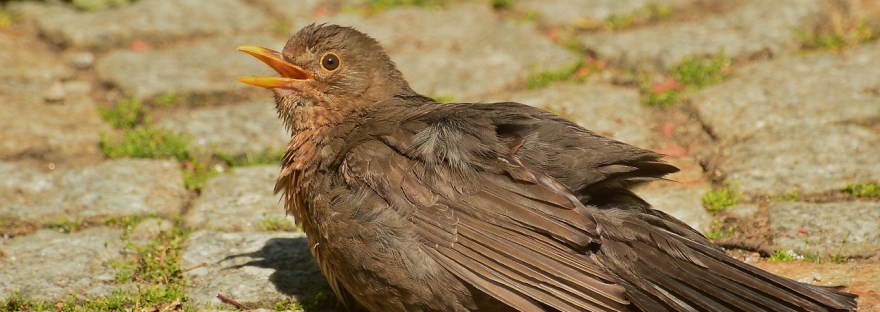
Image by Miroslaw Kolaczynski from Pixabay – a baby blackbird with scrappy feathers and not yet the proper colour.

 literally stories
A.J.
I find this outstanding. I truly admire the way the story goes back on itself and explores hope and false hope. Not an easy one to catch in a few sentences, but a fine read, regardless.
Leila
LikeLike
An enthralling read that is really well constructed it could so easily have become over sugary but didn’t, not at all. Thank you – dd
LikeLike
A thorough illustration of “You never know what the other person is going through”.
LikeLike
Thank you, this was the whole reason for the story. We meet and bump into people every day, and we don’t know others stories, or how we might affect them. Or how they might affect or influence you.
Be kind, always.
AJ
LikeLike
A story of how we live separately but also inter-connectedly. Nicely done.
LikeLike
Hi A.J.,
I enjoyed this.
It was a very well done writing circle!!
I did have to look up ute.
There is a lot of positives in this.
All the very best.
Hugh
LikeLike
Absolutely beautifully crafted writing. I thoroughly enjoyed this sad series of vignettes literally swooping in and out of lives carved by the world around them – really stunning.
LikeLike
Clever story of connection… the seven degrees of separation……it kept me absorbed because I wondered what will be the next communication, and how will that be judged and carried on? You never know what’s going on in someone else’s world, and this piece shows how the full story matters.
LikeLike
Worlds within worlds, within worlds…all looping back to an orphaned bird, the alpha and the omega. The quietly removed, omniscient narrator reveals all the misconnections of our hurried, goal directed days. Beautiful writing!
Claire Massey
LikeLike