
Do you ever feel stuck? Asleep at the wheel of your own life? Each day a motion, repeated to the point of mental RSI, a means to an end? You must surely know the feeling. The same papers passed over your desk. The same documents read on a dusty laptop screen. The same dull drum playing on the surface of your temples. And you think to yourself: surely this ends soon?
It never does. The date is on your wall. You’ve pinned it like a poster, hammered a nail through the chalky plaster to ensure it doesn’t run away. 20th June. That’s when you are done. You’ll make sure of it. But the passage of time from the 10th to the 11th seems as long as all three hundred days before it, and the 11th to the 12th will feel even longer still. Time layered upon time upon time, and there you are, trying to claw through its sheets. And just as you reach the top and gasp for air, time buries you beneath another one, and it is ice and rock and slime; all of those toxins that sludge up your muscles into paralytic dough, complete with unsightly, unkneaded lumps.
That paralysis is your prison. Your perception is slowed to make every second longer, that’s true, but your body slows with it, and so you can’t even make the most of it. You’re trapped in your age, creaky and stiff, increasingly unoiled by the zest of youth. The silhouette memory of that beautiful breath — the air of a child — is imprinted upon the forefront of your brain. You yearn to be as you were before, as you were when you were yearning to be as you were before that. Was it really that good a year ago, or have you just filtered out the worst of it? What will you think of the time you’re in now, in five years?
Don’t soil my memory, you ask your future self. It’s futile. Already, the moment you’ve just inhabited is pulling away, coloured half in rose. You’re now split halfway between who you were and who you will be, and as the face of your future comes clearer into view, though still obscure in the fog of the yet-to-live, you look back, and see only a stranger. Then you look forward, and see something that inspires a nauseous cocktail mix of both hope and dread. Who is it that stands there in a year? You hope that they’re not unemployed. Not homeless. Not unloved. Once you’ve moved on, or been forcibly moved on from where you are now, you hope that you’ll have somewhere else to go, so that you can spend your days waiting that out too. Maybe you’ll wait forty years for retirement, or five for layoffs. Six months if your conscience swells and you choose now to ignore it. Your partner tells you that in a time of conflict, defence contracts and companies are all the rage. Take from that what you will. Act on their advice. Or break up with them if you think them immoral for telling you to act in your own interest, or for acting selfishly and unconscientiously. Depends on how you choose to see things.
Of course, you can’t think of all of that now. There’s too much going on right now, although when you think about what that is specifically, you can’t come up with anything in particular. It dawns on you that the everyday crisis is silly. Wake up, a little voice tells you. Live now. It’s always been there, but it’s louder now than it ever has been. So you take the day off. You go and sit in a coffee shop, and watch the passersby. It’s pleasant, but nothing special. Or you go on a run. And again, it’s pleasant, because you run often, but it’s nothing special. Every time you’ve done this, chosen an alternative to that crux of your life, the wasting away of your days, you end up with exactly that. Nothing special. You don’t know how that’ll ever change. If it’s even possible.
So you go back to work and return to your mundane life. What more can you do? Now, you have one less day off this year. You’ll have to cut that family holiday short. Or skip Valentine’s Day. Who’ll give you more grief: partner or mother? And as you spiral and think of all the gifts you can’t give, the dinners you can’t have, the work yet to be done, you’re bogged back down by the minutia. Wake up, the voice tells you, but you can’t hear it from beneath the rubble. Live now, it says, but the words no longer compute. You tell yourself it’s because you can’t afford to. And just as you ready yourself to come up with more excuses, you realise that you’ve been standing perfectly still in the lobby for God knows how long.
‘Are you having trouble finding yourself?’ asks the trainee receptionist. You shake your head. You’re sure that’s the right answer. After all, your entire life nowadays is spent only two floors up. But in spite of the fact that you’ve passed almost every day for a year in this very building — eating, working, sometimes sleeping — you can’t escape the rising feeling in the pits of your stomach that you are still somehow lost.
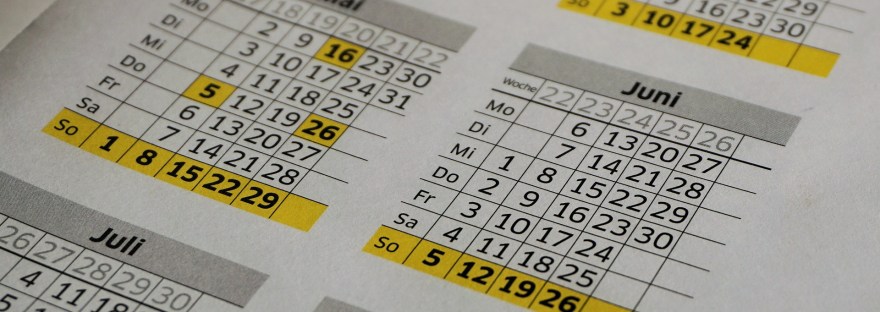
Image: Planning calendar in black on a white background with some dates highlighted in yellow. From pixabay.com

 literally stories
Hi Dylan,
This could have been one of those that all of us could have written but with only five sentences you lifted this somewhere else.
The weird thing, for me, was that they whispered and then shouted at me at the end of the story.
This shows a skill in writing or an acute perception towards readers reaction, or both!
…
The date is on your wall. You’ve pinned it like a poster, hammered a nail through the chalky plaster to ensure it doesn’t run away. 20th June. That’s when you are done.
You’ll make sure of it.
Absolutely brilliant!!!
Hugh
LikeLike
Hi Dylan
Very perceptive. We really cannot complain about time being short because we endlessly toss it aside with passive remorse.
Leila
LikeLiked by 1 person
Dylan
I truly appreciate the thoughts and ideas behind this story.
Your ability to challenge the status quo in this piece is a truly admirable thing.
These days, I can think of few things more important than challenging the status quo.
“That paralysis is your prison.” An excellent quotation, a great sentence that boils it all down in an original, twisted metaphor from a desperate-hearted character sensing doom – but maybe self-awareness can save this character in the end.
Great work!
Dale W. Barrigar
LikeLike
I remember such feelings from those bad old days, and this piece captures them well. I’ve also found though, that as one gets older, time passing too fast is even worse than time passing too slowly.
LikeLike
Who invented the calendar? What was the point? How about money? Anytime something new comes into being, it changes us — fundamentally. Things are in the saddle and ride mankind. How about the car and gasoline? What would Emerson say?
Dylan, you sure did a deep dive into this one. — gerry
LikeLike
A thought-provoking piece with an almost accusative tone (until the final paragraph ‘reveal’ as such). Palpable anger and frustration come off the screen with this Sisyphean tale in a way that makes this a ferocious read, with, again, that final paragraph really making it work for me as it turns it from an outward polemic to an inward, angered reflection.
LikeLike
Not quite silent desperation, but close. Actuarial work would have been a real downer for the narrator. Not exactly unsympathic, but one wonders if the the narrator could have found something of worth outside of the employment drudgery. It doesn’t have to be forty years at the office followed by a heart attack six months later.
LikeLiked by 1 person