
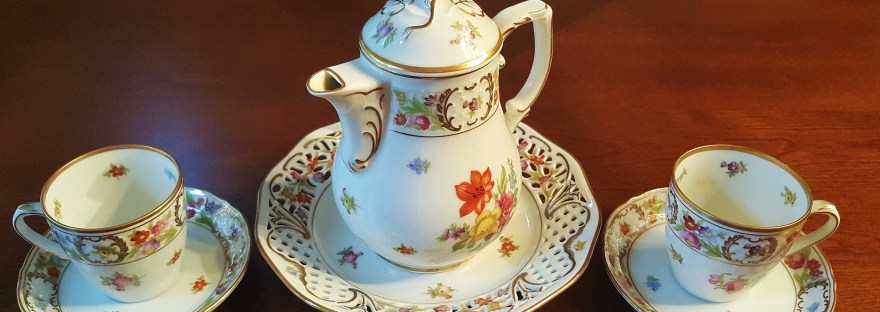
“The serving girl’s run off,” Cathryn said as she set the tea tray down on the blackened linen, “so I’ll be mother.”
Her guests inclined their heads politely and she poured, apologizing for the lack of sugar. “It’s the war of course, not a lump to be had for love nor money.” Her guests murmured softly. They understood, but still, it was frightfully embarrassing not to serve a proper tea. Why, she even had to make do with buttered bread instead of cucumber sandwiches.
She narrowed her eyes at the sandwiches. Was that a speck of mold? Horrified, she snapped out a hand to retrieve the plate before Teddy could help himself. Hoping no one had noticed, she pointed to the fine china. “The earl of Kent gave this set to my grandmama. And,” she added rather grandly, “it was given to him by Queen Victoria.”
The Countess’s eyes brightened, and her rosebud lips formed a little moue of surprise. Not to be outdone, she began a lengthy tale about a party she’d attended in the city. All very hush hush, of course, but she was quite sure she’d spotted Vivien Leigh among the guests. Not to mention all the handsome young soldiers in their uniforms.
That reminded Cathryn she should steer the conversation over to Teddy. “Colonel,” she asked brightly, “how goes the campaign?”
The Colonel said the lads were doing England proud and would knock back the Jerries in no time. He entertained the little gathering with some harmless gossip from the front about how Lieutenant Padgerton had received a package with two left-handed mittens and no right. The lads joked that it was because he was a left-tenant, not a right-tenant, and everyone had thought it was terribly amusing.
“You are awfully brave, Teddy,” Cathryn said.
The Colonel colored slightly above his whiskers. The Countess tapped his knuckles with her fan rather coyly and said he was too humble. Teddy was on the plump side, but quite fetching, nonetheless.
Cathryn sipped her tea, which was cold. She wished again that she had some sugar to stir into it. The lovely little cubes one could place between one’s teeth and suck the tea through, though that was terribly vulgar. She sighed down at the crack in her saucer. How could one be expected to entertain in such circumstances?
The countess said it was a shame about the Glenn-Burtons’ house, but such good fortune the family had left for the countryside before the bombing.
Teddy grumbled angrily. She thought he muttered, “Damn Jerries,” under his breath, though of course he would not have said that aloud in polite company.
“Yes, it’s a good thing they left before the shelling,” Cathryn agreed dully. She could hear the thin sound of her own voice and told herself to buck up.
The countess blinked, her lashes dark against the porcelain of her cheeks. She ventured that the Glenn-Burton’s little daughter was probably enjoying life in the countryside.
The Colonel offered the opinion that he’d never much cared for the countryside himself.
For a moment, the only sound was a sole teacup clattering in its saucer. Then the familiar wail of the air raid sirens rolled over them. The Countess opened her eyes wide and her mouth made a little ‘O’ of alarm. The Colonel sat quite erect and still, listening, before suggesting they make their way to the shelter.
“No, that won’t do at all,” Cathryn said. They weren’t to go to the shelter, she was quite certain of that. The shelter was down in the cellar. It was dark and damp and there were spiders. No, it was quite impossible. They were to stay right here, having tea, having a good time.
The Colonel’s button bright eyes studied her, waiting for her to explain, but she didn’t want to. They simply couldn’t go to the shelter. She clapped her hands to her ears and squeezed her eyes shut and thought of not going to the air raid shelter even though the Countess and the Colonel wanted her to. But they didn’t understand.
The last time she’d heard the sirens, she’d been in the gardener’s shed among the dusty sacks and cracked pots. She’d been hiding from her parents because they had interrupted her tea, telling her it was time to go the countryside. They’d insisted. But she didn’t want to go to the countryside. She wanted to have tea. Though they called and called, she hadn’t answered. Even after the sirens began moaning, she’d never made a peep. She didn’t want to sit in the mildewed darkness while muffled thumps shook the walls. She wanted to have tea.
When the bomb fell, the house seemed to shrug its shoulders and then give up in defeat, collapsing into the cellar. In less time than it took for her to recite her A.B.C.’s, her home became nothing more than a pile of rubble but for a corner of the nursery where the table was still set for tea, the linen black with soot. The Countess’s face was cracked and the Colonel’s fur was singed. It was all quite spoilt.
Cathryn had called and called for her parents, but they hadn’t answered. Neither had anyone else because everyone knew the Glenn-Burtons had gone to the countryside before the shelling started.
And now it was teatime again and the sirens were wailing again and they couldn’t go to the shelter in the cellar. “Damn Jerries,” she grumbled aloud and sat quite still in her chair while bombs dropped across London.
Image China tea pot and cups and saucers with a floral pattern and gold trim. on a wooden tabletop. From pixabay.com

 literally stories
A perfect capturing of a time, place, and class of people – a time when emotion was kept at bay, opinions were murmured under breath, and decorum almost drowned out the noise of bombs!
LikeLike
Thank-you.
LikeLike
I thought this was very cleverly constructed and it had me hoodwinked and then the reveal at the end fell just like a bomb. Well done – thank you – dd
LikeLike
Appreciate that it worked for you. Thank-you.
LikeLike
Laurel
The images this brings to mind are wonderful. I can see this “little group” and hear the voice of a long ago actor C. Aubry Smith grumble “damn gerries.” Sad, yet, well even a bit funny.
Leila
LikeLiked by 1 person
With such a title, who’d not want to read on? Altogether elegant & restrained. “When the bomb fell, the house seemed to shrug its shoulders . . .” Superb.
Geraint
LikeLike
Thank you for your kind comments. It means a lot coming from such a fine writer.
LikeLike
I wasn’t expecting that turn. It reframed the whole story. Poignant and well-crafted.
LikeLiked by 1 person
Laurel,
I was drawn in from the start when Cathyrn says, “so I’ll be the mother.”
I was born in NYC during the last months of WWII, so knew nothing of the horrors that Europe suffered through [except the inconveniences of evaporated milk, mayonnaise & Postum.]
Now ‘we’ have added AI assisted drones, Cyber & Laser weapon systems, and Space-based shit I don’t understand. So as not to write something trite, I’ll simply say, “Very well done, indeed.” Your story brought it all home. — gerry
LikeLiked by 1 person
Near in time accross the country – Portland 1943. Keith Richards mentions the bombing although he was born a few months after me.
LikeLike
Thank-you. I was not alive then either, nor am I British, so I hoped I found the right voice. Your comments are appreciated.
LikeLike
I appreciate your comments. I wasn’t alive then, and I am not British, but I was hoping to capture from this far remove, an effect on a child in war.
LikeLike
Hi Laurel,
Excellent control and the reveal was done perfectly.
All the very best.
Hugh
LikeLiked by 1 person