
In her nursing home bed, petite Margaret, just four feet tall, stared at the ceiling under the dim glow of fluorescent lights, her face devoid of the vibrancy it once held. Legs that had leapt across a sound stage lay thin and mottled with brown age spots. Feet that had slid into dainty slippers now stood as small, rigid reminders of long ago.
No window permitted the day’s sunlight to brighten the room, and no dust specks danced in the afternoon light that slipped in between the heavy curtains in the dayroom. During medication time, Margaret’s withered arm yielded limply to nurse Jenny’s soft touch. Her skin was paper thin, marked with wrinkles at the lightest touch.
Jenny paused by the meds cart in the empty hallway, her fingers skimming Margaret’s chart. “This is the third day she’s refused breakfast,” she murmured to Tom as he passed with fresh linens. Both of them had small furrows on their foreheads as they examined the chart. It wasn’t good and she was losing weight.
As they walked down the hallway, they could see through the open door of the dayroom, that a black-and-white film flickered on the ancient TV, showing Margaret’s much younger self twirling across the screen in a shower of sequins. The same high cheekbones and elegant neck, now withered by time, were unmistakable in the dancing ingenue. They kept playing the film because the residents felt comfortable watching it as it brought back memories of their youth and afternoons or evenings at the cinema.
Tom, his hand placed near his mouth, had an idea. They all needed a change of pace, and the aquarium would be the place for a trip. “It gets them out of these four walls, and it’s so calming,” he said after watching Margaret’s steady gaze. “Even if they just sleep through it.”
The trip was planned, and staff stood ready to assist patients in boarding the waiting bus. Despite her resistance, Margaret gave in, allowed herself to be dressed, and wheeled past other residents who chattered and fussed with their sweaters and handbags. Her hands lay motionless in her lap, shoulders rigid against the wheelchair’s vinyl backing. She said not a word to anyone. The prisoner was being given a short bit of probation from her pink cell.
Through the aquarium’s blue-tinted light, Tom guided Margaret’s trembling hand to the glass of the small tank in the children’s section. The tiny striped octopus, no larger than half her palm, should have drifted closer, but the tank appeared empty except for one white nautilus shell lying in a corner. Surrounding the shell, a ring of sand and small stones gave the appearance of an entrance to a cave.
Tom turned and asked a worker near the tank if it was empty. Immediately, the young man responded, “It’s a strange thing. The octopus should have been moving around, arranging items, changing colors like a neon sign, and even its appearance to look like a stone or a bit of coral in the tank. But it’s been hiding in that shell for over a week now, only scurrying out at night for some food. We can’t figure out what’s wrong, and the veterinarian doesn’t know, either.”
Margaret peered into the tank, raising one hand again and placing it against the glass. In a flash, the octopus darted out of the shell, swirled around several times, swaying as though in a graceful dance, and placed its tentacles on the glass over her hand without hesitation. When Margaret looked into its bulging eyes, a connection was established. Its tentacles unfurled with fluid movement, mirroring her shaking fingers on the other side.
Seeing it on Wednesdays at the aquarium became an eagerly anticipated routine. And the octopus, for its part, seemed to be waiting for her touch on the clear material. One finger on the glass was sufficient for the swish out of the shell and up against the glass with movement so graceful and coloring so vibrant and shifting that she marveled at it. Her eyes widened, her mouth agape and a soft “Oh,” was heard in the darkened area. She was coming back from somewhere she had been lost for a long time, but it wasn’t as a child. It was as another dancer meeting a new dancer in a liquid medium.
The staff at the marine center observed the transformations it could see in the little octopus as it responded whenever Margaret came to visit. “We can’t explain it,” the veterinarian said, “but that octopus is showing more life and interest than we’ve seen in the weeks that we’ve had it in this tank. Something wonderful has happened, but we’ll never know what it is.” The dancers knew, but it was their secret.
At dinner each night, Jenny helped Margaret to her seat. Together, they managed the soup spoon, Jenny’s steady hand guiding Margaret’s uncertain grip.
Slowly, minor changes emerged. With help, a silk scarf was knotted at her throat, and her silver hair was carefully combed and pinned. The hallway became a daily journey, Margaret leaning heavily on her walker while Tom stayed close behind.
“The blue scarf today,” she murmured one morning, her voice barely audible. It was a souvenir from her days of dancing in film, and she had retained it in her chest of drawers, but she had never worn it. Jenny gently draped the soft fabric around Margaret’s arms, supporting her as she wavered slightly on her feet. Though Margaret remained stooped, her eyes lifted more often to meet others’ gazes.
During the Sunday social, piano notes drifted through the dayroom. Margaret’s fingers fidgeted on her armrest in her room, trying to keep rhythm. A familiar melody played: “The Butterfly Ballet.” Her voice emerged as an almost inaudible whisper.
The following Wednesday, as they left the aquarium, Tom wheeled her past the gift shop, pausing at her gesture. Margaret’s thin hand pointed toward a display of silk scarves printed with ocean scenes. “Maybe,” she said, her voice uncertain but hopeful, “I could listen to next week’s sing-along with the others.” Her reflection in the glass showed the ghost of a smile, her eyes holding a glimmer of engagement.
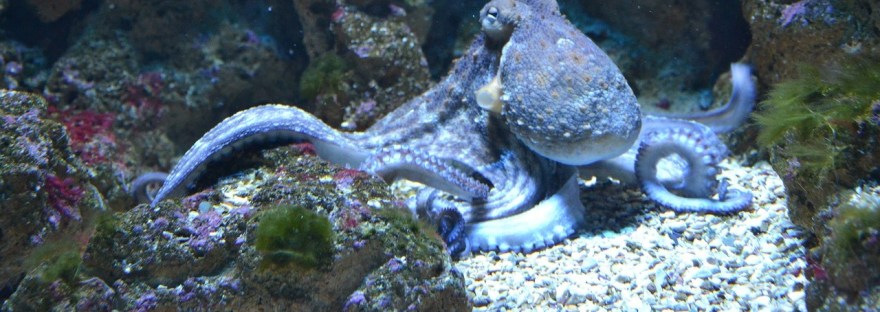
Image by sandrine RONGÈRE from Pixabay An octopus in a tank against a background of rocks and water plants.

 literally stories
P.A.
A therapy Octopus sounds like a great idea! This is a truly unique and winning piece about a typically depressing situation.
Leila
LikeLiked by 1 person
A deep connection between two creatures, no matter what species is a wonderful thing and hope and joy at any stage of life is to be celebrated. Lovely story, thank you. dd
LikeLiked by 1 person
As I’m at an age where I often wonder what lies ahead and why I even want to get there, I deeply appreciate the reminder that there are things undreamed of that are worth living for.
LikeLiked by 2 people
Hopeful thought for his old man.
LikeLike
It continues to amaze me that when it comes to talented, there is always something new under the sun. A beautiful story that’s uplifting in what could be a desperate and depressing situation.
LikeLiked by 1 person
*talented writers
LikeLike
P.A.
Could you imagine a squid dancing with Margaret’s hand? But an octopus! The gang used to carry a rat around the neighborhood with us. It would stay in our pockets and we’d take turns hiding it from our parents at night. Why didn’t it run away? What did we get from being “friends” with a rodent? They are not really questions? It’s just the way it is. A lovely story! — Gerry
LikeLike
This was magical! The way the little octopus came alive was a truly vivid image. I liked how the two dancers, in their own prisons, connected. A heartfelt story of old age and that distant, unchangeable, and far as the stars past. Sometimes as close as the next breath or in this case right up on the TV screen. Well done!
LikeLike
Cephapods are known for their intelligence, as are some old people. They are an enchanting couple
As an octogenarian, I’ve started to grow tentacles, but they usually don’t show when I’m dressed.
LikeLike
Hi P A,
This was strange, different, touching and thought provoking.
You didn’t need anything else!!!
I enjoyed this from the first time I read it.
All the very best.
Hugh
LikeLike