
Vacation Bible school came and went. Proverbs learned and unlearned, a paper badge, and the Lord. Then came our family camping trip. Please, don’t think it was all bad. It wouldn’t be fair to my mother.
“Jason! Don’t feed that goddamn dog!” We were at the picnic table in the Whispering Pines Campground. I saw his gold watch band—gleaming—flying. Dad looked around like a criminal. I guess he forgot he wasn’t home. His long sideburns turned toward the camp store. There was no, “Hey stop that!” or “I’m calling the cops!” Only the birds chirping and Mom to witness the crime. I didn’t know it was a crime, and that sounds strange to me now, but that’s what it was. He slammed the RV’s door and switched on the portable TV. A baseball game garbled out at us.
My new friend, a large curious German Shepherd stood on the asphalt, casting a beautiful shadow of that breed, beyond our family’s violence. Like he had witnessed these events unfold before.
Mom stood over the Coleman gas stove with a frozen scream wanting to break free from her throat. Smoke rose from a blue and white speckled skillet. The spatula shook at her side, like a gun, dripping lard. I sat there, swiping acrid tears, worse than getting clobbered…
“What did I do, Mom!” Trying to stand like a drunken boxer. I heard a ringing in my left ear and felt the odd shifting sense of losing my equilibrium.
She slammed the scalding skillet off the picnic table! I jerked back, hitting the ground. It made a thrumming harmonic sound, flying by my head. Everything exploded from her. “Goddamn him!” Then she screamed at the huge RV. “You no good, son of a bitch!” This time I looked around.
I took off running, and ran for a long time, like I was fleeing to Canada or Mexico. They would never see me again, but I found myself still in the campground, out of breath, and meandering along a sandy bubbling creek. Craw-fish darted from the edge in a puff of murky clouds. I stood on a bridge with my hands wrapped around an iron railing looking down, losing myself in the healing power of water. Dazzling dark flashes of sunfish swam from the arching shadows of the bridge into the sunlight. I cupped my sore ear. Blood dripped into the silver gleam. The sunfish hit the surface like piranhas.
The dog trailed along trying to understand my intentions. It probably did that a lot around the campground. I was only eleven, but I knew good dogs from bad ones. In my situation, a kid tried to pick up on the cues. He came up to me as if to say, Are you okay? I didn’t mean to get you in trouble. I petted him. “It’s okay boy, it’s not your fault.”
Later, after barely eating all day, Dad and I went to the lake for one last time, and tossed bobbers into the blue water like it never happened, that’s how things often went. He said, “This is not for fun, Jason. It’s work, it’s survival.”
But it was fun, watching the bobber dunking and my prized Diawa rod snapping forward with, “I got one!” Sometimes Dad was fun too, but his enormous hands made me flinch, and I never knew what might make them fly. Before long we’re back, and he dumped the stringer of bluegills on the picnic table.
“We caught a bunch, honey.” said Dad, smiling, showing his long dimples, acting all proud and sweet.
Mom silently killed the flopping fish and piled guts on bloody newspapers. It seemed like an ugly, slimy job for such a beautiful woman. Dad stepped away, shirking the work. He lumbered over to the restrooms and disappeared for a while. I think he was a little afraid of the razor sharp Rapala fish-knife that flashed in the sun. The fish guts smelled terrible. When Mom finished the work—all of it—including throwing the fish guts and scales into the woods. Dad came back from his little hiatus. The dog sniffed and Dad kicked at it. “Get outta here!” He looked around again.
Mom held my gaze, willing me not to speak. A quiet pleading in her eyes. Okay, Mom… okay, said my own eyes.
The skillet sizzled on the camp stove, like the smoke of déjà vu. Mom dragged the fish in a pie pan of flour and shook salt and pepper on them. She scrambled the fish eggs too; they looked like miniature yellow kidneys and bladders. I snuck a bluegill to the dog. The dog gently took it from my hand, and politely inhaled it.
After the fairly wordless meal. I looked at Mom’s pretty face. She didn’t really show her beautiful smile much, and that was a shame. “Mom, do you need any help?” I loved when I could make her smile.
“No Jason, run along and play.” Her voice rose, “And take that dog.” She looked stern, something tight around her eyes, then she softened and smiled at me. It was like the world came back into balance. I was looking into the beautiful healing waters of my mother.
“Boy, I wish I could keep him.” The dog was a German Shepherd, and it had curious brown eyes, and blond eyebrows. I loved his pointy black ears, but I tried to avoid its wet nose. I didn’t know who owned it, but it was well fed and muscular. He licked my face with a big smelly red tongue. I was in love.
Dad had already departed leaving her with the clean-up. Her face changed as she looked at the RV. Like a monster inhabited it, and I guess one did… I could hear the drone of race cars on the TV. AJ Foyt and Bobby Unser were battling for the checkered flag. “You can’t take that dog. It lives here in the campground. We’re leaving later.”
“Okay, Mom, takin off—later.” The dog was running and jumping beside me. All I needed was a kite and Norman Rockwell to paint us. I sat where a rock ledge jutted over the water and met the point of the lake. The water was a choppy blue washing up dead leaves onto the sand. I started hitching, then sobbing, my injured ear filled up with fluid and ached. “I have to leave.” He whined and snuggled up to me, smelling all doggy and warm—pure love. He needed a name? But I couldn’t come up with anything that fit him, and we ran out of time. He would become, The Campground Dog.
I watched from the RV’s giant side mirror. Mom laid down for one of her naps. Dad drove in his captain’s chair—like “King of the Road.” Mirrored sunglasses like that guy from “Cool Hand Luke.” A cigarette between his fingers riding the steering wheel. The dog ran behind us. I had an urge to cry again. I guess I’m not all that tough. He stopped and wandered up to a new boy, bouncing a basketball. The boy rubbed his head and said something, smiling. I wanted to yell; He likes fish! They were instant friends. I hoped the boy or whoever the dog met, would be good to him.
#
All these years later, I still think about The Campground Dog. I try to remember what he looked like, but it’s hard. He is kind of like one of those impressionistic paintings coming together in the distance of my memories. The sun is brighter and more pleasant, his fur is softer, his tongue lapping my face is cleaner, but his bad doggy breath is spot on and connects it. Then I remember the rest of it…
Mom divorced Dad not long after the Whispering Pines Camping trip. That little beating I took—that was it—one too many. She had enough and when Mom’s done with a person—it’s forever. Dad got custody for me on the weekends. He rarely bothered, but I still missed him… He was my Dad. I used to brag about his bronze Lincoln Continental to kids at school, but It was almost like he died.
Mom remarried a nice guy, but he drank Strohs beer from 7 AM until he went to bed. It was strange getting up for school and watching Joan London on Good Morning America and seeing Bill sitting there drinking. I think he was a night watchman, but I never learned where? On one superb note, Mom let me get a German Shepherd puppy. I named him, “Chance.”
Mom says nothing bad about Dad or his new wife, June. She doesn’t say much at all, so I don’t go on about my visits to him, which aren’t often. Mom only knows an obligation rolls over me and I make the drive. Something like blood calling blood.
At Dad’s, we sit in lawn chairs in the yard and talk about easy subjects like fishing—then that runs out. We are both on the clock and the sundial of our relationship moves slowly.
A silence comes, and it’s too hot, but to move into the shade would be a continuation of our conversation and neither really wants that. Something cold to drink would be nice, but he offers nothing for the same reason. His wife June is conveniently away, probably castigating me over iced lemonade and vodka.
He gives my Ford Escort a disapproving look, and says, “How’s your car running?”
A rusty truck with a hoist in the bed goes by with a muffler dragging, throwing sparks. “What?” I say in the loud throaty racket. I lean in, my hearing is bad on the left side.
Dad gets frustrated. His old hands fly up in anger. He sees me flinch. A sad look comes across his face and he looks around like a criminal.
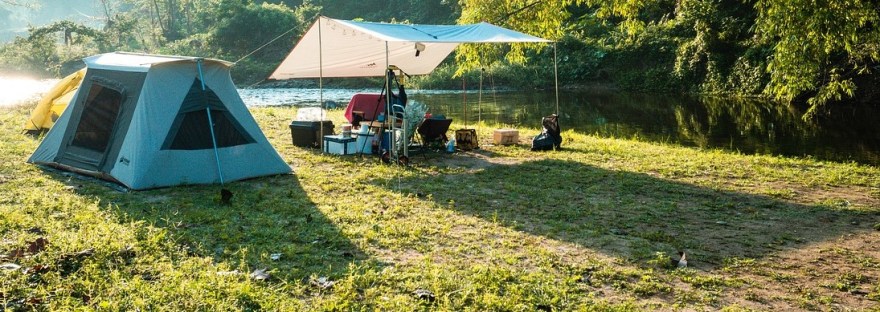
Image by ITUBB from Pixabay A little campsite with a tent and equipment in the trees.

 literally stories
Christopher
When I first heard of “VBS” (as an adult, never as a child) I thought “what a shitty way to ruin a week of summer!”
Anyway as veteran of five steps (I forgot the second one’s name) this is entirely relatable and brilliant in its depth. I saw the Dog (who has gone on to prosper in cinema) as something ideal, yet out of reach like Leave it to Beaver nonsense.
Yet another honest and tough story from you!
Leila
LikeLike
Hi Leila
Thanks for your kind comments! We had VBS a few times. I went to a church camp a couple of times, too.
Christopher
LikeLiked by 1 person
Hi Christopher
I am sure lots of kids enjoy that sort of thing and it might even do them good, but the idea of doing school-like anything between June and September seems a bit cruel and unusual. Then again I never went to “camp.” Actually, I do not remember anyone I knew who did. Just something we saw on TV!
Leila
LikeLike
Hi Leila
Yeah, I’m not sure if I wanted to go or not. A minister and his family were picking me up for church when I was around 11-12. Then I’m going to this Bible camp. We had to memorize the verses and went swimming at the pool and played games. Smacking a tethered ball swooping on a pole stands out. A mess hall for meals. “Keep your elbows off the table.” It was for five days, but I can’t remember exactly where it was, somewhere in Northeast Indiana in the woods. I think they were serious about the Lord.
I remember the hot girl counselors. Who weren’t that old–lifeguard types. One thing that sort of startled me was this counselor… Who changed into his swimming trunks in my cabin. I looked over and there he was naked. He had an expression on his face like why are you looking. Weird. But now that I think of it he may have been rooming with us, too.
Christopher
LikeLiked by 1 person
We do tend to be a bit hesitant to accept animal based stories. We are all lovers of furred and feathered creatures and don’t see the point in publishing something that sees them suffer. However, this dog is a hero to me at least. He knows which side his bread is buttered on and good for him. I identified with the boy in as far as I cried when leaving fur legged holiday friends but I was so much luckier in that I had good, kind parents who, at least for a long time, liked each other. So, basically, this story really made me think and reflect and that’s a really great thing is a short. As for the dog, as Leila said he went on to star in movies! Thanks for this – dd
LikeLiked by 1 person
Hi Diane
Thanks for your kind comments! Glad you took a chance on the Campground Dog!
Christopher
LikeLike
Christopher
OMG, this is such a great story! The narrative VOICE here is amazing, and the apparent ease with which this narrative gets told is a disguise, a brilliant disguise, because writing like this is NEVER easy. No, it’s never easy, because it takes years of wisdom, reading and writing practice to get to this level.
Bukowski, Hemingway, Carver, Chekhov, Dylan, Leonard Cohen, Robbie Robertson, Tom Petty, Bruce Springsteen, Bob Seger all write with an apparent surface SIMPLICITY that contains entire worlds of subtle and imaginative reality within it, and your style here (and in all your stories) is like that. That’s a lasting recipe for great writing.
This narrator can take his place next to Huck Finn, Tom Sawyer, and Holden Caulfield. This story captures something profoundly real and important not just about this particular family, but about the entire American family itself, its tragedy, its fragmentation, its break up, its resilience, its perseverance (both good and bad), its fear, its guilt, and its LOVE.
This story needs to be read more than once to get its full effect because this writing is so SUBTLE. Being SUBTLE is an amazingly important, and indeed crucial thing in good, and certainly in great, writing. Shakespeare’s great characters are all amazingly subtle. Being subtle is Hamlet’s key quality on many, many levels. Being subtle is so important and so key because it’s the way to really create great characters. Our interactions with real humans in the real world are always SUBTLE, even when they involve violence or other extremes, because we never know what someone else is REALLY thinking (and feeling).
You capture at least four great characters in this story who all have great subtlety about them, the mother, the father, the narrator, and the dog. The other, minor characters (at least three) are also extremely REAL-seeming and extremely subtle.
“The Campground Dog” is a great title, a simple, poetic title that when thought about in depth has more than one meaning. The way the events in your stories UNFOLD instead of “happening” is a part of your great and subtle characterization, and a massive thing that makes your stories seem and feel so Real and So True.
Congrats on this, it’s truly great writing and a major accomplishment on all levels! More later!
Dale
LikeLike
Hi Dale
Wow! Thank you for the high praise!
This truly is a great break down of this story!
I try to write simple sentences, to me it equals clarity. It’s easy to get lost in the woods–writing fiction. Professor Strunk pitied the reader when the writer wasn’t clear. He said, “Drain the swamp.” lol. Less words are more. Mark Twain, said “Don’t use a five-dollar word when a fifty-cent word will do.” But he also said to choose the correct word, too.
You hear the term heavy handed. I’m glad my characters come off as subtle. That’s really good to know. And a fine goal. I’m also happy the characters stood out.
It’s not easy getting to know your characters. They can be hard to glimpse. But when they become real and start walking around with shadows on the sidewalk. It’s one of the great joys of writing.
Can’t thank you enough for all the positive insights!
Christopher
LikeLike
Christopher
Another great thing about your stories is that they have ZERO “holes” in them. By holes, I mean places where the reader can easily see through the fictional world the writer was trying to build, places where “the dream” of fiction falls apart at its seams or just everywhere right in the middle – when it isn’t supposed to.
Your finished stories never do that, anywhere. They hold together perfectly without holes from first word to last.
The great Frenchman Flaubert, author of the perfect novel, Madame Bovary, said “le mot juste,” only the perfect word for every place and every thing you’re describing, or not at all. To him, such a quest was mystical in nature even though his fiction is considered hard-core realism by most critics.
Your hard-core realist stories also have that extra edge, like Flaubert did, that thing that takes them to the next level and is almost impossible to describe in words, but you know it when you see it.
Great writing!
Dale
LikeLike
Hi Dale
Thanks so much! I really like what Flaubert said about finding the right word. It really is a quest. Sometimes I’ll look at synonyms, and once in a while that works. Naming characters is hard too.
Earlier I mentioned using simple language, but I actually like using a longer word once in awhile, too, but I try to avoid the purple prose.
I’ve heard Truman Capote wrote great sentences. I read part of “In Cold Blood” in a very long 4 part series in the New Yorker, but as grisly and great as it was I didn’t stay with it. The last thing I read was the Cutter family lying in their coffins in a funeral home with a white shroud covering each of them, after being shot-gunned. Horrid! I think this was a prelude to the book.
Thanks again!
Christopher
LikeLike
Christopher
Yes, Flaubert was a bit of a madman, who (almost) literally turned himself into a hermit who did nothing all day or night long (or ever) except Search for the Perfect Word. Always searching for the perfect word – because there’s always a new perfect word to be found. That’s part of the Beauty, and sometimes the Exhaustion, of this process…but mostly the beauty.
He also felt and lived with his characters maybe more than almost anyone ever – including getting sick when they got sick, laughing when they did, weeping over their fates, and almost dying when he killed off his heroine. Literally…
Except for a few people he was close to in later life, he believed almost all the adults he knew were lame and useless – he chose the honesty of art instead, and paid the price – but it was a good price, especially now in this hell-hole of a culture we inhabit.
Check out my new installment on Saragun Springs today whenever you can – it has an Edgar Poe-ish poem, cool prose on Dostoevsky, and a photograph that you will look into AS IF IT WERE A MIRROR.
Thanks!
Dale
LikeLike
Hi Dale
Flaubert sounds like he is right up there with Kafka’s “The Hunger Artist.” Such a dedication to his craft, while transversing the useless people that always WANT MORE. The fatalism of more-ISM, I Self Me .
Thanks to your commentary I have started one of his short stories, ‘A Simple Heart.”
“Let the force be…”
Christopher
LikeLike
Hi Christopher
I want to return here briefly to go back to something you said the other day in another place (Leila’s Saragun Springs) because I think it’s so important; and that is the matter of writing in what you called “street language,” “lean language,” everyday language, colloquial language, and the vernacular. You have showed yourself a master of this idiom, and that’s massively cool.
Raymond Carver, Denis Johnson, Hemingway, Kerouac, Bukowski, Raymond Chandler, Dashiell Hammet, Robert Frost, William Carlos Williams, and, indeed, it could be said, almost every single great American writer has been/is a master of this mode. Writing in a style that LOOKS like and sounds like (but not literally IS) everyday, street, or vernacular language could even be called (by some people) the single greatest contribution of American Literature to World Literature in general. In your stories, you preserve and extend this all-important American contribution to the World of Letters, and that’s a hugely important thing.
I want to give two nineteenth century examples that later influenced Carver and Hemingway and the rest, so much.
The first is Walt Whitman, when he wrote in the mid-nineteenth century:
“I am the man, I suffered, I was there.”
When he first wrote that comma-splice, seemingly ultra-simple sentence, it was so revolutionary it was almost completely ignored by the world at large. Then it survived and went on to create the styles of Raymond Carver, J.D. Salinger, and so many others.
The next example is this:
“You don’t know about me, without you have read a book by the name of ‘The Adventures of Tom Sawyer,’ but that ain’t no matter. That book was made by Mr. Mark Twain, and he told the truth, mainly.”
One reason that writing in this kind of street and vernacular language is so important is because it gives massive credence to the kind of folks who actually SPEAK in this kind of language. It looks easy to do, too, but on the contrary; writing in a false-sounding, non-natural, highfalutin, stilted language is actually much easier to do than this.
And you have mastered the technique in your prose style!
Here’s an example from “The Campground Dog”:
“A silence comes, and it’s too hot, but to move into the shade would be a continuation of our conversation and neither really wants that.”
Besides (and because of) everything this sentence and everything surrounding it says about fathers and sons in America (and the world), the WAY this sentence is written is something that, literally, Mark Twain himself would be proud of!
Great job at every level, bravo, kudos, and keep on goin’! Your seriousness and talents are needed in this age and land of sad and pathetic, pointless distractions that devour so many minds (and souls)!
Dale
PS
This kind of writing has also influenced innumerable North American songwriters, everyone from Robbie Robertson, Neil Young, and Leonard Cohen, to Bob Dylan, John Mellencamp, Willie Nelson, Bob Seger, Tom Petty, Johnny Cash, Hank Williams, and of course The Boss, Bruce Springsteen: “Lights out tonight / Trouble in the heartland / Got a head-on collision / Smashin’ in my guts man / And I’m caught in a crossfire / That I don’t understand…”
LikeLike
Hi Dale
Yes the street language is in reality harder to write than the fluff. I used to write using complex words but it doesn’t work well in trying to tell a story. The voice sounds pretentious with a ring of that falsehood–you mentioned. It’s more of an ego trip and not for engaging a reader. It complicates and that’s bad.
I think that’s what I recognized in your poetry. Strong lean sentences, some with two or three words in a line. But conveying a lot. Like this “I am the man, I suffered, I was there.” I see how this could be so influential! This tells the whole story of life.
I felt like “The Campground Dog,” which had several different edits came out pretty good in the final copy. There are always lingering doubts…
I’m glad this made such an impression. “A silence comes, and it’s too hot, but to move into the shade would be a continuation of our conversation and neither really wants that.”
I see how this relates to a broader sense of fathers and sons. I did sit with my own father in the yard and talk… And it was Americana split between the generations with cars loudly flying by. And what did I hear? What was he trying to say?
Thanks for your great comments!
Christopher
LikeLike
Hi Christopher
There’s a truly great short story called “Fathers and Sons” by Hemingway: one of my favorites. If you’ve never seen it, check it out some day! Sometimes I think about this story when I’m walking my three dogs by the house where Hemingway’s father killed himself in an upstairs room with a pistol.
And this will sound excessive to some, but the truth of it is truly true: your depiction of the relations between the father and son in your story can be set beside his, and it can live up to this comparison. Your characterizations have that same kind of quiet power and true REALITY to them. I don’t know what it’s like in other countries, but the distance between so many fathers and sons in America is a truly tragic thing. At the same time, in your depiction, as in Hemingway’s, the LOVE is also there.
And then again, it’s often said that almost all male American writers have some sort of problem with their fathers (or many problems with their fathers), and that’s one of the truly driving impulses that turns them into writers….This has been said of Hemingway, of William Faulkner, of F. Scott Fitzgerald, of Raymond Carver, and of so many others, as well.
Thank you!
Dale
PS
See Saragun Springs for more comments whenever you have time…I say new things about John Belushi and Roger Ebert as drinking buddies, among other amusing topics…
LikeLike
Hi Dale
“Fathers and Sons” thanks I’ll have to read it. I’m currently reading a collection of short stories by Hemingway. More of a studying process, but I’m enjoying the writing. Since he was/is so great!
One of the first writers I tried to emulate was Hemingway. And the short sentences will hopefully continue. I like to add the lyric touches, too. If they can be found. The simple simple clear sentence and the lyrical work well. I think this goes counter to the complicated words people try to use to sound smart. (Tried that myself, ) lol.
I knew suicide ran in his E.Hem’s family. Tragic.
Yes this is a strange dynamic at work between fathers and sons. There’s a great Kafka story “Judgement” that shows this well.
Thanks for your comments on my story!
Christopher
LikeLike
CJA
One amazing thing about your fiction is that one can sense the Hemingway influence in the clean, clear, “simple,” colloquial, vernacular, poetic language and also, AT THE SAME TIME (paradoxically), there doesn’t seem to be any influence there at all – it’s like you’ve made the technique your own.
Another amazing thing about your fiction is the way you can deal with AMERICAN VIOLENCE…in some ways, BETTER than Hemingway!
If those two items ain’t signs of an advanced writer at every level, one who’s really mastered the craft so to speak, I don’t know what is!
Check out LS tomorrow if you can, I think some clown has something coming out here on that day (yours truly)….
D
LikeLike
Hi Dale
Thank you that’s high praise!
One thing I learned from SK’s “On Writing.” The cutting of words that he learned as a high school sports writer for a local newspaper. Hemingway (also and in a huge way) got his style of lean writing from his News Paper days. Newspaper journalism of straight reporting has been quite an influence on writers–I think. Where words are an expense on the page.
I’ll check it out!
Christopher
LikeLike
Christopher
Vonnegut was also a newspaperman in Chicago for a little while, if I’m not mistaken. And Roger Ebert was definitely a Chicago newspaperman for most of his life. Both of them masters of that lean and mean American prose style we’ve been discussing, here and on Saragun Springs.
It’s also very much worth mentioning none other than Thomas Jefferson, and Abraham Lincoln, in this context. These two titans (mortal gods really, almost) also wrote the lean and mean American style that’s done so much to influence writing all ’round the world, even in languages that aren’t English.
As everyone knows, Lincoln’s two most famous pieces of writing are just under 300, and just over 700, words long.
Thanks about tomorrow!
Dale
LikeLike
A powerful story of family relationships and, sadly, abuse. The forgiveness and healing is incomplete at best. Dogs can often bring out the best in people, but not in the case of this father. I appreciated the lyricism such as “kind of like one of those impressionistic paintings coming together in the distance of my memories.”
LikeLike
Thanks for your kind comments!
LikeLike
Christopher
There’s something powerful about THE TONE of your writing that’s completely unique as well – a kind of tragic acceptance, sardonic humor, wickedly good noticing and observation, a subtle understanding of the nuances of life, an adherence to truth, which is always internal, and a kind of forgiveness, too, in the way the world is viewed.
Yes, a kind of forgiveness, and one which is very profound.
These kinds of key, subtle traits in your writing are the things that might be (would be, will be) missed, and/or overlooked, by readers who are merely casual or transactional.
But they are also all the things which will be, and are, deeply appreciated by all the Readers who look for more in their readings, the Readers who are also Seekers, the ones who read for deeply human reasons, not just out of boredom or for some sort of material advancement, political, financial, or otherwise.
Thank you
Dale
PS The theme of FORGIVENESS cloaked in REALITY is really profound in “The Campground Dog.” Touching, memorable, restrained, understated (in the good way), and profound…
LikeLike
Hi Christopher,
Bleak, realistic and brilliantly written!!
I loved the last two lines as the man’s regret would never outweigh his actions.
You are putting together an excellent back-catalogue!!
All the very best my fine friend.
Hugh
LikeLike
Hi Hugh
Glad you liked it! Those last lines, I wondered if they would work. Glad they did!
Thank you for your excellent comments!
Christopher
PS I think I posted this reply on the wrong feed.
LikeLike
We had camping trips, but they were pleasant. I didn’t find out about family stuff until much later in life. As many have said, we don’t deserve dogs.
LikeLike
Thanks for your comments!
LikeLike
Hi Hugh
Glad you liked it! Those last lines, I wondered if they would work. Glad they did!
Thank you for your excellent comments!
Christopher
LikeLike
I mirror what Dale says about the subtle, but well-crafted simplicity of this story. It’s beautifully done and such a poignant story, and that ending is sad, but so well written too.
LikeLike
I really appreciate your comments! Thanks Christopher
LikeLike
A poignant and memorable portrait of an irredeemable relationship. I love hybrid pieces and writing styles, and this story combines lyrical lines with hard-hitting sentences reminiscent of Hemingway.
I will recommend this story to my writing community!
Claire Massey
LikeLiked by 1 person
Hi Claire
Thank you very much for reading my story, and your excellent comments!
Christopher
LikeLike
Family dynamics. I like the portrayal of dad, as perceived by the main character. It’s not all black and white to him. He sees his dad as a flawed human. But there’s still the after effects in the son that never go away. The story is as much about the fish as it is about the dog. Vivid descriptions.
LikeLiked by 1 person
Thanks for your excellent comments!
LikeLike