
That year, swan-operators were in short supply.
The work of a swan-operator is hard and unrewarding, apart from the admiration and praise, like other professions I shall refrain from mentioning. There’d been a falling off in applicants in the year before the great day. Recruitment was difficult. Working conditions are somewhat cramped and the hours are long. There are risks. It’s understandable.
Swans are designed, as isn’t obvious from their behaviour, primarily for flight. Air is, in fact, their best medium. Well, you’ve seen them in the air, right? Magnificent.
River work is more straightforward than sky work. Flying requires a higher certificate of competence. Once airborne, the procedure is easier, but the taking-off and the landing demand very high levels of coordination, and lightning-fast reflexes. Examiners are very strict on this point, understandably, given the terrible consequences to operators as well as spectators and unsuspecting dog-walkers, of accidents. Landing on water is preferable, needless to say, to alighting on unresisting material such as rock or, worse still, concrete, which should be avoided at all costs. There is too much concrete around these days, its day is done. Look at the pollution that comes from making it. But I digress.
So It’s true swans aren’t designed for walking on land. As you’ve noticed, they spend most time sitting in the river, apprentice operators maintaining their position against the current, near their home, or letting them drift and then recovering (the piston-leg action was not a challenging engineering design), or cleverly handling the internal sinews to preen their back-feathers and show off their long, sinuous, kinetic necks. Their webbed feet also are easy to engineer but they are better for paddling than making strides on the pavement. One wonders why the designers adhered so faithfully to the animal blueprint on this point.
The design history of swan-aeronautics is well known, but nevertheless it warrants a few further remarks here, bearing as it does, on our current predicament.
The moving parts of a swan are intricate, definitely. In particular, the coordination of the feather plumes from inside the breast-shell requires very delicate engineering and sensitive muscle control handles, pulleys and wires. This was one of the very last features of the designs to be mastered in the laboratories and workshop of the Amour Sisters in Île aux Cygnes, as it came to be called, in Paris, all those decades ago, as is evident in the historical archives.
As is usual, though hardly explicable, different inventors often labour away in their home-laboratories at more or less the same time, far apart, in different countries, unknown to each other, on similar engineering puzzles and projects, moved perhaps by the spirit of the times. The early swan-makers were no exception in this regard.
Hence it comes as little surprise to learn that Messrs Samuells and Son of Broadstairs, Kent, England, metal machinists by trade, laid claim to an original FeatherTite design, manufactured from the finest titanium, to produce all the variety of angles and shapes required of the feather systems, numbering some twenty-five thousand in an average model, though surprisingly light in weight, lodged with the patent office, at exactly the same time as the Amour Sisters were producing their own designs. Now, of course, an array of different technologies all jostle for position in the latest developments in cygnine bio-materials. The tail sector is booming, with this tweak and that. You might have seen mention of some of the newest refinements in Swan-Upping, the magazine representing the industry. What beautiful photographs it publishes!
So, not for the first time, there had been dispute between French and English commentators, in matters of large and national symbolic importance. Royal swans, by appointment to his or her Majesty; swans of the State and the People. Sad to say, xenophobia and patriotism insinuated their way even into the design and engineering of the world’s swans, into the bureaucratic records of their inventions, and into the historical accounts of their origins. This was not Concorde.
We historians will still have our favourite inventors, of course, of which one of the most notable is certainly M. Jacobsen of Toulouse, whom we believe should properly be credited with the first functional, elongated S-curve electro-neck, a beautiful artefact fabricated in inter-leafing silver, the first model of which is now to be found resting peacefully in the Musée des Arts et Métiers in Paris, Aviation section, not far from a gently swinging pendulum of Foucault, thirty metres long at least, showing us, happily, that the world is still turning, in spite of everything.
Swans used to have names like motor cars, had you noticed? Buick is a prime example. Beautiful tail-fins on those heavy, swishing old American vehicles, gas-guzzlers from the old days. Blackswan, a favourite for undertakers’ hearses, is worthy of mention too.
But let us turn from these reflections to the matter at hand. Let us return to the present, and the future.
Every two years is festival year. The biennial River Moon Festival is world-renowned, the envy of both hemispheres, held alternately on special rivers in France and England, recognising the soi-disant histories of the development of this proud aviatic technology. Hence, the festival takes place in medieval Troyes, on the river Seine in northeast France, or in the village of Cookham-upon-Thames, in southeast England, where the river is particularly fine and there was a long tradition of nicking the white birds’ beaks to claim ownership for the Monarch of the day.
That year, Troyes had the honour of hosting the event. As you know, Troyes is famous for its cathedral and its industries of clothing and chocolate.
The competition among elite swan-riders had not been as fierce as usual, due to the regrettable shortage of apprentices, as I mentioned. So, qualified operators were few. Manufacturers were accused of failing in their sponsorship, and the local governments were embroiled in financial disputes as usual, in spite of the touristic benefits of the festivals.
Nevertheless, three hopeful, qualified candidates had survived the selection process: Corinne Cloisier, Beatrice Marin, and George Madding. Young George had travelled over from England a few weeks earlier to join his fellow French riders for the training sessions. It had long been his ambition to ride a white swan in the showpiece event. He had once heard a catchy song about it, and he had never forgotten about flying ‘like an eagle in a sunbeam’. The trio had been practicing their routines for several weeks in readiness for the Festival, supported by a retinue of instructors and maintenance engineers.
Now, formation flying, as is obvious, demands extreme, split-second communication between the operators. Voice-to-voice radio is a prerequisite, and you need miniaturised components for all the flight systems, as space is at a premium in the cockpit of the bird.
But the ultimate technique, requiring exhausting training and teamwork, not to mention the most advanced brain synchronisation, is telepathy. I know what you’re thinking: ‘Isn’t that old technology?’ Well, yes, and – no. After decades of experimentation with wireless neuro-syncing, to little avail in spite of claims to the contrary, the bio-engineers were called in, to design a new, more reliable telepathy, telesyncopathy. The modulators now in use employ the most advanced interactive neurobiosensors known to humankind, with real-time cognitive synchromesh, without which The White Spears (Les Lances Blancs), performing their most daring off-ground airborne manoeuvres, would undoubtedly collide in a blizzard of molten feathers.
So Corinne, Beatrice and George had been prepared in every way possible. It had become their destiny. They felt the swan-ness of their vehicles around them in every sinew and in every brain cell.
Nevertheless, the run-up to the big day was fraught with anxiety. So many arrangements had to click into place.
The day of the festival did eventually arrive. It was summer in Troyes and the river Seine was sparkling in ripply sunlight. A crowd was gathering, excited conversation was rising to a hubbub. Medieval terraces lined the route. Small yachts were berthed on the riverside. Dinghies filled with children were tethered to mooring posts. Stallholders were doing good business – the scents of grilled sausage and vanilla waffles flavoured the air.
Then the festival had begun! Early performances on the river included rowing races, slalom canoeing, synchronised swimming, and a beauty contest for hand-built, wooden model sailboats – sloops and ketches. Ships I mean, not boats, sorry. What pretty things, bending in the breeze, across the current, with sails like happy handkerchiefs. All had been going according to plan.
But the Flight of the Swans was the highlight that everyone was holding their breath for. Their aerial displays and fly-past were to be the culmination and climax of the day’s proceedings. Nervous excitement was becoming palpable.
The riders climbed into their feathery vehicles and undertook all the necessary tests and checks. The announcer introduced them over the tannoy in a squawking frenzy of consonants. The crowd whooped as the white birds were paddled out into the mid-stream of the river. Their feathers glinted silver in the sunshine, and they wore garlands of flowers around their elegant necks. They made a line, one metre between each of them, facing upstream, and the riders turned their bodies right and left, left and right, showing off their beautiful engineering, so natural. They made their long necks curl and stretch, the orange beaks of their faces turning toward the gathered throng. It seemed like they were modelling for a beauty pageant. The crowd applauded and took photographs. The riders activated the paddlefeet to keep their position in the current.
Then they began the dressage show. Communication between the riders was good. The white birds made a circle rotating around and around in serene order; they made figures-of-eight in the water, weaving in and out of each others’ paths, such a stately parade.
The trio then lined up in single file close together, facing upstream. The crowd went silent; a baby cried.
‘Ready?’ said Corinne, the leader, into her mouthpiece.
‘Ready,’ replied Beatrice and George.
‘On y va!’ exclaimed Corinne. And they activated their paddlefeet into high gear and began to surge forward in unison, heading upstream toward the medieval, arched stone bridge one hundred meters ahead. They gathered speed, accelerating more and more, silver wings flapping, necks elongated forward, straight, concentrating, webbed foot-paddles first dragging then running on the river’s surface, faster and faster as the riders moved up the gears, hearts beating, crowd still silent, stupefied, as the clatter of flapping filled the sky, and then, legs trailing in the slipstream – airborne!
One by one the trio lifted their steeds into a single chain of white, spearing themselves up over the oncoming bridge, climbing and climbing, piercing the firmament, Corinne, Beatrice and George enjoying the view of the town, circling to make a giant loop, returning low over the bridge, swooping, brains linked as a single being, telepathically neuro-synced, as the crowd cheered and waved.
The three swans skimmed the surface of the river before climbing into the sky again. They repeated the manoeuvre twice more, and then Corinne separated, turned, and flew between her two oncoming team-mates with centimetres to spare, the crowd gasping at how close the swans passed by each other.
‘Nice one!’ said Beatrice.
‘Exact,’ said George.
‘Closer next time then,’ said Corinne. ‘Ten-five. Concentrate.’
They repeated the loop and passed each other even closer, their feather-tips almost brushing each other, a metre above the river’s placid surface, their wings slicing the air, their lubricated joints in perfect harmony, the crowd ecstatic.
The riders paused for a short while, circling gently above the crowd, their long, outstretched necks undulating rhythmically with the beating of the white birds’ wings. They were readying themselves for the climax of the show, the pièce-de-resistance. They communicated with each other wordlessly now, their thoughts and feelings meshing together like woven strands of silk. Below, the crowd of people craned their necks to stare up at them. What would be their final, showstopping display?
Corinne, Beatrice and George started counting in time, one, two, three, numbers animated, neurons flashing, fusing, four, five, six, counting, counting, in time with the slow beating of the birds’ wide white wings. Les Lances Blancs. The air was still, the sun bright, everything was electric.
The blueprint for the final fly-past was wired into the riders’ brains. They would circle, and loop so they lined up in the sky with the sun behind them, and then set the controls for the stone bridge as if swooping over it again, but at the last moment they would push forward the joystick to dive, each of them swerving down through a tunnelled arch of the bridge, scarcely wide enough to allow their waving wings, then exploding out the other end, right in front of the crowd. It was time.
They began circling and looping , lining up in readiness.
Beatrice, all of a sudden, imagined she heard a tiny, muffled crackling in her head, as if electric wires were burning in the distance. This was not the clear channel they were used to. Then a distorted voice disturbed the concentration of George, just as he was preparing his descent. Who had spoken, and how? He could not make out the words, was not sure even if it was words or some other interference in the cortex of his brain. Everything should have been working seamlessly between them, wordlessly, they could not afford any break in their concentration.
Corinne was lining up her flight path to the arch that she would fly through. Then, as she was about to give the command, she imagined she smelled a meaty smoke. Was the fume of the barbecues and sausage-sellers down below reaching her? She looked to either side of her and saw that her team-mates were in place. She felt their readiness. She gave the signal. This is what they trained for, never mind any distractions. As one, they set off on their trajectories to the bridge, necks long, eyes focused, the birds’ bodies moving with grace and power. Once through the arches, they would speed down the river before spreading their wings like parachutes to land in a spectacular show of reverse thrust to settle on the river right in front of the cheering stands of spectators.
They gathered speed and the river started rushing up to meet them. The crowd were agog. From now, every tiny adjustment relied on the instincts of the finely tuned engineering of the craft and their pilots, fused in a single aerial machine.
As they concentrated on their targets, Corinne, Beatrice and George felt more unusual sounds and odours in their cockpits. They blotted out the noises and other sensations as they lined up the arches of the bridge in their sights, the arches growing large before them as they shot downward. It would be only a moment now. They were racing in their whole beings.
The trio of birds and pilots speared through the arches with miraculous precision, emerging out in a flapping thunder of flashing feathers, sun-spangled white wings bearing them forward. The crowd roared.
All was silent now in the cockpits of the swans. They had nearly fulfilled their mission, their final manoeuvre. The riders had resigned all conscious sensation; their swan-ness, their destiny, had become total, it had consumed them like blue, electric fire.
The birds soared onward, pilotless.
The crowd watched, mesmerised, stupefied, as the swans flew on, skimming the surface of the river, then slowly rising, metre by metre, still in perfect line abreast, beautifully calibrated. The birds continued their upward path, onward, determined – a few of the onlookers started turning to each other: Huh? Quoi? What the? – wings beating in unison, rhythmic, eyes glinting, rising over the outskirts of the town, majestic, magnificent creations, the crowd shrinking below, murmuring, disquieted, then filled with alarm, aghast, disturbed, squinting, shading their eyes, as the white birds shrank and shrank, smaller and smaller, and then slowly disappeared, dissolving into the welcoming, distant skies of the vast, pale blue yonder.
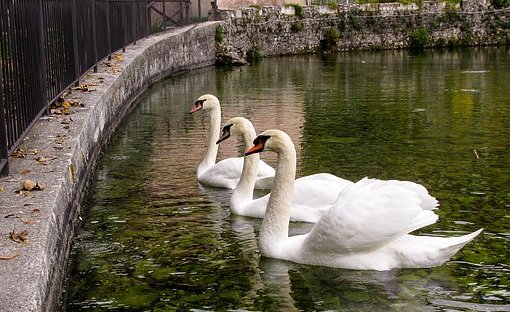
Image: Three swans on the calm river with railings and stone bank.

 literally stories
Wonderful! And with just the right dash of weirdness. Nicely descriptive in a way that took the reader in and I loved the T-Rex reference!
LikeLike
Many thanks, Steven. Glad you liked it!
LikeLike
This was enthralling. I really hope you have more stories like this for us. Your descriptive writing is lovely. I really enjoyed this. Thank you. dd
LikeLike
Thanks Diane, and for the encouragement – currently toying with a new animal idea…
LikeLike
Alex
Wonderful. I have a poster copy of Dali’s Swans Reflecting Elephants on the wall. Your story made me imagine operators in all the creatures. Too bad about the apprentices–that might make finding others even harder to do!
Leila
LikeLiked by 1 person
Haha, thanks Leila, maybe the supply of operators will pick up soon 🙂
LikeLiked by 1 person
A bizarre and elegant satire. I loved the fusion of futuristic tech, avian grace, and cultural critique. The idea of swans as pilotable machines is absurd yet made plausible. The tongue-in-cheek prose is just the right blend of beauty and madness. As others have said … More, please
LikeLike
Thanks, David, glad you like the story. Interesting comment – I hadn’t really thought of it as a satire but I suppose it probably is. Thank you too for thte encouragement – There might well be another animal hybrid thing in embryonic form…Best wishes.
LikeLike
Alex
The animal psyche has always been a homunculus at the controls for me, even though I knew it couldn’t be true. Perhaps a guy inside a swan works or for us, a tiny swan in charge across the corpus colosseum. The human/animal mind is a nebulous place. I love the interchangeability and that there was enough pure swanness and/or human swanness for a soaring retreat at the end. Or whatever it was.
I’ll take this one to bed with me tonight. After a wee toke. Thanks! — Gerry
LikeLike
Thank you for your nice riffing on the story, Gerry. A ‘nebulous place’ indeed. Hope you enjoyed the wee toke too :-). Wherever it took you. Cheers
LikeLike
Hi Alex,
Bizarre, imaginative, descriptive and very entertaining.
This is a cracking piece of writing.
All the very best.
Hugh
LikeLike
Many thanks Hugh. Glad you enjoyed!
LikeLike
Quirky and different for sure, but also such a down-to-earth sense to it. I thoroughly enjoyed this – your command of pace, cadence, lyricism make this quite poetic to read, and so also an absolute joy. Excellent stuff!
LikeLike
Thank you , Paul. ‘quite poetic’? well, what can I say…
LikeLike
Memorable stuff, Alex. Loved the poker-faced narration, especially in regard to the buick swans. Any truth in the rumour that your next piece is about two aardvarks receiving the Legion d’Honneur for mine clearance? bw Mick
LikeLiked by 1 person
Many thanks, Mick. Aardvarks? How did you guess? all best.
LikeLike
Memorable stuff, Alex. I loved the poker-faced narration, especially the buick swans bit. Is there any truth in the rumour that your next piece will be on the award of the Legion d’Honneur to two aardvarks for mine clearance? bw mick
LikeLike