Each morning my mother opens the door in her housecoat and slippers and draws the newspaper inside like a prisoner drawing his supper dish through the metal slot of his prison door. She lays the paper across my father’s plate so that it will be there when he comes down for breakfast, but she never slips the rubber band off the tightly rolled bundle.
When my father comes down, he moves the newspaper aside, pushing it almost to the corner of the breakfast table, as far away as he can get it without having to admit that he is frightened by it and doesn’t want to touch it. And after he is gone, my mother takes the newspaper, still tightly bound, and dumps it into the garbage can with the remnants of scrambled egg and burnt edges of toast. There it stays, unwound, unread, unable to hurt them again.
Nineteen months ago, on a morning that looked just the same as any morning during the nineteen months since, my father opened the newspaper to discover there had been a plane crash the night before. He said nothing as he read the entire article. It was my mother who dropped the plate of steaming eggs when she read the headline over my father’s shoulder: Fiery Crash in Montreal. My father did not flinch when the plate broke apart on the kitchen floor. He laid the paper down on his placemat and left the table without a word, while my mother, snatching up the newspaper and seeing the name of the airline and flight number that my brother had gotten on late the night before, began to hyperventilate.
My father’s voice was clear and calm and in control as he spoke to someone on the phone. I can still hear him yelling at my mother to shut up, he can’t hear with all her noise. Hear him saying yes, he’d hold. Hear him say my brother’s name. Say there must be some mistake.
And all the while, my mother’s noise got louder and louder, and she was sitting, almost lying, over the newspaper on the kitchen floor which still had the little black scuffs where my brother’s cowboy boots had left marks on his way out the door the night before. Marks which my mother scolded him about six, maybe seven, times during his visit home, warning she was going to take the boots from his bedside in the middle of the night if he wasn’t more careful. He had laughed and kissed her on the cheek and promised that next visit he’d leave his boots at school, even though he’d hate to do it.
I didn’t read the article until later, and so I didn’t know that it said: No Known Survivors. My mother held onto that paper, clutched it in her hands until her fingers were black with the ink. She clutched so tight that sometimes whole words transposed themselves backwards onto her skin. After we took the crumpled newspaper from my mother’s hands, I tried to concentrate on reading the backwards words on her skin instead of thinking of my brother who wouldn’t be sending me something from Montreal, maybe a baseball cap from McGill, like he’d promised before going. I could only make out one word, though. Even backwards and mirror-imaged, I could tell that one. No matter how you see it, it looks the same.
The next day, I looked at the black smudges on the kitchen floor from the ink on my mother’s hands. The scuffs from my brother’s boots were hard, straight, real lines. Lines with edges. Lines that announced that he was here. But my mother’s smudges had blurred edges, cloudy middles, not really sure if they were here or not.
My mother wasn’t so good for a long time. Right afterwards, when the cleaner mopped the kitchen floor, she started with the newsprint smudges, but when she came to the boot scuffs, my mother went crazy. Grabbed the mop in a wild panic and fired the cleaner on the spot, even though she’d been cleaning for us for almost three years. The boot scuffs stayed on the floor for a long time after that. Everybody walked around them. Nobody mentioned them. One morning, I came downstairs and my mother was kneeling over the spot on the floor, her fingertips touching the scuffs, whispering to them just as if they were my brother.
I didn’t read the newspaper article until after my parents left for Montreal to help the investigators figure out if any of the parts of the things they found were my brother’s. Instead of the newspaper, my mother went clutching my brother’s dental records.
My father said, don’t be stupid, Ellie, it’s a mistake, they won’t need those things. My father thought that because my brother had flown stand-by, he wasn’t actually on the plane when it crashed. He thought that the fact that we weren’t notified the night before when all the other families were meant that my brother hadn’t ever gotten on the plane. He thought my brother was back in Montreal, safe and alive, and the reason he wasn’t answering his phone was because he’d gone straight to his girlfriend’s and hadn’t looked at his phone yet. Don’t be stupid, Ellie, it’s just a mix-up, stop all that goddamn noise. He didn’t believe that my brother was on the plane until they showed him one of the cowboy boots.
You would have thought that a man like my father, who likes hard proof, would have insisted on seeing the body to make sure, but in the end, it was my mother who had to go with the investigators to identify the charred body they’d found still strapped into his seat. She was even able to tell them which severed foot belonged to it since it was still in the cowboy boot she knew so well. But my Dad, he stayed outside the huge tent that the investigators had set up by the crash site and waited until my mother came back outside.
So now, every morning, my father pushes the newspaper away without opening it, and my mother drops it into the garbage along with the half-eaten food. They don’t know much about the news, but at least they are safe.
My father hugs me goodbye when he gets up to leave, something he never used to do before my brother got on a plane to Montreal. Today, he hugs me and reminds me about my dentist appointment after school. My father has become very concerned about my dental health.
After he is gone, my mother takes the newspaper from the table and steps over the place where the scuff marks used to be, even though they have been gone a long time now. She drops the rolled paper into the garbage. She takes a wrapped box from the counter and puts in on the table in front of me. She pats it softly. I know what it is. I have been waiting for my mother to surprise me with a pair of the cowboy boots that are so popular this season, but I will put them with the leftover scrambled eggs and unread newspaper now that she’s done it.
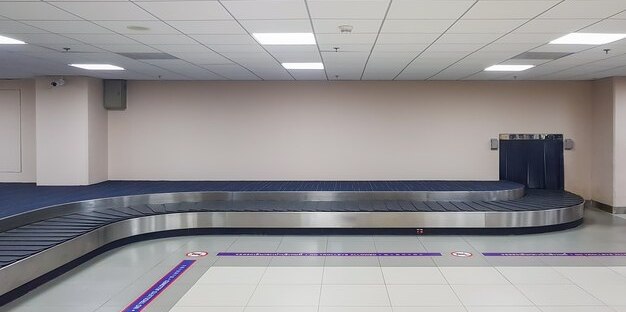
I have a dream sometimes. In this dream, my brother and I are on one of the baggage carousels at the airport. We are going around and around in circles on the conveyor. We pass my parents and wave at them, but they are arguing about which one of us is their bag, since we don’t have our name tags on. My brother is ahead of me on the conveyor, and he says to me that he will send me something from Montreal. I see his lips move: they form the words “something from Montreal.” But he is passing under the long rubber strips that separate the inside of the baggage area from the outside where the men load the luggage onto the belt. The strips pass over his shoulders and fall in front of his face as he speaks. So what I hear him say is this: Some Mistake.
Image: An empty airport baggage carousel from freepik. Shiny steel and dull rubber conveyor leading to the rubber curtain of the baggage area.


Elizabeth
The details of the grief and the realistic actions are wonderful. There are no cliches, the parents continue to implode as one should expect. The vision at the end is beautiful.
Leila
LikeLike
This is absolutely heart wrenching and so very well observed – things such as – the boot marks, the reasons and excuses the father makes etc., give this a feeling of believability. Great writing I think – thank you – dd
LikeLike
Oh wow, this is so sad, and it takes a lot of skill to convey grief this well. I could really feel the initial panic and denial when the family realised, and you did a great job in conveying their own version of acceptance.
LikeLiked by 1 person
Elizabeth
A gentle, quiet power — the lines on the floor, the boy & girl on the baggage carousel. Then everything comes together, evocative of both restraint and perfect command. Just perfect. Wow. — Gerry
LikeLiked by 1 person
What a gut punch. The story shows the power of imagery and details. The boot marks were poignant enough, but having the mother step over the area after they were removed is brilliant. And the banner image, in context of the story, is chilling.
LikeLiked by 1 person
So poignant, the way the most insignificant leavings of the deceased are transformed into holy relics, giving comfort to the bereaved. Very well observed and very well written. Thank you.
LikeLiked by 1 person
A nightmare that becomes real, and how do we deal with it? The survivors carry on, each in his or her own way. And at the end of the story, another dream. Well constructed and vivid.
LikeLike
Hi Elizabeth,
The pace was outstanding and the details were heartbreaking.
Excellent!
Hugh
LikeLike
This story combines and balances beautifully a very moving story that is somehow calm, and a style that is simple, quotidian, but also ethereal and poetic.
LikeLike