

Warning: Extreme content – see tags.
Running.
Gasping.
Retching, the son of Olayo Mejia charges toward his village amid the stench of burning wood and searing flesh. The odor is heavy and it is moist and it fills the valley beneath him in a haze of squalid yellows and heavy browns. It covers the fog-laced treetops and mingles across the terraced fields and, as gunfire again bursts over the Salvadoran hills, its reek grows sharper with every footfall and every wild swing of his arms. Its taste lingers in his mouth, its fumes choke his lungs and he wants so much to pause and catch his breath. He wants to fall to his knees and weep in terror but he knows he cannot, for the helicopters are prowling above him, the smoke is billowing high into the morning air and his home is very far away.
There is no time to rest, no time to sob and veering off the ochre-colored path, he proceeds straight down the mountain, his sprint uncertain and frenzied, his strides reckless and panicked. His legs buckle and with each clumsy step, he prays his mamá and papá have made it to the far-off calle negra, the river and the Honduran frontera beyond or at the very least, are hiding in the chicken coop or in the hollows and crags of the forest. He hopes they are nowhere near the gunshots surging in long, repeating trails but somehow, he knows they are not; somehow, he knows they are trapped within the burning huts and adobe buildings, and if he ever wants to save them, nothing must slow him down and nothing must get in his way.
He scrambles and he swerves and he vaults between tufts of decaying foliage. Mounds of dirt collapse under his feet, puddles engulf his bare toes and trying to avoid a half-buried stump, he trips on a root hidden beneath the weed-choked earth and he soars with flailing arms. The land twists and blurs as he tumbles into the mud and when he comes to a stop, another explosion thunders in the distance and another charcoal-stained plume rises into the clear, tropic-blue sky.
Grime covers his body and drips from his broad nose and shaking his head, the boy staggers to his feet. The fields are wider here, the ground is leveling out toward the sparse jungle ahead and so he ignores the explosions. He ignores the thorns that have shredded his pants at the cuffs, he ignores the jolting throb where the root has ripped the nail from his toe and he begins to run again. His dark eyes sting from the thickening, gritty haze and he has forgotten how peaceful these hills were a few hours ago, how he had stood there and shoved his papá’s machete into a pale, mealy anthill and reveled in the morning’s birth. He had gazed at the far-off calle negra where trucks and cars rolled toward the city of La Palma and he tried to hear the distant, flowing rapids of the Río Sumpul. It was a singular, reclusive moment, a rare pause he had learned to cherish since becoming a man; the conical summits along the horizon were being washed by the sun’s maize-yellow strands and the faint aromas of spicy chiles simmering with arroz wafted up from the valley below. The land was still moist from the night’s deluge, things were quiet and he scratched his course black hair and removed his sandals. He rubbed his brow the same way the other men did, he started to plan where his work would begin and just as the gray shadows receded across the slopes of Cerro El Pital, the first pop-pop-pop ricocheted in his ears.
If only I had the machete, he thinks, reaching the dirt path at the forest’s edge. If only I had not forgotten the machete . . .
Again, the boy stumbles but this time he does not fall. Trees close in and the sun’s mantled shafts attempt to pry through ashen clouds. The fumes have thickened here and his throat burns, and leaping past the old crabapple stump, he has to make a decision. His home is on the other side of the village and he can either go around the settlement or head straight into it. The journey between the maze of narrow trunks and bristled stalks is safe but long and while the other is shorter, it will force him to go by the plaza where the fires and explosions are. He knows what he should do but with the smell of burning flesh getting worse, he continues toward the center of town where last Sunday, the men who toil with him in the fields sat and talked beneath the tall maquilishuat tree.
That night, his fellow campesinos were muttering about whether they should move to a refugee camp. A few smoking, a few drinking Tic-Tack rum, they were shaking their heads and complaining about being forced to grow coffee and cotton instead of food. They gazed at their sandals and they grumbled about the government taxes on Salvadoran corn and wheat. They spat on the ground and cursed how it was cheaper to import food from the gringos up north than to grow it at home. Then they agreed they could never abandon the place they were born. They looked into the shadows around the village square and whispered of using the land on the other side of the valley to grow something besides crops useless to starving people.
“Don’t be stupid,” Camaro Guevara said. “The land up there is Salaverría land. It’s Los Catorce land. It has been since before anyone can remember.”
“They can’t possibly keep track of all their land,” Juan Alvarenga stated. “If you ask me, I think they’ve forgotten it. I mean, does anyone remember the last time it was even cleared?”
“That’s not the point,” replied Eugenio Chavarría. “You know the Fourteen Families. You know how the rich are. Those serotes will call it stealing and we’ll be done for: they’ll tell the politicians they own and we’ll have the Atlacatl Battalion here before you—”
“Exactly,” said Matias Flóres. “We shouldn’t give those butchers an excuse. Radio Venceremos says a bunch of them just got back from training in America. They said the army wants payback for what the rebels did to them in Morazán last—”
Eugenio Chavarría snorted. “You shouldn’t be listening to leftist propaganda.”
“This has nothing to do with propaganda,” Facundo Vigil interrupted. “It’s about us being in the middle of things we have no business in.”
Peto del Cid shook his head. “Do we have a choice? If we don’t do something soon . . .”
“We’ll be fine,” Juan Alvarenga reassured. “If we each work different areas, I don’t think anyone will notice. We just need to get organized and—”
“You’re all fools,” Mateo Claros declared suddenly. “You know whenever Los Catorce hears talk like that they label you a Communist and . . .” He drew his bony, knotted thumb slowly across his throat.
“But this isn’t political,” Juan Alvarenga said. “What reason would—”
“Those chimados don’t need a reason,” Mateo Claros replied. “Ask Olayo Mejia.”
Then they stared at the boy’s papá, the old man trying to hide his useless hands, the fingers curled and mangled from the police and the round tips of their ball-peen hammers.
Breaking through the forest, the boy stops at the village edge and its charred vista of blackened adobe walls, splintered rafters and collapsed roofs of corrugated tin. Every sty and pen has been toppled, an ankle-deep hole smolders where the chicken coop was, and moving amid the broken bodies of slaughtered livestock, a wake of scarlet-crowned vultures feasts. They land with wings like glistening shadows and perch upon emaciated cows to tug at long tongues and peck at soft eyes. They tear and they hiss, their hooked beaks root into the bowels of goats and their talons rip into bullet-mauled swine. Even the local dogs are splayed open and ignoring the blood and viscera surrounding him, the boy starts to run again.
He scampers from hiding place to hiding place, zigzagging from one ruined building to another. The zócalo is not far now and reaching the first muddy street, its cobblestones dappled with bloody footprints, the boy remembers walking past here earlier this morning. He remembers the way the sky was fading from black to blue in the first glow of sunrise and he remembers how his chest was tight and heavy because his papá had not said good-bye. The old man did not wave or nod and beginning his slow march toward his wearisome day, the boy had to remind himself his father had not always been like that. Once, he had been the most respected campesino in the valley and he would walk the mountain’s pathways as if he owned those fields and not the patronos who lived in San Salvador or Miami. He had once been tall and proud and vital but after his first son vanished and he spoke up and the men with the hammers came, he stopped being any of those things. From the instant the rich earth no longer filled his nails and the calluses disappeared from his palms, he became worthless to the village. No one frowned when he raised his useless fingers and openly cursed the army, the government and the wealthy families who controlled them. No one listened when he was drunk and spoke of joining the rebels and no one cared when he would stagger in the dark, calling out to his missing son.
Another explosion rumbles and another column of smoke and cinder is forced into the sky. Its black torrents frolicking upward, another blast quickly follows and between the detonations, the boy can hear anguished screams from the encircling hills. He hears the screams and the crisp, staccato bark of rifle fire and then he hears something else. Above the rasping from his lungs and the roar of blood pounding in his ears, above the rhythmic thumps of the helicopters and the terror-filled cries, he hears the sound of laughter. It is throaty and cruel, and the boy stops running from hiding place to hiding place and he moves directly toward the plaza. Its shrill timbre grows more brutal the closer he comes and though the taste of sulfur and burnt hair is getting worse, he still rushes on. He hurries past scorched homes and the remains of the mercado and when he arrives at the place where Eugenio Chavarría stacks his firewood, the son of Olayo Mejia falls to the ground.
His knees skid along the dirt-covered lot and trying to stifle his breath, the boy scurries behind piles of wood as screams and begging prayers rise from every direction. The wails are desperate, the words are garbled and he crawls until he has found a few angular gaps to peer between. He must keep changing positions but he can already see the bullet holes scaring the whitewashed buildings of the zócalo and the lean shapes of government troops silhouetted by tall flames. The soldiers appear and disappear within the distended clouds and their savage curses punctuate the silence after each volley of rifle fire. Many are holding bloody machetes, some are taking small groups of bound and blindfolded campesinos up into the jungle and off to one side, there is another group of them, laughing and hurling rocks at a trio of bodies strung up beneath the maquilishuat tree. They are close to the boy and he recognizes the forms of Peto del Cid and his two grandsons. Their necks snapped, their faces bent upward, the corpses sway in gentle, irregular motions. The gnarled branches cast warped lines on their faces and dangling like puppets next to their abuelo, the children appear to float beneath the tree while the stones cut into their gray skin and their shadows revolve in ever-shrinking circles.
The boy turns and huddling against the crusty bark, he searches for a new crevice and notices a row of campesinos lying in the hot sun. Their swollen faces resting on the pavement, they are the old and the sick, the blind and the crippled, and the soldiers are yelling about delincuentes terroristas to these men. They flinch whenever they are kicked or grabbed by the hair. They groan and tremble but their answers are always the same: There are no guerrilleros here. The men keep repeating it and they are beaten with every denial. They cringe and cover their faces but many of them are straining between their fingers to watch a line of children being herded into the village church. A few holding the hands of their smaller brothers and sisters or carrying them in their arms, most of the niños are covering the eyes of their younger siblings. Their steps are hesitant and unsure, and they stumble because they do not want to look at the naked corpse of Juan Alvarenga, a gory, hair-framed wound between his legs, a bulbous, flesh-colored mass between his lips.
Some of the children are getting sick and a few meters away, there is another group too frightened to do anything but cover their ears and rock back and forth. The soldiers yell at these children, they slap them and they finally beat them with their fists but the niños still cower on the pale dust and bawl for their mothers; and eventually the soldiers pick the children up and toss them through the church’s doorway like bundles of sugar cane, sodden and unwieldy.
The boy knows they are whimpering. He knows their sobs are loud and frightened but he cannot hear them because they are overtaken by the shrieks of women being dragged into places solitary and dark. They are both young and old and they struggle within clouds of sprawling dirt. They seem immune to the impacts of rifle butts and the backs of hands and even tiny Sonia Chavarría fights, spitting and waving her arms before a soldier punches and pulls her away by her long hair. Skinny and not much older than the boy, the girl claws at the man’s heavy fatigues. She writhes and flails her legs and, when she is brought into another hut, her fingers scrape grooves on the doorframe’s round, unstable posts.
There is someone else weeping inside the rickety home and the boy prays it is not his mamá. He squints and shifts but the woodpile is blocking his view and he wishes he could find a better place to hide. He feels exposed here, for with each twist of their camouflaged helmets, the boy is positive the soldiers will find him. He can almost sense their persistent glares drifting closer and closer but when a piercing scream rings across the plaza, the son of Olayo Mejia turns toward the far end of the zócalo where a soldier holds a newborn child over the village well.
Hanging by its feet, it squirms in the man’s grasp while an officer yells at its mother. The woman is the daughter of Facundo Vigil and on her knees, she cries with swollen lips. She pleads with her hands clasped but the officer keeps asking about the guerrilleros. He questions her again and again, but she merely shakes her head and begs for her child to be returned. Once more, he asks the question and once more, she answers with a shake of her head. And then the officer nods and the soldier swings her baby girl into the well’s side. The child’s still-malleable skull flattens and the daughter of Facundo Vigil crumples to the ground with a final shout. Her howling call shudders and contorts within the veils of smoke and after the soldiers have tossed the infant into the deep well and dragged its mamá toward another place solitary and dark, they bring a new campesina to the officer and a new baby to the well.
The boy tries to turn away but before he can, another voice sounds. It is deep and gruff, and it comes from an officer standing near the round fountain that does not work. He says one word and before its last syllable has been uttered, the soldiers fire into the mass of old men lying before them. The rounds tear open the villagers’ torsos. Scarlet jets burst into the air and the guns continue to roar and the bullets continue to crack. They fire and fire and the boy’s papá jerks up from the mass of bodies. Shrieking, Olayo Mejia gyrates and rolls in capering spasms and his agonized squeals only end after a soldier fires his rifle into the back of the old man’s head and the plaza’s stones muffle his final, burbling gasp.
For a moment, the boy remains still but when more women are dragged away, he wipes the tears from his soot-dusted cheeks and crawls from the woodpile. He begins to stand on his quivering legs and though it is hard to rise, he tells himself a true campesino, a true man would not let this happen. It does not matter if he has never hurt another creature in all his eleven years or he does not have a machete; he must do something.
The soldiers force the last child into the church and while they open fire through the doorway and broken windows, the boy stumbles onto the cobblestones. He steps into the pools of blood coursing and draining amid the roar of machine guns. He stands before the golden flames that burn and snarl, and he watches the black plumes haunting the green valleys and tall mountains of Chalatenango. And with the sound of the Río Sumpul’s churning waters lost in the echo of gunfire, he starts to move just as the soldier behind him brings down his machete again and again and again.
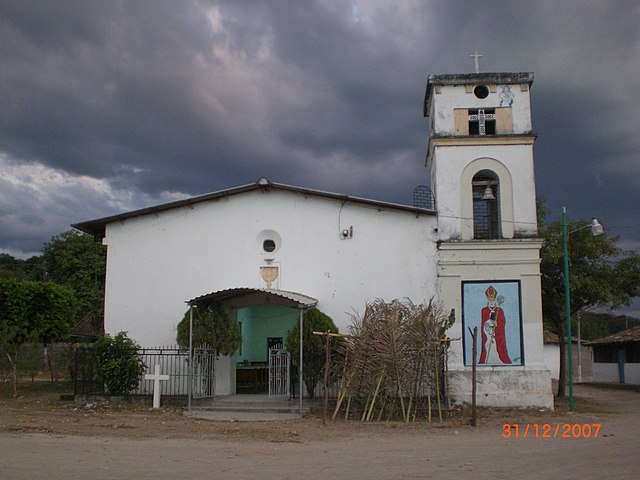
Image: Iglesia San Nicolas Piedras Gordas en Santa Rita, Chalatenango – a church in Chalatenango from Wikimedia commons Iglesia San Nicolas Piedras Gordas en Santa Rita, Chalatenango. This file is licensed under the Creative Commons Attribution-Share Alike 3.0 Unported license.

 literally stories
This is tense, the writing is lean, action-filled, full of verbs and movement, and the choice of present tense is perfect. This story had my heart beating as the protagonist races towards some climatic moment. I thought this was superb writing, and after reading I Googled ‘Chalatenango 1983’ – this story comes up top, but after that some news items about the events themselves. This piece does justice to those events and those who suffered.
LikeLiked by 2 people
J.P.
Tremendous effort. These horror shows from history should not be allowed to flee into the years. Yet another tiny nation allowed to rip itself apart with the aid of the “super powers.” I recall the atrocities being under reported, and when people did hear about them a strange moral lassitude was the typical response. That social numbness that comes from hearing about the tragedies of people faraway.
Thank you for writing this, and for keeping it from hiding in time.
Leila
LikeLiked by 2 people
A difficult read but very well written and yet another example of man’s inhumanity. These things should be talked about (and written about) in my opinion. I would like to say that it helps to ensure that it never happens again but as we all know that is just not true. Still as writers we have to keep these things alive and this story does that extremely well, I think. The scenes are so visible and the pace of it it is spot on. Thank you – dd
LikeLiked by 2 people
J.P.
This was a realistic “action” tale where the excellent writing jumps out at the reader in a good way, especially in the fabulous use of good old verbs and nouns. The variety, and at the same time the focus, of the verb usage was really vivid and it brought the situation, character, and setting to life. In terms of the theme, it shows the extent of the Joseph Conradian, Mr. Kurtz-like horrors that can and will occur when the wrong kind of propaganda gets embraced by too many people for whatever reason. The theater of cruelty up to and including being torn to shreds by wild beasts, was embraced by thousands upon thousands of citizens at the Roman coliseum twice a week for five hundred years, and that was in one of the so-called “civilized” societies. Fiction that tries to confront the savage realities brings us a little closer to the truth and the truth, as someone once said, will set us free. Thanks for writing.
Dale
LikeLiked by 3 people
JP
As the earth reverts back into war, barbarity, and continues to environmentally self-destruct, I recall reading about when the first homo sapiens reached the landmass of Australia. They arrived at one end, and before several generations, had slaughtered every woolly mammoth and large mammal available to them. It’s what we do.
Your story was a reminder. We don’t need reasons. It’s what we do. Ecce Homo. You want to really get sick? Read The Sermon on The Mount: about humility, forgiveness, and generosity for our neighbors — all of them.
Nice job! Gerry
LikeLiked by 1 person
This was incredibly horrifying and I was genuinely frightened by it. I’m ashamed to say that I had no knowledge of such an atrocious and dark episode, which made it all the more visceral. Unflinchingly violent, which does an excellent job of painting the soldiers as the monsters they became.
LikeLiked by 1 person
Visceral, horrible and excellent. Such atrocities need to be memorialized, and this work helps do just that.
LikeLiked by 1 person
No let-up here. Searing stuff, graphic without being gratuitous; horribly powerful.
LikeLiked by 1 person
Hi Paul,
An excellent piece of descriptive writing all around actual events.
One line stood out for me and that was ‘ It’s about us being in the middle of things we have no business being in.’
That says so much about so many situations past and present!
Hope you have more for us soon.
All the very best.
Hugh
LikeLike