
One could argue that, as a native Batistan (even though I currently reside and work in Bocay), my opinion of the events I am about to recount must necessarily be tainted by local prejudice and distorted by personal involvement. And, in a sense, it would be accurate. But rest assured, I will tell you what happened as best as I and my fellow Batistans remember, local prejudice or not.
Before I start my story, I must set the stage for you. Please picture our little village as well as the hero of the unusual events. Named after Padre Batista, a Jesuit priest and saint, our hamlet lies in the district of Jinotega, south of the Honduran border. Wedged into a backdrop of greenery, it differs little from dozens of other villages in the country (if one is bold enough to call the cluster of huts a village). Following well-rooted but unwritten rules, we have erected a church for the consolation of the soul and an inn where we gather at dusk to douse deep sorrows with wine and to celebrate small triumphs with nacacatamales made from maize dough and stuffed with pork.
Batista, population forty-six, has carved a passage in the jungle from which tagua palms and mauritia trees periodically send scouting tendrils to reclaim the territory unlawfully appropriated by people. We are a tightly-knit community where not much happens apart from the occasional variations in births and deaths, and we rely entirely on whatever we can wrench from the surrounding fields, catch in lakes and streams, or pick from trees and bushes.
Life’s not perfect in Batista, but if we ignore the occasional flooding of the Cua River and the volcanic indigestion that makes the Yeluca volcano belch ashes and smut, we could call it pretty good.
Once a year, to celebrate the birthday of the patron, San Batista, the village awakens from its dormancy, and the preparation for the annual fiesta begins. Festive clothes are extracted from trunks, coils of smoke laze up from adobe ovens late into the night, bottles of guaro line the banks of the stream to cool, the effigies of the Saint are dusted and polished.
It is Paco “Cara de Palo’s” job to go to Bocay, the nearest town, to fetch the priest who says Mass on that special day.
Paco earned the nickname Wooden Face because his otherwise unremarkable features are permanently fixed in an expression of solid seriousness. I’ve known Paco for over four decades, and I can’t recall a single moment when he cracked a smile. Before the events I am going to tell you about happened, I had often wondered if, by no fault of his own or because of a hereditary flaw, Paco had been born without the necessary smiling muscles. Be it that or some other thing, no one had ever seen Wooden Face smile or even lift the corners of his mouth to show amusement.
Paco’s cows are quite the characters. These two feisty heifers have names that match their owner’s inflated sense of their potential. Isabel de los Santos and Carmelita de Aragoña had quite the reputation for being both temperamental and fully aware of their important standing in Paco’s household and the entire village.
Wooden Face has a special bond with his cows that beats his relationship with Jacinta, his wife of twenty years. He gets all sensitive if someone dares to call them just ‘cows’ or uses only one of their names.
Now that you know a little about the protagonist of my story, I will go directly to the miracles.
That year, just like every year, we were getting ready for the fiesta. The saint’s figure was given a new coat of paint, and our women prepared a full set of clothes for him; even his nose, chipped off by a drunken bearer in a previous ceremony, was lovingly restored.
Early in the morning, Paco set off for Bocay to fetch Padre Rigodolfo, a wisp of a man with the face of an old chihuahua and the communicative skills of a macaw.
But for some reason that year, an acute feeling of doom nudged at his stomach, and, before leaving, he had made sure the heifers were safe in the corral and told Jacinta to give them an extra forkful of hay.
The night before, he had heard shots. The Sandinistas had ambushed the Contras or the other way around. Paco didn’t pretend to understand, and he didn’t want to understand politics beyond the context of everyday life.
“They can go ahead and measure red tape and spit out slogans in Managua,” he said to his mule.
“Down here in Batista, we worry about crops failing, the unpredictable weather, and making sure we got enough guaro for the celebration.”
He rested in the plaza in Bocay for a while, letting the mule drink water from the fountain. Around him, the hectic Sunday activity was further increased by a protest of workers from a local bottle factory. Armed with guitars and harmonicas, carrying placards, groups of youngsters loitered about and sang. Paco watched and listened, his ears registering the pleasant sounds of the tune. Although it was a Sandinista song, he was pleased to find the words “holy water” incorporated into it. To express his approval, he launched a tentative attempt at joining in.
Ay Nicaragua, Nicaraguita,
The prettiest blossom of my love,
Blessed by holy water,
Nicaragua, shining with shed blood.
The crowd passed by, and the mule, with its belly bloated from the ingested water, was getting impatient to move on.
He picked up the priest at the Jesuit Mission, helped him mount, and, leading the animal by the harness, left Bocay.
“How’s life, Paco?” Padre Rigodolfo inquired.
“The same as always, Padre, the same,” Paco answered with his usual limited loquacity.
“And Jacinta?”
“Bearing up, padre, bearing up.”
“Thank God, Paco, thank God.”
The conversation ground to a halt. The priest, lulled by the mule’s steady clickety-clop and the sun’s warm fingers caressing his bald pate, dozed off.
The road led through the jungle. Spider monkeys hopped from treetop to treetop, porcupines scuttled through the undergrowth, and the whisper of the foliage had a sedating effect on the preoccupied Paco, who had not been able to shake off the feeling of foreboding since they left Bocay.
They were approaching the village when the unusual calm of the afternoon sent pangs of alarm to Paco’s mind. It was eerily quiet—unnaturally so. Expecting to see the usual coils of smoke battling with the wispy puffs of steam found in every rainforest, he peered up at the hills wrapped in a thick blanket of foliage. Nothing was visible above the dense canopy of leaves.
“Padre!” Paco yelled, shaking the priest.
“Ha?” The priest woke up with a start.
“Can you see smoke?”
“What smoke? Where?”
The priest squinted against the sun’s blinding glare.
“No, Paco, there’s no smoke.”
“There should be,“ Paco remarked with a sinking heart.
“Jacinta was going to bake empanadas.”
The old priest slid off the mule, listened, then shook his head.
“Not a sound.”
A terrible certainty dawned on Paco. The Contras!! While looking for food, they were known to wipe out entire communities.
“Stay here, Padre. I’ll go and look.”
He tethered the mule to a tree and left the priest sitting at its side.
As he tiptoed around the village, the sense of impending disaster grew stronger with every stride. He was mentally preparing himself for the worst-case scenario – bodies scattered and, heaven forbid, his beloved cows Isabel de los Santos and Carmelita de Aragoña missing or skewered and slowly roasting over a spit.
And then he saw him—a man in a khaki uniform with splotches like dried blood, a bullet-studded belt, and a gun slung over his shoulder—rushing from hut to hut, pushing people out. He saw Jacinta, her back slumped, dash to the center of the village, where forty-five men, women, and children huddled together, fear stamped on their faces.
Paco retreated quietly, his heart thumping a wild zarzuela against his ribs. What should he do? What should he do? He crept towards the altar where the figure of San Batista stood, a mild smile affixed to the plaster lips.
“Ay, Santito, auydeme por favor. They will kill Jacinta.”
Exercising a degree of control, he refrained from mentioning the cows.
The saint stared at him without blinking, the new robes neatly draped over his rigid shoulders. Paco approached the figure and leaned against it as one might on an unfeeling tree stump. Amidst the chaos, a distinct sound pierced the air, cutting through the clamor. He shifted his gaze toward it… Isabel de los Santos—her mooing would stand out from the crowd, no doubt! And was she steaming mad! Jacinta must have forgotten to feed her. Before long, Carmelita de Aragoña’s loud complaints joined in, and the two started a heated duet.
And Paco understood. It was San Batista’s way of answering his prayer —the miracle he had hoped for! The cows! Bad-tempered when fed, they turned into demons on empty stomachs, of which they had four: the rumen, the reticulum, the omasum, and the abomasum—all of them empty! It had happened before. One day, when they broke free, those mischievous critters went on a wild rampage through the village, desperately hunting for a forkful of hay. And once, poor Crooked Rafael (named after his wonky eye) got the horns, and he never dared to go near them again.
“Thank you, Santito.” Paco bent to kiss the saint’s feet.
He hurried towards the corral, where the bellows reached a desperate crescendo. He was about to open the gate when another idea crossed his mind. He ran back to the house, rummaged through Jacinta’s sewing box, and took out the thickest darning needle he could find.
“It’ll do just fine,” he muttered, and, a miracle of miracles, his mouth stretched in a half-grin.
The heifers, impatient to get out, pushed against the fence as he unlatched the gate. Holding the needle between his fingers, he stuck it into Isabel de los Santos’ rump. The deafening roar that erupted from her throat was absolutely bone-chilling. She dashed out without a care in the world, with Carmelita de Aragoña hot on her heels, receiving the same treatment.
“The bulls!” Paco screamed
“The bulls are charging!”
The cows really know how to make an entrance – their hooves kicked up a massive cloud of dust as they charged forward. The man in the uniform didn’t stand a chance. He reached for his rifle, but it was game over. The cows charged ahead, ignoring the terrified villagers, as they relentlessly pursued the soldier.
Batistans cheered.
Paco looked around, his chest puffed out like a peacock’s, his mouth stretching more and more until it stretched to its full capacity.
“Paco!” Jacinta screamed.
“You are smiling! A miracle, todos los santos, a miracle!”
A suffocated giggle bubbled on Paco’s lips, then burst out like a gunshot. Holding his belly with his hands, his eyes watering, Paco laughed.
“With a needle…” Paco squealed.
“Isabel de los Santos… With a needle.”
And even though we had absolutely no clue what he was going on about, we all burst into laughter.
Still giggling into his fist, Paco collected Padre Rigodolfo and the mule, and Mass began. We thanked San Batista for the miracle. Two miracles, to tell the truth. First, we were saved from certain death, and if that wasn’t enough, Paco actually laughed for the first time in his entire life.
When all the empanadas had been eaten and the liquor coursed warmly through his veins, Paco laughed some more.
“With a needle, San Batista, with a needle…”
With all due respect, Holy Father, the reason for writing this letter is nothing more than to express our gratitude to our patron Saint and add to the list of other known miracles attributed to him. For many, they may not amount to much, but we, Batistans, consider it clear proof that he takes great pleasure in looking after the village for which we shall keep cherishing his memory.
I wish Your Holiness good health and prosperity, and I will remain your faithful servant forever.
Arnaldo Nogal, the scribe.
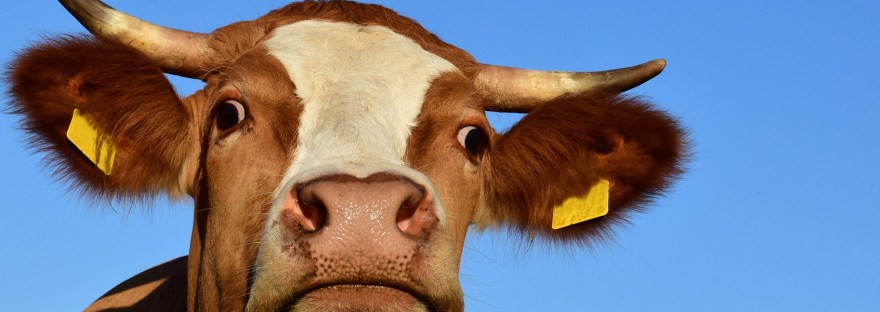
Image: Rather scary looking brown and white cow with horns from Pixabay.com


Hi JB,
A brilliant piece of character writing and that was just the two cows!!!
The best way I can put this is, this is an entertaining romp of a story that leaves me with a smile on my face!!
Loved this!!
Hugh
LikeLiked by 1 person
Thank you so much,
JB de Aragoña.
LikeLike
I thoroughly enjoed this story. It’s a fine example of how entertaining fiction writing can be. I cared about the characters – especially the cows, of course and it had a satisfying conclusion. Great stuff. Thank you- dd
LikeLiked by 2 people
I have just seen all the comments and I am overjoyed! Happy 2025 to you all.
JB (writing from Bocay)
LikeLike
JB
You found humour in a dark situation. Such an enjoyable read that ends happily (unless you are a Contra). Too bad Ollie North wasn’t there for the miracle.
Leila
And to Diane, that is a fine fine Bovine in the header
LikeLiked by 2 people
I find that humor is more difficult to write than tragedy but I try. We need humor in these difficult times.
Village scribe, JB Polk
LikeLike
LB
I enjoyed how you managed to maintain the colorful local feel while making the story accessible to all. A great way to spend a half hour while preparing for the storm of the century [such hyperbole everywhere except in the breweries] to hit Florida. Perhaps Padre Rigodolfo could say a few sacred prayers. He seems up to the job.
Gerry
LikeLiked by 1 person
It means the world to me that readers like my story. Happy 2025.
JB
LikeLike
Father Rigodolfo did say a few prayers. Happy New Year!
JB
LikeLiked by 1 person
JB
I admired the liveliness of the prose in this story, the way the writing is packed full of vivid details that present narrative images tumbling down the screen one after another, enough to keep the reader’s interest plunging forward along with it. The lively, action-packed tone of this tale was effective. The reader can feel the narrator’s fondness for the subject matter; the way the narrating character enjoys the regional details comes through. A kind of blind, but endearing, faith in life amidst all the chaos, happenstance, uncertainty and confusion seems to be one of the story’s reasons for being. Congrads on the publication of a fully accomplished tale.
Dale
LikeLiked by 1 person
Jusst read all the comments and I am beyond grateful to you all.
JB de los Santos LOL
LikeLike
Excellent descriptions and an over-the-top, yet ultimately believable character. The humor contrasts with the more serious themes of potential violence and heroes of a different kind. Cowabunga!
LikeLiked by 1 person
Cowabunga to you too, friend
JB
LikeLike
Beautiful! I love the quirkiness of this and how certain phrases and ideas are turned on their head, such as ‘limited loquacity’ and the idea that no smoke means trouble – brilliantly done. The folk tale nature of it, and the South American setting, can’t help but remind me of the short stories of Gabriel Garcia Marquez.
LikeLiked by 1 person
I suffer from limited loquacity sometimes. In modern lingo it is know as writers block.
Happy 2025.
JB
LikeLiked by 1 person