I only eat meat, what the kids nowadays call a carnivore diet. Out back of the house, I got a garden, but that’s for the wife and kids. I haven’t had a vegetable since I was thirteen years old, and for that, I blame my pops. Blame my mama for other things, like why I save every dollar I earn for booze and smokes and complain about the lights being left on in rooms nobody’s in. They’re the reason my two boys are running around with ripped jeans and holes in their shoes, why I got a woodstove instead of a furnace, and why I don’t allow pets under my roof, no matter how much the kids beg me.
My parents did a number on me.
Some might say we was poverty-stricken, which we were, but I chalked it up to my folks being cheap. If I could ask them today if we was poor or if they were just close-fisted cheapskates, they’d say neither…they were efficient.
I didn’t learn until I was twenty-five that you could put clothes in the dryer after taking them out of the wash. We hung our laundry on a line in the yard and only put them in the dryer to get the wrinkles out. In the winter, Mama would bring the line inside and tack it from one wall to the other near the fireplace. You never put wet clothes in the dryer. “The dryer’s allergic to wet,” she’d tell me and my brother.
When I’d finally learned the truth, I disregarded her lies when she wasn’t home, but she would always come back within five minutes of me putting those sopping wet clothes in the machine. Seemed she had an intuition of when too much electricity was going, meaning money was being spent. If I had the dryer running, she’d tear into the house, shut it down, pull the clothes out and throw them in a basket and force me to hang them up. I swear to God, if my mama had ever gone missing, I’d have just thrown a soaking load in the dryer, turned on every light and appliance, and waited for her to come storming back in as if she was just sitting out on the porch.
My old man was a penny-pincher too. In the bedroom me and my brother shared, there was a thermostat that was never to be cranked up past sixty degrees. On bitter days, our pops would make hourly rounds like a corrections officer checking on inmates, coming into our room, inspecting the dial, and making sure the temperature hadn’t been touched. One time he slipped in while me and my brother was sleeping, the thermostat set to seventy degrees, and he woke us up by whipping his belt across our stomachs, and after that, he installed a plastic shield and key lock over the dial so we couldn’t fuss with it no more. Turned the heat right off before he did it, too.
It blew my mind we had all these luxuries but were forbidden to use them.
My brother and I settled the heat problem like a couple of safe-cracking criminals. The thermostat shield had tiny slits on the sides for, I don’t know, ventilation, I suppose. We unraveled a paperclip into a straight line, fished it through one of the openings, and pressed it against the dial until it spun that red arrow to seventy. We felt a certain triumph for having gotten past our father’s security, but the satisfaction didn’t last more than sixty seconds. Pops heard the boiler kick on in the basement, and he came up and kicked our asses. After that, he tore the dial right off the wall and then tore our asses apart some more.
What did we do if we was cold? Put on a sweater and get under the blankets. Air conditioning if we was hot in the summer? Take off the sweater, or go sit in a stream. How about AC in the car? Nonsense. That burns extra fuel. Close your mouth and stick your head out the window.
Pops said these were economical solutions, but what he meant was cheap. Mama would race from one end of the house to the next, turning off whatever lights were on, and shutting down appliances, sometimes while we were still in the room or still using something.
“Who left this light on?” she’d screech as she came into the kitchen and slapped the switch.
“I’m still in here,” I’d say, rummaging through the cabinets for food.
“Who left the TV on?” she’d croon as she snatched the remote from my brother’s hand.
“Who left the bathroom light on?” she’d holler.
“I’m still in here,” I’d say, taking a shit in the dark.
You spent more than two minutes in the shower or flushed the toilet after a piss, there was hell to pay.
My mother and father did everything in their power to save a buck.
Camping trips with the grandparents, grandma would give me and my brother each twenty-five bucks, which, back in those days, was a lot for a child to have. It was just a little spending money if we wanted to buy something when we went into town. One year, I remember, just before our annual trip, my old man won five hundred dollars on a scratch-off, so Grandpa suggested he throw us some dough. Pops cringed as he retrieved his wallet, a sign of tremendous pain on his face as he fingered the bills. Counting. Counting. He looked down at me and my brother and said, “Five bucks enough? For the both of you, that is.”
Growing up, there was tons of books in the house, but I never once saw anybody read them. Our parents didn’t read—unless it was the lottery numbers off the television. The walls, mainly the living room and the downstairs bedrooms, were stacked from the floor to the ceiling with novels of every genre. Mama would find them in boxes at the end of people’s driveways with a free sign on them. She’d get them from neighbors, tag sales, anywhere people were giving them away for nothing. Most people take their unwanted books to the local library; in our town, they donated them to us. It got to be we had so many books in the house that there wasn’t an inch untouched by hardcovers and paperbacks.
I asked Pops once, “What’s with Mama and all these books?”
He told me, “They’re not books, son. They’re the world’s cheapest insulation.”
To this day, I cannot recall what colors the walls were in that sorrowful home.
They weren’t always pinching pennies because they were cheap. What they were really doing was saving up for the things they wanted, like an illegal cable box you hooked up to the TV to get free HBO, Pay-Per-View, and porn. Or the week-long trips they’d take together when they dumped me and my brother off with the grands. Extra lotto tickets, booze that wasn’t on the bottom shelf, a fancy dinner at Red Lobster, new clothes for Mama, a new gun for Pops.
We didn’t get nothing.
“Turn off the television,” Pops would say. “What do you think we are, made of money?”
“No, you can’t come on the trip with us,” Mama would say. “Disneyland is no place for children.”
We was thirteen the first time we got a pet, a black lab named Poe, and I honestly don’t know how we ever convinced our parents to let us keep him. I can’t recall where Poe came from. Either it was a stray or someone was giving it away and my old man must have seen a free sign light up in his head and couldn’t pass up a bargain. All I know is he’d said okay, fine. But what he didn’t realize was that it’d cost money to feed the thing. Bringing home canned wet food and bagged dry food lasted about a month, and then Pops started feeding him table scraps, and not much longer, he was eating everything but plastic bottles and tin cans. Within a year, Poe had gotten severely overweight and his poor legs couldn’t hold him up any longer. The dog became a living garbage disposal (I truly believe my old man had somehow trained it to eat trash so he could eradicate the garbage utility bill).
Needless to say, Poe didn’t last long. The dog got fat, ill, and weak, and started pissing and shitting in the house. When the time came to put Poe down and Mama suggested we take him to the vet, my father said, “Vet? Nonsense! They’ll charge an arm and leg and I’ve got something that costs a buck, maybe less.”
He, of course, was talking about the price of a bullet. But Mama drew the line and said he couldn’t blow the dog’s brains out, so we brought him to the vet to have him put down, and then the vet asked us if we’d be taking him home with us or sending the body away for cremation.
Oh, but a cremation costs money.
“We’ll take care of it ourselves,” Pops said. “Grab an end, boys.”
“Where do you want us to prep the fire?” I asked when we got home.
Pops scrunched his eyebrows at me. “Fire? Fire for what?”
“To cremate Poe.”
“Boy, do you realize how hot you’d have to get it to incinerate a body to dust? Well, I don’t either, but I ain’t wasting the firewood I broke my back splitting all year on a dead dog when it could be used to heat my house.”
I wanted to ask him, “Ain’t that what the books are for, you cheap son of a bitch?” but didn’t. The only way split firewood could ever hurt his back was if the truck his friend delivered it in backed into him. Instead, I inquired how he planned to take care of Poe’s body himself like he’d told the vet.
“You know how much fertilizer costs these days?” he said and pointed to the garden in the yard. “That mutt’s good compost.”
So me and my brother dug a hole and buried the dog in the garden, and when the season’s vegetables came in, I had none of it on my plate. Never again. I’m forty-five years old, and if I so much as smell a carrot or potato, I’m reminded of Poe rotting under four feet of soil, fertilizing the crops. It’s why I’m a carnivore, as they say. I won’t eat nothing I ain’t hunted and killed myself. Hell, you couldn’t get me to swallow a store-bought head of lettuce if you tied my hands behind my back and tried to cold press it down my throat.
I hope I haven’t screwed up my sons like my parents did to me and my brother. Sure, we ain’t got a dishwasher, dryer, furnace, internet, or cable TV, but the kids can’t miss what they never had. I’ll slap them upside the head if they forget to turn the lights off or let the heat out when they leave the door open for too long, but that’s just sensible discipline. I got me a woodstove, and I make the boys cut down trees every spring for firewood, tell them if we don’t have at least four cords by fall, they’ll be spending the winter picking icicles off each other’s peckers while they’re pissing behind the shed they’ll be living in. Them ungrateful bastards is lucky I don’t make them take showers together.
Every birthday and Christmas, they ask for a puppy, and my response is the same as when I’m asked if I’d like a salad: No way, no how.
What’s the point of having a dog when I can afford the garbage bill?
I ain’t that hard up for cash.
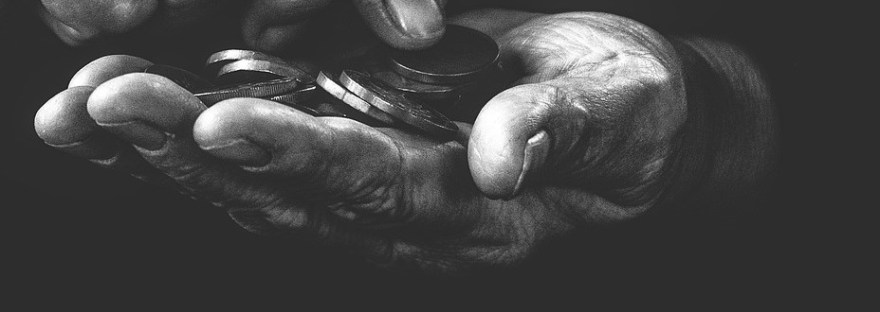
Image by Frantisek Krejci from Pixabay – a cupped hand holding coins in black and white.

 literally stories
Great tale of extreme parental selfishness written in a really engaging narrative voice. I particularly like the somewhat redemptive ending and the reveal as to the reason for not eating vegetables anymore. A dark, yet clever and meaningful story.
LikeLiked by 1 person
Boy, does this story take me back — not to my own parents, who, though impoverished, never stinted when it came to their sons — to parents of children I knew when I was young. When I read the content alerts at the beginning of the story and saw “child abuse,” I thought it would be more blatant, more perfidious, but no. Sometimes it is a subtle as a way of life. As an adult I’ve known men who think more of guns than butter; a slap upside the head than a loving embrace, when it comes to their kids. This was just so alien to my own upbringing that I can only shake my head in wonder. And when it comes to economizing, one can make better choices that “smokes and booze,” in an effort to save money, when others’ mental and physical wherewithal are concerned. Although the characters in this story were joyless, the fiction reminded me of how lucky to I was to have had the parents I did when I was growing up, and for that I thank you.
Bill Tope
LikeLiked by 1 person
Devin
Happy to see your work up today. A tough, hardscrabble existence well displayed. The bit about the dog was disturbing and highly effective. It proves that a miser doesn’t need money to hoard. Any resource (or perceived “loss”) will do.
Leila
LikeLiked by 1 person
This story makes you realise that true poverty has nothing to do with the lack of money. The voice was great and unwavering all the way through. This is sad and makes me realise again just how brilliant my own parents were when we had literally no money but we never felt poor. Great story with lots of depth. Poor dog. Thanks – Diane
LikeLiked by 1 person
A grim but effective read as what could be seen as abuse gets passed on down the generations. Well told.
LikeLiked by 1 person
Hi Devin,
Grim, but brilliantly grim.
I felt for the boys as kids, not so sure if I would feel the same when they became adults!
All the very best.
Hugh
LikeLiked by 2 people
I absolutely loved this piece. It may be my favorite piece I’ve read this year. The voice is mesmerizing and appropriate. The details are everything! Two generations of story in one piece! Beautiful!
LikeLike
Earlier readers said it all. My perspective is a little older. My parents came from the depths of the depression. No way they were as extreme as this story, BUT –
Clothesline in the backyard – didn’t always work in rainy Oregon also one indoors
Original clothes washer had a wringer for partial drying
Repackaged tree tinsel when the tree came down – hated it
At the end of a bar of soap’s life it was combined with other bits to make liquid soap
Same thing with lights
Mother spent money on smokes and liquor
Later parents went on cruises and trips to Reno. Loosened up a bit.
LikeLiked by 1 person
I still dry the washing outside. The only time we haven’t has been when we have lived in flats and even then we have used an airer on the balcony when we were allowed. The soap thing made me laugh. When we were short of money my hubby decided to buy a thing called a soapy Joe and it was supposed to squash all the ends of soap together to make a new cake. Hey, guess what it didn’t it just stuck them together until the first use and then you had lots of bits of soap again!! Really though, turning off the lights when you leave a room is just the right thing to do in my opinion for all sorts of reasons. I like me a mangle!!
LikeLike
Diane – Unlikely you read Stephen King. Yes, I am going somewhere with this. He worked in a laundry before “Carrie”. One of his short stories was about a mass murdering mangler of the laundry variety. Don’t trust them!
We now have several US politicians who are manglers of words.
LikeLike
Ah but I do. I have just read Fairy Tales which was brilliant. My facourite is Duma Key but think Lissey’s Story is up there with the best and my copy of The Stand – long version in paperback is falling apart on the book shelf even as we speak. I still love a mangle. 🙂
LikeLike
Diane – I’m both a fan and critic of King. I’ve given up reading everything he writes because he writes faster than I can read.
“smart car” is my “Christine” and “AKA Kerry” is my “Carrie”. Both are in Fiction On The Web. “Dumb” is my, well you can guess what, in LS.
LikeLike
You’re taking me back to my childhood, Duke: mother and father both bought smokes, at least at first, but they cost only 15 cents a pack back then.
We also repacked the Xmas tree tinsel — and bolluxed up the strings of lights each time we packed them away.
My mom’s first washing machine had a mangle as well, but for the first few years of her marriage she used a freakin’ washboard! She didn’t buy a dryer until my dad developed Alzheimer’s and wet the bed constantly and she needed the dryer. Also, the birds began to wreak havoc on the hanging clothes. Our basement was teeming with drying laundry.
Needless to say, they lived through WWII and the Great Depression as well.
LikeLike
Devin
Your story reminds the reader that there are humorless, moralistic folks at all levels of society everywhere, from the lowest to the highest. And probably more true in puritanical, technocratic, materialistic, Godless America than anywhere else. I also admired how your story uses the colloquial unreliable narrator tradition of American short story writing. William Faulkner was a master at depicting morally and emotionally void characters by focusing on the twisted way they see the world. I also wondered about the narrator’s obsession with his own childhood and his apparent refusal or inability to do anything to make the situation better for the newer generations coming on. Some folks who are horrifically abused during childhood turn into abusers in turn. Others turn into gentle and good folk, as a reaction against their vile upbringings. Charles Bukowski was viciously beaten by his father every day of his life for ten years, and by his own daughter’s account he turned into a gentle, humorous and loving father who rarely even got angry at his daughter, much less ever raised a hand against her. Thanks for exploring the dark side of human nature with a fearless gaze. The refusal or the inability to feel is probably the scariest thing there is.
Dale
LikeLiked by 1 person
Dark dark humor. Goes to show the nut doesn’t fall far from the tree. Nut being the operative word. Well done.
LikeLike
Talk about being frugal. Pretty good stuff. Applause!
LikeLike