
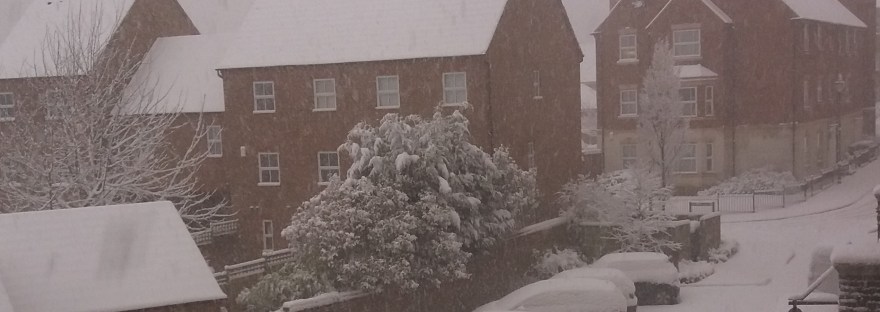
Snow happens quietly in many places, often overnight, without drama. Pull back the curtains before sunrise and under the streetlamps a sulphur tinted fondant drapes over everything – the rows of Victorian terraced houses on either side of the street, the pavement, cars, wheelie bins, everything. Garden hedges and shrubs sit undisturbed, revealing dots of evergreen just visible through layers of cotton. Higher up, tree branches, recently bare and springy, now sag wearily as bits of fine powder dust off intermittently in the breeze.
With Christmas only a fortnight ago, feet-less firs freely shedding needles now lie on their sides along the pavement awaiting municipal disposal. They won’t be collected today. Not now there has been snow overnight. This isn’t Scandinavia. Two inches here is enough to halt most things.
There’s a faint hint of a sunrise struggling to drag itself up through the dark. As the street starts to stir, and the day begins, lights go on in the houses, curtains are drawn back. On the outside walls of the terraced houses gas flues softly blow while, inside, radiators clank and gurgle, the rising cost of energy a problem for another day.
A front door opens. A young man in a parka comes out. He struggles to pull the blue door shut behind him. The damp wood, swollen with winter moisture, has expanded within its frame. He pulls with more force and it shuts with a bang. It’s not snowing anymore but he pulls his hood over his head anyway. His ears tingle in the cold but there’s no way he’ll wear muffs over them. They look ridiculous. He slips unsteadily, straightens himself and carries on, crunching his way out along the short path from his front door to the pavement. Ignoring the prints left by the neighbourhood fox earlier, he delights in being the first to step into unbroken snow. He scoops up some snow from the bonnet of a parked car and packs it into a ball. Shrugging to shift his slipping rucksack further up his right shoulder, he carries on walking, his footsteps pock-marking a path through the white along the pavement. In the distance he hears a bus. He is relieved. They are running this morning. He picks up his pace and, curving round the corner, disappears from view.
For a while afterwards the stillness returns. The young man was the first out of the blocks. Others now follow. More front doors open to tip out their occupants. One by one they step out onto the pavement, gingerly at first, slipping and sliding, not yet used to walking on snow. They’ll never get used to it. The snow never stays for long enough around here.
The winter sun has risen now, just about. The streetlamps are off but they’ve left behind an oddly orangey wash to everything.
Along the lines of parked cars, drivers are scraping snow and ice off windscreens and windows. Engines are being turned on and run to warm up the interiors. Children giggle and shriek, grabbing handfuls of snow, making the most of the few minutes before they are bundled into back seats for the school run, a jumble of limbs and coats. Moments later the cars start pulling out, slowly making their way along the road, creating tracks of grey as increasing amounts of asphalt are revealed behind them.
Across the street a red door opens, two women stand in the doorway. One of them is in a dark blue uniform, the heart shaped curve of a stethoscope poking out from the lower right pocket of her duffel coat. The other woman is in her late 70s, dressed in a light blue jumper and jeans, bedroom slippers on her feet. Her tousled grey hair is thin and limp, framing an ashen face, lined with fatigue. The uniformed woman steps out onto the path pulling a low-level trolley bag out behind her. Doing up the toggles of her coat, she turns round, and blinking back her overdue-for-a-trim fringe off her forehead she says something instructive to the other woman who nods and smiles weakly before following her out of the doorway and onto the path. The uniformed woman hesitates, then pulls her into a hug. It is a long hug. They pull apart but remain holding hands for a moment. The uniformed woman releases her, pats her on her arm, ushers her back into the house, pointing to her damp bedroom slippers, and then turns to go, waving as she walks to her car. The woman in the doorway waves back and shivering slightly, wraps her arms tightly around herself. She watches the car struggle out of the tight space and eventually drive away. She turns to go into the house and is about to shut the red door when she sees a black estate car with blacked out windows draw up and pull into the recently vacated space. She waits and watches. Her feet are cold. The wet has seeped through her slippers. Two men in smart black coats and suits exit the car. One straightens his black necktie while the other glances at his shiny black patent leather shoes before they both make their way towards the house. The woman in the doorway is expecting them. She notices that one of the black suits is clutching a zipped up black leather folder. There is always paperwork first, she thinks ruefully. She wonders how many forms she will need to sign, how many decisions she will now make, how long it will all take. She makes a mental note of the people she will need to call. The vicar. And the children. Of course, the children. What time is it in Australia? She has to call the children. She is so tired. All of a sudden, she is aware of the stinging behind her eyes, the heaviness slowly seeping over her limbs. Then it occurs to her that tonight will be the first uninterrupted night’s sleep she will have had in a very long time. She forces a tight smile and stretches out her hand to the two suits. They shake briefly, one after the other, and follow her into the house shutting the door behind them.
It hasn’t taken long for the snow to start turning into slush, previously crisp Egyptian cotton sheets now piles of soiled laundry bunched up on the sides of roads and pavements. The stillness replaced by a series of traffic induced wet whooshes, changing in pitch – a splashy Dopler – as vehicles go by.
By tomorrow it will all be gone. There will be no trace of today.
Emily Emmanuel
Image – Urban street in the snow by Alex Dickson

 literally stories
Eileen
This is a great example of restraint. Beautifully done. There are so many of us and our tragedies. Yet as it is said about snowflakes, every pain is different from the others.
Leila
LikeLike
Thank you Leila. I like your comment about the snowflake. Each is different and yet, in the broadest of terms, the same. And each adds to the sum of the whole.
LikeLike
Beautifully observed with a perfect tone and pace this was a most enjoyable read even though it was actually rather poignant. Thank you
LikeLiked by 1 person
Thank you Diane. I was hoping to convey the ordinariness of life in which all our somethings and nothings happen.
LikeLiked by 1 person
An absolutely beautiful and poignant piece that took me somewhere I hadn’t expected – that last line nailed it.
LikeLike
Thank you Steven. So glad you liked it. Thanks for reading it.
LikeLike
This is a masterclass in observational writing. Not only that though, but the kind of almost aloof, reportage style of voice is genuinely interesting – in that sense it brings a stronger feeling of reality and emotion to the piece. This might be an odd comment, but two things came to mind whilst reading this – the first was Penny Lane by The Beatles in that the song describes a street and the brief events on it. Stylistically it is reminiscent of Jon Fosse’s style of writing in that it is so controlled and kind of objective, which brings much more feeling to it. In that way, this is also a masterclass in show and not tell.
LikeLiked by 1 person
Thank you Paul. Apologies if this is a repeat reply. I haven’t quite grasped the posting process.Really appreciate your comments. I had a look at the lyrics for Penny Lane and can see why you mentioned it. 🙂 Thanks again.
LikeLike
The descriptions accumulate like snow, paint a beautiful picture, then melt away. Such is life. An excellent story.
LikeLike
Thank you David. Very kind of you.
LikeLike
So sorry for the multiple postings everyone. I clearly haven’t got the hang of this “did it work or have I messed up…again” thing. 🤦🏻♀️
LikeLike
Don’t worry I’ve been through and culled some of the repeats.
LikeLike
Thanks Diane.
LikeLike
Hi Eileen,
A brilliant piece of snapshot of life descriptive writing.
We have had many of these and not that many make it as the balance is off. You gave each section the respect it deserved and the balance was perfect.
I find it strange that Paul mentioned Penny Lane – Due to the tone and pace it was actually Eleanor Rigby that came into my head!
And as already stated, that last line was a belter!!
All the very best.
Hugh
LikeLike
Thank you, Hugh. I’m very new to writing and a bit (more like a lot) clueless about what a story needs in order to work. It’s all hit or miss with me but I hope to learn along the way so your comment about balance is very helpful, thank you. I’m also not very familiar with Beatles’ songs (sacrilegious, I know) so had to look up the lyrics of Eleanor Rigby. I can see why you referred to it. Thanks again.
Eileen
LikeLike