
Three mummers scurried down Halstead Lane. They huddled together, a mass of grey and brown rags, buckets hanging off their elbows and pockets bulging with brushes and cloths. Somewhere in the folds of their shapeless rags, each one had a tin cup half-filled with their earnings of the night. They moved with little stubborn stomps, their buckets and coins clinking with every step, determined to keep their footing on the ice-slicked pavement.
They reached the Working Men’s Club and stopped. Three faces, blackened with soot, turned upwards to stare at the door. The lamppost above them flickered, the bulb about to go out. So thickly had they painted on the soot that no spot of skin could be seen. Beneath their headscarves, six wide eyes floated in the darkness.
One figure emerged from the group. It stepped forwards and reached to the door, but a hand shot out and tugged on their elbow, pulling them back to merge with the others.
‘Not this one, we don’t know anybody here,’ a voice hissed.
‘But when else are we going to get the chance to look inside?’
There was an awkward shuffling.
‘I just want to see,’ the voice persisted, then added in a hushed tone, ‘they say he died in there.’
They could only mean John Lee.
John Lee had been homeless for eighteen years. Occasionally, things had been tried. Worthy people had intervened, but John Lee was John Lee and there wasn’t much that could be done about that. Sometimes he would whittle these odd toy whistles and hand them out to children on the street. They never worked. You couldn’t get a proper tune out of them, but it was a thing to have a John Lee whistle. And it was another thing if you managed to keep it. In general, the mothers didn’t like John Lee’s whistles, and if they found a child with one, they would throw it away and mutter something about not taking risks with strange old men.
The snow this December had been bad. The whole town had felt it. The relentless cold had gnawed through coats and gloves, and window panes. The impassable roads and iced pavements had brought about a collected feeling of being penned in. With no wind stirring to push holes in the steely grey sky, time had stopped moving properly. Locked in their own misery no one had even thought of John Lee until he showed up at the club looking thinner and greyer than ever, missing his usual backpack and walking cane, and dragging his left leg behind him in a new and pronounced limp.
‘They might not like us in there,’ said one of the mummers.
‘But it’ll be the worst luck to turn us away on New Year’s Eve. They’ll have to let us in.’
‘Your sister won’t be able to cover for you for much longer, Anita. Oughtn’t we get back?’
But the mummer repeated her plea. ‘I just want to see.’
A pause.
‘I want to see too,’ said the mummer called Anita. ‘We go in. One more before I have to get back.’ Her voice was firm, but she tugged at her sleeves and ensured that not a sliver of skin was visible before she stepped forward and opened the door.
A blast of cold air entered with the mummers and all the patrons looked up from their glasses and cigarettes to clock the newcomers. There was a moment when the drinkers took in the strangeness of the mummers, and the mummers took in the strangeness of the club.
Unlike the other pubs they had visited, there were no signs of New Year’s Eve festivities. No red and gold streamers hanging from the ceiling, no band playing in a cramped corner, no music playing at all. No woman’s laughter carrying across the bar. In fact, there wasn’t a single woman there. All the patrons were men, and they eyed the mummers with puzzled frowns, as if trying to decide whether to be amused or annoyed at this intrusion.
‘Ah, the mummers are here! You lot are running late!’ cried out a wheezing voice from the back, choosing amusement for the collective. The men stirred at their tables, eyes suddenly brightening. A general loosening of shoulders and tongues spread through the small, cramped room.
‘Come on then, you’d better get to work,’ called Paul Smith, the landlord; a tall, spindly man with a long nose. ‘The Lord knows there’s plenty of bad luck to shift out here.’ He rapped the bar three times with his knuckles before touching his thumb to his chin and muttering underneath his breath, ‘God rest his soul.’
The mummers did not reply, for mummers mustn’t utter a word until they’ve been paid, but once they had been officially welcomed they each began to hum, each producing a strange nonsense tune of their own invention. Humming their songs, the three figures drew out their brushes and parted to sweep different corners of the room.
Whilst sipping their drinks the men shot glances at the mummers at work, making observations and inferences. When the mummers moved apart, it was easier to see them clearly. They were young, but mummers always were. Twelve, thirteen, fourteen at a stretch. Their wrists were narrow and their faces delicate. Girls. Three girls.
Sometimes the shoes would give a mummer away. They would dress all in rags, cover their faces in soot, but leave their scuffed school shoes poking out beneath torn hems. But these ones had thought it all through. They each wore clumpy old workboots, clearly a few sizes too big. Borrowed from older brothers, perhaps?
The men tried to get them to talk. If a mummer talks before the cleaning is done then the landlord doesn’t have to pay up.
‘Hello there, what’s your name?’
‘Now I bet there’s a pretty lass under all that soot. Would you like a sip of whisky? All you have to do is say yes. I’ll make sure your mama never finds out.’
‘You missed a spot down there! Look right there. Don’t you see that great big mark?’
The nearest mummer knelt to where the man had pointed and whilst she was sweeping at his feet, the man said loudly, ‘Whilst you’re down there, love.’
He took an exaggerated gulp of his pint whilst laughter erupted from the tables around him and the mummer scurried off to the next table, her head bent low as if to hide a blush that burnt beneath the soot on her cheeks.
One mummer lingered at the quieter edge of the room, where the only patron was an older man sat alone. He was smoking a pipe and his eyes were half-closed as if on the verge of sleep. The mummer methodically dusted a collection of photographs that hung on the wall next to the man’s table. Each one was a picture of the local cricket team, their annual team photo. The oldest one dated back fifty years. The mummer recognised the face of Learie Constantine among the photos. Constantine had been born in Trinidad and had led the cricket team to such glorious heights that he had been made an honorary Freeman of the Borough. She had done a report on him for school last year.
But the mummer was not really looking at the cricket team. In the glass of the photos the mummer could see the whole club. Through their reflection she watched the way the men lifted their pints in mechanical movements, and the way they nodded so gently when their companions spoke and the way their feet were planted so evenly and squarely on the floor as if each one was screwed permanently in place.
And as she slowly dusted the frames and stared at the reflection of the room behind her, she thought that her grandparents may have crossed half the world, but they had never stood in exactly this spot. They may have left everything behind, built a new life, gained the wealth that meant she and her sisters and her cousins had never gone hungry. They may have done all of that. But they had never pushed open that door of this club and crossed over the threshold. She was standing on ground that no one else from her family had ever stood. It was even possible that no one else from all of Pakistan had ever stood in the spot that she was standing right now. She was the first.
‘Don’t know why you bothered to put soot on your face, weren’t you dark enough already?’
The mummer’s arm froze. She saw that in reaching up to dust the higher frames, her sleeve had fallen back, revealing two inches of her wrist. She dropped her arm quickly and tugged at her sleeve. She half-turned to look at the old man. He wore a dozy, satisfied smile.
‘Thought I wouldn’t notice, huh? I don’t look it, but I’m very good at noticing people. I clocked you the moment you walked in.’
That had to be a lie. Doris had said before they had left that no one would ever know by looking that they weren’t three white girls. The old man couldn’t have clocked her the moment she walked in. He was only trying to make himself sound clever. But under the malicious toothy grin of this old man, the mummer lost her humming tune.
It didn’t matter if he lied about when he had clocked her, that he had clocked her at all is all that mattered. If he raised his voice just a little louder, if all the heads looked up and stared at her now, if they talked. If word got out that an Asian girl had gone pub crawling as a mummer…
It wouldn’t matter that her head was covered, or that she hadn’t drunk so much as a drop of water, or that she hadn’t spoken a single word to anyone. It wouldn’t matter that she had only wanted to see. There was no acceptable reason for her to enter a pub. She knew it, her parents knew it, and from this old man’s widening triumphant smile, he knew it too.
She couldn’t move. Couldn’t think. The air seemed to press in upon her head, blanketing her thoughts under relentless white noise.
Then a figure came towards her, shuffling awkwardly with hands full of buckets and brushes. A strange, sooty face pressed close to her. A strange sooty face with Shirley’s soft blue eyes peering out of it. A vibrant humming song drove out the white noise. This mummer was humming wildly and loudly enough for both of them. She pulled her friend away from the old man and nodded to the fireplace where the third mummer stood waiting for them.
Clearing the fireplace was the most important job. It was custom to leave it to last because it was in the fireplace that the worst of the bad luck accumulated. Elbow to elbow, the three girls bent at the hearth. The fire was lit, but the flames were low, almost at the point of dying out. Traditionally, the fire was meant to be unlit until midnight to give the mummers a proper chance to clean out the bad luck. But there were fewer mummers about these days, and December had been so bitterly cold and long. No one wanted to sit in a cold pub just in case the mummers showed up.
The girls worked around the embers. Using their brushes, they swept loose ash and soot into their buckets. Two mummers hummed loudly, their voices echoing up the chimney. One mummer’s voice was still choked up with worry.
After a few minutes, they stood up. When they were together, side by side, they had an unnerving way of moving in unison. Three heads turned as one to survey the long low bench next to the fire. And then the rest of their bodies turned in that direction too, and as one they took a step towards it. The chatter of the club quietened a little.
The bench was covered in red cushions. A tartan blanket was draped over its back. Although it must have been the most comfortable and warmest seat in the club, no one was sitting on it.
John Lee had died on that bench last week.
Paul Smith had fed him some stew, giving him his own lunch, and sat him down by the fire. John Lee ate half of it, then lay down on the bench to sleep. By the time the landlord had returned with the doctor, John Lee had died.
Starvation was the doctor’s verdict.
All conversation stilled as the three mummers stared at the bench. The humming stopped, too. Then two of the girls took off their gloves. They picked up the cushions and piled them neatly by the wall, then they took the blanket, folded it and placed it on top of the cushions.
The third mummer watched them work. Her hand wavered on the edge of her sleeve for a moment and then she too removed her gloves, stained from the night’s work, and folded them into a pocket. She pulled out a fresh, clean cloth and joined the others.
Gently and thoroughly they cleaned the bench, wiping down the arms, legs, back and seat, using their own breath as polish. As they worked, one of them began to hum again. This new melody was a wild wailing thing that halted abruptly now and then as the girl stopped to puff out her breath upon the woodgrain. Though the rhythm was strange and uneven, the other two mummers caught the tune and joined in. Their three voices rose and fell in this wordless mournful song that erupted in snatches, quieted to sharp panting breaths, only to rise up once more. If the whistle that Anita kept hidden beneath her bed had ever been able to sing a tune, she thought it would have been this one.
The air thickened and vibrated with the mummers’ lament. The men listened, their glasses paused before their lips, held in a stupor of lost tenderness. Laughter of childhood friends rang in their ears and the ghosts of kisses pressed against their lips. Buried pains seeped into the lines of the men’s faces and dug new furrows.
The song finished, the reverie ended, and the bench was clean. The mummers stood up, their faces no longer completely concealed with soot. Streams of tear-washed skin ran down their cheeks. The mummers looked at one another and saw clearly the faces of Shirley, Doris and Anita.
As the girls fell silent, a new kind of muttering took up around the club. Heads leaned in close together, agitated hands flexed around pint glasses. The feet that had been so still before now tapped and jerked beneath the tables. Why they were so troubled, they could not say; their mutterings were senseless. All that was understood was that one kind of world had intruded upon another, and the club was exactly the kind of place men retreated to in order to avoid that kind of thing.
As the muttering grew louder, Paul Smith left his spot from behind the bar. He approached the three girls and stood towering over them.
‘Take your payment,’ he said. His hand jingled with coins.
The girls shook their heads. It felt wrong all of a sudden.
Paul Smith got impatient.
‘You didn’t talk, so I have to pay you. It’s how it works.’
So the girls held out their tin cups. Paul Smith dropped a shower of coins into each one, paying three times more than the other landlords had done. He bit back a smile as the girls’ eyes widened at the noise of the falling coins.
‘Well? Ain’t you got nothing to say now?’ he asked gruffly.
In the last two pubs, it had been Shirley and Doris who had called out in a loud voice. Anita had stayed silent, not wanting to draw attention to her accent. But her hands were ungloved, and the song still echoed in her ears, and she was the first of her blood to stand here. Why should she be afraid?
‘Happy New Year!’ Anita said. And looking into Paul Smith’s eyes, she meant it. She willed this tall thin landlord and these tired old men in this shabby little closed off club, the very happiest of New Years. Didn’t they need it? For good measure, she repeated the greeting in Urdu. ‘Naya saal mubarak ho!’
The patrons stirred and exchanged startled glances with one another. The tapping feet froze in shock.
Doris and Shirley added their well wishes to Anita’s.
‘Happy New Year! Happy New Year!’
Then the three mummers ran out of the club, jumping out into the cold night air, buckets and coins clanking loudly, before the men could find their voices.
|
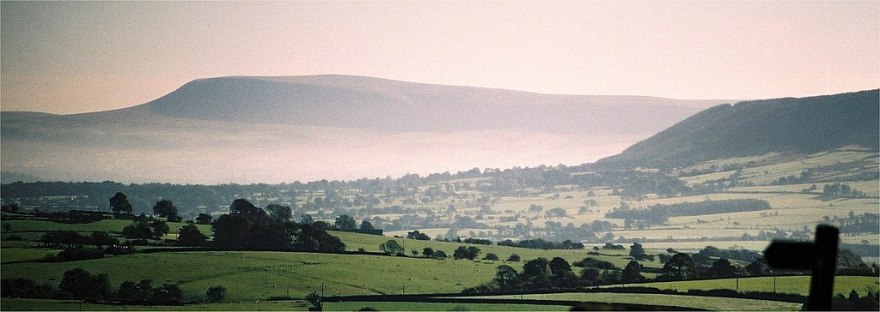
Banner Image: Pendle Hill, in Lancashire, England. To the right is the east end of Longridge Fell. Mist lies in the Ribble valley between them. Photographed from Beacon Fell. Wikicommons – Dr Greg
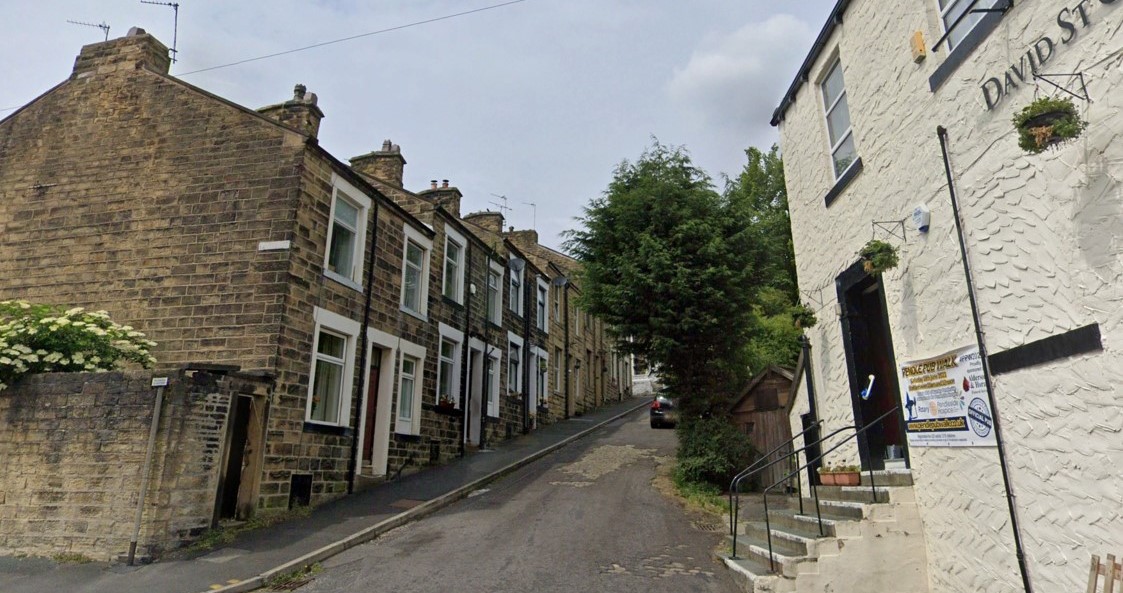
Story image: Halstead Lane, Barrowford – a steep lane of stone houses with a working men’s club on the right. Google Earth
|

 literally stories
Cathy
The appealing mummers, the sad tale of John Lee and the older parties in club make this a winner. “Just gotta look” is such a human thing, desirable, like a John Lee whistle.
Leila
LikeLike
A wonderful story and a great read. I enjoyed the sudden turn adding a shift of community attitudes from hard set working clubs. The care of local character and poor tramp was very real.
LikeLiked by 1 person
I loved this! A current twist on an old folk scene with nice attention to detail and perfect pacing. Excellent.
LikeLiked by 1 person
Fine writing and fine header images. I’m not a fan of all old British customs (like fox hunting, for example), but my Dad used to drink in the working men’s club and my brother did a bit of folk dancing, complete with his own budgie bells. This piece is a most enjoyable celebration of both. Thank you.
LikeLiked by 1 person
I’ve only heard about mummers in English mysteries and stories about Philadelphia until now – a learning experience.
LikeLiked by 1 person
Subtle, mysterious with a touch of magic. Human connections can emerge in unlikely times and places from unlikely catalysts. We need more.
LikeLike
Absolutely lovely. So many great details which made it real. And so much revealed in the girls’ attitudes. Wonderful story.
LikeLiked by 1 person
Hi Cathy,
I’ve honestly never heard of Mummers. Don’t know if we have ever had them in Scotland, I need to ask around!
A beautifully balanced piece of writing! You gave each topic just enough time to keep the reader interested.
With the topics that you touched on, this became a very real piece of writing.
Excellent!!
Hugh
LikeLike
This is superb. A rich story of tradition, attitudes, different races and classes of people all told in such a well written narrative. The overlapping story lines of John Lee’s destitution, Anita’s background, and the mummers themselves make this such excellent storytelling. I love the defiant shouting out in Urdu from Anita at the end of the story too. All in all, a truly intriguing, warm story with a lot of depth.
LikeLiked by 1 person