The usual doubts arrive as I cross the street, heading for the corner of Abbeville Road. This seemed like the right thing to do an hour ago, sitting in a pub on the South Bank, toasting our anniversary with a third glass of wine. But now I’m here, all I can imagine is another rejection.
You stride round the corner while I hesitate in the road, your head down, lost in a world of your own. I follow ten yards behind, watching you pull keys from your pocket and turn into our front garden.
The lower lock sticks, bolt and plate misaligned since those boys kicked down the door to steal your bike. As I draw close, the corners of your mouth start to twitch, your face about to break into a smile. Life’s petty irritations never bother you. You’ll just be thinking about something funny, perhaps a quip from a workmate or a joke you read in a magazine.
“Hello, Alistair,” I say.
You whirl around; the keys falling from your hand and jangling onto the step. The smile falls away, replaced by smouldering eyes and clenched lips. You look incredible – on some level, I almost enjoyed our arguments. Or was it the making up afterwards?
“God, not again,” you say. “Haven’t I told you enough times? I’m not interested.”
I hold out the chocolates, the expensive ones from Switzerland that I used to bring home from trips to CERN.
“These are for you,” I say.
You dart forwards, one hand flashing out as if you’re about to hit me. You did that once, after my affair. But you just slap the chocolates from my outstretched hand. The box smashes open as it hits the ground, scattering its contents amongst the dried-up leaves and dog turds.
“You can’t buy me, mate,” you say, retreating towards the front door. “I know it’s you. The presents, the flowers, those donations at work. Do you want me to get the police involved?”
Your charity would have gone under if it hadn’t been for my donations. You’d have spent two agonising years on the dole, emerging into your teaching career like a tortured butterfly. I couldn’t bear to see you go through that again.
You bend down, scoop up the keys and resume your battle with the lock. The bolt slides open with a dull clunk, sounding notice that you’re about to shut me out again. There’s only one thing left to do.
“I love you, Alistair Morgan,” I say.
Your hand freezes on the door handle, and, for one glorious moment, I think you’re about to turn around and run into my arms. But, instead, your shoulders slump forwards and a quiet sigh rises into the evening air.
“Buddy, you don’t love me. You don’t even know me.”
#
We met at a networking event: scientists meeting science journalists, attendance subject to a three-line whip from the college management.
You worked for a charity, translating the jargon-laden babble of physics into something that even politicians could understand. There were four of you, working out of a dilapidated office in Highbury, living from grant to grant on a budget that wouldn’t cover our stationery order at Imperial College.
I spotted you at the buffet table, filling your plate with those minuscule pastry creations that were popular at the time. I wriggled free from an old bore who didn’t know his quarks from his bosons, picked up a plate and joined you at the buffet. INXS were playing over the tinny sound system. Need You Tonight – it would be our song.
“Congratulations,” I said, pointing a fork at an almost invisible vol-au-vent. “You’ve discovered a new fundamental particle.”
The edges of your mouth turned up – my first glimpse of that smile. Then a laugh erupted, along with a tiny cloud of feta cheese.
“Sorry,” you said, brushing crumbs from my jacket. “When my Nobel cheque arrives, I’ll pay for your dry cleaning.”
We talked about science and life in London, but mainly about baking. Ironic, as you never raised a cake tray in anger over the decades that followed.
I’d been there before, always thinking, does he, is he, but, with you, it was just obvious. I asked for your number, suggesting we meet up at a bar. You gave me your business card, writing your home number on the back in blue biro.
I saw you again an hour later, by chance boarding the same tube at Knightsbridge. Awkward, but only for a moment. By Covent Garden, you suggested we bring that drink forward. The next morning, I woke up at your house – our home – on Abbeville Road for the very first time.
We had our challenges – who doesn’t? Those tight times in the early nineties when you lost your job. My affair, an indiscretion born of loneliness during a brief contract in Berlin; one you forgave me for, eventually. Your decade-long struggle with the bottle, a quick glass after work spiralling into verbal incontinence and social shame.
But we got through it, our love unstoppable, flattening every challenge. Two days after the law changed in 2014, we took a taxi down to the registry office on Brixton Hill. Young lovers became a middle-aged married couple, with receding hair, laughter lines and three arthritic fingers.
#
Sometimes, I wonder if I could just make you love me. Could the Beatles be wrong? I always have plenty of money – perhaps it can buy me love.
I could pay off the debts that crushed your parents after your dad’s heart attack, the unpayable bills they didn’t tell you about until their savings were gone and the house mortgaged beyond the point of no return. And perhaps help your sister as she struggles to bring up three girls on a school cleaner’s wages. Would you love me then? I think not; you’d just accuse me of trying to buy you, like you always do.
Or perhaps I could pay hard-set men to spirit you away to an island paradise, where I’d break you down with kindness and love, whether you wanted it or not. Stockholm Syndrome they call it. It might work, but it would be a lie, a chimaera of what we had before.
No, McCartney was right. Money can’t buy true love, just transactional relationships of dependency and deceit.
#
It began with trivia: cramps in the night, a spot of blood when you used the loo. Nothing to worry about, no need to trouble our GP’s fearsome receptionist. By the time you submitted to a barrage of scans and tests at the Royal Free, it was already too late. You squeezed my hand as the grim-faced consultant delivered her verdict. “Relax”, you said, “I’m a fighter.”
You were true to your word. The consultant gave you four months. You lasted over a year, dragging a morphine drip across the hardwood floors of our home during those last precious months.
I followed the standard academic script for grief, refusing offers of early retirement and throwing myself into my work. Papers and prizes washed over me, meaningless baubles when all I desired was one more day with you. A decade dragged by, family and friends believing I was getting over you and moving on with my life. How wrong they were. I was a cold husk, empty without your love.
And then, an answer to those prayers I sent into the void. Every other faculty member had passed on the PhD proposal before it landed in my inbox, the accompanying email thread describing logical fallacies, circular arguments and terrible grammar. Was my desire to see you again the reason I could see the threads of genius woven into that mess? I called the boy to my office that same day, promising my undivided attention and all the resources my dwindling prestige could bring.
As it turned out, the mathematics were surprisingly simple, the doorways between realities open for anyone with the right keys. We spent months converting theoretical construct to laboratory reality, toasting our prototype with cava from the corner shop decanted into plastic cups. The boy went to celebrate his achievement with friends. I stayed behind, making the final adjustments. Then I flicked the switch.
There I was. Back in my flat near Tower Bridge, twenty-three again. I should have called the Royal Society, the Prime Minister, revelled in the achievement. But all I could do was rush to see if I’d arrived in time.
The newspaper said 8th September 1987: two days to go. Two agonising days spent resisting the urge to run to your office, burst through the door and throw myself at your feet, crying, it’s me, I love you.
But I resisted; I waited. Until I stood there again with that pensionable BBC correspondent, watching you approach the buffet table.
“Congratulations,” I said. “You’ve discovered a new fundamental particle.” It had to be the same – exactly the same – to take us to forty-two years of pure, unconditional love.
The cloud of feta cheese felt like a kiss.
I remembered it all, word for word. The little jokes, the favourite bars and clubs, the made-up baking masterpieces. It wasn’t like following a script: it was like watching a favourite film, finding new meanings in familiar words. At the end of the evening, I asked for your number. Once again, you passed me your card.
There was no blue biro on the back.
“Could I have your home number?” I asked. “We could meet up for a drink,” I suggested the bar, steering us back to the movie.
I can read your face like a book. First came confusion, then awkwardness. Was there a flicker of disgust there too? Perhaps I add it in, editing the scene, twisting the knife.
“Oh, um, yeah. Look, mate, I’m flattered,” you said, your voice edging into the tone you use around builders and football fans. “But, you know, I like girls.”
I laughed; it couldn’t be true. I told you it couldn’t be true.
It was true. Before that day, I’d rarely seen you angry, with me anyway. After that day, your anger became the rocks that wrecked my dreams.
Two members of the chemistry department dragged me out of the room, delivering a punch in the ribs as they bundled me into the street. The dean gave me a warning the next day. We turn a blind eye to that kind of thing, he said, but not in public, for goodness’ sake.
#
I’ve watched you die so many times now, too many to count. It’s the cancer, always the cancer, that takes you away. I’ve watched from windows and TV screens, nurses’ pay too low to refuse the kind of money that a knowledge of the future provides me.
Most of the time you die with a wife, her hand stroking your head as children weep, their carefree progression from infancy to independence rudely interrupted by the wrecking ball of parental mortality. Sometimes it’s been a man by your side at the end: mostly kind, never me. Twice you died alone, taking your last breath between the nurse’s ward rounds.
And once – just once – you died with me. You were too far gone to recognise me when I snuck into the ward, but when I took your hand, your fingers squeezed back.
Maybe I should die too, just accept that there was only that one, perfect version of the world where you and I could be together. I could throw myself off a building as you breathe your last, or just let nature sweep me away into the black hole of oblivion.
I can’t. I won’t.
I’ll make my way back to the lab, hoping that the next throw of the dice will deliver the reality I long for. Where I stand on the doorstep at Abbeville Road and say, I love you, Alistair Morgan. And you open the door and welcome me home.
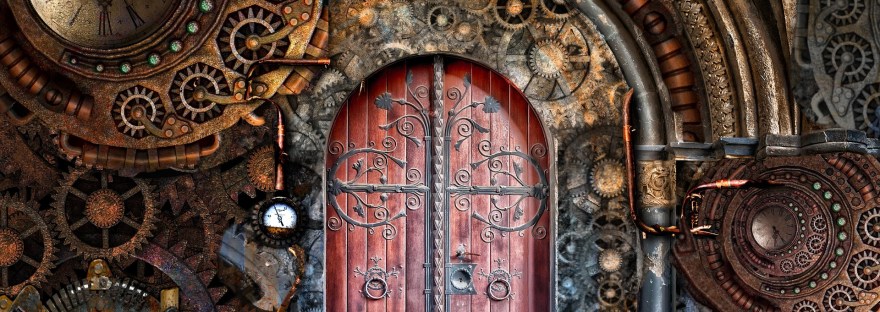
Banner Image: – Pixabay.com Ancient door surrounded by many clock faces.

 literally stories
Ed
The possibilities pile up as this unfolds. “The usual doubts” that open this is a fine bit of foreshadowing. There must be billions of locks. Maybe it should be let alone, but MC appears fated by determination.
Leila
LikeLiked by 1 person
Thanks Leila. I think my MC should give up, enjoy his money and have a few flings, but that doesn’t seem to be his fate!
LikeLiked by 1 person
Ed,
I liked this. Time loop stories are numerous, good ones like this one, rare.
I won’t say more. Everyone, please read this well written, heartfelt piece.
Ed McConnell
LikeLiked by 2 people
Thanks Ed
LikeLike
Thanks Ed
LikeLike
Straight or gay, withering grief is withering grief. This evokes it perfectly.
LikeLiked by 2 people
Thanks Bill.
LikeLike
Hi Ed,
I like the twist on someone looking for the same. There is normally a difference somewhere along the line and with that difference, even if you were happy with your partner, that alteration would change things.
A very entertaining piece of story-telling!
All the very best my fine friend.
Hugh
LikeLike
That’s one ground hog day love story, with a few different twists. Love motivates the protagonist’s search for a way to bring back Alistair, as he discovers how to go back in time. Then it appears the scientist’s in a life loop, somewhat changed each time….and he becomes an immortal stalker never to get exactly what he wants. Stalkers can’t let go and this guy can’t let go of his control of time or his lover either. Very imaginative.
LikeLiked by 1 person
I really liked the obsessive, but kind of everyday / mundane tone of this which really made it very real.
LikeLike