
Envision a seamless sky lining a hillside speckled with white stones. The air surrounds them, almost scentless, incensed lightly by pungent moss. Gaze ahead as the lush hills overlap, take hold of one another, layered green and hazel veils each saying to the next: Spring. Translucent Spring. And I could see through it and taste it as anyone can at seventeen. Every day seemed to be like this one, then, endless and shady, but on this Tuesday morning curiosity did more than lead me. We ran. Run with me now.
It is April in the cemetery, but the air still defends a briskness, tight and relentless, as I clean about the gravestones. I am a long-limbed boy, growing as the minutes go by, and I am wide-open, precise, the way I’ve always been. My job is certainly an odd one but admirable in a once-again-odd-way, it needs to be done and I set out to do it, the money being meager but enough to fill one of my pockets weekly. I live over that last stretch, where the road splits up like a crooked crutch, one direction to town the other down to where I live. My house is tightly woven within heavy wooden beams, breathing and bursting with my brothers, sisters, cousins, aunt and uncle. My mother and father died of Rubella when I was eight. Aunt Marie jokes that they’re still keeping their eyes on me, resting here where I work on the weekends. But I don’t feel their eyes on me. They left me long ago and took their eyes with them. Aunt Marie says lots of things. She tells everybody I have a poet’s heart and that life isn’t easy for a poet. A poet works hard, she explains, her face a moon with pursed lips. It’s like walking in sand: writing and writing while trying to earn my keep. But I don’t mind. I hardly mind much really. All I need is what’s in my head, and on this clear day my ears ringing cold, the crisp ground shattering beneath my feet, what’s inside is what’s outside. It’s all the same when I’m alone.
An old pop bottle. A crumpled newspaper sports section. A stray, sticky ice cream stick. But everything here isn’t trash. Sometimes I find treasures near the stones that I keep inside my pockets or under my mattress. I don’t tell anyone about it, not even my cousin Cara. “You’re crazy to work where the dead people are,” Cara always says. Her round face is pale and flat as a nickel but her eyes smile, two shiny puddles of blue. She is a tiny little girl with tiny little ways; the tiniest being the way she says: “dead people,” her voice low and her mouth small as if she were underground, as if it were the worst thing to be, dead. Being only six years old I could see her believing it to be the very worst of horrible thing. If she worked in the graveyard like me, she’d feel different. If she stood here between the gravestones where there’s no sound, just the dangling of weeping willows, she’d see things clear. But she won’t come anywhere near here. It’s my place.
I work way down to the last line of tombs, scanning each green and brown blade of grass, hungry as a sea urchin. Darkened in thick, ragged strips by a lanky dogwood tree, this last row is very straight, refined, dignified like the keys of the old upright in the living room. And I play them as I fix the flowers left behind, water the plants that have been planted, and collect the remnants. McCarthy. Richards. James. Farley. All names I’ve heard of in town. Each a weathered testimony to people I’ve never talked to or even looked at. Dead people. I blink.
I read the etching on this last stone again: Born 1902 Died 1906. Every time I pass, I notice these dates, stark and stone. Liza Marion James.
The first occasion I saw this name the afternoon was without a cloud. Sunlight glistened on a slight, gold chain buried halfway into the soft earth surrounding of this name. I pulled it out, dusted it off and placed it in the pocket of my overcoat. It was a baby’s gold necklace with a heart-shaped charm. I could never bring myself to look at it again, but I can still feel the necklace there. A small, comfortable coolness deep in the corner of my warm pocket.
The sun is caught behind a cloud as I stand hungry, tired and all but through for the day. I pull up my pant legs and sit on a patch of grass, eating an apple I picked in the orchard behind the far hill. There is movement, there, from across the great lawn. A white figure. A mere outline coming closer as the sun emerges. It is a mourner. A mourner, here, in the only place left where there is no hum in the air, the last place I can think alone. My home is too noisy with fourteen people planted in a single house. Sounding off in a single place. There’s no sound here. No humming.
It is that woman. I’ve watched her here before. Once when it was raining. Once when the air and ground were dry and brittle. Each time her footsteps approached on a Saturday morning. Last week she wore a veiled, black hat. But now her hair, long and light, stirs in the breeze blending with the blue sky behind her. She walks slowly giving me time to hide behind the cluster of dogwoods. Used as a fan, their bark is rough against my palms. Their leaves, sprouting far above, shade us. She hesitates in front of the Farley grave and she could touch me if she should see me, so I don’t breathe. The color of her eyes is unknown to me while, like before, she cries. Two hands gloved in white cover her full, quivering lips and I realize that the cemetery is a painting surrounding her, she is absolute motion while everything else remains a still-life and I am rendered behind a tree.
That instant, her hair permeating the bright expanse of sky, her long, white fingers becoming nothing but a shield, was the last occasion I saw Beatrice. She was merely a stroke of white though the green field when I finally emerged. I thought of her throughout the day. Her image filled me when I’d touch the cool links of the tiny necklace in my pocket.
Work is over but will begin again. The next day I found the note she had left.
It read in narrow lines:
Johann,
I was in the kitchen this morning and I filled your cup with coffee and some cream. I don’t intend to, but I know I will do the same tomorrow…and the day after that. One thing is certain, I will join you. I love you.
Beatrice
This is Beatrice’s lover under this ground, beneath my feet, as I clutch the note. A flurry of early-morning birds spray through the air. She wants to join him, here, in my place. The woman whose eyes I never got to see will kill herself. The woman with those quivering lips I will never get to kiss will “off herself” as Uncle Pete says. I touch the note to my chest and notice the humming in my ears.
In the last months I’ve found, in these hills, a letter or two left behind. They were simply sad and having read them I put them back, being meant for the dead they said nothing to me. But I recognized these words, somehow, and in between each line, the yearning. There are two coffee cups in my cupboard which will never be used again. Never.
Morning warms, shifting through the trees and falls into afternoon. Shadows fall longer and leaner on the ground and I haven’t managed to move far from the face of the Johann’s grave, not a foot from the simple cluster of trees. Beatrice. Beatrice has been here three times and on the fourth she will find a folded message shaded by the dogwoods. Words, from this man I’ve never seen, written on the onionskin paper of my note pad. Cautious in pace, the words come to me not in verse but in a single line and I can’t decipher what my pen-point leaves behind. They are black lines on paper, designs, like the pattern of the grass and the trees creating the hills:
I await you, my Beatrice.
Love, Johann
On that day I left Johann’s note next to the cool stone and bounded down the windy path home as the sun lowered itself downward toward the darkening horizon. Did Beatrice join Johann? It remains a mystery. No other notes were left, no tombstone bore her name, at least not in my cemetery. She never visited the grave again, and I chose and still choose, to take that as a sign. A sign that she joined in him and they remain together. I created this union that day with a few strokes from my pen. Johann spoke through me and it didn’t feel odd, it gave me a fullness of self, of becoming a vessel. That’s the day it all commenced. The day my secret was born.
I was ignorant that April, caught in the newness of spring, of how often I would be drawn to use my pen. How frequently I would be spoken to and compelled to record. I never wanted this task, this never-ending dictation in my mind. Fate of a poet? Perhaps. Or something evil? I think not. I am no more an evil thing than the peonies, the tall swaying grass, wind through the trees or the fact that we can never fully understand the inner workings of the world. My gift seems more along the lines of a kind of telegraph with messages coming to me clear and stark. Instructions of what I should convey, to whom and when. Beatrice being the first of many receivers of my orders. Long after I went onto many tedious jobs of full-employ and eventually travelled half-way around the globe, and even now standing here with you, I’m unable to escape the voices. Instructing. Persuading. Inflicting. A messenger is what I will always be.
So, come now – open your hand and take this note, do not take long to read it. The paper is smooth, and the message is clear. Now that your shadow has grown long, and your hair is gray. Take stock in the note. It’s my gift to you. Is it advice? Not in the least, it’s an invitation.
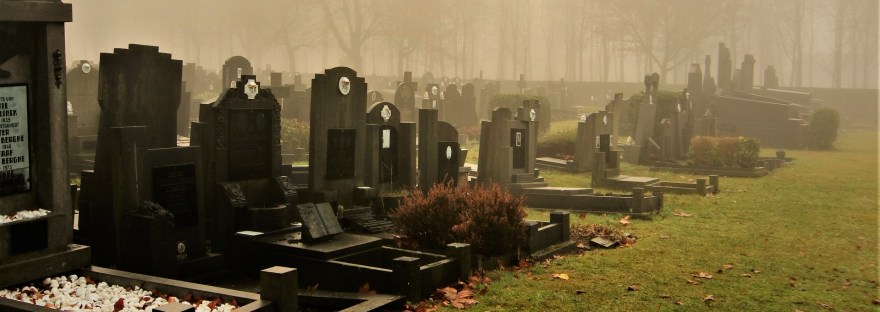
Image: An old cemetary with grand graves, headstones and footstones, neatly lined up. Mist in the trees in the background.

 literally stories
I’m something of a skeptic. Wouldn’t some or most of those receiving the notes consider it a prank and the narrator would be outed? Even though, I’d like to read more of the notes and responses. An extended story could be keep my attention.
LikeLike
Susan
The setting is perfect. And the idea of him being a messenger no more evil than the peonies is exceptional. I grew up across the street from a graveyard, if any place has strange magic, it is there.
Leila
LikeLike
Hi Susan,
I really did enjoy this.
I found it to be poetically written and in a way, very respectful.
…Maybe intrusive but still respectful.
Surely working with the dead and the memories that those who loved them must be something very worthwhile.
Excellent!!!!
Hugh
LikeLike
I think the tone of this is perfect for the story. I wonder if working so closely with death and memory influences your mind, I think it must and there are so many things that are inexplicable and surely when you have encountered a number you are open to belief in others. A thought provoking story with an interesting narrator. Thank you – dd
LikeLiked by 1 person
Lyrical, eerie, sad, and well done. The story had me willingly suspending disbelief although I reject such things in real life.
LikeLike
Susan
“Run with me now.” What followed were surprises, linguistic and imaginary, and small-gigantic, magical moments. A cluster of dogwoods is used “as a fan” as the narrator is “rendered behind a tree.” Even koans are to be found there on the story-surface: “what’s inside is what’s outside. It’s all the same when I’m alone.”
Very well written from the outside, in; from the inside, out; and every which way! — Gerry
LikeLiked by 1 person
Quite the possibly sinister messenger, yet his intent is good. Everyone has a shadow side. Well, we won’t really know… if he indeed does get messages from the dead… like the Irish “automatic writing” of Yeats’ time. I like the way the story draws me in to the main character’s world, and I see from his perspective. “Run with me now,” he invites, and I do, into his graveyard world.
LikeLike