
In the muted afternoon light that leaked through the curtains high on the cellar wall the old man, sweaty and disoriented, reached out from a nap he had not planned to take. He lurched forward and tumbled headfirst out of his recliner and up against the television, two feet in front. He cursed himself.
It was too quiet. The TV was off. Was he responsible? He liked the TV on, always. He would mention it to Joan. No.
Eventually, he brought his legs beneath him and shambled back to the recliner. He fell and sank to full extension. The fabric of the chair had been bright blue when he had purchased and installed it in the other house. Now the blue was grey all over except for the spots where his body met the fabric, which were bald and shining, or broken through. This was his chair.
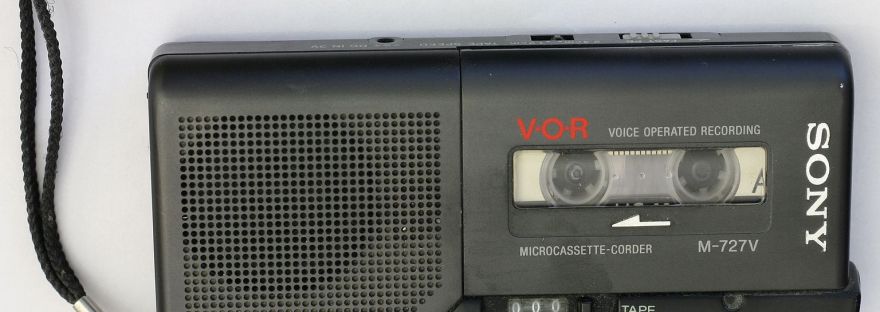
He slipped his hand between the cushion and arm on his right side and extracted the tape recorder from within the recess there. In the silence, which he didn’t like, the sound of the record button shocked his ears. He let the tape run a moment before speaking.
“The right leg”—he paused to peer down at it—“the right leg does not respond. Not well.” He raised a hand to cover his left eye. “The right eye: floaters? Muscae volitantes? Weiss ring on the vitreous humor? No.”
He stopped recording, rewound for a moment, pressed play. The right eye: floaters? He pressed stop. The sound of his voice was too loud.
He fast-forwarded and began again. “The right leg does not respond well at all. The right eye is dimming. Stool: meager. Urine: same. Appetite: same.”
He stopped the recording again abruptly. Something was off. Something, something: he found it.
“The television was shifted upon impact. Judging from the indentation, three inches approx. Was the recliner shifted also? Will have to reassess.”
He gathered himself and stood, then paused to survey. From left to right: chifferobe, sideboard, settee, grandfather clock, whatnot, armoire, rolltop desk. 1923, 1938, 1929, 1903, 1910, 1919, 1925. Beyond the small and shabby island populated by the recliner and TV stood a gleaming navy of their things. Joan’s things, well-kept.
“The right leg is responding, now. Standing it responds. The recliner was purchased in 1964. It was not shifted, after all.”
They were all at right angles, except for the TV. He stepped towards it, lowered himself upon his right knee. Three inches, yes. It could be done.
He reached behind to pull it forward, and did so with ease, guiding the front of the set to settle back into the cleft in the carpet.
Triumphant, he gripped the TV and hoisted himself upwards with such force that he lost his balance and went crashing backwards, into the chifferobe. It did not shift, he was sure.
“Joan! Joan!” There were footsteps on the stairs beyond, someone racing down the hall. He did not face the door. “Joan, get me up, I’ve fallen!”
The steps stopped in the doorway. It was not Joan.
“Hello? Who’s there? Cole? Tommy. Tommy that’s you, isn’t it?”
The boy did not respond. He stepped forward to see the old man better, standing well to his blind side.
“Tommy, you must answer your father! Go get your mother, you can see I need help, can’t you?”
The boy turned and fled. The old man could hear him charging the stairs, mounting them without slowing. Tommy, yes. He was sure.
Above him he heard movement and the noise of voices, and he wondered again who had turned off the TV.
The movement and voices reached the stairs and descended, then entered the room in a rush.
“Ay, Mister Howard, what has happened, are you okay? You must be more careful, I have Mani here with me today and so much to do before Mister Thomas come home, so no more falling, okay?”
The boy from before was not Tommy. The woman upon him was not Joan. She was squat and dark and her face was full of concern. She lifted him up easily and sat him back down in his recliner.
“Ah yes, thank you Lupe,” he said. “Do you see the remote control? I can’t find it.”
She did and passed it to him, then left. The boy slipped out with her.
The old man turned on the television. He turned up the volume and let the sound fill the space. Then he turned the television off and reached for his tape recorder.
“The right eye: floaters? No. The right leg clearly cannot be trusted. The chifferobe could have been damaged. Joan’s mother, whose name was Helen Turner, purchased the chifferobe in 1923, when Joan was seven years old.”
“Nine.”
He stopped recording. He waited, then pressed the button again.
“Nine. When Joan was nine years old.”
He rewound the tape and played it back. Was there a voice? He wasn’t sure.
In a rush he turned the television on, turned up the volume. He closed his eyes. The day darkened. After a while he turned the TV off.
He stood to survey. 1923. The woman Turner, his mother-in-law, had never known him. She died in 1935. 1934?
“35.”
35. He met Joan a little less than two years later. An old twenty. Not old: aged. Too mature for twenty. It had been hard to make her smile, at first.
“But I did, didn’t I?” He directed his question at the chifferobe. “I could make her smile. A little silly, sure. Whatever it took.”
The chifferobe did not respond. The settee, however, was much more accommodating. 1929.
“My dear,” he said to it, “you can’t imagine the dream I had. The boys were lying flat on cracked and broken ground, naked, watching clouds that passed behind me. I was hovering invisible above them. Only I could see the ants start welling up from the cracks in the ground and rise to where they lay. So young and perfect! Untouched! I screamed but couldn’t materialize, I pitched forward and woke up here . . . “
He trailed off. Were these floaters inside or out? He should have turned the volume up again. The light was softening, and the shadowed spaces between pieces yawned like tunnels for his mind. 1929.
“When Tommy gets here,” she said, from just beyond the whatnot, “you must remember to be brave.”
He bristled. “I am always brave.”
She laughed quietly in response.
There were heavy footsteps on the stairs, a man’s tread.
“Dad, what’s this about you falling over?”
This was Tommy then. Was he sure? So tall!
“Are you okay, Dad?”
He rewound a bit, and played.
The right eye: floaters?
“Do you hear another voice here, Tommy? Can you?”
They listened together. Nine.
“Dad, why don’t you sit down. It’s so dim in here.” He went towards the light switch.
The old man reacted at once. “No! No lights!”
“Why not?”
“No lights.”
Tommy shrugged, and sat down on the settee. “Fine. Have it your way. We’ll sit in the dark.”
They sat in silence for a moment. It was dark. Tommy coughed..
“Why do you stay down here in the dust, Dad? You have the whole house to live in, and you insist on staying in this room all day.”
He took offense. “I prefer to be near my things. Your mother’s things.”
Tommy paused a moment. “You remember about tomorrow, right?”
“Remember about tomorrow?”
“Yes.”
He did not remember about tomorrow.
Tommy sighed. “All this stuff goes tomorrow. Into storage. I’m going to open this up for you, make it suitable. Move your bed down here. Make an ensuite.” He paused. “We’ll leave the recliner, okay?”
“1923, 1938, 1929, 1903, 1910, 1919, 1925.” The old man took a breath and started louder. “1923, 1938—”
“Yes,” said Tommy. “Yes. But even so, it goes tomorrow.” And he stood and left.
The sharpness of his leaving set all the floaters spinning. The old man stood to survey, and turned to address the room.
“Don’t be afraid,” he started, then paused, unsure of how to continue. The chifferobe was dismissive, while the settee needed comfort. He decided to sit on it.
He started forward but realized too late that the right leg would not respond. He toppled forward into the sideboard. He heard the tape recorder as it skidded away.
He did not cry out. He lay in twilight for some time. The pieces whispered to him with the voices they’d absorbed. He reached out to hold the sideboard and clung to it like a man lost at sea. 1938. He was sure. His mother coughed, and read the paper to him from her place at the table. Joan was there, too, but silent.
The button clicked beyond. He heard himself: The right eye is dimming. The button clicked to stop. Fast forward: Will have to reassess. The button clicked again.
“Tommy? Cole?”
The boy stepped forward.
“Help me to the recliner. Please.”
He was nine, but strong. The old man leaned his full weight upon the boy’s shoulder. He guided the old man to collapse back into his chair.
“And the remote? We must turn on the TV,” the old man said. “We must turn up the volume.”
The remote was nowhere to be found. The boy moved to turn on the light to search for it, but the old man grabbed his arm.
“No light!”
The boy shook the old man off and fled, the tape recorder still clutched in his hand.
“You were too rough with him.”
“Boys need a strong hand, sometimes.”
“And you are strong. And brave.”
“Yes. Sometimes.”
“You don’t need the television.”
“No. Not really, I suppose.”
“Or the recorder.”
“I just need to keep my place.”
“Yes.”
The thought struck him: had the sideboard been shifted? He struggled up to see, but quickly realized that now neither leg responded.
“It would help,” he admitted towards the sideboard, “if the lines were straight. It would make it easier to navigate.”
He squinted. In the near darkness the pieces were being swallowed up and lost in a rising, murmuring tide. She was wrong. He did need the television.
“1938. My mother bought it. Ordered away for it. It stood in the dining room until she died in 1971. That’s when it came to us. Went to the dining room in our house. The old house. The boys were careful with it, I made sure. 1971 until . . .”
He paused to think and found he couldn’t. The murmurs grew but he found the strength to look anyway, into the sea tunnels where he knew the pieces were. The floaters were outside his eyes, he was sure. 1938. His mother. Joan. Just there.
“Mister Howard, what happened? Why is Mani so upset? He says you scared him.”
She flipped the switch and the world exploded into light. He shrieked as the sea was sucked inward. The chifferobe was incredulous, ashamed of him. The settee was heartbroken. He could see them all, but the murmuring continued. So did the floaters, treading water, awash in his eyes. He was sure of it all, and he shrieked again.
“Turn off the light! Turn up the volume! Please!”
Image: Dictating machine with tape casette. Black suqre device with a little window to see the tape. Gophi, CC BY-SA 4.0 https://creativecommons.org/licenses/by-sa/4.0, via Wikimedia Commons

 literally stories
Andrew
Fascinating look at someone trying to keep a fix on reality; the coordinates of his existence; where, but more importantly, when. The familiar “landmarks” and the vain attempts to control his being a part of a universe he wants to hold onto adds up to sadness; but the attempt is courageous and even ingenious.
Leila
LikeLiked by 2 people
A well-crafted piece that takes the reader deep into disorientation and increasingly frantic attempts to retain a grip on things. Poignant and a little disturbing but nicely done!
LikeLiked by 1 person
I found this equally disjointed and intriguing – a real insight into a declining mind perhaps? The voice is very strong in this one and the general feeling of distress and anxiety comes through strongly.
LikeLiked by 2 people
We recieve a huge number of submission on the theme of dementia and they have to have something really special and unusual to stand out from the crowd. This one had this. We can’t really know how it is to be locked in your own reality but this was believable as a possiblity. Apart from that I really cared about the character he was wonderfully developed, not just a pathetic responsibility for a grieving family. I thought this was really outstanding. Thank you – dd
LikeLiked by 2 people
Andrew
The Nobel Prize-winning Irish writer Samuel Beckett was severely neglected for many decades because he virtually always focuses his work on the deeply, truly desperate, the diseased, the decrepit, the isolated, the old, and the extreme outsiders among the human population. Ironically, his work, while challenging and often near-tragic and sad, is very far from depressing, because the bleakness has a spare and pared-down beauty to it. That was the genius of Beckett’s work: he took characters and/or situations that almost no one in their right mind would think of as beautiful and intriguing on the surface and shows how they are, in fact, exactly that.
Your story had a similar kind of sympathy for someone who’s completely isolated and lost in his own little world. As your character’s world narrows and his grip on “reality” becomes increasingly untethered, he continues doing all he can to stay afloat. It looks sad and pathetic to all the outsiders watching it happen. Within himself and his own person, he still has dignity and a reason for being, even though death is coming for him, just like it does for all of us in the end. Your story did a great job of making someone who’s literally losing their mind look heroic from the inside. The empathy and understanding came through.
Beckett wrote: “I can’t go on, I’ll go on.”
Dale
LikeLiked by 2 people
Unsettling and poignant, conveying as it does a man’s efforts to keep track of who he is. A real poignancy in the mere listing of the years. Shades of Krapp’s Last Tape by Beckett, though the disorientation depicted here much more disturbing.
LikeLiked by 1 person
Hi Andrew this was very well done.
What makes this story is the reader accepts and believes. Others of this ilk makes us think ‘How is that known?’.
Brilliant!
Hugh
LikeLike
As others have said, the style of the story does an excellent job of reflecting the disorientation of the old man. His confusion, isolation, and struggle with his failing body and mind are heart-wrenching. I especially appreciated the recurring references to the TV, recorder and furniture to emphasize his detachment from reality and reliance on familiar objects. Fine title, too.
LikeLiked by 2 people
A well-crafted salute to the bravery of the decrepit and a reminder of the darkness to come. Fine writing
LikeLiked by 1 person