
Windy and me were digging the back garden of another new kid who’d just moved in to Horseshoe Walk. This time it was on the other side of the garages, opposite my house. I didn’t play with Windy normally because he hung around with the little kids, so I’d been a bit taken aback when he knocked on my door and asked me if I wanted a job. Sitting in our conservatory that day he’d also showed me how there were naked ladies hidden in magazine adverts if you looked at them the right way – Martini and Cinzano bottles were the best. We found pictures of Mrs Cropper in Mum’s Women’s Own too. Not naked, but modelling fancy dresses which was weird when you considered what a complete tip her house was. He told me his cat had come back as well after disappearing for twelve months, rattling their letterbox late one night to be let in just the same as she always had, although there was something strangely different about her now, he said, fixing me with his wide puffy eyes. Windy wheezed like an old tap on those rare occasions he played football with us, or handled a spade, but I began to think I’d underestimated him.
He lived a few doors up from me, next-door to Ted, and I could often hear his mum banshee shrieking at him and his two sisters in their house. That made me like him more too. It was funny how Mrs Sprocket would put on a posh stroky voice whenever you saw her on the walk on her own. ‘Helllooo,’ she’d say, smiling at you through her blue butterfly glasses, as if she hadn’t been chasing one of her offspring around the lawn with a broom and screaming her head off not five minutes before. Her husband had died under mysterious circumstances after falling backwards out of the attic, Martha said.
Anyway, we took pride in our work. We had already spent the whole of Friday and most of Saturday hacking away at the tall weeds and nettles, wrestling with Triffid-sized thistle stalks and brambles, and now we were breaking up the hard-won soil into smaller and smaller clumps, wanting to make the job last longer and get every last weed out before we asked for our money. It was really hot as it had been all summer, but we still had our T-shirts on – Windy for obvious reasons, and me because I didn’t want to end up with a builder’s tan as dark and slippery brown as Dad’s. We’d been waiting for the new kid to come out, but so far the only time the back door opened had been when his gran had come out to empty a slop bucket, and she hadn’t even looked up to acknowledge us, let alone compliment us on our gardening skills. She had on one of those draught-proof dresses old ladies always seem to wear whatever the weather. Grey face and see-through hair. Ankles the colour of dripping. Otherwise the door and living-room curtains had remained creepily closed.
I was a bit anxious of meeting the new kid. He had the same name as me and it’s one thing to have the same birthday as someone else, but how can you not worry about people with the same name as you, and being better at your name than you are? I hoped he didn’t take offence as easily as that troll down the maisonettes had.
It was getting dark by the time Windy knocked on the door. The old woman answered. Up close, she had saggy eyelids and the smudgy down of a moustache. More cracks in her papery face than one of Martha’s face-packs when I made her laugh. Not that she showed much sign of doing that. She gave us the three pounds Windy had agreed on at the beginning – which didn’t seem very much now split between two considering they’d never have to do another stroke of work in their garden again, – and then shuffled back inside without a word.
We were slouched on the kerb near the top of the hill, wondering what to do. The hot tarmac sucked the strength from our limbs, and the garage doors stung our backs. Ted had suggested we commando crawl the laurel hedge along Horseshoe Walk again – as we’d once famously done about three years ago all the way to the youth club gates without touching the ground a single time, – but we were too old and cumbersome for that now, just as we were too old to scrape up little stones from the gutter to build hurried dams to try and halt the advance of the Sunday snakes of soapy water creeping down the hill when Mr Lusher came out to sponge down his sports car. The heat had defeated us anyway. We couldn’t move, any more than the two blackbirds lying on Mrs Watkins’s lawn with their wings splayed out, could be bothered to fly.
Belinda Watkins made it worse. She was kneeling in the shade of her doorstep, rocking back and forth and singing along to her music box again. The first verse of ‘Row, row, row your boat,’ over and over, winding it up every time the tune showed the slightest hint of slowing down and putting us out of our misery. It was like hearing an ice-cream van that never quite arrived.
Then there he was, climbing the heat-rippled street towards us. He didn’t look like a Grant at all really, and the sickly feeling of being watched I’d been carrying around with me ever since he moved in vanished the instant I set eyes on him. He was a reedy-looking boy with dark mustardy circles under his eyes. We introduced ourselves, and when he found out we shared the same name, far from looking at me like an intruder, he gave me a wink as if we recognised each other.
He talked a lot, peppering his speech with lots of big words that had us all tied up in admiring knots.
‘Why don’t we play war?’ he said. We considered ourselves too old for war games, but when he started teaching us valuable SAS survival skills, such as the fastest most efficient way to relieve an advancing enemy of their weapon, and how to disable a man with a single swift kick to the oesophagus, we paid attention. It felt good to be moving, as if the day were uncoiling at last.
The garages would make excellent torture chambers, he said. This had never occurred to us before. There were plenty to choose from too because most of them were left open and carless during the weekdays when the dads were out at work, and weekends sometimes. We followed him into Morgan’s. ‘According to the laws of the Geneva Convention, torture is illegal,’ he said, running his finger along the teeth of an old saw hanging in the shadows. ‘But a certain amount is permissible under extenuating circumstances.’
We nodded. Cones of sunlight slanting through the yellow doors made me think of Richard Harris strung up by his chest with eagle’s talons. It was nice and cool in there. The actual torture sessions weren’t too bad, usually involving not much more than Chinese burns, split the kipper and short periods of solitary confinement. Plus what Thistleton called intimidation tactics. One afternoon he had us all standing in a row in Mr Reece’s garage up the top. It was like a line-up before a match, the big difference being that nobody wanted to be picked. Everyone was there, including Jack. I didn’t see him so often now we went to different schools, but spotting him in a crowd of St Martins’ boys still felt like coming across a missing number of The Amazing Spider-Man in a pile of American Marvels, crushed between hundreds of Conan the Barbarian and Howard the Duck.
Thistleton started off by giving us a version of the speech he always gave, delivered in his brilliant American accent.
‘It has been brought to my attention that someone in our company has been leaking important information to the enemy. Fraternising with the enemy is a serious breach of protocol. It directly contravenes article six-four-seven, chapter four, paragraph three of army regulations … Now we know who this person is, so I’m gonna give him a chance. If he gives himself up now we will take this into consideration. If not –’
No one moved or said a word. How could we when nobody had done anything wrong? Still, the more he went on pacing back and forth across the entrance of the garage like that the guiltier I felt. Somewhere a lawnmower was breathing deeply in and out.
He went on pacing. ‘Okay, I’m gonna count to ten, after which if the guilty man has not identified himself I’ll be forced to pick him out myself.’ He stood facing us with his arms behind his back, legs apart, letting his eyes move slowly along the line while he counted.
‘three … four …’
The lawnmower held its breath. His eyes snagged on mine for a second, and it occurred to me I didn’t know whose side Hungary had been on in the war. The Axis powers or the Allies? I stared at an oily patch on the concrete.
‘six … seven …’
It was behind the Iron Curtain, I knew that, but I had only a vague idea what that was. There was a picture in one of Martha’s fairy-tale books of a golden-haired girl walking up a snowy white hill towards a glass palace, and the night sky full of huge ribbon-like waves of oily coloured light.
‘eight … nine …’
They had been in the World Cup final twice which was one more than England, even if they hadn’t won. Beaten England 7-1 in Budapest in 1954. The lawnmower stopped again. I looked up. It was Windy.
Thistleton ordered us to seize him. Windy started yelling he didn’t want to play anymore, but our new leader was unmoved. ‘Gag him,’ he said, and Dylan stuffed a handkerchief into his mouth while Jack and Ted held his arms. Max was staying out of it, but even his impassive Action-Man-blue eyes couldn’t hide his excitement.
‘Do you know what we do to Nazi spies?’ Thistleton said. Windy’s eyes widened. ‘Shall I tell him boys?’ He caught my eye. Windy looked terrified. He spat the handkerchief out and screamed for his mum, and I couldn’t help feeling sorry for him – he’d bought her a box of Matchmakers with his share of the gardening money. Still Thistleton did not soften. He just stood with his back to us on the sharp edge of the shade, facing towards the maisonettes and the blue unshockable sky. ‘Take off his shirt.’
Windy put up a good struggle this time, but it wasn’t long before a wodge of quivering jellied flesh had spilled out around his middle. I laughed along with everyone else. I tried not to, but he just looked so ridiculous standing there, all white and flabby, arms crossed over his tits. No wonder he’d won first prize as Elsie Tanner in the jubilee fancy dress (beating me into second place as a chimney sweep).
Thistleton eyed him. ‘Look at you. Call yourself a soldier. Your body’s a disgrace, man.’ He went on like that while Windy cowered. His American accent was gone. There was a blue jerrycan in the corner. Thistleton went over to it and shook it. Liquid sloshed inside. He unscrewed it, took a sniff and grimaced, before holding the can out to Windy. ‘Drink it.’
Windy shook his head.
Thistleton whispered something in Windy’s ear. It must have been pretty scary because the next thing we knew Windy was clutching the can, head bent over the open lid. Sobbing, he raised it to his lips.
We were interrupted by shouts from further down the garages, and I felt the fire immediately go out in my stomach. The others ran down the hill to investigate, and I had no choice but to follow. It was Dad. Having an argument with Thistleton’s gran. She was wearing the same dress she’d had on when I first saw her. Dad was in his overalls. He had the old woman backed up against Mr O’Sullivan’s garage door, one of the two near our back gate.
‘Get back to where you came from,’ she was shrieking. ‘You’re not welcome ‘ere. Coming ‘ere as if you owns the place.’
‘Listen, my dear, I’ve got just as much right to be here as you,’ Dad roared back. ‘I works hard. I pays my taxes. I am a British citizen. What do you do, eh? You are a parasite on a state. You got no human understanding whatsoever.’
I went and stood by our gate. Why couldn’t he speak properly? And why did he keep calling her ‘dear’? But the old woman wasn’t listening anyway. She went on screaming, spit sparking from her mouth. There was nothing frail or decrepit about her anymore. Hatred had brought her to life. ‘You bloody foreigner! Taking all our jobs and fouling up the neighbourhood. Get back to where you came from …’
I snatched a glance at the gathering crowd. There were adults now too, but no one dared pull them apart. Or maybe they were enjoying it? Dylan was. Windy’s face was blotched and swollen from crying, but he had his T-shirt back on now, his sufferings forgotten.
‘I beg your pardon,’ Dad said. ‘You mean to tell me with all a honesty in your heart, I don’t belong here. I belong here just as much as anyone.’
She shouted back at him, calling him a nig-nog and all sorts of terrible names. I tried to catch Jack’s eye. He wasn’t a nig-nog I wanted to say. It was only a builder’s tan. As soon as the cool weather came again and his skin started peeling, he’d be back to normal. But Jack couldn’t keep his eyes off the fight any more than anyone else. Dad had his finger pointed at her face now while he continued to shout.
‘Don’t you point your finger at me,’ the old woman shouted over him. ‘Wagging your finger at me like you owns the place.’ She grabbed his finger and held onto it. For a moment they were silent. Neither of them seemed to know what to do next. Dad didn’t want to back down by pulling his finger out of her grasp, and the old woman was reluctant to give up her prize.
Then she slapped him in the face. I flinched as if I’d been slapped too, before just as quickly – I couldn’t be sure – like a snake striking, he slapped her back.
She let out a scream and clamped her hand to her cheek. ‘Oh, ‘ow dare you! I’ll have the police on you for that. I’ll have the police on you. How dare you hit an old woman. Oh, oh, oh – ’ She slid along the garage doors and crossed the road to her gate, her hand still fastened to her cheek as if to hold the pain there and keep it alive. Slippers slapping at her heels, she skulked up the path and slammed her door behind her.
‘SILENCE ON NIGHTS,’ said the sign on the Cropper’s boarded-up back gate next door to Thistleton’s.
Dad came towards me. I swung our gate open and stood aside to let him by, saying nothing. He was still too dangerous. He hadn’t been home long, because he was still wearing one of his work shirts with holes in. He was always getting holes in his shirts from the hydraulic acid they used at the factory, so Mum just threw them away without bothering to wash them and bought new ones from the jumble sales. He walked up the path, and disappeared inside.
The crowd lingered. Only Thistleton who was standing with his back against Mr O’Sullivan’s high curved garden wall met my eyes. He wouldn’t look away, and there was nothing friendly about them anymore. That was when I knew I was next.
I would have been too but for the fact that a few months later the Thistletons moved out. I did a jig across the landing when I heard the news. Then the sky opened at last, and Jack and me and Ted and Max and Windy and Dylan pulled our trunks on and ran around the maisonettes performing mad chanting rain dances and cartwheels, and giving tribal thanks of praise to the black-bellied merciful clouds. ‘Pearls of heaven,’ Dad called it when I saw him in our dripping crystal garden later, already examining his roses for signs of growth.
That day we tortured Windy was one of the last times we played in the garages as it turned out, because not long afterwards someone from the maisonettes died in one of them. Max’s dad only popped out in his car for some rawl plugs from Rockfield Road, but when he came back half an hour later and went to get his lawnmower he found his stepladder lying on the garage floor and this man hanging in the shadows from one of the joists. He didn’t even know if it was an actual body at first. He’d never seen a dead body before, least of all one hanging from his garage roof. He had to go and ask Mr Watkins to come and tell him if it was real or not.
‘Yes, it is real,’ Mr Watkins said. ‘It is a body.’
Mum said it was a selfish thing to do, whether he was a druggie or not. The man had even used Trevor’s rope! So it was no surprise when all the dads stopped leaving their garage doors open after that, and we had to find new places to play.
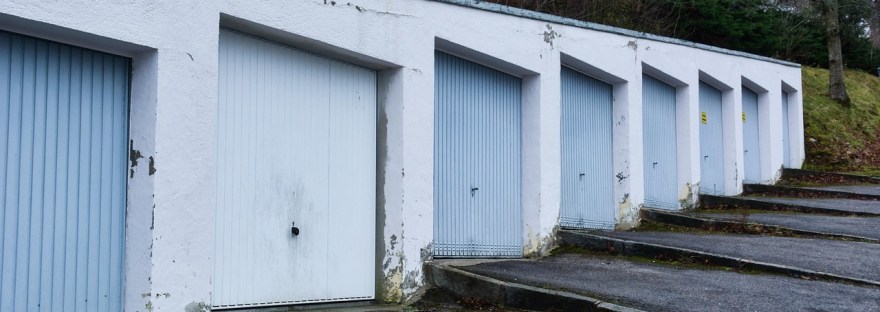
Image by Manfred Antranias Zimmer from Pixabay – A row of garages with all the doors closed. Flat roofed concrete boxes with double entry doors.

 literally stories
Hi Mark,
This is a well written and visual piece of storytelling.
The slice of life feel to it makes it all the more realistic.
Excellent.
Hugh
LikeLike
There are countless stories out there of the ‘When I was a Boy’ type and quite often they paint a golden image of bike rides and picnics but this one was really close to the bone. I recognised so much of Britain in the days when children played out all day and the behavior of the lads was very realistic. and believable. Of course it has to stir up thoughts of ‘Lord of the Flies’ even with the ‘fat lad’ in there. It was enthralling and very well written. I enjoyed this. thank you – dd
LikeLike
Mark
As Diane said, we see a lot of Way Back When stuff, and a lot of it has been heavily sanitized or was led by people who led lucky childhoods. There was always an insane element about life when I was young, and this captures the era of young life fairly and with tremendous honesty.
Leila
LikeLike
As already said, this brilliantly captures the joy and cruelty of being young and feckless! Kept me gripped throughout.
LikeLike
The child narrator’s voice is pitch-perfect – that mix of observation and not-quite-understanding what’s happening around him. The shift to real darkness (the racist confrontation, the suicide) is unsettling in the best way. Really well done.
LikeLiked by 1 person
Mark,
So much of a boy’s childhood in the neighborhood is dominated by older boys: sexually, sadistically, and criminally. Some are affected for as long as they live. I just don’t have the stomach to write about it. I’m glad you did. Nice work — Gerry
LikeLike
Very absorbing and well paced story. Starts out adolescent boy style and moves into more serious themes. The character’s physical descriptions are original and detailed, I could picture them clearly, and the personalities come over well also, esp. Thisleton. The adolescent boy world becomes a mirror on the real one. The interaction between the old woman and dad very real and serious and darkly funny also.
LikeLike
I’m a sucker for childhood reminiscence stories and this is really good one, full of rich and evocative description with great pace.
LikeLike