
It’s somehow apt that among Shakespeare’s most idiosyncratic spellings is his rendering the word ‘silence’ as ‘scilens’. No other writer of the period is known to have spelt the word in this way. It appears in the printed plays and it appears in the manuscript of Sir Thomas More, a collaborative work written in six different hands, one of which, referred to by paleographers as ‘Hand D, is thought to be Shakespeare’s. There’s good evidence to back it up: quite apart from the distinctive spellings, the handwriting seems consistent with that of his various signatures.
As the most famous, most talked about, and least known of writers, this ‘scilens’ of his could – at a stretch – be said to come with something of a cosmic wink, another ‘tease’ from the great Beyond; it could also very well be said to come with no such thing. There have been other supposed little teases. It took an intrepid mind (though quite whose is uncertain) to find one of Shakespeare’s teases in the King James Bible, specifically Psalm 46: if you count the first forty six words of the Psalm, you’ll come to the word “shake”; if you count back forty six words from the end, omitting the formal ‘Selah,’ you’ll see the word “spear”. The King James was published in 1611, but the translation had, the year before, according to some, been circulated among a handful of the nation’s finest writers, Shakespeare among them, needless to say. In 1610 Shakespeare was forty-six winters old. Hence his little tease. What could be made of this ‘scilens’ of his one wonders, or of course, one does not; but there’s sure to be someone, somewhere, who’ll have read into it a heralding of the great silences to come, silences Beckettian, Wittgensteinian, Rimbaldien, Garboesque . . . I jest, but only just.
On a more serious note, it strikes me as curiously apt, too, that in the manuscript of Sir Thomas More the three pages reckoned to be in Shakespeare’s hand should contain a scene that explicitly addresses the ‘issue’ of immigration, an issue as relevant then as it is now; (in fact the play itself, from around 1594, was deemed too ‘hot’ to stage – London having been shaken by xenophobic riots the year before.) The scene in question depicts a crowd already fired up by the rhetoric of a man who warns them of price rises to come such as will see “butter at eleven pence a pound, meal at nine shillings a bushel and beef at four nobles a stone . . .” Other hardships are conjured. And the culprits behind this dire state of affairs: “strangers”, these foreigners and refugees with their unEnglish eating habits, customs, accents. It is then that Thomas More addresses the unruly mob, calls mightily for tolerance, and makes “the strangers case”. It is, essentially, a plea for imaginative empathy. More asks the assembled to:
‘imagine that you see the wretched strangers
their babies at their backs, with their poor luggage
plodding to th’ ports and coasts of transportation . . .
Why you must needs be strangers. Would you be pleased
To find a nation of such barbarous temper
That breaking in hideous violence
Would not afford you an abode on earth,
Whet their detested knives against your throats,
Spurn you like dogs, and like as if that God
Owed not nor made not you . . .
What would you think
To be thus used? This is the strangers case,
And this your mountainish inhumanity . . .’
Truly, words to walk with in these benighted times. Selah.
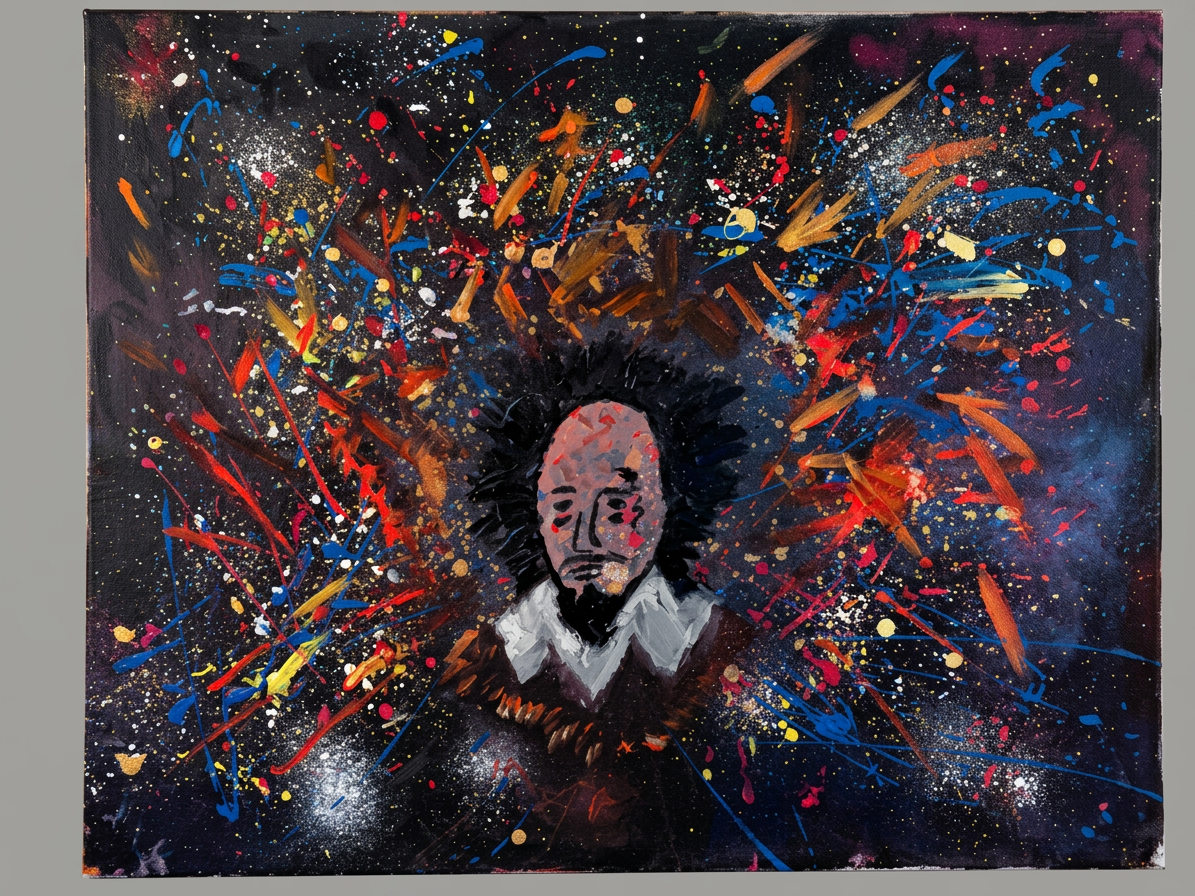
Image: By Morecambe based graffiti artist E.D Reapa – Image of shakespeare with a colourful background that looks like fireworks. Image supplied by the author


Geraint
This is brilliant. I recall the thing about the words in the Bible and it would not surprise me at all if he didn’t have a hand. The speech by More is top rate, Ian McKellen, well past 80, does it brilliantly!
And I need to get that image on my wall!
Leila
LikeLike
A really great read for today. Just as some composers and artists are thought by some to be old souls revisiting surely the bard was something more than most of us. I agree with Leila the rendering by Ian McLellan is worth a watch. Thanks for this interesting and thought provoking essay. dd
LikeLike
This really drew me in. Wild about Shakespeare and the Bible. And how times change but people don’t–especially with immigration.
LikeLike
Hi Geraint,
Very interesting.
I do think that the fellow who found the forty six word reference forward and back about Shakespeare is the first fellow who should have been diagnosed with OCD!!
Excellent my fine friend.
Hugh
LikeLike
G
This Shakespearean fable also reminded me of the parables of The Good Samaritan, The Prodigal Son, and Dives and Lazarus, where the rich man ends up in Hell begging for a sip of water and the poor man ends up in Heaven hanging out with Abraham. Whether or not it ever is, that’s the way it should be, and on some level, that’s good enough.
Great work! But even more importantly: GOOD WORK(s).
Dale
LikeLike
PS
That is a wildly cool picture of Good Will!
LikeLike
A refreshing start to a dull Sunday morning. Thank you.
LikeLike
Interesting and informative. A mind as brilliant as Shakespeare must surely have had a mischievous side.
Excellent banner image.
LikeLike
I had to google ‘Selah.’ To those who are similarly ignorant, I pass on the info that it is a Hebrew word, associated with music in general, and the chanting of the psalms in particular, meaning ‘pause/reflect.’
So, the perfect word to end Geraint’s instructive, lucid, and celebratory essay.
mick
LikeLike
Thanks, all, for the very generous comments. I commissioned the painting 11 years ago – & it’s somehow kinda cosmic.
Geraint
LikeLike
Fascinating! I love the King James bible part – I wonder how many historical literary gems have eluded us over the centuries.
LikeLike