
It was a cold day in the Tonopah Basin. Ground temperatures hovered near freezing. Even seasoned Nevadans found such days eerie; frightening almost. The sun still arced through the sky, the desert looked as it did on the days it was baked, but William Navarro’s breath had condensed during his last refueling stop. It was as if the air had been shifted one world over, destabilizing the familiarity of the landscapes through nothing more than a drop in temperature.
With his heater on full blast, William guided his car over the linear stretches of the I-95. The radio, so far from mainstream stations, was nearly silent. When turned all the way up, it whispered NATO phonetics.
Electrical cables swooped parallel to the blacktop, drooping between the towers in a gently undulating pattern. William tried not to get hypnotized by them. His eyes were doing three things already—watching the road, keeping track of the cars heading in the opposite direction, and examining the fence bordering the highway on the right shoulder—and didn’t want to add a fourth task to the mix.
That fence continued on, unbroken. How many people had driven this stretch of highway, never wondering why there was a fence separating empty land from the straight-world of interstate travel?
He was looking for a hole. He knew it would be unmarked, and his odometer showed him that he was near its location. Clouds were forming over the snow-caped Grapevines.
There it was, and there was the dirt road intersecting the break in the fence, dust from a previous driver scattering across the shoulder like a faint alluvial fan. William slowed, reached over to the glove compartment, opened it, and flicked a switch inside. A transponder built into his car pinged a nearby radio tower hidden up in the mountains which—having received proper identification codes—relayed the signal to long communication wires buried besides the highway which in turn amplified the signal and told a series of ten popup barriers hidden under the dirt road to not activate when they felt the pressure of William’s car.
He turned off the highway and crunched onto the dirt road. It didn’t matter if other cars saw him, not really. They’d assume he was just another hermit forsaking civilization for a life in the dust. Christian survivalists had been in the news recently. The barriers would reactivate to stop anybody foolish enough to follow him.
The dirt road was two miles long; to a trained eye it was well-maintained, just rugged enough to not arouse suspicion, but not too rugged as to stop your average hatchback. At the end, another highway. This one didn’t need fences or an interstate number. If somebody was on it they knew where they were and where they were going. No speed limit either. William floored the accelerator, heading north to Area 33.
#
When had it happened? William wondered after uncounted hours in the ranges. The therapist called it death salience.
He was a civilian contractor, connected to the military but not a part of it. An electrical genius for hire, isolated him from the fatalities of military life. Years ago he watched a test pilot dive into the ground at twice the speed of sound, but the death felt abstract. Back home he had a wife and kids, happy and healthy. No major deaths in the family; no fatal illnesses; no wartime service; no tragic car crashes. But one day he woke up and a hole in reality opened. Death became a subjective experience to live through, not a philosophical statement of thermodynamic birthright.
The inevitable last moment haunted him from that point on, the infinitely divisible blip that contained the shift from this life to nothingness; time to no time. How could the continuum of life lead to such a thing? How could the ever-constant present exist if there was a certain no future—a subjective experience ending in the absence of anything? Limits at infinity.
It hadn’t taken him long to sign on to Operation Hierophant, the ultimate attempt to find out what awaited him. If spaceships went up, the Operation would go across.
He remembered the briefing:
“It is said that a person is composed of two bodies. One is our physical flesh and blood. The other is our spirit, or soul. Modern science has proved that the dead can manipulate electromagnetic fields (EMFs) in order to communicate in our world, mostly through recording devices. For reasons poorly understood, the dead can only weakly interact through this medium. To counteract this limitation, field investigators have experimented with various techniques to produce EMFs to aid in spiritual communication. The modern age has not only given us the proper theoretical understanding of paranormal communication, but increasingly powerful EMF generation techniques, the most powerful of which are nuclear weapons. Underground nuclear testing provides a discrete way to generate the required energy to test these theories…”
The desert gave way to shrublands as William sped on. Black dots appeared over the mountains; helicopters monitoring preparations, keeping out the unwanted. Thick electrical wires appeared parallel to the highway, snaking out from underground generators. Then the highway bent around a hill and the test site appeared.
Shining in the cold afternoon sun, Area 33’s entrance was built into the side of an unnamed mountain, identified only as a constituent part of a greater landform. It was completely nondescript, like the front of a subterranean warehouse. Deep beyond the entrance though, a nuclear bomb was lying in wait. The location of the bomb was noted by a huge drilling gantry distantly rising from the shrubs, painted white and International Orange, the color scheme of large-scale scientific hardware.
William drove to the gate and flashed his badge, then proceeded through five layers of chain link fence. Electrical poles dotted the landscape, rivers of thick black wires converged on a single opening in the white concrete wall, a black tunnel leading deep into the heart of the mountain. He parked among the other cars, the rides of all the people who had left home that morning to see what was on the other side.
Stepping onto the concrete, he could hear the buzz of high voltage wires, a crackling sound of purpose and danger, electricity pulled from throughout the western states to this desert locale. Helicopters thrummed overhead.
He flashed his badge at the tunnel entrance. A big, six foot thick blast door was open. He entered the facility.
The Army engineers had made no attempt to make the place seem welcoming. Why would they? The entrance tunnel was semicircular in profile, the walls exposed rock. Work lights created pools of illumination every few feet, tapering down to the elevators in single-point perspective. He hadn’t even descended yet, but the first few steps into the entrance immediately disconnected William from the outside world.
Through another blast door. At the elevator he flashed his badge again and piled in. He found himself side-by-side with one Herbert McClean, a fellow middle-aged electrical contractor. The elevator lurched and started descending.
“How’s life, Herb?” William asked, to make small talk.
“Not bad, can’t complain.” Herb shrugged.
“And how’s the kid?”
“Got his first posting. They’re keeping him at Nellis.”
“That’s nice for you. Congratulations.”
The elevator stopped. Herb said goodbye and exited the lift. Then it shuttered again and started descending the remaining hundreds of feet (the actual number revealed on a need to know basis) until it stopped at the bottom of the facility.
William exited through a final blast door and into stale air. While the tunnel had been claustrophobic, the equipment and detection level was the inverse. The space had been hollowed out for a project that required much more room, but William was never told what that was. The vault was hundreds of feet tall, the rock ceiling only discernable due to a constellation of suspended work lights. It stretched even farther in the longitudinal directions. The volume was so large one could fly a helicopter inside. Maybe that’s what they had built it for, though William couldn’t guess why the military needed to fly something underground.
In the middle of the vast space was a sphere, four stories in diameter, with a tube leading out of it and into the rock. This was the collection equipment. The tube would channel and reflect the energy from the nuclear blast—miles away and deeper underground—and route the data into the control center where William would diligently monitor the status of the recording equipment. They’d even wired up speakers to hear the voices of the dead directly and live. Dozens of white coat technicians milled about.
When William entered the control room he saw that he was the last controller to arrive. Clinically bright fluorescents washed out the faces of the subject matter experts. Rows of terminals filled the room. Computer cores processed away. Big, black concert-sized speakers were fixed to the ceiling corners.
There was Anna Strong, nuclear engineering lead, responsible for anything involving the bomb, currently working with her trusty assistant Brett Abate to troubleshoot some data relays. Vincent Vincenzo, professional psychic, stalked the back of the room. Casually reading thoughts, perhaps? Margaret Bondara sat in the corner. Nominally a historian of folklore, she seemed to most to have cultivated a less than objective take on stories of spiritual manifestation. Audio engineer Joseph “Cans” Mallide sat before a huge mixing board, plastic headphones blocking out the rest of the room. Colonel Metcalf Harriman, military commander for the Operation, sat chainsmoking in front of a dead terminal, making the industrial air scrubbers work overtime to keep the air pure. Mia Desmonda, official photographer, bounced around the room, clicking an endless series of shots.
William took his position and started working through his test procedures rotely. He lost track of time. He could only sense the temporal flow via the increasing anticipation of the room, a signal presumably lighting up Vincent’s pre-frontal cortex.
At the five minute mark, Colonel Harriman called for focus.
William could imagine the nuclear mass lying in wait on the other side of miles of rock, the material held at a precarious equilibrium, waiting to be knocked off its energy hilltop and into instant conflagration. A hush filled the room.
One minute. Last equipment checks. Verified working. Thirty seconds.
Ten seconds. He knew it would happen in a blink of an eye. Peace to fireball.
Zero. A sphere of explosives detonated and the shockwavecompressedthematerial and the materialstartedachainreaction and allitsneighborssplit and therayswereemittedfromtheprimaryexplosion and those rays compressedthesurroundingsecondarymaterial and the material underwenttremendeouspressure and theatomsfuzedreleasingtheirenergy and all this happened in 10 x 10-9 seconds and there was a world shattering FLASH.
“Successful detonation!” Anna Strong confirmed, nearly yelling.
“Positive contact on all devices,” William responded.
“Bringing up the levels,” Cans announced, sliding whole banks of levers with his forearm. “Should expect a signal in a few seconds.” Margaret put her hands up to her face, whispering a prayer. The room shook as the nuclear tremors reached them.
The speakers came alive. It started as a faint squeal, and then suddenly ratcheted up to an ear shattering volume. Cans yelped and pulled all the levels back down, but the speakers didn’t respond.
The shrieking came from all the speakers at once. It was nothing like William had heard before. He couldn’t map it to any instrument; it was a pure wall of noise. His synapses rattled.
“Bring it down!” Colonel Harriman ordered but Cans simply held up his hands in surrender. “What are you getting?” Harriman asked, looking back at Vincent.
The psychic put his fingers to his temples, unable to resist the classic image, but shouting to be heard over the malfunctioning speakers. “Difficult to make out. It’s not pain in the physical sense, more of suffering from being forcibly displaced…”
Then the individual waves making up the wall started to change frequency.
So many separate signals. Small frequency shifts devolved the screeching into a cacophonous pattern of beats.
The frequencies continued morphing, pulling away from each other. The beat pattern melted. Discrete signals became discernible in both tone and timbre. They were, in fact, voices, but not like any William had heard. Too pure, too focused.
“That’s them,” Margaret whispered.
Shifting auditory focus, William could pick out individuals. They were certainly human, and they were filling the room.
“That doesn’t sound like pain to me,” Anna said, eyes dreamy, “Listen to it.”
How many were there? Hundreds, he estimated, possibly thousands; many more hidden in the lower harmonics or in pitches too high for the human ear. There were words. He strained to understand the message.
It was beautiful in its own way, but after a few seconds he realized it was gradually becoming not so. The frequencies converged again, the beating reemerged, and then the screech. Much, much louder this time. William covered his ears; they all did. It was unbearable. He wanted to run from the speakers.
Then they exploded, each in turn. Sparks fell.
The lights snapped off. Little fires on the floor were the only illumination.
Colonel Harriman hit a button and alarms blared. Evacuate! A flash out the corner of William’s eye: a line of flame had appeared at the top of the left wall, connecting two speakers. Circuitry must have exploded. One detached, fell, and smashed through Mia’s skull. The other caught fire. The flames began crawling down the wall.
Goddamn! William thought or yelled. He jumped out of his chair, tripped over some cords and started groping to the back of the room, suddenly realizing that the air was mostly smoke.
Out into the cavern. There was a mighty rumbling in the space.
“Ceiling’s collapsing!” Brett screamed as he grabbed William’s arm and pulled him towards the elevator. It was hundreds of feet away. Dust and pebbles rained down. Lights disconnected, falling hundreds of feet to the ground, bouncing off the floor, equipment, or human heads. A canister of something flammable sparked and ignited, consuming a group of technicians in a split second. The white sphere shook and tilted off its mountings. Where was all that force coming from?
No time to think. The blast door to the elevator shaft was slowly closing, rate determined through countless simulations by the Bechtel consortium. Enough time for an acceptable number of workers to get out before radiation could seep out into the shaft.
William sprinted for the door, lungs pumping. He made it through the doorcrack, (heard a wall of Gieger counters clicking frantically), looked behind him into the cavern to see Harriman crawling with shattered legs. Then Brett squeezed around the six-foot thick chunk of moving metal, and the door pistoned shut. The holding mechanisms click and whirled to seal the cavern from the outside world.
He looked around. Anna, Brett, Cans, and Vincent were the only ones that made it. He looked at the door—ghostly silent—and thought of the people on the other side, the newly condemned, fated for painkiller-less deaths by radiation. At least they weren’t alone.
“Oh God, what have we done?” Vincent croaked. Dirt and dust fell.
“We only have a few minutes to lockdown, get your asses in gear,” Anna commanded, starting to run towards the elevator shaft. Thankfully, the car hadn’t ascended.
“I’m not dying underground,” Cans announced as he took off.
The other three followed suit. Breathing was getting painful. Of all times to be reminded to hit the gym, William thought, improbably. So pedestrian.
Into the metal box, slam the gate shut. Anna smacked the up button open-handed, then did it again and again until the metal box started moving.
William slumped against the wall, looking up through the ceiling gate. The shaft tapered above him; the lift cables twanged as the shaking in the mountain shifted the load distribution. The elevator jolted as it rose.
“Come on, come on, come on,” Cans begged the winches. Below the elevator, the air concentration was shifting. More radioactivity elements—so eager to break apart and throw off rays of subatomic death—were filling the cavities below.
Up through multiple stories, blast door after blast door sealed shut. Is the elevator accelerating? thought William, but then realized that it was actually his breathing and heartbeat.
Then, with a merciful lurch, the elevator was at the top of the shaft, finally above ground level. Sensors recognized they had arrived. The blast door to the shaft began winching shut. The five easily squeezed around it.
One thousand feet of cavern, one more blast door and the end to get around. The lights shook, rocks crashed to the ground. William ran faster than he ever had before, and probably ever would again.
There was a light at the end of the tunnel, the glare of the sun blinding his dark-adapted eyes. Suddenly a person emerged from the wall ahead—popping out of a secondary alcove serviced by stairs—and took off ahead of him. It was only a back, but William knew the shape: Herb. As William ran through the thickening dust, he watched the engineer reach the entrance and disappear into the light.
More dust, and now smoke; alpha particles mixed in with the debris; pressure differential sucking the air back through the tunnel. Radiation collecting up and through the rock. The mountain shaking. The light ahead, growing; a circle in the dark beginning to grow, the edge of it getting slowly pushed in by a blast door.
And then air and light.
William’s right big toe caught an unevenness in the concrete that sent him sprawling onto the ground.
He groaned, and his body told him to not try any funny business, just lay there and let it pass. He rolled onto his back, tasted blood from a shattered nose on his upper lip. He heard a slam as the blast door closed. The sun was in the late-afternoon, starting to send shadows from electrical pylons across the concrete. William stared into that brilliant disk, frying his retinas with the glare.
Then, finally, an answer.
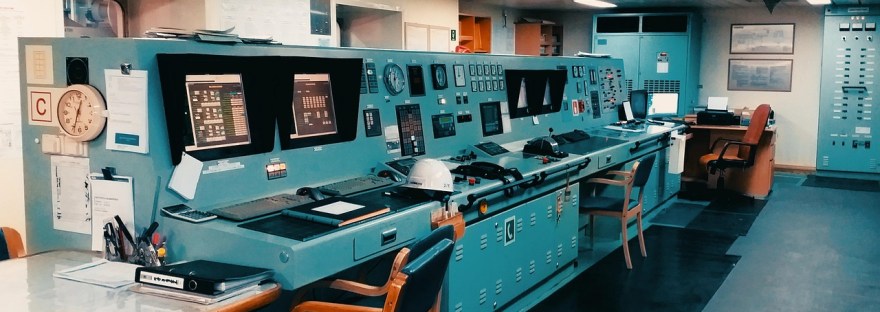
Image by LYUCHI from Pixabay – a bank of control monitors in blue cabinets with empty chairs, a hard hat,and files.


A hugely imaginative story. I am mightily impressed by the action sequence which is expertly handled and all in all this was a mist impressive and entertaining, if rather unsettling, read. Thank you- dd
LikeLike
Hi Zachery,
Sometimes when this genre is written, there is a lot of detail that is left to assumption. You skilfully created clarity without taking the reader by the hand.
Excellent!
Hugh
LikeLike
Zachery
What a tremendous story. And the way you drove it along, the action at the end, is first rate and very hard to do.
The Project Command should have taken into account that the Dead outnumber the living by a factor of at least twenty, maybe thirty to one. I guess they needed a bigger boat.
Leila
LikeLike
A genuinely original premise that’s ‘out there” but made believable. The technical detail is convincing, and the compressed syntax of the detonation sequence works well. The shift from the voices being beautiful to unbearable is haunting. William is a man so afraid of nothingness that he goes looking for proof of the other side. Many people do this in one way or another. But based on what William discovers, or doesn’t, maybe nothingness would be better.
LikeLike
Zackery,
Whether I was lost or not, the words kept me moving to the end. It was like reading downhill. Such momentum! Stunning. — Gerry
LikeLike
A real pump of a read! Very well written (I’ll leave any comments on the physics to one side!) but also enigmatic, leaving the reader to wonder what actually happened. Great stuff!
LikeLike
Action packed, like a modern movie about madness. I was drawn into these scenes of apocalypse. Indeed, don’t fool around with atomic bombs you might wake the dead, and/or death for sure. “I am become death, the destroyer of worlds” said Robert Oppenheimer, scientist who worked on the bomb at Los Alamos. Some intriguing concepts, glad William got his answer, but I guess we all get the same answer somewhere down the line, just don’t know where or when.
LikeLike
Great compelling action. The opening section had me thinking of Tom Joad in Grapes of Wrath, but then the action really kicked in. I love the compounding of words, eliminating all the spaces, when the detonation occurs – very smart.
LikeLike