Harry Pembroke, 67, a retired PE teacher came to London from Gobowen. It took him five hours to reach the capital; he had missed one of his connections. He felt really clever though when he arrived to his destination. He had paid for his tickets three months ago, used his National Railcard, and was able to save quite a lot of money with his advance booking: instead of £317 one way which he would have paid had he bought the tickets right before his trip at the station he had only paid £143 return. These numbers kept him warm and happy when he walked out of the train terminal into the cold November drizzle.
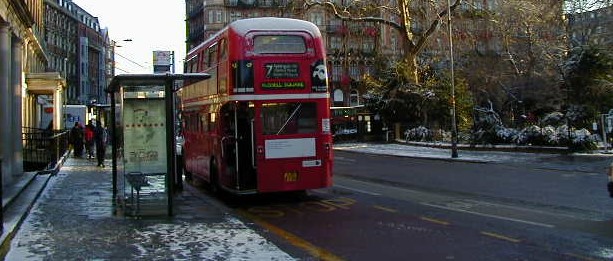
Now he had to check in to his carefully selected hotel about half an hour away from the station. Harry had planned his visit meticulously, to the tiniest detail. He already knew where he had to find the bus stop. He had downloaded an Oyster app to his phone and transferred 25 quid to the app. All went smoothly; the bus arrived presently. Harry enjoyed the sensation of a well-planned, well-prepared trip. He stepped inside the bus; his phone pinged. The app informed him that the sum of £1.75 was deducted from his account. A sweet little jab of triumph pocked Harry in the solar plexus: this was what he had expected; he also couldn’t quite believe that the London bus fare was that low. It reminded him that he indeed was now travelling on a real double-decker. He looked around, climbed the short staircase to the upper deck, and found himself a place. The busy, bustling street slid back behind the window. Harry suppressed a smile. This was his dream adventure.
The street lamps flashed their ghostly sodium lights; the neon tubes flickered in the mist. The river of traffic, all ablaze, shuddered along. The evening quickly descended on the city. In five minutes the moving cityscape behind the window turned into a low-resolution, glitchy video, monotonous and soporific. The phone warned Harry that his stop was coming next. He climbed down the stairs and pressed the button.
The hotel he had booked two months ago after weeks of online research was small and neat. The website described it as “boutique”; it was called St Guerin. Harry checked in, unpacked, enjoyed his solitude for half an hour in his tidy little room, looked out of the window into a narrow passage between two buildings, saw two large rubbish bins next to a lamppost, switched on the TV, watched a show about debt collectors for a couple of minutes, switched the TV off, and decided to take a stroll in the neighbourhood.
After a couple of minutes walking the deserted, gloomy streets, he came to a pub called Pleasant George. Inside, in a large and rather dark room he found the family of a Slovakian banker eating their late dinner — the man dressed in a navy suit, pink shirt and an orange tie, his blonde wife balancing out his excessive cheerfulness with her severe intensity, and two children, a younger boy and an older girl, synchronously, with a slightly petulant looks on their faces, eating their identical veal pies. He saw a Chinese tourist with a satchel belt across his chest nursing his pint of Guinness while watching a Chinese soap opera on his oversized smart watch. He saw a woman in her late fifties staring into space. An old man was pushing the buttons of a fruit machine. The man behind the bar counter was reading a book. Harry ordered a pint of Moretti. He necked half the glass thirstily, wiped his mouth with the tissue, and caught his breath. He felt the vaguely apocalyptic atmosphere thicken around him, coagulate into an almost palpable suspense.
‘Is this the Hungarian Pálinka in that bottle?’ he asked the man behind the counter.
The thin tall man turned around slowly, as if he was afraid to fall apart at any moment and looked at the shelves full of drinks as if he saw this bar for the first time.
‘I think it is,’ he said after a pause in a strangely low, husky voice.
‘Our volleyball school team played Hungarian girls in Kiskunfélegyháza,’ Harry said. ‘I was their coach back in 2004. The match went to a fifth set and we lost 39 to 41, if you can imagine that, but it was a good game. Tough but good.’
The man placed his book on the shelf near the bottles.
‘Oh,’ he said.
‘I don’t think I’d mind a wee little glass of that beast,’ Harry said. ‘Just to refresh the memories, if you know what I mean. Is it apricot?’
The man peered at the bottle.
‘No,’ he said, ‘it’s plum.’
‘Never mind,’ Harry said. ‘Just a tiny, wee, little glass.’ He showed with his fingers. ‘This much.’
‘Sure,’ the bartender said.
Harry sipped the amber liquid.
‘Oh,’ he said, ‘the taste of the victory which never came. Should be familiar to all of us with rare exceptions, shouldn’t it?’
‘What?’ the bartender said.
‘I mean, after the war,’ Harry said. ‘Many people think it all went downhill after our days of glory so to say, but I don’t really see it like that. I think that history progresses in ways we cannot easily comprehend. People miss the past, it’s only natural. It’s hard to really appreciate the present. What are you reading if you don’t mind my asking?’
‘It’s Hansard,’ the bartender said. ‘My uncle-in-law said that his father was an MP in the fifties who introduced a bill demanding equal rights for big apes, which was defeated by a slim majority. Just wanted to check. He’s a Tamil guy. I don’t think he’s telling the truth. I think he was pulling my leg.’
‘Our biology teacher,’ Harry said, ‘became an MP. I was 12. He was a very nice guy, young, openly gay, but he completely lost his mind later and had to resign because he thought that the secret world government controlled him through some device from space or something.’
A man approached the bar.
‘Is that Pálinka you’re drinking?’ he said.
‘Yes it is,’ Harry said.
He finished his drink.
‘Is it Romanian?’ the man said.
‘No,’ the bartender said, ‘it’s Hungarian.’
‘Is it apricot?’ the man asked.
‘No,’ Harry and the bartender said together, ‘it’s plum.’
‘This is not real Pálinka,’ the man said. ‘They only produce real Pálinka in Slovakia in a place called Modry Kamen. I am from Modry Kamen. I am a baker, sorry, I mean a banker, I work here in a bank in London. The real Pálinka is only made from apricots harvested at the border between Slovakia and Hungary where the army of the Ottoman Empire in 1683—‘
‘Karl,’ his wife said.
‘Oh, I am sorry,’ the banker said. ‘I must go.’
He looked at his children.
‘Apricots and plums are the same,’ the bartender said. ‘Both belong to the genus Prunus together with cherries, peaches, and almonds.’
‘Not real Pálinka,’ the banker said, pointing at the bottle. ‘The Ottoman Empire in 1683—‘
‘Karl,’ his wife said. ‘We are late.’
‘Sorry,’ the banker said with an apologetic shrug. ‘It’s Les Mis.’
Harry finished his pint.
‘Thank you for the company,’ he said. ‘It’s a really nice place you have here. As a writer once said the only place where a man can feel at home is a dry, warm drinking establishment on a stormy night in November, if I remember correctly … I think, it was Somerset Maugham,’ he said. ‘Tranquillity of heart,’ he said, collecting his hat from the counter.
‘A good insurance claim,’ the bartender said, ‘this is what this place needs. To survive in this economy …’ he said and shrugged.
‘Things change,’ Harry said.
Outside the pub he walked aimlessly for about five minutes thinking of the economy, the recent books he read, the political scandals, the elections in the US, the tranquillity of heart, the planet drifting in the cold universe, the novel he could have written long ago when he wanted to become a writer, the distant memory of himself starting with this novel in his room, alone with his notebook on his knees and his new pen. He only finished two pages, he remembered, a Somerset Maugham he was certainly not. Suddenly he realised that he urgently needed to pee. He turned and tried to find the way back to the pub. After a minute, he understood that he was lost. He found his hotel on the screen of his phone. He followed the blue line. Presently, he entered a square with a lawn in the middle. At the next corner, under a huge plane tree, he saw a small futuristic booth, a kiosk of sorts without any windows but with a convex automatic door, closed, a streamlined pod made of grey shiny plastic, cast aluminium painted olive, and curves of stainless steel. “Happy Point” read the illuminated letters above the door with a flickering little “y” beneath, in the middle of a long, narrow gap. Near the door, Harry located a panel with a slot. The panel instructed him to insert three pound coins — or the equivalent — into the slot to operate the installation. Harry fumbled in the coin compartment of his wallet, scraped out two pound coins, a 10p coin, two 20p coins, and 50p coin and inserted them all one by one into the slot.
‘Talk about spending a penny,’ he mumbled under his breath. ‘Three bloody quid. This is London, mate. You are in London.’
The panel flashed him a green Thank You message, something clicked softly somewhere near his feet and the door opened with a quiet whoosh.
Harry stepped inside; with a soft pneumatic sound, the door closed behind his back. The interior was all clinical porcelain enamel, polyurethane, stainless steel, synthetic rubber, and glass flooded with the vaguely sinister faux-sunshine glow from the multipoint ceiling spots. Now Harry faced a formidable contraption, something that looked like a combination of a gynaecological examination chair, a poolside lounger, and a cradle for a grown up person complete with a headrest. In the middle of the slightly concave floor, Harry located something looking like a bathtub drain covered with a round plug. Reluctantly, he looked around, cleared his throat, and shrugged. With a little frown, he carefully inspected the chair. After a moment of hesitation, he undid his belt, unzipped his trousers, dropped them together with his boxers to his ankles and climbed onto the seat. Choose Music — suggested a control panel to his right. He tapped the touchscreen, and a wonderful electronic reinterpretation of a classical symphony filled the room. Choose Video — advised the console. Harry tapped the touchscreen again and selected something called Asphodel Meadows. Choose Fragrance — appeared the words on the display. Harry chose Infinity Zest. Start the Process — appeared the next message running across the screen. A thick pulsating arrow pointed at the large red button. Harry pushed the button. Thank You For Using Happy Point — responded the device — Enjoy Your Experience. Harry placed his head onto the headrest and listened to his bowels. On a large screen in the middle of the ceiling a gentle summer breeze made the petals of large white flowers tremble. After a couple of seconds, Harry felt that he was falling asleep. His eyes closed. He felt a pleasant peacefulness filling his body; he felt borderline euphoric. He didn’t know that a simple bowel movement could be that nice. Another moment passed, and he stopped breathing. A red light flashed on the panel several times; a thin laser beam scanned Harry’s pale face, moving quickly up and down. A loud, discordantly unpleasant tone sounded for a moment and ceased. Procedure Complete — flashed the message on the display — No Life Detected. The music stopped; the lights in the ceiling faded. Intensely blue germicidal irradiation filled the little room. With a soft, quiet whine, the ventilation system came to life. It quickly cleared the space of the nitrogen-ether mixture. Sprinklers opened in the ceiling. Thin sparkling mist descended on the body. In about ten minutes the concentrated Piranha solution dissolved the cadaver, the clothes, the wallet, the phone (which, while melting, issued forth a little burst of flame and a wisp of smoke), the shoes, the coins, the belt, and the wristwatch (which, first, with a loud solitary clack, had fallen down on the floor from the crumbling wrist), buttons, zippers, and glasses into a pool of dark brown-green foamy liquid on the floor. The plug popped up and the liquid slowly gurgled down the drain. Another sprinkler system cleaned the room with steamy spurts of scalding hot water and copious amounts of sanitiser. The ventilation system came to life again and filled the space with hot air.
A couple of minutes passed, and the red word on the outside display — Occupied — vanished. The display flashed friendly green again. Welcome To Happy Point, it said — Please Insert The Coins.
Several hours later, at about 10 in the morning, a white van stopped near the installation. A young man in blue overalls jumped out of the vehicle. He opened the back door of the van. Humming a popular melody under his breath and moving quickly, he brought a tall stepladder and a red toolbox to the entrance of the booth. He climbed the ladder and unscrewed the side panel of the display above the door. Instantly, with a loud crackle, a thick jet of sparks flew out of the dark hole and rained down on the pavement. Unfazed, the man flipped the switch at the back of the display and pushed his needle nose pliers into the opening. He pulled at something inside the box, whistled a little melody, extracted a small green circuit board from the depths of the device, inspected it with a brief grimace of insincere surprise on his face, sniffed at it sceptically, shook his head, with a somewhat exaggerated affectation took aim and dropped it into his open toolbox below, showed a compact explosion with his both hands when the PCB met the target and animated this little aerial bombardment with an appropriate quiet growl, produced a new board out of his front pocket, installed it inside the unit, and flipped the switch back on. He looked at the display. Happy Point, it read now and in smaller bright letters beneath — assisted dying facility. The man screwed the side panel back in place, climbed down the ladder, placed his tools and the ladder back into the van, and drove away.
Image: Double decker bus in London colours from Pixabay.com

 literally stories
This mans life flashed in front of him during his vacation, only to be taken away by a walk in toilet for elders. That sucks. Good story.
LikeLike
Sergey
Truly a fine piece of work. Of course, I am certain that you understand that being sixty-seven is awfully young for the Happy Point machine–yes, I am sure you do. I would hate to think you didn’t know it.
The effortless dialogue in the bar is brilliant!
Leila
LikeLike
Hi Sergey,
I thought this was going to be a travel guide but it ended up as an Assisted Dying story with a twist!
You’ve probably put Switzerland’s tourist trade back years!!
…Anyone up for muesli and some funny tasting orange juice?
A dark (But fun!!) way to start the week.
All the very best my friend.
Hugh
LikeLike
This starts with a very entertaining read, nicely paced and with believable and realistic dialogue but when the twist comes it is so very cleverly handled. I never trust those cabinet type toilets, I always think they are going to open when I’m not ready but I wouldn’t expect them to do what this one did. Just goes to show you that you should always check the labeling carefully. A super story really well written. Thank you – dd
LikeLike
Great story! Clever twist: meticulous planner obliterated by automatic toilet. Like other commentators, never trusted those contraptions.
LikeLike
At first I thought Harry realized what he was getting into, and it was the finale to a meticulously planned death. But apparently it was a horrible malfunction. Excellent dark comedy.
LikeLiked by 1 person
There are definitely worse ways to go, both bathroom wise and death wise, so Harry got the best of both experiences. Kind of a droll lead up of micro experiences as Harry visits London. I like the matter of fact language and the conversations about minutiae. As the Grateful Dead sang “What a Long, strange trip its been.”
LikeLike
Coming to this a bit late but I really enjoyed this one, twist and all! Very well, almost lovingly, written with some great touches and of course, a smack in the mouth ending.
LikeLike
This is superb, a really remarkable piece. The joy he takes in his tiny miserliness and then the pedantry of the pub conversation on the Palinka, with the slight one-upmanship between those speaking all bely what is to come, and then when he arrives at the Happy Point the description is so well done through to the conclusion. This is a genuinely thought provoking piece with top notch writing.
LikeLike